
Robot Software Market Report 2026
Global Outlook – By Software Type (Recognition Software, Data Management And Analysis Software, Communication Management Software, Simulation Software, Predictive Maintenance Software), By Robot Type (Industrial Robots, Service Robots), By Enterprise Size (Large Enterprises, Small And Medium Enterprises), By Deployment Model (On-Premises, On-Demand) – Market Size, Trends, Strategies, and Forecast to 2030
Robot Software Market Overview
• Robot Software market size has reached to $10.11 billion in 2025 • Expected to grow to $39.19 billion in 2030 at a compound annual growth rate (CAGR) of 31% • Growth Driver: Growing Adoption Of Automation Across Industries Driving The Market Growth Due To Increasing Efficiency Needs • Market Trend: Advancements In Humanoid Robot Software Platforms Revolutionize Human-Robot Collaboration • North America was the largest region in 2025 and Asia-Pacific is the fastest growing region.What Is Covered Under Robot Software Market?
Robot software refers to coded commands that are programmed to give instructions to robots to perform tasks by controlling their actions and movements. It enables the user to quickly program complex processes with intuitive desktop-style interfaces or icon-based graphical user interfaces. This robot software is used for programming various industrial or service robots to perform numerous autonomous tasks. The major software types in robot software are recognition software, data management and analysis software, communication management software, simulation software, and predictive maintenance software. Recognition software refers to coded commands that are programmed into devices to recognize particular actions. The main robot types are industrial robots and service robots. The main enterprise sizes include large enterprises as well as small and medium-sized enterprises. The major deployment models are on-premises and on-demand. The several industry verticals include manufacturing, healthcare, aerospace and defense, media and entertainment, logistics, and others.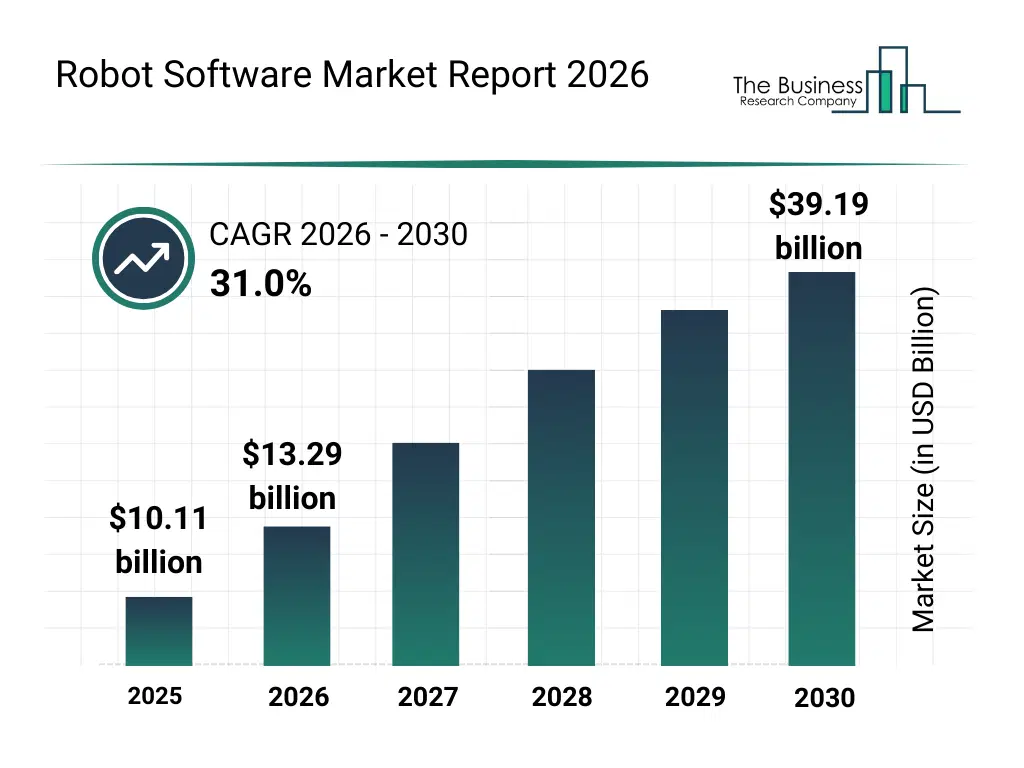
What Is The Robot Software Market Size and Share 2026?
The robot software market size has grown exponentially in recent years. It will grow from $10.11 billion in 2025 to $13.29 billion in 2026 at a compound annual growth rate (CAGR) of 31.4%. The growth in the historic period can be attributed to increasing industrial automation adoption, growing complexity of robotic workflows, rising need for flexible robot programming, expansion of industrial robot installations, increasing availability of industrial software tools.What Is The Robot Software Market Growth Forecast?
The robot software market size is expected to see exponential growth in the next few years. It will grow to $39.19 billion in 2030 at a compound annual growth rate (CAGR) of 31.0%. The growth in the forecast period can be attributed to increasing deployment of AI-enabled robot software, rising demand for scalable robot operating platforms, expansion of service robot applications, growing integration of robotics with enterprise IT systems, increasing focus on software-defined automation. Major trends in the forecast period include increasing adoption of low-code robot programming platforms, rising use of simulation-based robot software, growing deployment of predictive maintenance algorithms, expansion of cloud-based robot control systems, enhanced focus on human-robot interaction software.
Global Robot Software Market Segmentation
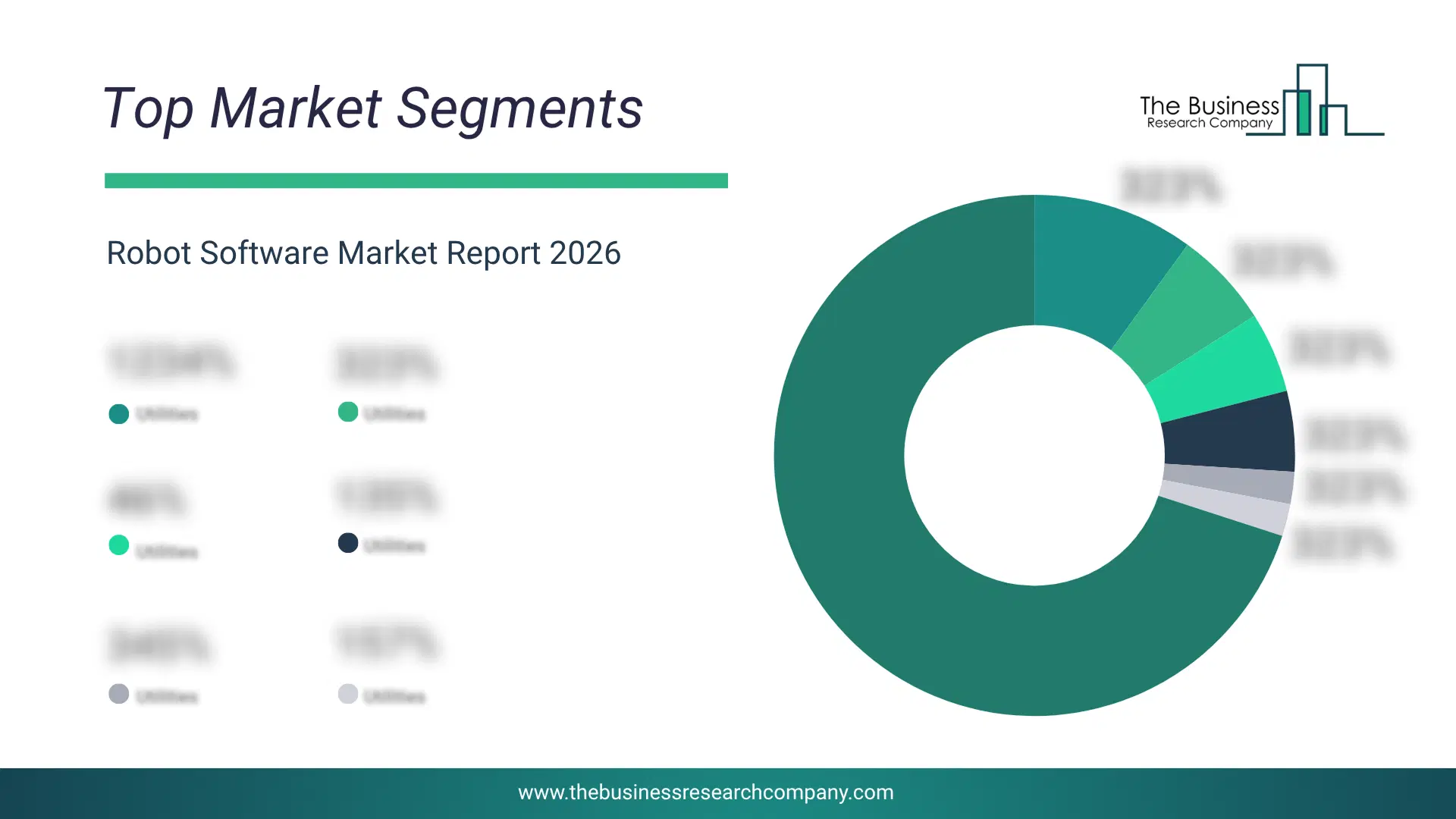
1) By Software Type: Recognition Software, Data Management And Analysis Software, Communication Management Software, Simulation Software, Predictive Maintenance Software 2) By Robot Type: Industrial Robots, Service Robots 3) By Enterprise Size: Large Enterprises, Small And Medium Enterprises 4) By Deployment Model: On-Premises, On-Demand Subsegments: 1) By Recognition Software: Image Recognition Software, Speech Recognition Software, Object Detection Software 2) By Data Management And Analysis Software: Data Storage Solutions, Data Processing Software, Analytics And Reporting Tools 3) By Communication Management Software: Robot-To-Robot Communication Software, Human-Robot Interaction Software, Network Management Solutions 4) By Simulation Software: 3D Simulation Tools, Virtual Environment Development Software, Testing And Validation Software 5) By Predictive Maintenance Software: Condition Monitoring Tools, Failure Prediction Software, Maintenance Scheduling SoftwareWhat Is The Driver Of The Robot Software Market?
The growing adoption of automation across industries is expected to propel the growth of the robot software market going forward. Automation adoption across industries refers to the integration of technologies such as artificial intelligence, robotics, and automated systems that streamline processes and reduce manual tasks in business operations. The rising adoption of automation is due to the increasing need for operational efficiency, as businesses seek to remain competitive by reducing costs and improving productivity through automated workflows. Growing automation supports the robot software market by creating demand for sophisticated software platforms that control, manage, and optimize robotic systems in manufacturing, logistics, and service operations. For instance, in September 2024, according to the International Federation of Robotics, a Germany-based international organization, there are 4,281,585 robots currently operating in factories worldwide, marking a 10% increase. For the third consecutive year, annual installations surpassed half a million units. In 2023, the majority of new deployments were in Asia (70%), followed by Europe (17%) and the Americas (10%). Therefore, growing adoption of automation across industries is driving the growth of the robot software industry.Key Players In The Global Robot Software Market
Major companies operating in the robot software market are Asea Brown Boveri; AIBrain Inc.; Brain Corp; CloudMinds Technologies Inc.; Energid Technologies Corporation; Furhat Robotics; IBM Corporation; Liquid Robotics Inc.; NVIDIA Corporation; Neurala Inc.; Clearpath Robotics Inc.; Oxbotica; Teradyne Inc.; Accenture PLC; RoboGroup T.E.K. Ltd.; Fanuc Corp.; Universal Robots; Rethink Robotics Inc.; Denso Corporation; Kawasaki Robotics Inc.; Omron Corporation; Staubli International AG; KUKA Midea Group; Robotnik Automation S.L.L.; Intelitek Inc.; Yaskawa Electric Corp.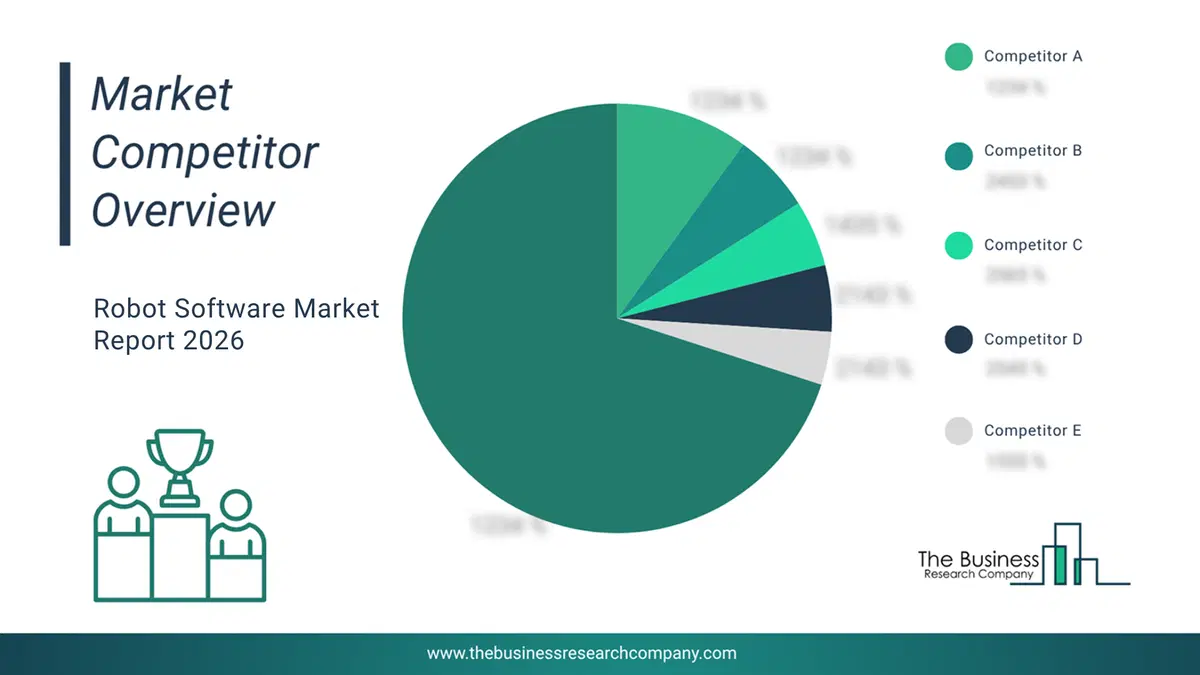
This chart is for illustrative purposes; the full report includes a detailed competitor analysis and comprehensive overview of the top 10 companies in the market.
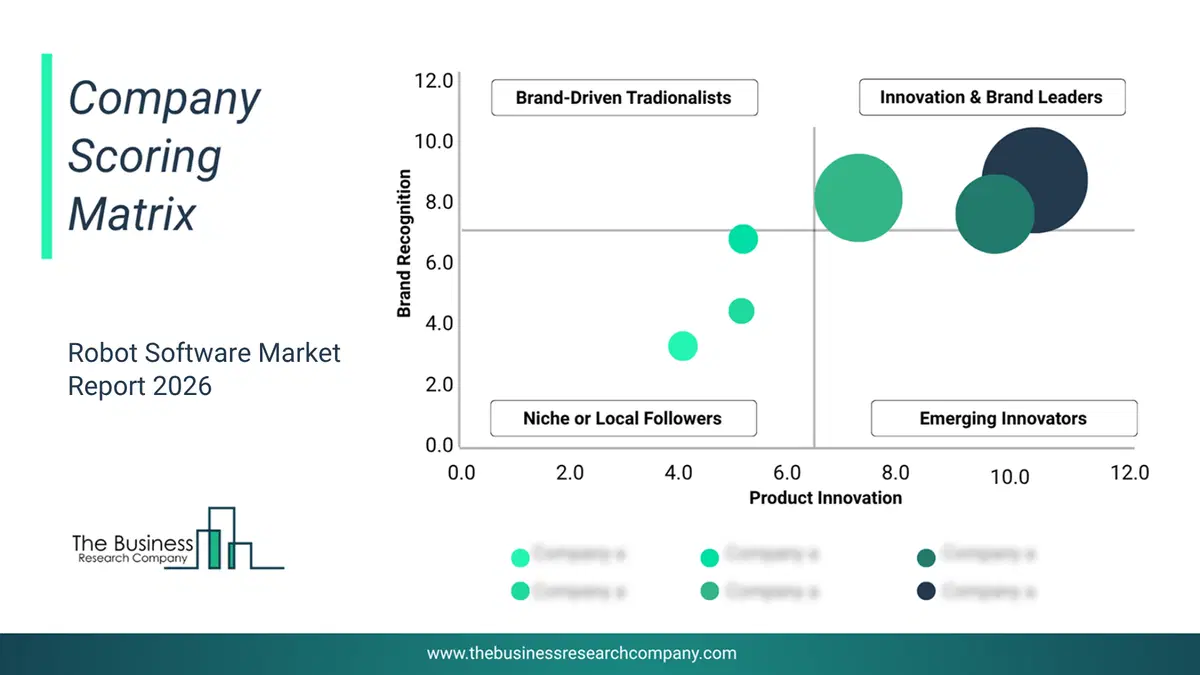
This chart maps companies by product innovation and brand strength, with bubble size indicating relative revenue, helping identify market leaders, challengers, and niche players. This is an illustrative chart; the full report provides a complete and accurate competitive analysis.
Global Robot Software Market Trends and Insights
Major companies operating in the robot software market are focused on developing advanced technology, such as humanoid robot software platforms, to drive efficiency and enable more sophisticated human-robot collaboration. A humanoid robot software platform is a specialized framework that integrates AI, machine learning, and computer vision to control humanoid robots, enabling them to mimic human behavior and actions. For instance, in September 2024, Fourier, a China-based provider of full-stack robotics technology, launched GR-2. The GR-2 stands 175 cm tall, weighs 63 kg, and offers 53 degrees of freedom with a 3 kg single-arm load capacity. It features a detachable, swappable battery with double the capacity of its predecessor, offering up to two hours of runtime. GR-2’s integrated cabling and redesigned joint configuration improve modularity, maintenance, and real-world learning. Its hands, with 12 degrees of freedom and tactile sensors, enhance dexterity and precision, supporting advanced teaching modes like VR control and lead-through programming.What Are Latest Mergers And Acquisitions In The Robot Software Market?
In August 2024, TKH Group NV, a Netherlands-based technology company, acquired Liberty Robotics Inc. for an undisclosed amount. The acquisition strengthens TKH's presence in North America and supports growth across Asia-Pacific and Europe. The integration of Liberty's systems with TKH's 3D vision sensor technology enhances robotic guidance for applications like part handling and coating. Liberty Robotics Inc. is a US-based provider of 3D vision guidance systems for robotic applications.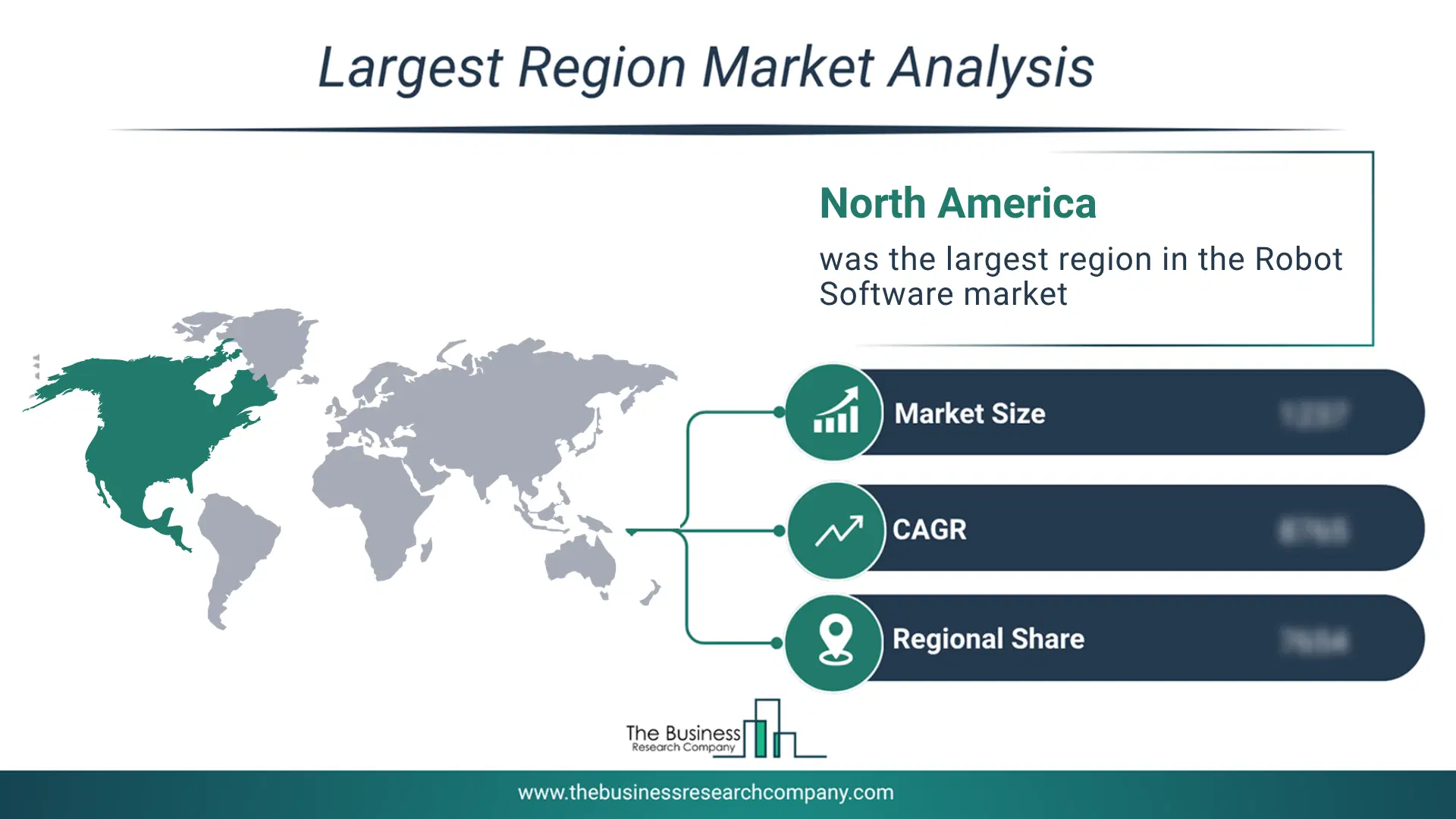
Regional Insights
North America was the largest region in the robot software market in 2025.Asia-Pacific is expected to be the fastest-growing region in the forecast period. The regions covered in this market report are Asia-Pacific, South East Asia, Western Europe, Eastern Europe, North America, South America, Middle East, Africa. The countries covered in this market report are Australia, Brazil, China, France, Germany, India, Indonesia, Japan, Taiwan, Russia, South Korea, UK, USA, Canada, Italy, SpainWhat Defines the Robot Software Market?
The robot software market includes revenues earned by entities by traditional industrial robots and collaborative robots used for offline programming, middleware, mobile robot planning, real-time path planning, and UAV (drone) control. The market value includes the value of related goods sold by the service provider or included within the service offering. Only goods and services traded between entities or sold to end consumers are included.How is Market Value Defined and Measured?
The market value is defined as the revenues that enterprises gain from the sale of goods and/or services within the specified market and geography through sales, grants, or donations in terms of the currency (in USD unless otherwise specified). The revenues for a specified geography are consumption values that are revenues generated by organizations in the specified geography within the market, irrespective of where they are produced. It does not include revenues from resales along the supply chain, either further along the supply chain or as part of other products.
This chart presents market attractiveness based on a quantitative evaluation of growth, competition, strategic alignment, and risk, offering a clear view of opportunity areas for decision-making. This chart is for illustrative purposes; the full report contains the complete analysis.

This chart highlights the Total Addressable Market (TAM) by estimating the maximum revenue opportunity using an assumption-driven approach, supporting strategic planning and opportunity sizing across markets. The chart is illustrative; the full report provides a more comprehensive analysis.
What Key Data and Analysis Are Included in the Robot Software Market Report 2026?
The robot software market research report is one of a series of new reports from The Business Research Company that provides market statistics, including industry global market size, regional shares, competitors with the market share, detailed market segments, market trends and opportunities, and any further data you may need to thrive in the robot software industry. The market research report delivers a complete perspective of everything you need, with an in-depth analysis of the current and future state of the industry.Robot Software Market Report Forecast Analysis
| Report Attribute | Details |
|---|---|
| Market Size Value In 2026 | $13.29 billion |
| Revenue Forecast In 2030 | $39.19 billion |
| Growth Rate | CAGR of 31% from 2026 to 2030 |
| Base Year For Estimation | 2025 |
| Actual Estimates/Historical Data | 2020-2025 |
| Forecast Period | 2026 - 2030 |
| Market Representation | Revenue in USD Billion and CAGR from 2026 to 2030 |
| Segments Covered | Software Type, Robot Type, Enterprise Size, Deployment Model |
| Regional Scope | Asia-Pacific, Western Europe, Eastern Europe, North America, South America, Middle East, Africa |
| Country Scope | The Countries Covered In This Market Report Are Australia, Brazil, China, France, Germany, India, Indonesia, Japan, Taiwan, Russia, South Korea, Uk, Usa, Canada, Italy, Spain. |
| Key Companies Profiled | Asea Brown Boveri, AIBrain Inc., Brain Corp, CloudMinds Technologies Inc., Energid Technologies Corporation, Furhat Robotics, IBM Corporation, Liquid Robotics Inc., NVIDIA Corporation, Neurala Inc., Clearpath Robotics Inc., Oxbotica, Teradyne Inc., Accenture PLC, RoboGroup T.E.K. Ltd., Fanuc Corp., Universal Robots, Rethink Robotics Inc., Denso Corporation, Kawasaki Robotics Inc., Omron Corporation, Staubli International AG, KUKA Midea Group, Robotnik Automation S.L.L., Intelitek Inc., Yaskawa Electric Corp. |
| Customization Scope | Request for Customization |
| Pricing And Purchase Options | Explore Purchase Options |