
RoboTaxi Market Report 2026
Global Outlook – By Type (L4 Robo-Taxi, L5 Robo-Taxi), By Component Type (Light Detection And Ranging (LiDAR), Radio Detection And Ranging (RADAR), Camera, Sensor), By Service (Rental-Based, Station-Based), By Propulsion Type (Electric Vehicle, Hybrid Electric Vehicle, Fuel Cell Vehicle) – Market Size, Trends, Strategies, and Forecast to 2030
RoboTaxi Market Overview
• RoboTaxi market size has reached to $3.49 billion in 2025 • Expected to grow to $33.49 billion in 2030 at a compound annual growth rate (CAGR) of 57.1% • Growth Driver: Traffic Congestion Fuels Growth In The Robotaxi Market • Market Trend: Advancements And Deployments In The Robotaxi Industry Through Modular Autonomous Driving Platforms • Europe was the largest region in 2025 and Asia-Pacific is the fastest growing region.What Is Covered Under RoboTaxi Market?
A robotaxi is a driverless vehicle equipped with autonomous technology that can transport passengers from one location to another, functioning similarly to traditional taxis but without a human driver. RoboTaxis has the potential to revolutionize transportation by reducing congestion, lowering costs, and providing accessible mobility options. The main types of robotaxi are L4 robo-taxi, and L5 robo-taxi. An L4 (Level 4) robotaxi is capable of full self-driving in specific conditions and environments without human intervention. The components used in robotaxi are light detection and ranging (LiDAR), radio detection and ranging (RADAR), camera, and sensor. The service includes rental-based and station-based and the propulsion types are electric vehicles, hybrid electric vehicles, and fuel cell vehicles. The applications of robotaxi include goods transportation and passenger transportation.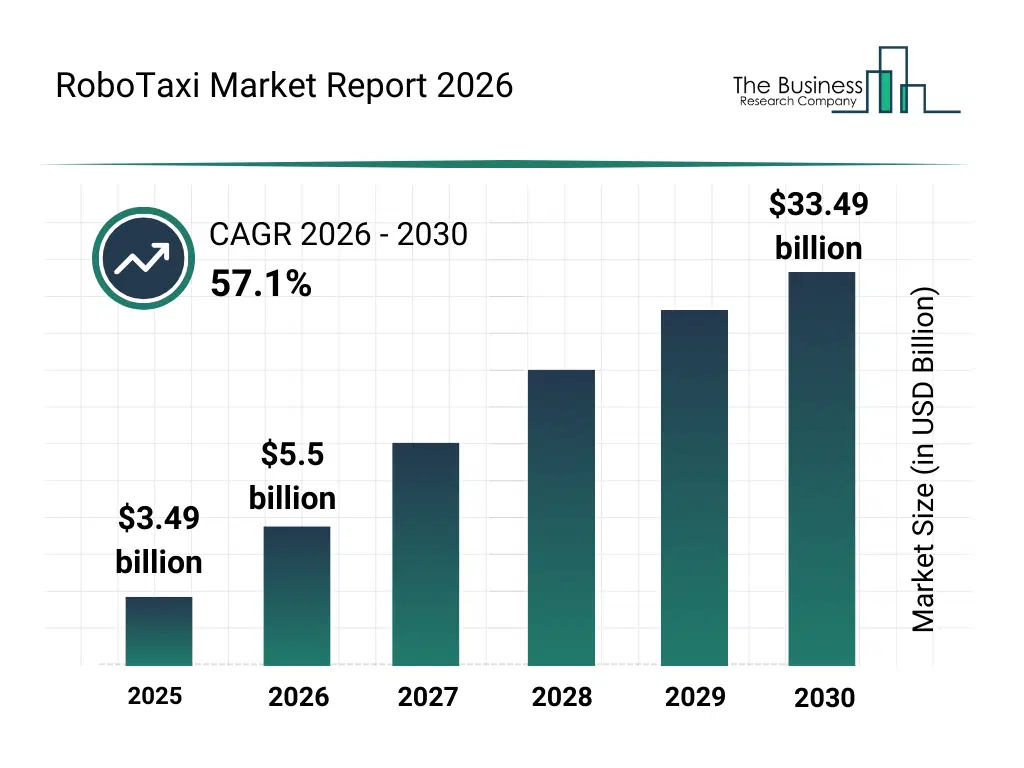
What Is The RoboTaxi Market Size and Share 2026?
The robotaxi market size has grown exponentially in recent years. It will grow from $3.49 billion in 2025 to $5.5 billion in 2026 at a compound annual growth rate (CAGR) of 57.4%. The growth in the historic period can be attributed to pilot deployments of autonomous ride-hailing services, advancements in autonomous driving software, growth of electric vehicle platforms, increasing urban mobility challenges, investments in smart city projects.What Is The RoboTaxi Market Growth Forecast?
The robotaxi market size is expected to see exponential growth in the next few years. It will grow to $33.49 billion in 2030 at a compound annual growth rate (CAGR) of 57.1%. The growth in the forecast period can be attributed to scaling of commercial robotaxi services, rising consumer acceptance of autonomous mobility, expansion of smart urban infrastructure, growing demand for shared autonomous transport, increasing regulatory clarity for driverless taxis. Major trends in the forecast period include expansion of geo-fenced autonomous ride services, increasing integration of ai-based passenger management systems, growing adoption of electric robotaxi fleets, rising focus on urban autonomous mobility, enhanced safety validation and redundancy systems.
Global RoboTaxi Market Segmentation
1) By Type: L4 Robo-Taxi, L5 Robo-Taxi 2) By Component Type: Light Detection And Ranging (LiDAR), Radio Detection And Ranging (RADAR), Camera, Sensor 3) By Service: Rental-Based, Station-Based 4) By Propulsion Type: Electric Vehicle, Hybrid Electric Vehicle, Fuel Cell Vehicle Subsegments: 1) By L4 Robo-Taxi: Fully Autonomous Robo-Taxis, Geo-Fenced Urban Robo-Taxi Services, Urban And Suburban Robo-Taxi Operations, Robo-Taxis With Remote Assistance 2) By L5 Robo-Taxi: Fully Autonomous Robo-Taxis, Fully Autonomous For All Environmental Conditions, All-weather, All-Terrain Robo-Taxis, Passenger-Only Robo-Taxi ServiceWhat Is The Driver Of The RoboTaxi Market?
The growing issue of traffic congestion is expected to propel the growth of the robotaxi market going forward. Traffic congestion is a condition on road networks that occurs when traffic demand exceeds the available road capacity. Traffic congestion often arises due to a combination of factors such as high vehicle volumes, inadequate road infrastructure, inefficient traffic management, and disruptions like accidents or construction, leading to reduced roadway capacity and increased travel times for motorists. Robotaxis can alleviate traffic congestion by providing on-demand transportation services, optimizing routes, and reducing the number of privately owned vehicles on the road, thereby improving traffic flow and decreasing congestion. For instance, in January 2023, as per the Federal Highway Administration, a US-based government agency, there was a 5.6% increase (+13.2 billion vehicle miles) in travel on all roads and streets compared to January 2022, totaling an estimated 247.3 billion vehicle miles for the month. The seasonally adjusted vehicle miles traveled for January 2023 amounted to 272.5 billion miles, reflecting a 4.5% increase (+11.6 billion vehicle miles) over January 2022 and a 3.1% change (+8.1 billion vehicle miles) from December 2022. Therefore, the growing issue of traffic congestion is driving growth in the robotaxi industry.Key Players In The Global RoboTaxi Market
Major companies operating in the robotaxi market report include Amazon.com Inc., Toyota Motor Corporation, Mercedes-Benz Group AG, Ford Motor Company, BMW AG, Hyundai Motor Group, Tesla Inc., ZF Friedrichshafen AG, Volvo Personvagnar AB, Uber Technologies Inc., Zhejiang Geely Holding Group Co. Ltd., Baidu Inc., Aptiv PLC, Lyft Inc., Cruise LLC, Waymo LLC, Motional Inc., Pony.AI, EasyMile, MOIA, AutoX Inc., Navya, Didi Chuxing Technology Co. Ltd., GAC Aion New Energy Automobile Co. Ltd.
This chart is for illustrative purposes; the full report includes a detailed competitor analysis and comprehensive overview of the top 10 companies in the market.
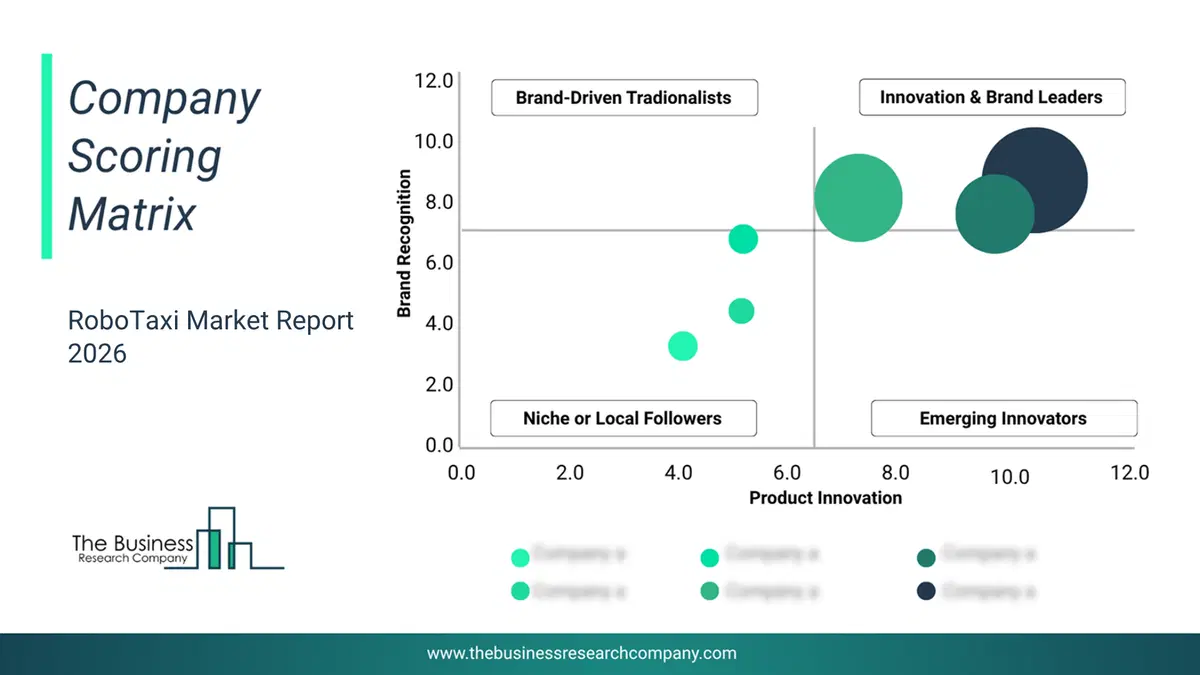
This chart maps companies by product innovation and brand strength, with bubble size indicating relative revenue, helping identify market leaders, challengers, and niche players. This is an illustrative chart; the full report provides a complete and accurate competitive analysis.
Global RoboTaxi Market Trends and Insights
Major companies operating in the robotaxi market are focusing on developing advanced solutions, such as modular autonomous driving platforms, which allow for seamless integration of sensors and computing units with scenario-specific tuning for different urban environments with ride-hailing platforms for routing and fleet management. Modular autonomous-driving platform refers to a flexible architecture for self-driving vehicles that separates the system into independent modules, and each module handles a specific function with sensors, software, and vehicle control without redesigning the entire vehicle. For instance, in November 2025, WeRide Holdings Limited, a China-based autonomous mobility company, in collaboration with Uber, a US-based technology company, launched fully driverless robotaxi trial operations in Abu Dhabi, United Arab Emirates, deploying a Level 4 autonomous vehicle platform capable of operating without a safety driver onboard, and this service integrates with the Uber ride-hailing app to allow users to request rides via standard categories such as UberX and Uber Comfort or through a dedicated autonomous option for driverless trips. Additionally, it also offers autonomous driving solutions for commercial fleets and autonomous shuttle services by leveraging its modular hardware and software architecture for safety and real-time decision-making.What Are Latest Mergers And Acquisitions In The RoboTaxi Market?
In August 2023, Toyota Motor Corporation, a Japan-based automobile manufacturer partnered with Pony.ai. Through this partnership, both companies aim to advance the commercial application of high-level autonomous driving technology and enable the mass production of robotaxis. Pony.ai is a US-based autonomous vehicle technology startup company that offers robotaxi services.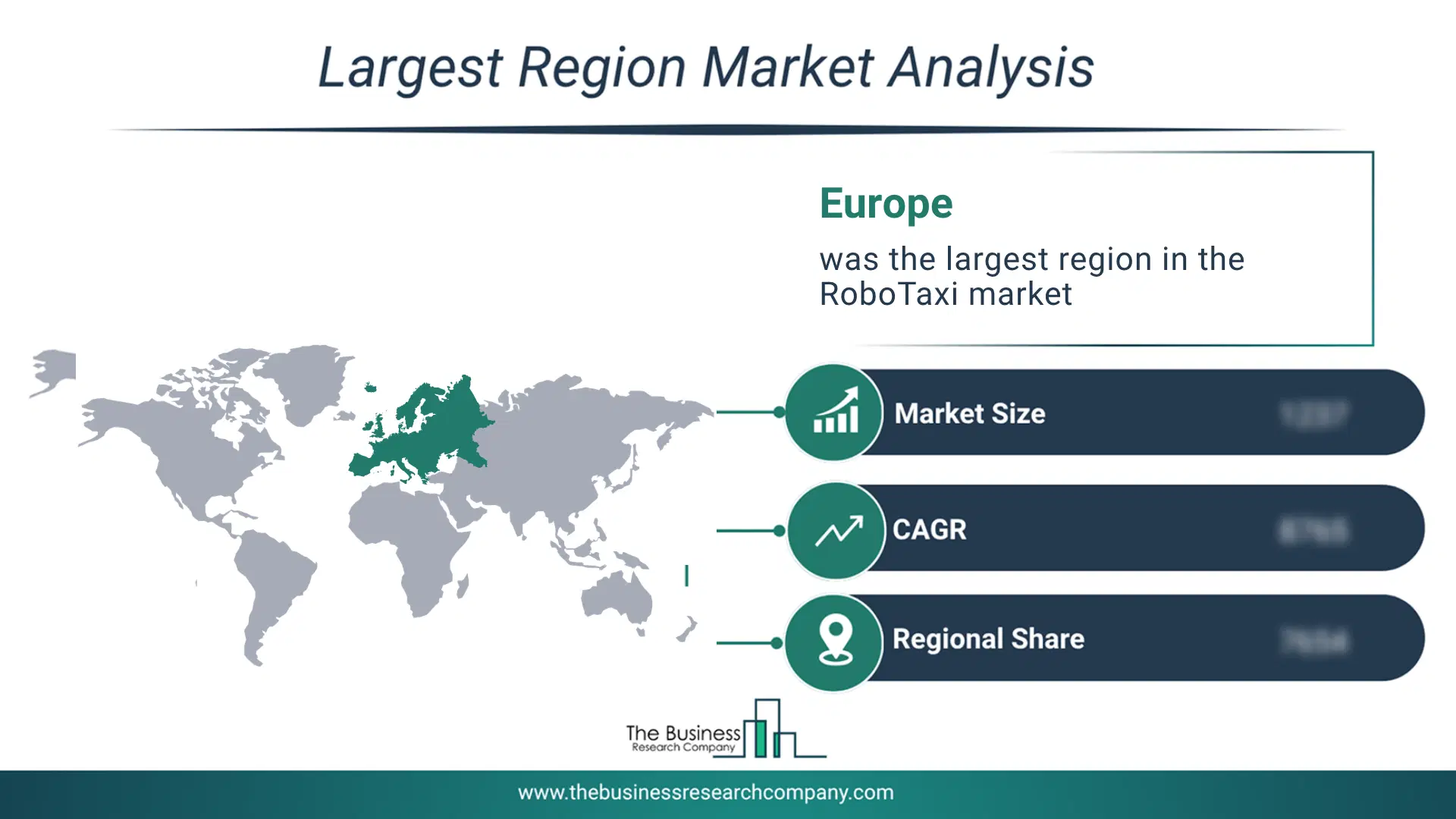
Regional Outlook
Europe was the largest region in the robotaxi market in 2025. Asia-Pacific is expected to be the fastest growing region in the market. The regions covered in this market report include Asia-Pacific, South East Asia, Western Europe, Eastern Europe, North America, South America, Middle East, Africa. The countries covered in this market report include Australia, Brazil, China, France, Germany, India, Indonesia, Japan, Taiwan, Russia, South Korea, UK, USA, Canada, Italy, SpainWhat Defines the RoboTaxi Market?
The robotaxi market consists of sales of autonomous driving systems, communication systems, and fleet management platforms. Values in this market are ‘factory gate’ values, that is the value of goods sold by the manufacturers or creators of the goods, whether to other entities (including downstream manufacturers, wholesalers, distributors and retailers) or directly to end customers. The value of goods in this market includes related services sold by the creators of the goods.How is Market Value Defined and Measured?
The market value is defined as the revenues that enterprises gain from the sale of goods and/or services within the specified market and geography through sales, grants, or donations in terms of the currency (in USD unless otherwise specified). The revenues for a specified geography are consumption values that are revenues generated by organizations in the specified geography within the market, irrespective of where they are produced. It does not include revenues from resales along the supply chain, either further along the supply chain or as part of other products.
This chart presents market attractiveness based on a quantitative evaluation of growth, competition, strategic alignment, and risk, offering a clear view of opportunity areas for decision-making. This chart is for illustrative purposes; the full report contains the complete analysis.

This chart highlights the Total Addressable Market (TAM) by estimating the maximum revenue opportunity using an assumption-driven approach, supporting strategic planning and opportunity sizing across markets. The chart is illustrative; the full report provides a more comprehensive analysis.
What Key Data and Analysis Are Included in the RoboTaxi Market Report 2026?
The robotaxi market research report is one of a series of new reports from The Business Research Company that provides market statistics, including industry global market size, regional shares, competitors with the market share, detailed market segments, market trends and opportunities, and any further data you may need to thrive in the robotaxi industry. The market research report delivers a complete perspective of everything you need, with an in-depth analysis of the current and future state of the industry.RoboTaxi Market Report Forecast Analysis
| Report Attribute | Details |
|---|---|
| Market Size Value In 2026 | $5.5 billion |
| Revenue Forecast In 2030 | $33.49 billion |
| Growth Rate | CAGR of 57.4% from 2026 to 2030 |
| Base Year For Estimation | 2025 |
| Actual Estimates/Historical Data | 2020-2025 |
| Forecast Period | 2026 - 2030 - 2030 |
| Market Representation | Revenue in USD Billion and CAGR from 2026 to 2030 |
| Segments Covered | Type, Component Type, Service, Propulsion Type |
| Regional Scope | Asia-Pacific, Western Europe, Eastern Europe, North America, South America, Middle East, Africa |
| Country Scope | The countries covered in the report are Australia, Brazil, China, France, Germany, India, Indonesia, Japan, Taiwan, Russia, South Korea, UK, USA, Canada, Italy, Spain. |
| Key Companies Profiled | Amazon.com Inc., Toyota Motor Corporation, Mercedes-Benz Group AG, Ford Motor Company, BMW AG, Hyundai Motor Group, Tesla Inc., ZF Friedrichshafen AG, Volvo Personvagnar AB, Uber Technologies Inc., Zhejiang Geely Holding Group Co. Ltd., Baidu Inc., Aptiv PLC, Lyft Inc., Cruise LLC, Waymo LLC, Motional Inc., Pony.AI, EasyMile, MOIA, AutoX Inc., Navya, Didi Chuxing Technology Co. Ltd., GAC Aion New Energy Automobile Co. Ltd. |
| Customization Scope | Request for Customization |
| Pricing And Purchase Options | Explore Purchase Options |