
Robotic Arm For Space Market Report 2026
Global Outlook – By Type (Articulated, Selective Compliance Articulated Robot Arm, Cartesian, Cylindrical, Polar, Others Types), By Payload Capacity (Low, Medium, High), By Application (Satellite Servicing, Space Station Maintenance, Cargo Handling, Assembly, Others Applications), By End-User (Government Space Agencies, Commercial Space Companies, Research Institutes, Others End-Users) – Market Size, Trends, Strategies, and Forecast to 2030
Robotic Arm For Space Market Overview
• Robotic Arm For Space market size has reached to $4.14 billion in 2025 • Expected to grow to $8.01 billion in 2030 at a compound annual growth rate (CAGR) of 14.1% • Growth Driver: Surge In Satellite Launches Fueling The Growth Of The Market due To Increasing Demand For Global Communication Networks And Precise Satellite Deployment • Market Trend: Next-Generation Space Robotics For Satellite Maintenance And On-Orbit Operations • North America was the largest region in 2025 and Asia-Pacific is the fastest growing region.Market Gains By 2030 – Top Opportunities By Segment
Market Gain identifies the most promising market opportunities by highlighting the segments or products expected to generate the highest incremental revenue growth over the next five years.
What Is Covered Under Robotic Arm For Space Market?
A robotic arm for space is a mechanical device designed to perform precise tasks in the harsh environment of outer space. It is equipped with joints, actuators, and sensors that enable controlled movement, manipulation of objects, and execution of complex operations. These arms are used to handle satellites, assist in spacecraft assembly, perform maintenance tasks, and support scientific experiments in zero-gravity conditions. The main types of robotic arms for space are articulated, selective compliance articulated robot arm, Cartesian, cylindrical, polar, and others. Articulated are robotic arms with multiple joints that allow a wide range of motion, mimicking the movement of a human arm. The different payload capacities are low, medium, and high. The various applications involved are satellite servicing, space station maintenance, cargo handling, assembly, and others, and they are used by several end-users such as government space agencies, commercial space companies, research institutes, and others.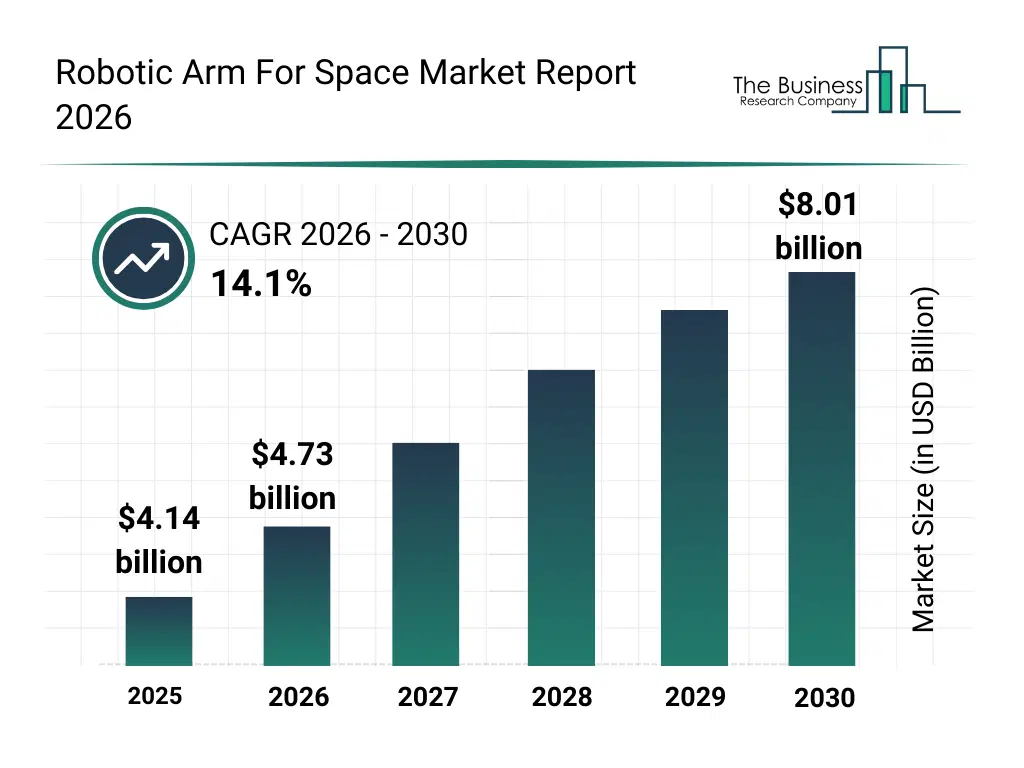
What Is The Robotic Arm For Space Market Size and Share 2026?
The robotic arm for space market size has grown rapidly in recent years. It will grow from $4.14 billion in 2025 to $4.73 billion in 2026 at a compound annual growth rate (CAGR) of 14.3%. The growth in the historic period can be attributed to increasing satellite launches and in-orbit servicing demand, technological advancements in actuators and sensors, growth in space infrastructure projects, rising government and private space missions, development of specialized robotic arm types like scara and delta arms.What Is The Robotic Arm For Space Market Growth Forecast?
The robotic arm for space market size is expected to see rapid growth in the next few years. It will grow to $8.01 billion in 2030 at a compound annual growth rate (CAGR) of 14.1%. The growth in the forecast period can be attributed to expansion of on-orbit satellite servicing services, adoption of autonomous dexterous robotic operations, increase in commercial space stations and orbital construction projects, integration of ai and machine learning for precision tasks, demand for hybrid and telescopic robotic arms for complex operations. Major trends in the forecast period include on-orbit satellite servicing automation, dexterous payload handling and manipulation, space infrastructure assembly robotics, teleoperated and remote-controlled robotic arms, maintenance and repair robotics in zero-gravity.
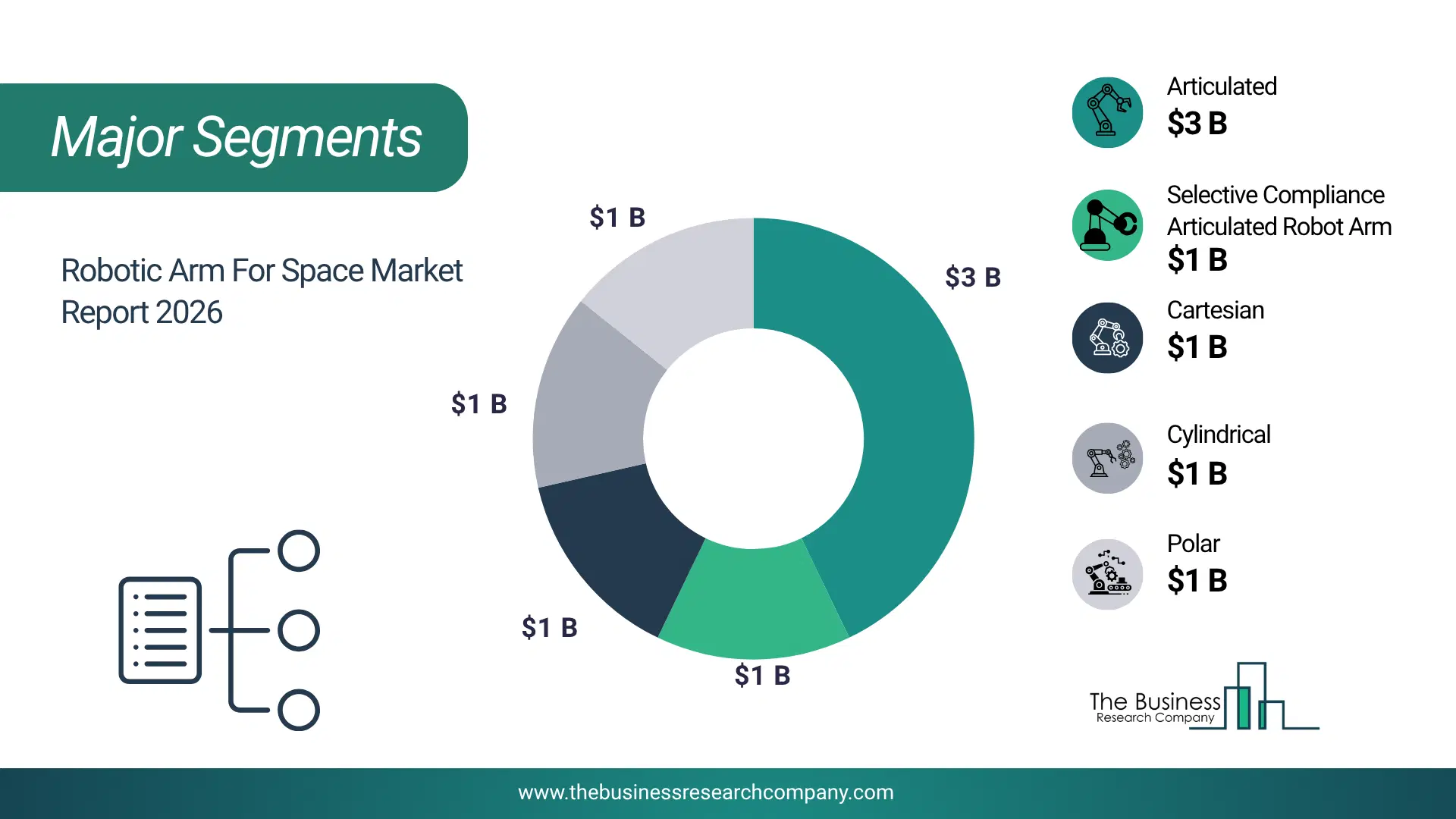
Global Robotic Arm For Space Market Segmentation
1) By Type: Articulated, Selective Compliance Articulated Robot Arm, Cartesian, Cylindrical, Polar, Others Types 2) By Payload Capacity: Low, Medium, High 3) By Application: Satellite Servicing, Space Station Maintenance, Cargo Handling, Assembly, Others Applications 4) By End-User: Government Space Agencies, Commercial Space Companies, Research Institutes, Others End-Users Subsegments: 1) By Cylindrical: Vertical Cylindrical, Horizontal Cylindrical, Rotational Cylindrical 2) By Polar: Spherical, Revolute, Radial 3) By Others Types: Selective Compliance Assembly Robot Arm, Delta, Hybrid The top segments in the robotic arm for space market will be: • Articulated will reach $3.35 Billion by 2030. • Selective Compliance Articulated Robot Arm will reach $1.47 Billion by 2030. • Cartesian will reach $1.12 Billion by 2030. • Cylindrical will reach $0.79 Billion by 2030. • Polar will reach $0.68 Billion by 2030.What Is Driver Of The Robotic Arm For Space Market?
The increasing number of satellite launches is expected to propel the growth of the robotic arm for the space market going forward. Satellite launches refer to the process of sending artificial satellites into orbit around the Earth or other celestial bodies using launch vehicles or rockets. The increasing number of satellite launches is due to the growing demand for global communication networks, as more satellites are needed to provide faster, more reliable internet, mobile connectivity, and data services worldwide. Robotic arms for space support satellite launches by precisely capturing, positioning, and deploying satellites into their designated orbits from spacecraft or space stations. For instance, in February 2024, according to the China Aerospace Science and Technology Corporation (CASC), a China-based government-owned aerospace corporation, China has planned to carry out around 100 launches in 2024, after 67 in 2023. Therefore, the increasing number of satellite launches is driving growth of the robotic arm for the space market.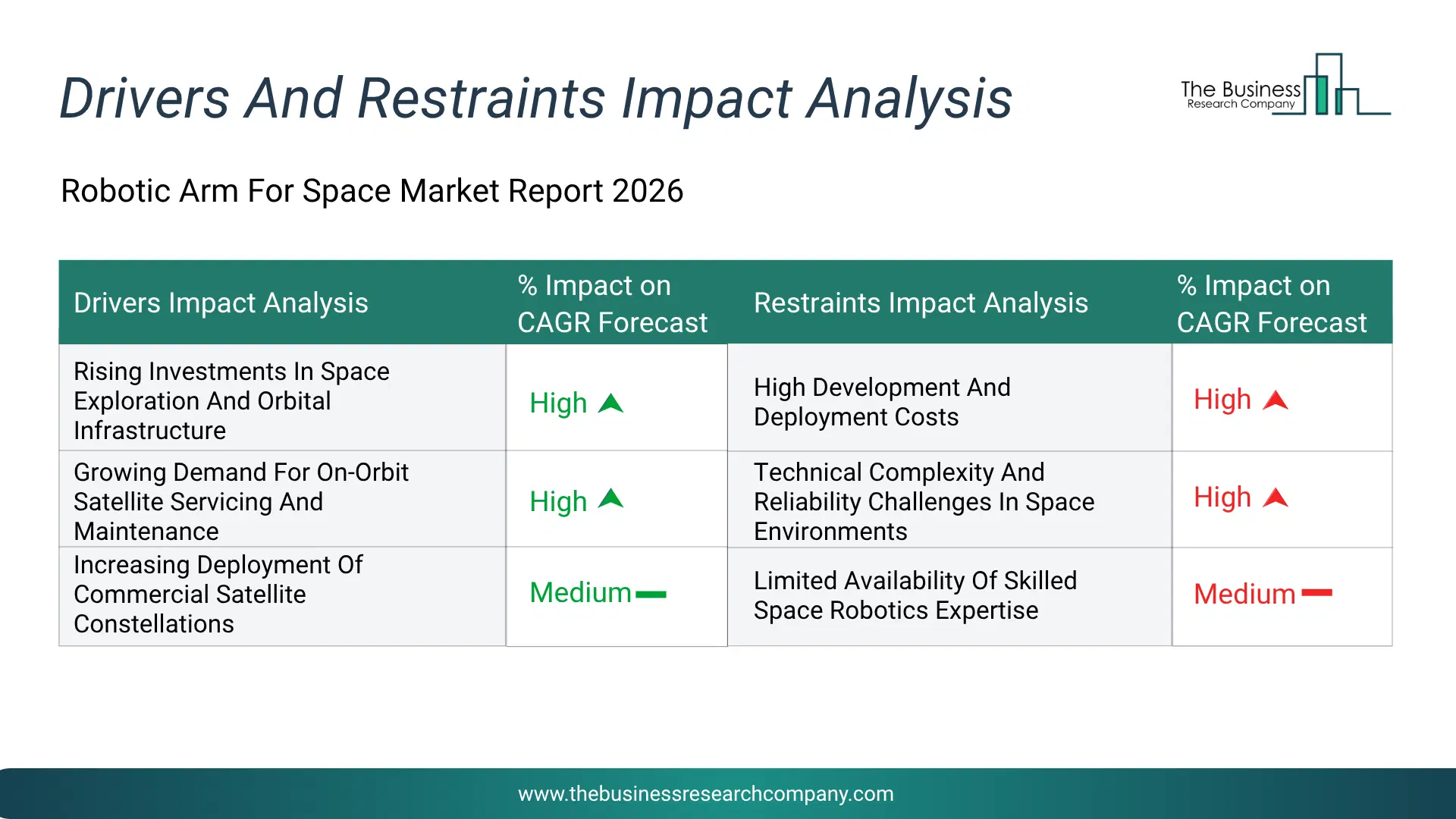
Infographic Chart Showing Key Market Drivers Analysis And Restraints For Robotic Arm For Space Market
The chart presents an impact analysis of key drivers and restraints, quantifying their relative influence on the market's growth rate and helping assess the balance between growth enablers and limiting factors. This chart offers a high-level perspective; the full report contains more detailed insights.
How Will The Drivers Impact Growth In The Global Robotic Arm For Space Market?
• Rising Investments In Space Exploration And Orbital Infrastructure (High) – During the forecast period, the rising investments in space exploration and orbital infrastructure are expected to become a key growth driver for the robotic arm for space market by 2030. Governments and private organizations are allocating substantial resources toward lunar missions, deep-space exploration programs, orbital stations, and next-generation spacecraft development. Robotic arms play a critical role in supporting construction, equipment handling, and mission operations in challenging space environments. Growing focus on expanding long-term human and robotic presence in space is further increasing the need for advanced robotic manipulation systems. This trend is reinforcing sustained market expansion. • Growing Demand For On-Orbit Satellite Servicing And Maintenance (High) – During the forecast period, the growing demand for on-orbit satellite servicing and maintenance is expected to emerge as a major factor driving the expansion of the robotic arm for space market by 2030. Satellite operators are increasingly seeking solutions that extend spacecraft lifespan, reduce replacement costs, and improve operational efficiency. Space robotic arms enable inspection, repair, refueling, repositioning, and component replacement activities without requiring complete satellite replacement. The increasing value of orbital assets and the need to maximize mission returns are accelerating adoption of robotic servicing technologies. • Increasing Deployment Of Commercial Satellite Constellations (Medium) – During the forecast period, the increasing deployment of commercial satellite constellations is expected to act as a key growth catalyst for the robotic arm for space market by 2030. Expanding constellations for communication, navigation, Earth observation, and broadband connectivity are creating greater requirements for assembly, deployment support, and operational management in orbit. Robotic systems are becoming essential for handling complex tasks associated with large-scale satellite networks while improving mission flexibility and reducing operational risks. As the number of satellites launched into orbit continues to increase, demand for advanced space robotics solutions is expected to strengthen.How Will The Restraints Impact Growth In The Global Robotic Arm For Space Market?
• High Development And Deployment Costs (High) – During the forecast period, the high cost associated with designing, manufacturing, testing, and deploying robotic arms for space is acting as a major restraint for the market. Space robotic systems require highly durable materials, radiation-resistant electronics, advanced sensors, and precision engineering to operate reliably in harsh orbital conditions. Extensive validation and mission-specific customization further increase development expenses and extend project timelines. Smaller aerospace firms and emerging space startups often face budget limitations that restrict adoption of advanced robotic arm technologies. These high financial barriers reduce large-scale commercialization and slow the expansion of the robotic arm for space market. • Technical Complexity And Reliability Challenges In Space Environments (High) – During the forecast period, the extreme environmental conditions in space create major operational and engineering challenges for robotic arm systems, restraining market growth. Robotic arms must function accurately under vacuum conditions, radiation exposure, extreme temperature fluctuations, and zero gravity without failure. Even minor technical malfunctions can lead to mission failure, costly damage, or loss of critical equipment in orbit. Maintaining precision, durability, and autonomous functionality over long-duration missions requires highly sophisticated system integration and continuous testing. These technical complexities increase development risks and limit faster adoption across multiple space applications. • Limited Availability Of Skilled Space Robotics Expertise (Medium) – During the forecast period, the shortage of highly skilled professionals with expertise in space robotics, autonomous control systems, and orbital operations is acting as a restraint for the robotic arm for space market. Developing and operating advanced robotic systems for space missions requires specialized engineering knowledge and extensive research capabilities. Many organizations face challenges in recruiting experienced professionals capable of designing complex robotic manipulation systems for harsh extraterrestrial environments. The limited talent pool slows innovation, increases development timelines, and raises operational costs for manufacturers and space agencies. This shortage of technical expertise restricts the pace of market expansion and technology commercialization.Key Players In The Global Robotic Arm For Space Market
Major companies operating in the robotic arm for space market are Airbus SE, Leonardo S.p.A., Kawasaki Heavy Industries Ltd., Oceaneering International Inc., SENER Grupo de Ingeniería S.A., Sierra Nevada Corporation, MDA Space Ltd., GITAI Inc., ClearSpace SA, Space Applications Services NV/SA, Astrobotic Technology Inc., Novium Inc., Motiv Space Systems Inc., Lunar Outpost Inc., PIAP Space Sp. z o.o., China Academy of Space Technology (CAST), Rovial Space Inc., Astrabionics Inc., Lodestar Space Ltd., Maxar Technologies Inc., Redwire Corporation, Northrop Grumman Corporation, Thales Alenia Space, Mitsubishi Electric Corporation, Honeybee Robotics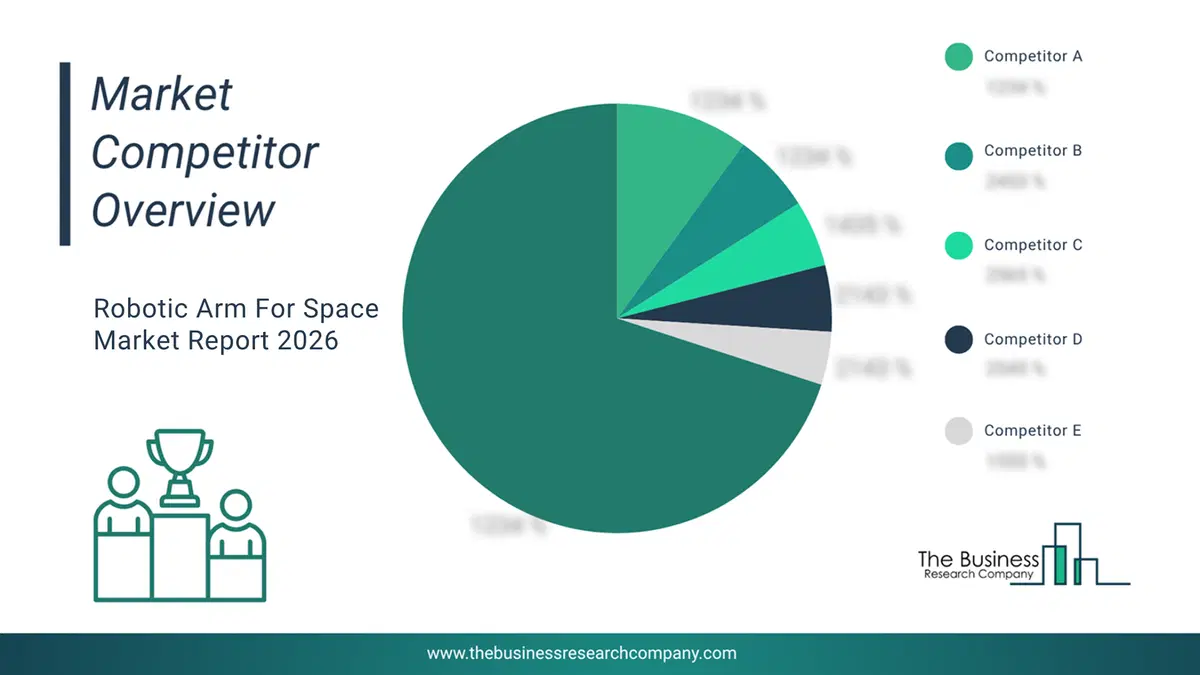
This chart is for illustrative purposes; the full report includes a detailed competitor analysis and comprehensive overview of the top 10 companies in the market.
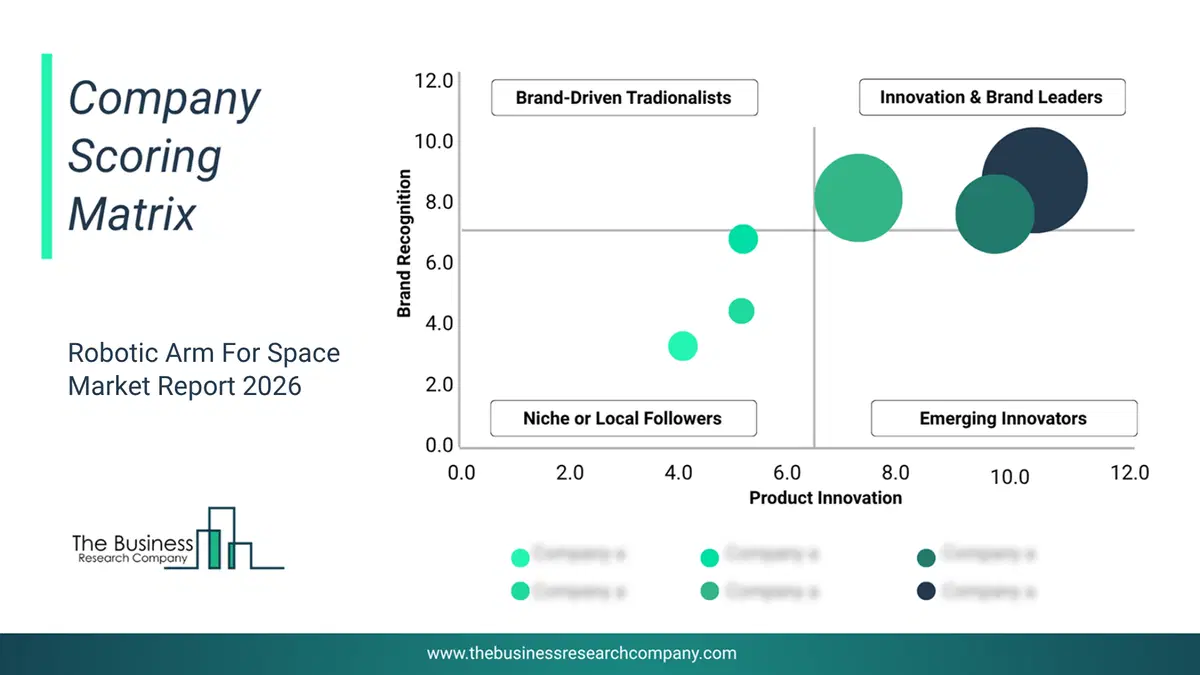
This chart maps companies by product innovation and brand strength, with bubble size indicating relative revenue, helping identify market leaders, challengers, and niche players. This is an illustrative chart; the full report provides a complete and accurate competitive analysis.
Global Robotic Arm For Space Market Trends and Insights
Major companies are operating in the robotic arm for the space market, focusing on technological developments such as in-space servicing, assembly, and manufacturing (ISAM) to enhance satellite maintenance, extend spacecraft lifespans, enable on-orbit assembly of structures, and advance autonomous operations in space. In-space servicing, assembly, and manufacturing (ISAM) refers to the use of robotic and autonomous systems to maintain, repair, assemble, and produce spacecraft or structures directly in orbit. For instance, in January 2024, GITAI USA Inc., a US-based space robotics startup company, launched its 1.5-meter-long autonomous dual robotic arm system, S2, aboard SpaceX’s Falcon 9 NG-20 mission to the ISS. The robotic arm, designed for satellite servicing, orbital assembly, on-orbit manufacturing, and other in-space operations, features a proprietary tool changer and will perform maintenance, inspection, and life-extension tasks for satellites, marking a significant milestone in autonomous space robotics.What Are Latest Mergers And Acquisitions In The Robotic Arm For Space Market? Blue Origin Acquires Honeybee Robotics To Advance Planetary Exploration And Robotics Capabilities
In March 2025, GITAI Japan Inc., a Japanese subsidiary of U.S.-headquartered space robotics company GITAI, partnered with the Japan Aerospace Exploration Agency (JAXA) to conduct a concept study for a robotic arm system for a pressurized crewed lunar rover. With this partnership, the aim is to develop advanced robotic arm technologies that enhance lunar exploration and support human operations on the Moon. The Japan Aerospace Exploration Agency (JAXA) is a Japan-based space agency responsible for space research, satellite development, and exploration missions.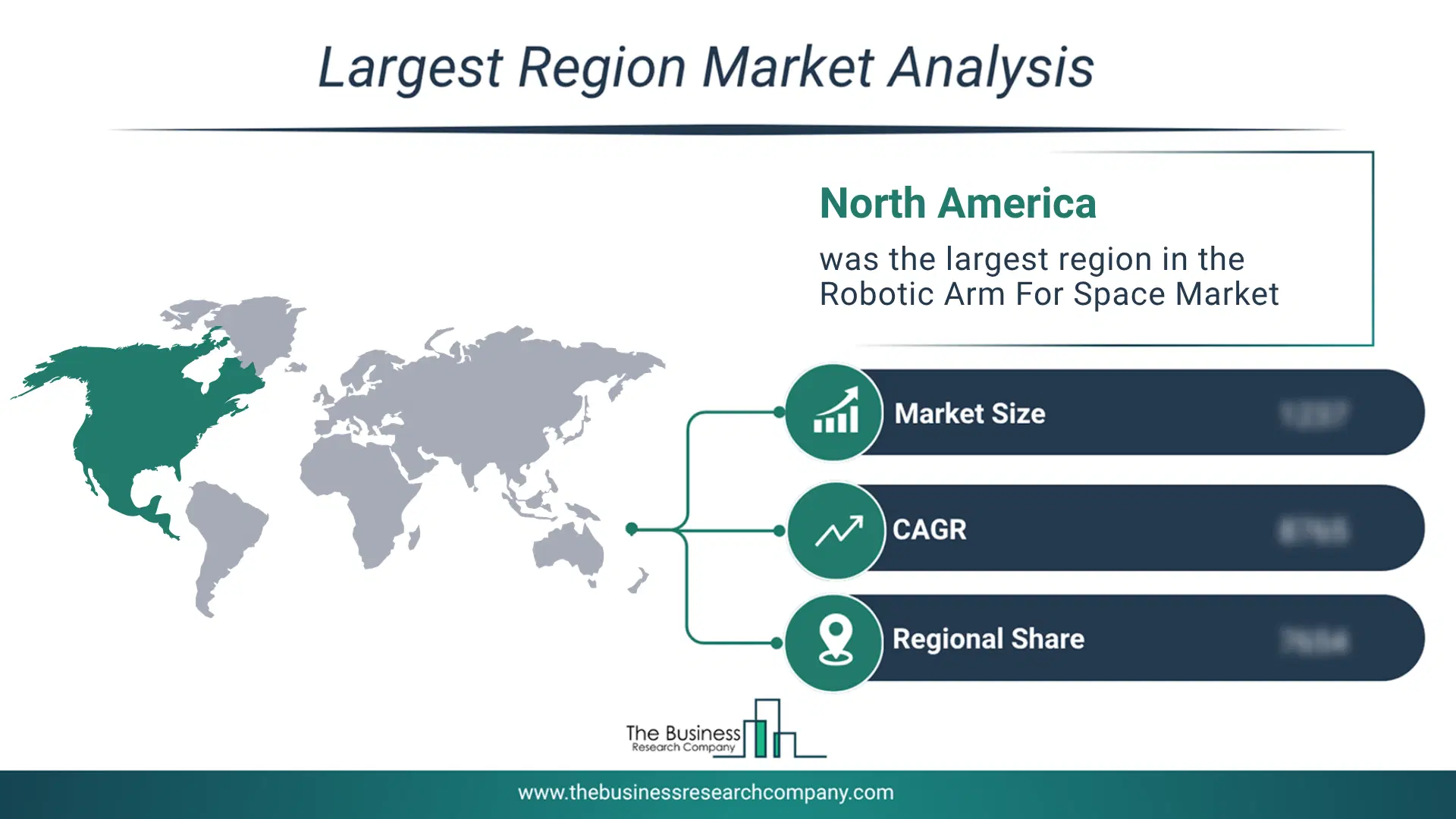
Regional Insights
North America was the largest region in the robotic arm for space market in 2025. Asia-Pacific is expected to be the fastest-growing region in the forecast period. The regions covered in this market report are Asia-Pacific, South East Asia, Western Europe, Eastern Europe, North America, South America, Middle East, Africa. The countries covered in this market report are Australia, Brazil, China, France, Germany, India, Indonesia, Japan, Taiwan, Russia, South Korea, UK, USA, Canada, Italy, SpainWhat Defines the Robotic Arm For Space Market?
The robotic arm for space market consists of revenues earned by entities by providing services such as on-orbit satellite servicing and maintenance, assembly and construction of space infrastructure, assistance during extravehicular activities, autonomous or remote dexterous operations, payload handling and manipulation. The market value includes the value of related goods sold by the service provider or included within the service offering. The robotic arm for space market also includes of sales of selective compliance assembly robot arm (SCARA), delta arm, parallel arm, hybrid arm, and telescopic arm. Values in this market are ‘factory gate’ values, that is, the value of goods sold by the manufacturers or creators of the goods, whether to other entities (including downstream manufacturers, wholesalers, distributors, and retailers) or directly to end customers. The value of goods in this market includes related services sold by the creators of the goods.How is Market Value Defined and Measured?
The market value is defined as the revenues that enterprises gain from the sale of goods and/or services within the specified market and geography through sales, grants, or donations in terms of the currency (in USD unless otherwise specified). The revenues for a specified geography are consumption values that are revenues generated by organizations in the specified geography within the market, irrespective of where they are produced. It does not include revenues from resales along the supply chain, either further along the supply chain or as part of other products.
This chart presents market attractiveness based on a quantitative evaluation of growth, competition, strategic alignment, and risk, offering a clear view of opportunity areas for decision-making. This chart is for illustrative purposes; the full report contains the complete analysis.

This chart highlights the Total Addressable Market (TAM) by estimating the maximum revenue opportunity using an assumption-driven approach, supporting strategic planning and opportunity sizing across markets. The chart is illustrative; the full report provides a more comprehensive analysis.
What Key Data and Analysis Are Included in the Robotic Arm For Space Market Report 2026?
The robotic arm for space market research report is one of a series of new reports from The Business Research Company that provides market statistics, including industry global market size, regional shares, competitors with the market share, detailed market segments, market trends and opportunities, and any further data you may need to thrive in the robotic arm for space industry. The market research report delivers a complete perspective of everything you need, with an in-depth analysis of the current and future state of the industry.Robotic Arm For Space Market Report Forecast Analysis
| Report Attribute | Details |
|---|---|
| Market Size Value In 2026 | $4.73 billion |
| Revenue Forecast In 2030 | $8.01 billion |
| Growth Rate | CAGR of 14.3% from 2026 to 2030 |
| Base Year For Estimation | 2025 |
| Actual Estimates/Historical Data | 2020-2025 |
| Forecast Period | 2026 - 2030 |
| Market Representation | Revenue in USD Billion and CAGR from 2026 to 2030 |
| Segments Covered | Type, Payload Capacity, Application, End-User |
| Regional Scope | Asia-Pacific, Western Europe, Eastern Europe, North America, South America, Middle East, Africa |
| Country Scope | The countries covered in the report are Australia, Brazil, China, France, Germany, India, Indonesia, Japan, Taiwan, Russia, South Korea, UK, USA, Canada, Italy, Spain. |
| Key Companies Profiled | Airbus SE, Leonardo S.p.A., Kawasaki Heavy Industries Ltd., Oceaneering International Inc., SENER Grupo de Ingeniería S.A., Sierra Nevada Corporation, MDA Space Ltd., GITAI Inc., ClearSpace SA, Space Applications Services NV/SA, Astrobotic Technology Inc., Novium Inc., Motiv Space Systems Inc., Lunar Outpost Inc., PIAP Space Sp. z o.o., China Academy of Space Technology (CAST), Rovial Space Inc., Astrabionics Inc., Lodestar Space Ltd., Maxar Technologies Inc., Redwire Corporation, Northrop Grumman Corporation, Thales Alenia Space, Mitsubishi Electric Corporation, Honeybee Robotics |
| Customization Scope | Request for Customization |
| Pricing And Purchase Options | Explore Purchase Options |