
Robotic Arm Market Report 2026
Global Outlook – By Type (Articulated, Cartesian, Selective Compliance Articulated Robot Arm (SCARA), Spherical Or Polar, Cylindrical, Other Types), By Payload Capacity (Less Than 500 Kilogram (KG), 500-3000 Kilogram (KG), 3001 Kilogram (KG) And Above), By Axis (1-Axis, 2-Axis, 3-Axis, 4-Axis, 5-Axis, 6-Axis, 7-Axis), By Application (Materials Handling, Cutting And Processing, Soldering And Welding, Assembling And Disassembling, Other Applications), By End-User Industry (Automotive, Electrical And Electronics, Metals And Machinery, Plastics And Chemicals, Food And Beverages, Other End-User Industries) – Market Size, Trends, Strategies, and Forecast to 2030
Robotic Arm Market Overview
• Robotic Arm market size has reached to $42.63 billion in 2025 • Expected to grow to $86.19 billion in 2030 at a compound annual growth rate (CAGR) of 14.8% • Growth Driver: Robotic Arm Market Growth Driven By E-Commerce Demand For Material Handling Efficiency • Market Trend: Innovative Modular Robots Enhance Productivity And Performance In Industrial Applications • North America was the largest region in 2025 and Asia-Pacific is the fastest growing region.What Is Covered Under Robotic Arm Market?
A robotic arm is a mechanical device typically designed to perform tasks that require precision and dexterity, mimicking the movements of a human arm. It consists of several segments connected by joints, allowing it to articulate and maneuver in various directions. The main types of robotic arms are articulated, cartesian, selective compliance articulated robot arms (SCARA), spherical or polar, cylindrical, and others. An articulated robot arm is a flexible robotic device with rotary joints, enabling it to move in different directions, similar to a human arm. The various payload capacities include less than 500 kilograms (kg), 500–3000 kilograms (kg), 3001 kilograms (kg) and above, with different axes such as the 1-axis, 2-axis, 3-axis, 4-axis, 5-axis, 6-axis, and 7-axis. A variety of applications, including material handling, cutting and processing, soldering and welding, assembling and disassembling, and others, are used in many end-user industries, such as automotive, electrical and electronics, metals and machinery, plastics and chemicals, food and beverages, and others.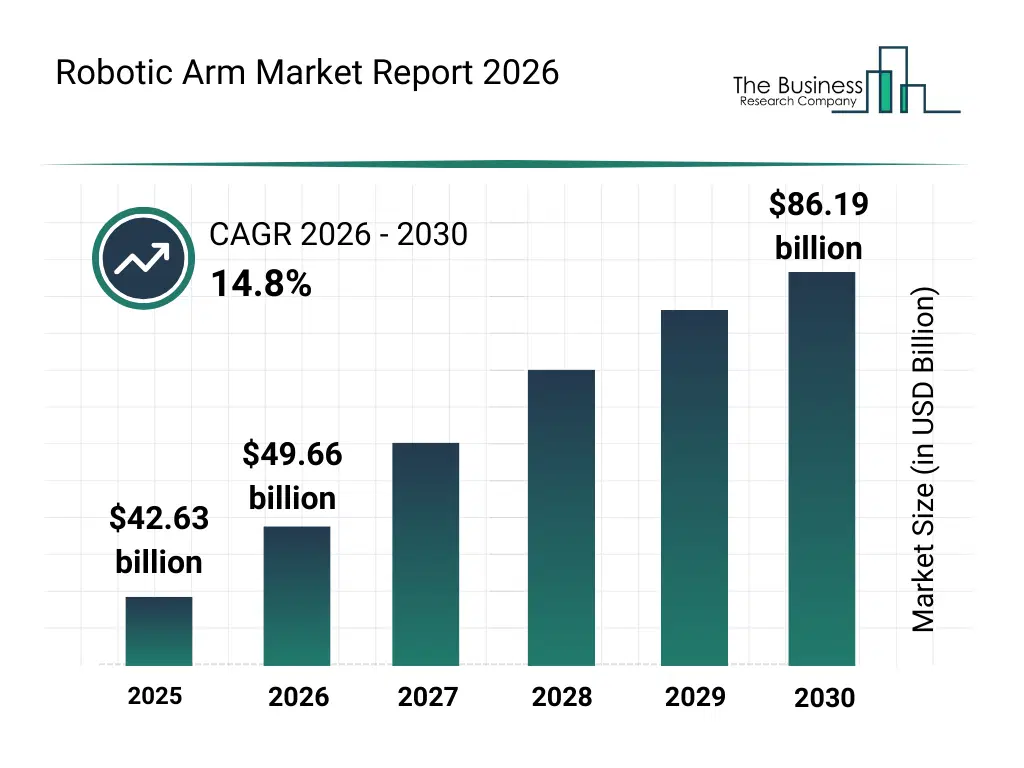
What Is The Robotic Arm Market Size and Share 2026?
The robotic arm market size has grown rapidly in recent years. It will grow from $42.63 billion in 2025 to $49.66 billion in 2026 at a compound annual growth rate (CAGR) of 16.5%. The growth in the historic period can be attributed to growth in automotive manufacturing automation, rising labor cost pressures, adoption of industrial robots in assembly lines, increased demand for production efficiency, early integration of robotics in electronics manufacturing.What Is The Robotic Arm Market Growth Forecast?
The robotic arm market size is expected to see rapid growth in the next few years. It will grow to $86.19 billion in 2030 at a compound annual growth rate (CAGR) of 14.8%. The growth in the forecast period can be attributed to expansion of smart factories, growth in electric vehicle manufacturing, increasing adoption of AI enabled robots, rising demand for automation in SMEs, integration of robotics in food and beverage processing. Major trends in the forecast period include rising adoption of collaborative robotic arms, increasing demand for high precision multi axis robots, growing use of robotic arms in flexible manufacturing, expansion of modular and reconfigurable robotic systems, increasing focus on safety and human robot collaboration.Tariff Impact On Robotic Arm Market
Tariffs have impacted the robotic arm market by increasing the cost of imported motors, sensors, controllers, and precision mechanical components. Articulated and SCARA robotic arm segments are most affected, particularly in Asia Pacific and North America where global supply chains are deeply integrated. Higher tariffs have increased system costs for automotive, electronics, and machinery manufacturers. At the same time, tariffs are encouraging localized production, supplier diversification, and innovation in cost optimized and modular robotic arm designs.
Global Robotic Arm Market Segmentation
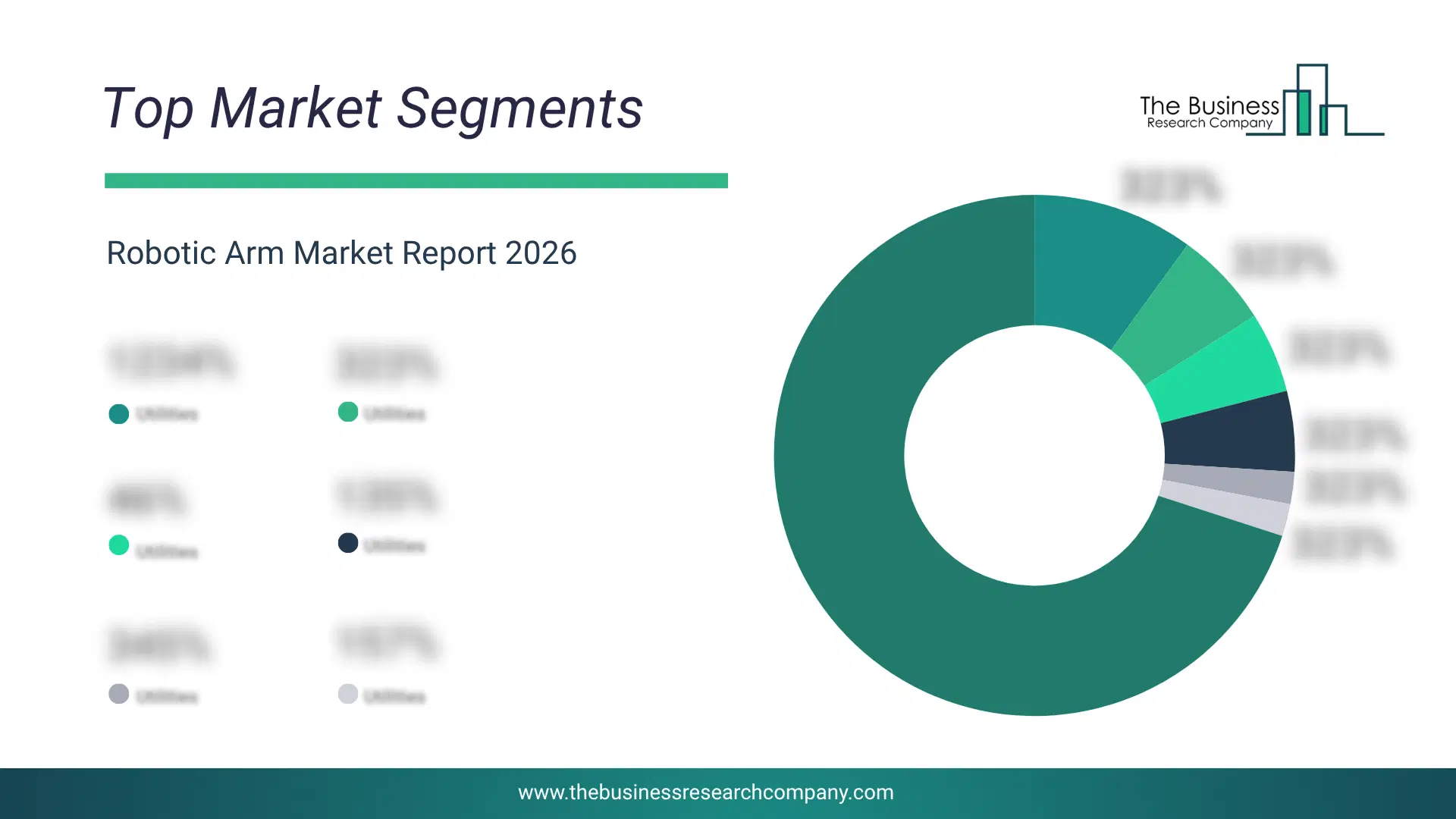
1) By Type: Articulated, Cartesian, Selective Compliance Articulated Robot Arm (SCARA), Spherical Or Polar, Cylindrical, Other Types 2) By Payload Capacity: Less Than 500 Kilogram (KG), 500-3000 Kilogram (KG), 3001 Kilogram (KG) And Above 3) By Axis: 1-Axis, 2-Axis, 3-Axis, 4-Axis, 5-Axis, 6-Axis, 7-Axis 4) By Application: Materials Handling, Cutting And Processing, Soldering And Welding, Assembling And Disassembling, Other Applications 5) By End-User Industry: Automotive, Electrical And Electronics, Metals And Machinery, Plastics And Chemicals, Food And Beverages, Other End-User Industries Subsegments: 1) By Articulated: 6-Axis Robotic Arms, 7-Axis Robotic Arms, Multi-Axis Robotic Arms 2) By Cartesian: Gantry Robots, XYZ Cartesian Robots 3) By Selective Compliance Articulated Robot Arm (SCARA): 4-Axis SCARA Robots, 5-Axis SCARA Robots 4) By Spherical Or Polar: Spherical Robots (Polar Coordinates), Polar Robotic Arms With Rotational Axes 5) By Cylindrical: Cylindrical Robotic Arms 6) By Other Types: Delta Robots, Parallel Robots, Hybrid Robotic Arms, Collaborative RobotsWhat Is The Driver Of The Robotic Arm Market?
The expansion of the e-commerce industry is expected to propel the growth of the robotic arm market going forward. The e-commerce industry refers to the buying and selling goods and services over the internet. It has transformed how businesses and consumers interact, offering convenience, accessibility, and a global reach. The growth of e-commerce is driven by the widespread use of smartphones, internet access, and a broad selection of online products. Robotic arms are crucial in optimizing supply chain and logistics operations within the e-commerce industry, enabling businesses to manage inventory more efficiently, reduce operational costs, and enhance overall productivity. For instance, in February 2024, according to the United States Census Bureau, a US-based government agency, in 2023, e-commerce sales were projected to reach $1,118.7 billion, marking a 7.6% (±1.2%) increase from 2022, while total retail sales saw a 2.1% (±0.4%) rise over the same period. In 2023, e-commerce sales constituted 15.4% of total sales, compared to 14.7% in 2022. Therefore, the expansion of the e-commerce industry is driving growth in the robotic arm industry.Key Players In The Global Robotic Arm Market
Major companies operating in the robotic arm market are ABB Ltd., Mitsubishi Electric Corporation, FANUC America Corporation, Yaskawa Electric Corporation, KUKA AG, Kawasaki Heavy Industries Ltd., Nachi-Fujikoshi Corp., Stäubli International AG, Comau, Universal Robots A/S, DENSO WAVE INCORPORATED, Seiko Epson Corporation, Omron Corporation, Panasonic Corporation, Flexiv Robotics Inc., Franka Robotics GmbH, Dobot, Gridbots Technologies Private Limited, EVS Tech Co. LTD.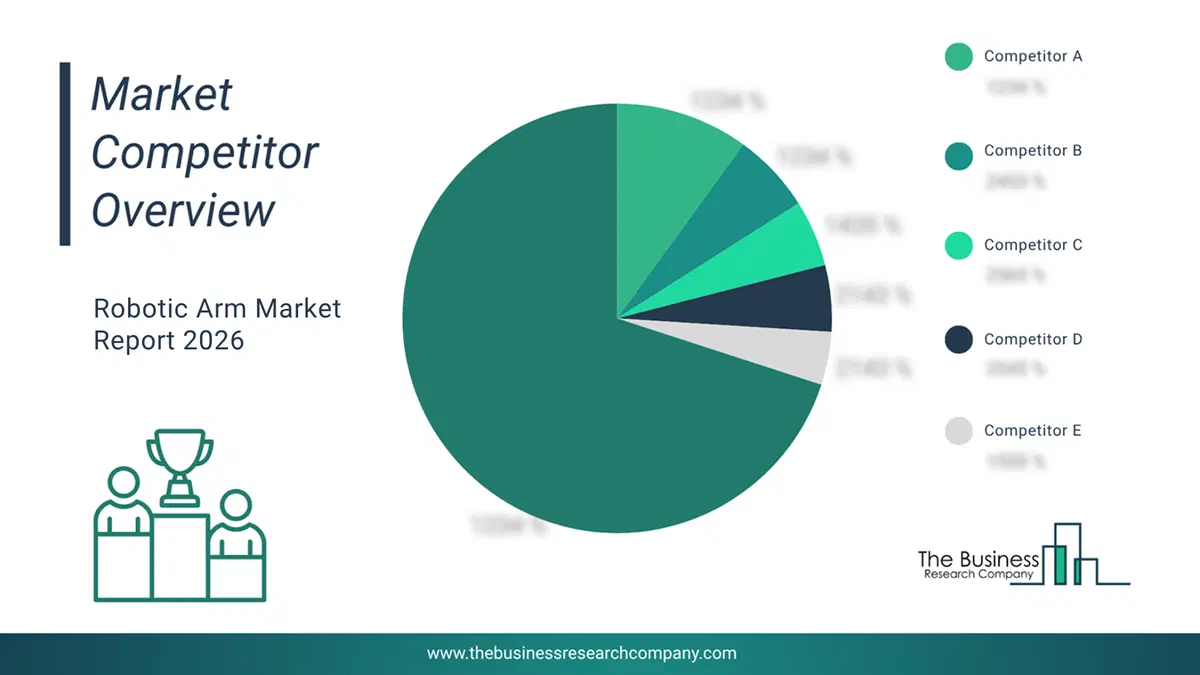
This chart is for illustrative purposes; the full report includes a detailed competitor analysis and comprehensive overview of the top 10 companies in the market.
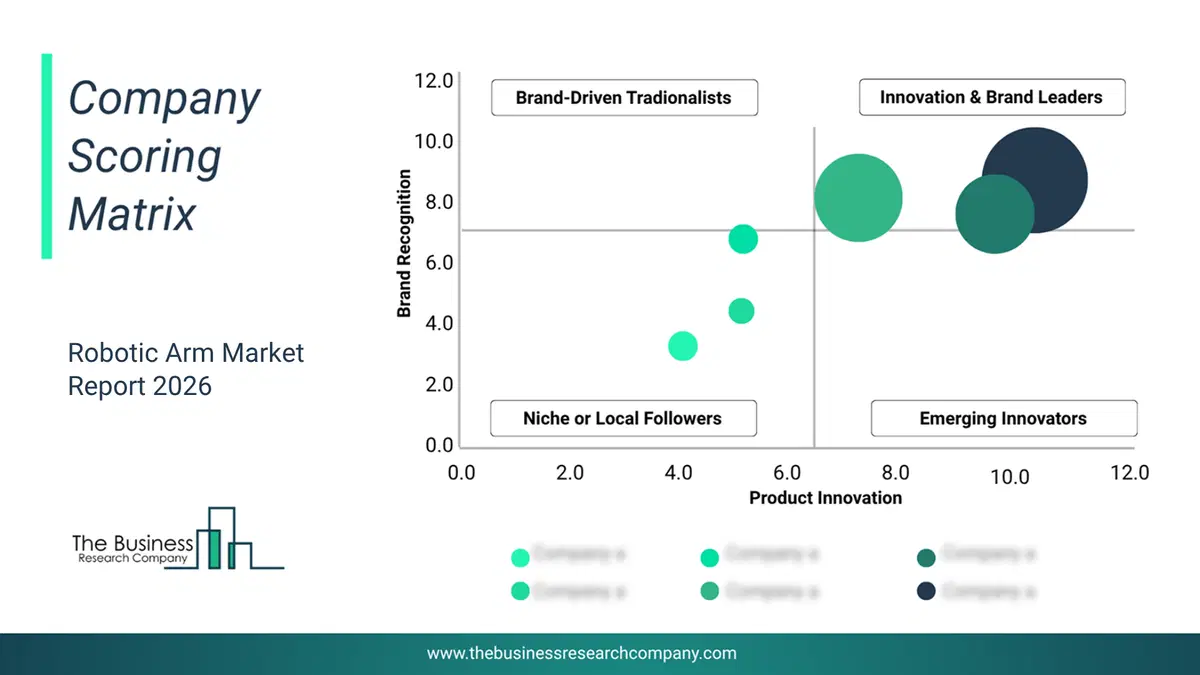
This chart maps companies by product innovation and brand strength, with bubble size indicating relative revenue, helping identify market leaders, challengers, and niche players. This is an illustrative chart; the full report provides a complete and accurate competitive analysis.
Global Robotic Arm Market Trends and Insights
Major companies operating in the robotic arm market are focusing on developing innovative products such as modular high-performance robots to provide flexible, high-performance robotic solutions for various industrial applications, enhancing productivity and sustainability. Modular high-performance robots are versatile robotic systems composed of interchangeable components that can be reconfigured to perform a variety of tasks efficiently, adapting their shape and function based on specific operational needs. For instance, in May 2024, ABB Ltd., a Switzerland-based engineering company, launched the IRB 7710 and IRB 7720 robots as part of its modular large robot portfolio. These robots offer a 25% reduction in cycle times and deliver class-leading path accuracy down to 0.6 mm at high speeds of up to 1600 mm/s. The robots are designed to handle payloads of up to 620 kg, making them ideal for applications in automotive, logistics, and construction industries, ensuring improved productivity and energy efficiency with up to 30% energy savings.What Are Latest Mergers And Acquisitions In The Robotic Arm Market?
In April 2024, WALTER Surface Technologies, a US-based abrasive and power tool manufacturing company, acquired PushCorp Inc. for an undisclosed amount. Through this acquisition, WALTER Surface Technologies aims to expand its offerings in robotic equipment and force control devices for industrial customers. PushCorp Inc. is a US-based autonomous solutions company that offers robotic arms for the automotive and aerospace industries.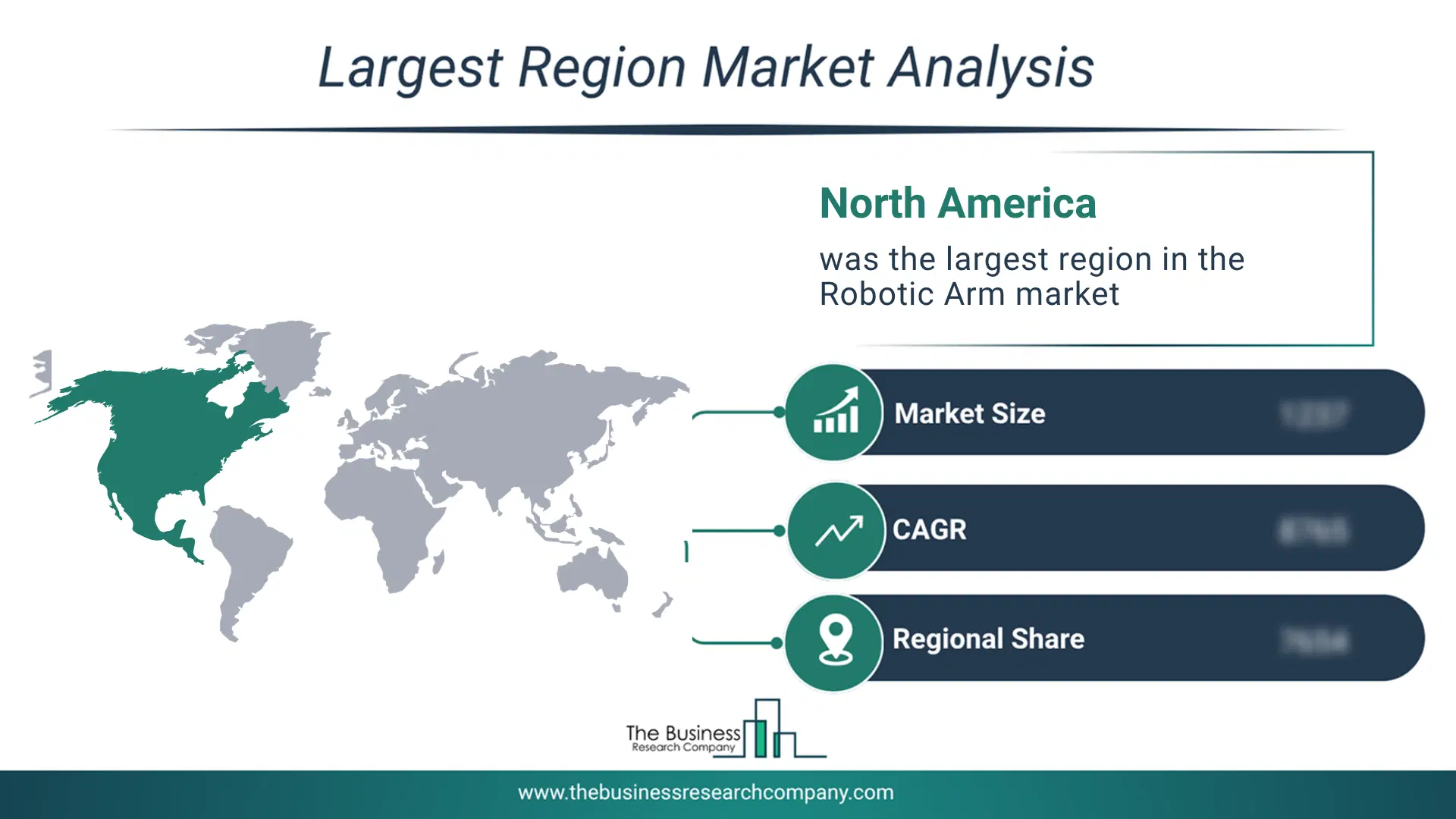
Regional Outlook
North America was the largest region in the robotic arm market in 2025. Asia-Pacific is expected to be the fastest growing region in the market going forward. The regions covered in this market report are Asia-Pacific, South East Asia, Western Europe, Eastern Europe, North America, South America, Middle East, Africa The countries covered in this market report are Australia, Brazil, China, France, Germany, India, Indonesia, Japan, Taiwan, Russia, South Korea, UK, USA, Canada, Italy, Spain.What Defines the Robotic Arm Market?
The robotic arm market consists of sales of hybrid robotic arms, mobile robotic arms, collaborative robotic arms, and parallel robotic arms. Values in this market are ‘factory gate’ values, that is, the value of goods sold by the manufacturers or creators of the goods, whether to other entities (including downstream manufacturers, wholesalers, distributors, and retailers) or directly to end customers. The value of goods in this market includes related services sold by the creators of the goods.How is Market Value Defined and Measured?
The market value is defined as the revenues that enterprises gain from the sale of goods and/or services within the specified market and geography through sales, grants, or donations in terms of the currency (in USD unless otherwise specified). The revenues for a specified geography are consumption values that are revenues generated by organizations in the specified geography within the market, irrespective of where they are produced. It does not include revenues from resales along the supply chain, either further along the supply chain or as part of other products.
This chart presents market attractiveness based on a quantitative evaluation of growth, competition, strategic alignment, and risk, offering a clear view of opportunity areas for decision-making. This chart is for illustrative purposes; the full report contains the complete analysis.

This chart highlights the Total Addressable Market (TAM) by estimating the maximum revenue opportunity using an assumption-driven approach, supporting strategic planning and opportunity sizing across markets. The chart is illustrative; the full report provides a more comprehensive analysis.
What Key Data and Analysis Are Included in the Robotic Arm Market Report 2026?
The robotic arm market research report is one of a series of new reports from The Business Research Company that provides market statistics, including industry global market size, regional shares, competitors with the market share, detailed market segments, market trends and opportunities, and any further data you may need to thrive in the robotic arm industry. The market research report delivers a complete perspective of everything you need, with an in-depth analysis of the current and future state of the industry.Robotic Arm Market Report Forecast Analysis
| Report Attribute | Details |
|---|---|
| Market Size Value In 2026 | $49.66 billion |
| Revenue Forecast In 2030 | $86.19 billion |
| Growth Rate | CAGR of 14.8% from 2026 to 2030 |
| Base Year For Estimation | 2025 |
| Actual Estimates/Historical Data | 2020-2025 |
| Forecast Period | 2026 - 2030 |
| Market Representation | Revenue in USD Billion and CAGR from 2026 to 2030 |
| Segments Covered | Type, Payload Capacity, Axis, Application, End-User Industry |
| Regional Scope | Asia-Pacific, Western Europe, Eastern Europe, North America, South America, Middle East, Africa |
| Key Companies Profiled | ABB Ltd., Mitsubishi Electric Corporation, FANUC America Corporation, Yaskawa Electric Corporation, KUKA AG, Kawasaki Heavy Industries Ltd., Nachi-Fujikoshi Corp., Stäubli International AG, Comau, Universal Robots A/S, DENSO WAVE INCORPORATED, Seiko Epson Corporation, Omron Corporation, Panasonic Corporation, Flexiv Robotics Inc., Franka Robotics GmbH, Dobot, Gridbots Technologies Private Limited, EVS Tech Co. LTD. |
| Customization Scope | Request for Customization |
| Pricing And Purchase Options | Explore Purchase Options |