
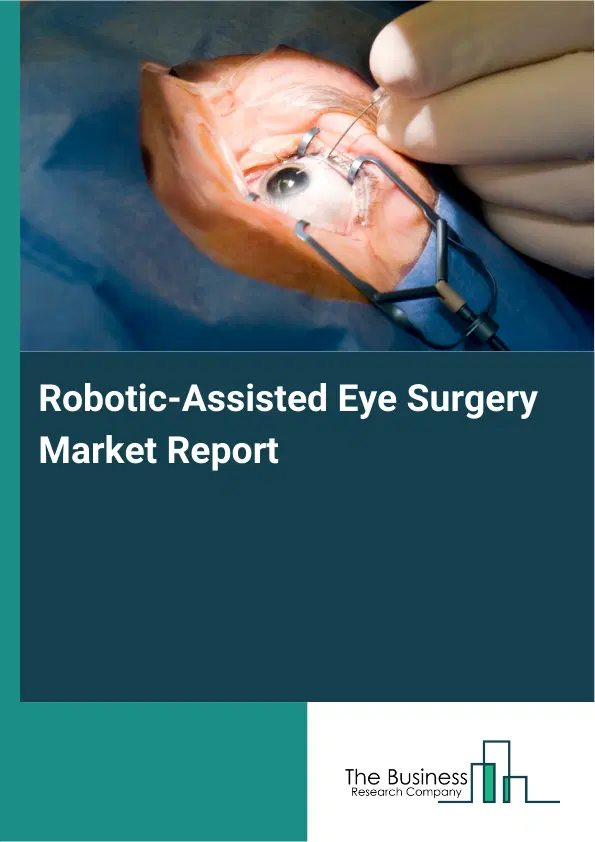
Robotic-Assisted Eye Surgery Market Report 2026
Global Outlook – By Type (Robotic Systems, Instruments And Accessories, Software And Services), By Surgery Type (Cataract Surgery, Retinal Surgery, Corneal Surgery, Glaucoma Surgery, Refractive Surgery, Other Surgery Types), By Technology (Telerobotics, Haptic Feedback Systems, Image-Guided Systems, Artificial Intelligent (AI)-Driven Robotic Systems, Other Technologies), By Application (Anterior Segment Procedures, Posterior Segment Procedures, Corneal Procedures, Other Applications), By End-User (Hospitals, Ambulatory Surgical Centers (ASCs), Specialized Eye Clinics, Research And Academic Institutes) – Market Size, Trends, Strategies, and Forecast to 2030
Robotic-Assisted Eye Surgery Market Overview
• Robotic-Assisted Eye Surgery market size has reached to $1.39 billion in 2025 • Expected to grow to $2.66 billion in 2030 at a compound annual growth rate (CAGR) of 13.7% • Growth Driver: Rising Prevalence Of Eye Disorders Fueling The Growth Of The Market Due To Increasing Demand For Precision Surgical Solutions • Market Trend: Technological Advancements In Robotic-Assisted Phacoemulsification Platform • North America was the largest region in 2025 and Asia-Pacific is the fastest growing region.What Is Covered Under Robotic-Assisted Eye Surgery Market?
Robotic-assisted eye surgery refers to a surgical procedure involving the use of robotic systems or robotic tools to assist ophthalmic surgeons in performing precise and minimally invasive eye surgeries. These systems enhance the surgeon’s capabilities by providing greater precision, stability, and control, especially for delicate and complex procedures involving the retina, cornea, or other ocular structures. The main types of robotic-assisted eye surgery include robotic systems, instruments and accessories, and software and services. Robotic systems refer to integrated combinations of mechanical components, sensors, control systems, and software designed to perform tasks automatically or semi-automatically, often with precision, consistency, and minimal human intervention. The multiple surgery types involved are cataract surgery, retinal surgery, corneal surgery, glaucoma surgery, refractive surgery, and others that use various technologies, including haptic feedback systems, image-guided systems, artificial intelligence (AI)-driven robotic systems, and others. The various applications include anterior segment procedures, posterior segment procedures, corneal procedures, and others and cater to several end users such as hospitals, ambulatory surgical centers (ASCs), specialized eye clinics, and research and academic institutes.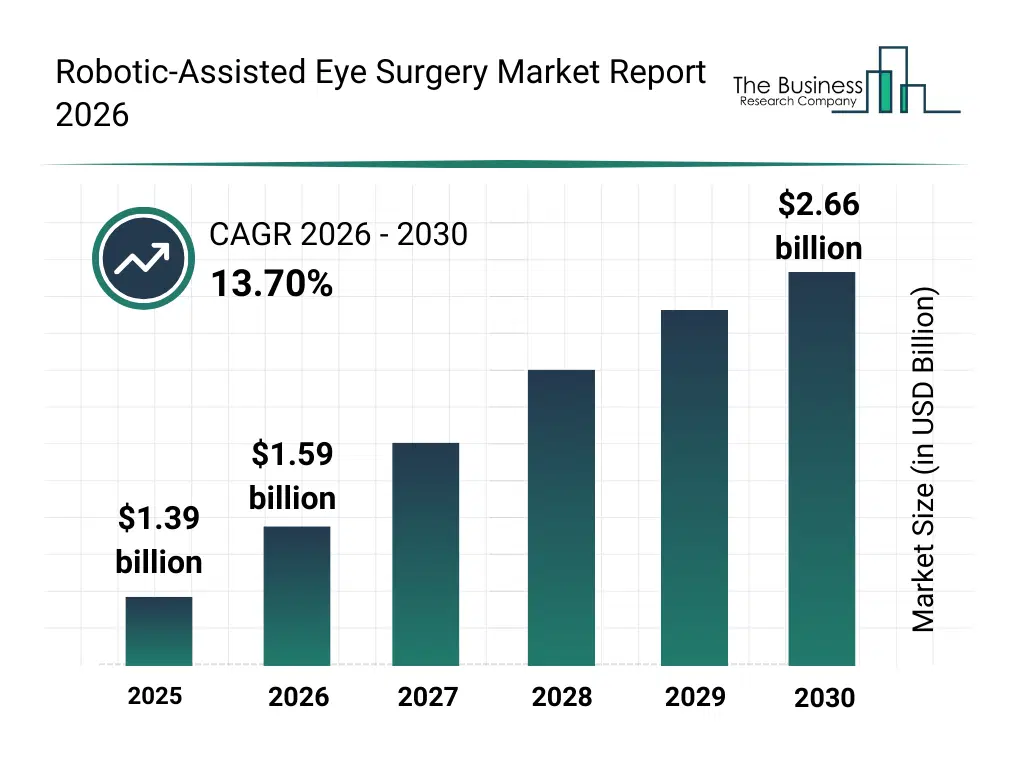
What Is The Robotic-Assisted Eye Surgery Market Size and Share 2026?
The robotic-assisted eye surgery market size has grown rapidly in recent years. It will grow from $1.39 billion in 2025 to $1.59 billion in 2026 at a compound annual growth rate (CAGR) of 14.4%. The growth in the historic period can be attributed to limitations of manual microsurgical techniques, increasing prevalence of cataract and retinal disorders, growth in specialized eye care centers, rising surgeon demand for enhanced precision tools, gradual adoption of computer-assisted ophthalmic systems.What Is The Robotic-Assisted Eye Surgery Market Growth Forecast?
The robotic-assisted eye surgery market size is expected to see rapid growth in the next few years. It will grow to $2.66 billion in 2030 at a compound annual growth rate (CAGR) of 13.7%. The growth in the forecast period can be attributed to advancements in AI-driven robotic systems, increasing aging population with eye disorders, expansion of ambulatory surgical centers, growing investments in ophthalmic robotics R&D, wider acceptance of robot-assisted procedures by surgeons. Major trends in the forecast period include rising adoption of minimally invasive ophthalmic procedures, increasing demand for high-precision and stable surgical outcomes, growing use of robotic assistance in complex retinal and corneal surgeries, expansion of training and skill enhancement programs for surgeons, higher focus on patient safety and reduced surgical variability.

Global Robotic-Assisted Eye Surgery Market Segmentation
1) By Type: Robotic Systems, Instruments And Accessories, Software And Services 2) By Surgery Type: Cataract Surgery, Retinal Surgery, Corneal Surgery, Glaucoma Surgery, Refractive Surgery, Other Surgery Types 3) By Technology: Telerobotics, Haptic Feedback Systems, Image-Guided Systems, Artificial Intelligent (AI)-Driven Robotic Systems, Other Technologies 4) By Application: Anterior Segment Procedures, Posterior Segment Procedures, Corneal Procedures, Other Applications 5) By End-User: Hospitals, Ambulatory Surgical Centers (ASCs), Specialized Eye Clinics, Research And Academic Institutes Subsegments: 1) By Robotic Systems: Fully Automated Systems, Semi-Automated Systems 2) By Instruments And Accessories: Surgical Instruments, Robotic Controllers, Visualization Systems 3) By Software And Services: Robotic Surgery Software, Maintenance And Upgrades, Training And SupportWhat Is The Driver Of The Robotic-Assisted Eye Surgery Market?
The increasing prevalence of eye disorders is expected to propel the growth of the robotic-assisted eye surgery market going forward. Eye disorders refer to medical conditions that affect the structure or function of the eye, potentially leading to vision problems or blindness. The rising prevalence of eye disorders is driven by increasing screen time, which leads to digital eye strain, dry eyes, and blurred vision due to prolonged exposure to screens without adequate breaks. Robot-assisted eye surgery helps address various eye disorders by enhancing surgical precision, reducing human error, and enabling minimally invasive procedures, which leads to improved patient outcomes and faster recovery times. For instance, in May 2024, according to the Centers for Disease Control and Prevention, a US-based government agency, 20.5 million people aged 40 and older in the United States, representing 17.2% of that age group, were expected to have cataracts in at least one eye in 2024. This number is projected to grow to over 30 million by 2028. Therefore, the increasing prevalence of eye disorders is driving the growth of the robotic-assisted eye surgery industry.Key Players In The Global Robotic-Assisted Eye Surgery Market
Major companies operating in the robotic-assisted eye surgery market are Johnson & Johnson, ZEISS Group, Alcon Inc., Intuitive Surgical Operations Inc., Bausch + Lomb Corp., Leica Microsystems, Lumenis Ltd., Topcon Healthcare, IRIDEX Corp., ForSight Robotics Ltd., Prasad Netralaya, Haag‑Streit Group, Nidek Co. Ltd., Ophthorobotics AG, Preceyes BV, Horizon Surgical Systems, AcuSurgical, LENSAR Inc., Ziemer Ophthalmic Systems AG, STAAR Surgical Company, Optovue, Glaukos Corporation, Eyenuk, AcuFocus, Avedro Inc., Aeon Astron Europe BV, Omega Ophthalmics
This chart is for illustrative purposes; the full report includes a detailed competitor analysis and comprehensive overview of the top 10 companies in the market.

This chart maps companies by product innovation and brand strength, with bubble size indicating relative revenue, helping identify market leaders, challengers, and niche players. This is an illustrative chart; the full report provides a complete and accurate competitive analysis.
Global Robotic-Assisted Eye Surgery Market Trends and Insights
Major companies operating in the robotic-assisted eye surgery market are focusing on developing advanced solutions, such as the robotic-assisted phacoemulsification platforms, to enhance surgical precision, reduce complication rates, and improve patient outcomes. A robotic-assisted phacoemulsification platform refers to a surgical system that uses robotic technology to assist doctors in performing cataract removal surgery more precisely. For instance, in May 2024, ForSight Robotics, an Israel-based provider of robotic surgery platforms, launched the ORYOM surgical robotics platform to perform a complete, remote robotic cataract procedure. The ORYOM surgical robotics platform is equipped with a miniature robotic hand featuring 14 degrees of freedom and hybrid kinematics, allowing for superior maneuverability inside the eye. It combines artificial intelligence, advanced imaging, and compact mechanical components to support accurate and consistent surgical performance. The use of stereoscopic imaging enhances depth perception and provides real-time visual feedback, helping surgeons achieve high precision. The platform also utilizes machine learning to adapt and improve its capabilities with each procedure performed.What Are Latest Mergers And Acquisitions In The Robotic-Assisted Eye Surgery Market?
In March 2025, Alcon Inc., a Switzerland-based provider of eye care products, acquired LENSAR Inc. for $430 million. Through this acquisition, Alcon aims to gain access to LENSAR’s advanced laser technology and surgical planning software to offer more precise, efficient, and integrated solutions in robotic-assisted cataract surgery. LENSAR Inc. is a US-based provider of robotic-assisted eye surgery.
Regional Outlook
North America was the largest region in the robotic-assisted eye surgery market in 2025. Asia-Pacific is expected to be the fastest-growing region in the forecast period. The regions covered in this market report are Asia-Pacific, South East Asia, Western Europe, Eastern Europe, North America, South America, Middle East, Africa. The countries covered in this market report are Australia, Brazil, China, France, Germany, India, Indonesia, Japan, Taiwan, Russia, South Korea, UK, USA, Canada, Italy, SpainWhat Defines the Robotic-Assisted Eye Surgery Market?
The robotic-assisted eye surgery market consists of revenues earned by entities by providing services such as training and support services, tele-surgical support services, data management, maintenance, upgrade services, and remote surgery assistance. The market value includes the value of related goods sold by the service provider or included within the service offering. The robotic-assisted eye surgery market also includes sales of wearable visualization devices, robotic-compatible surgical microscopes, microsurgical instruments, and navigation systems. Values in this market are ‘factory gate’ values, that is the value of goods sold by the manufacturers or creators of the goods, whether to other entities (including downstream manufacturers, wholesalers, distributors and retailers) or directly to end customers. The value of goods in this market includes related services sold by the creators of the goods.How is Market Value Defined and Measured?
The market value is defined as the revenues that enterprises gain from the sale of goods and/or services within the specified market and geography through sales, grants, or donations in terms of the currency (in USD unless otherwise specified). The revenues for a specified geography are consumption values that are revenues generated by organizations in the specified geography within the market, irrespective of where they are produced. It does not include revenues from resales along the supply chain, either further along the supply chain or as part of other products.
This chart presents market attractiveness based on a quantitative evaluation of growth, competition, strategic alignment, and risk, offering a clear view of opportunity areas for decision-making. This chart is for illustrative purposes; the full report contains the complete analysis.

This chart highlights the Total Addressable Market (TAM) by estimating the maximum revenue opportunity using an assumption-driven approach, supporting strategic planning and opportunity sizing across markets. The chart is illustrative; the full report provides a more comprehensive analysis.
What Key Data and Analysis Are Included in the Robotic-Assisted Eye Surgery Market Report 2026?
The robotic-assisted eye surgery market research report is one of a series of new reports from The Business Research Company that provides market statistics, including industry global market size, regional shares, competitors with the market share, detailed market segments, market trends and opportunities, and any further data you may need to thrive in the robotic-assisted eye surgery industry. The market research report delivers a complete perspective of everything you need, with an in-depth analysis of the current and future state of the industry.Robotic-Assisted Eye Surgery Market Report Forecast Analysis
| Report Attribute | Details |
|---|---|
| Market Size Value In 2026 | $1.59 billion |
| Revenue Forecast In 2030 | $2.66 billion |
| Growth Rate | CAGR of 13.7% from 2026 to 2030 |
| Base Year For Estimation | 2025 |
| Actual Estimates/Historical Data | 2020-2025 |
| Forecast Period | 2026 - 2030 |
| Market Representation | Revenue in USD Billion and CAGR from 2026 to 2030 |
| Segments Covered | Type, Surgery Type, Technology, Application, End-User |
| Regional Scope | Asia-Pacific, Western Europe, Eastern Europe, North America, South America, Middle East, Africa |
| Country Scope | The countries covered in the report are Australia, Brazil, China, France, Germany, India, Indonesia, Japan, Taiwan, Russia, South Korea, UK, USA, Canada, Italy, Spain. |
| Key Companies Profiled | Johnson & Johnson, ZEISS Group, Alcon Inc., Intuitive Surgical Operations Inc., Bausch + Lomb Corp., Leica Microsystems, Lumenis Ltd., Topcon Healthcare, IRIDEX Corp., ForSight Robotics Ltd., Prasad Netralaya, Haag‑Streit Group, Nidek Co. Ltd., Ophthorobotics AG, Preceyes BV, Horizon Surgical Systems, AcuSurgical, LENSAR Inc., Ziemer Ophthalmic Systems AG, STAAR Surgical Company, Optovue, Glaukos Corporation, Eyenuk, AcuFocus, Avedro Inc., Aeon Astron Europe BV, Omega Ophthalmics |
| Customization Scope | Request for Customization |
| Pricing And Purchase Options | Explore Purchase Options |