
Robotic Automated Meat Trimming Market Report 2026
Global Outlook – By Product (Beef Trimming Robots, Pork Trimming Robots, Poultry Trimming Robots, Other Products), By Automation Level (Fully Automated, Semi-Automated), By Distribution Channel (Direct Sales, Distributors, Other Distribution Channels), By Application (Slaughterhouses, Meat Processing Plants, Other Applications), By End-User (Large Enterprises (Small And Medium Enterprises) – Market Size, Trends, Strategies, and Forecast to 2030
Robotic Automated Meat Trimming Market Overview
• Robotic Automated Meat Trimming market size has reached to $1.78 billion in 2025 • Expected to grow to $3.17 billion in 2030 at a compound annual growth rate (CAGR) of 12.2% • Growth Driver: Rising Meat Consumption Driving Growth In The Market Due To Increasing Demand For Efficient And High-Quality Meat Processing • Market Trend: Technological Advancements Driving Efficiency And Quality In Meat Processing • North America was the largest region in 2025 and Asia-Pacific is the fastest growing region.What Is Covered Under Robotic Automated Meat Trimming Market?
Robotic automated meat trimming involves the use of robots and automated systems to cut and trim meat with high precision. It improves processing efficiency, ensures consistent product quality, reduces labor costs, and enhances hygiene and safety in meat processing operations. The main product types of robotic automated meat trimming are beef trimming robots, pork trimming robots, poultry trimming robots, and others. Beef trimming robots are automated systems that precisely trim and process beef carcasses to maximize yield, reduce waste, and improve efficiency. It can be both fully automated and semi-automated and is distributed through direct sales, distributors, and others. It is applied for slaughterhouses, meat processing plants, and others, with end-users including large enterprises and small and medium enterprises.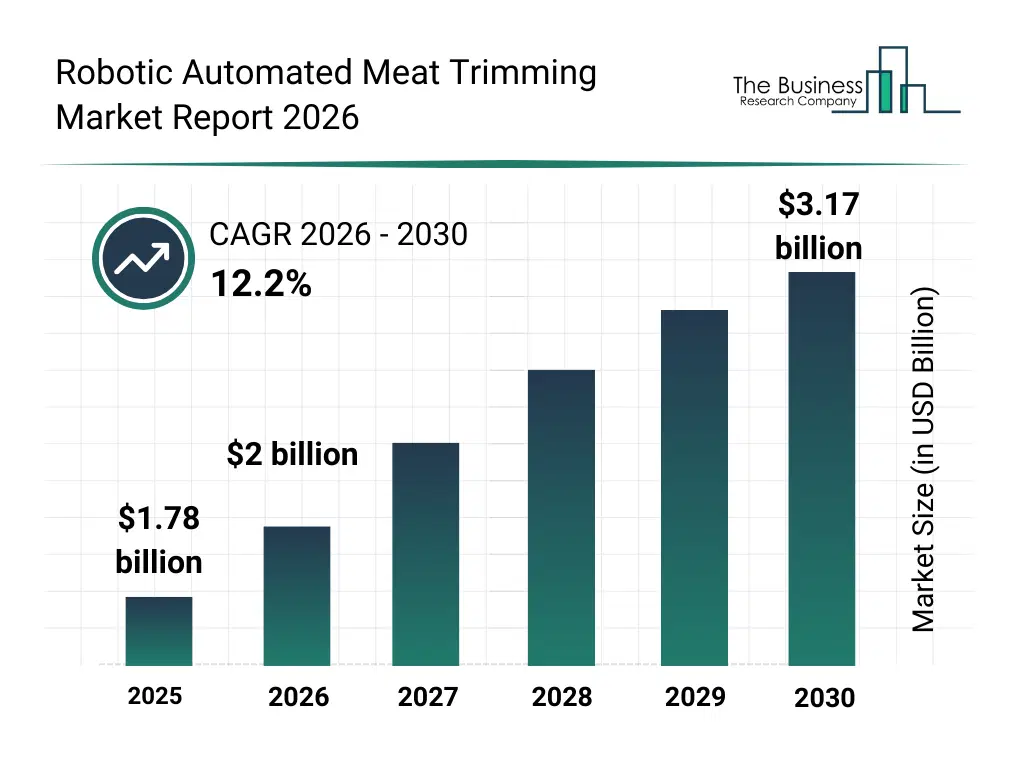
What Is The Robotic Automated Meat Trimming Market Size and Share 2026?
The robotic automated meat trimming market size has grown rapidly in recent years. It will grow from $1.78 billion in 2025 to $2 billion in 2026 at a compound annual growth rate (CAGR) of 12.4%. The growth in the historic period can be attributed to rising labor shortages in meat processing plants, increasing demand for processing efficiency, expansion of large-scale meat production facilities, stricter food safety regulations, early adoption of industrial robotics.What Is The Robotic Automated Meat Trimming Market Growth Forecast?
The robotic automated meat trimming market size is expected to see rapid growth in the next few years. It will grow to $3.17 billion in 2030 at a compound annual growth rate (CAGR) of 12.2%. The growth in the forecast period can be attributed to increasing investments in smart meat processing facilities, rising demand for consistent product quality, expansion of automation in protein processing, growing focus on worker safety and cost reduction, increasing adoption of data-driven processing systems. Major trends in the forecast period include increasing deployment of vision-guided trimming robots, rising adoption of fully automated meat processing lines, growing integration of ai-based quality detection systems, expansion of high-speed robotic cutting solutions, enhanced focus on hygiene and contamination control.
Global Robotic Automated Meat Trimming Market Segmentation
1) By Product: Beef Trimming Robots, Pork Trimming Robots, Poultry Trimming Robots, Other Products 2) By Automation Level: Fully Automated, Semi-Automated 3) By Distribution Channel: Direct Sales, Distributors, Other Distribution Channels 4) By Application: Slaughterhouses, Meat Processing Plants, Other Applications 5) By End-User: Large Enterprises: Small And Medium Enterprises Subsegments: 1) By Beef Trimming Robots: Brisket Trimming Robots, Ribeye Trimming Robots, Sirloin Trimming Robots, Chuck Trimming Robots, Round Trimming Robots 2) By Pork Trimming Robots: Ham Trimming Robots, Bacon Or Belly Trimming Robots, Shoulder Trimming Robots, Loin Trimming Robots, Ribs Trimming Robots 3) By Poultry Trimming Robots: Breast Trimming Robots, Wing Trimming Robots, Thigh Trimming Robots, Drumstick Trimming Robots, Whole Bird Trimming Robots 4) By Other Products: Lamb Trimming Robots, Fish Or Seafood Trimming Robots, Game Meat Trimming Robots, Multi-Species Trimming Robots, Customized Trimming RobotsWhat Are The Drivers Of The Robotic Automated Meat Trimming Market?
The increasing meat consumption is expected to propel the growth of the robotic automated meat trimming market going forward. Meat consumption refers to the amount of meat products eaten by individuals or populations as part of their diet. Rising meat consumption is largely fueled by higher incomes, allowing more people to include protein-rich foods such as meat in their daily meals. Higher meat consumption necessitates robotic automated meat trimming as automation enables efficient, precise, and hygienic processing of large meat volumes, ensuring producers can meet demand while maintaining consistent quality and safety standards. For instance, in March 2025, according to the Australian Bureau of Statistics, an Australia-based government agency, in the 2023–24 financial year, Australians consumed 2.3% more meat and poultry than in the previous year, averaging 145 grams per person per day. Therefore, the increasing meat consumption is driving the growth of the robotic automated meat trimming industry. The growing demand for automation is expected to propel the growth of the robotic automated meat trimming market going forward. Automation refers to the use of advanced control systems, robotics, and software to perform tasks with minimal human intervention. Automation is rising due to labor shortages, as companies increasingly rely on automated systems to maintain production efficiency despite limited workforce availability. Robotic automated meat trimming enables automation by performing precise, high-speed cutting tasks with minimal human input, improving productivity, consistency, and hygiene in meat processing operations. For instance, in September 2025, according to the International Federation of Robotics, a Germany-based non-profit research and industry association, the total number of industrial robots in operational use worldwide reached 4,664,000 units in 2024, reflecting a 9% increase compared with the previous year. Therefore, the growing demand for automation is driving the growth for the robotic automated meat trimming industry.Key Players In The Global Robotic Automated Meat Trimming Market
Major companies operating in the robotic automated meat trimming market are DENSO Robotics, ABB Ltd., Rockwell Automation Inc., FANUC Corporation, KUKA AG, Yaskawa Electric Corporation, Stäubli International AG, John Bean Technologies Corporation, Marel hf., Bizerba SE & Co. KG, BAADER Co., Meyn Food Processing Technology B.V., Reiser & Co., Scott Technology Limited, Bettcher Industries Inc., Mayekawa Mfg. Co. Ltd., EVS Intelligent Technologies, Marble Technologies Inc., Robots Done Right LLC, Soft Robotics Inc.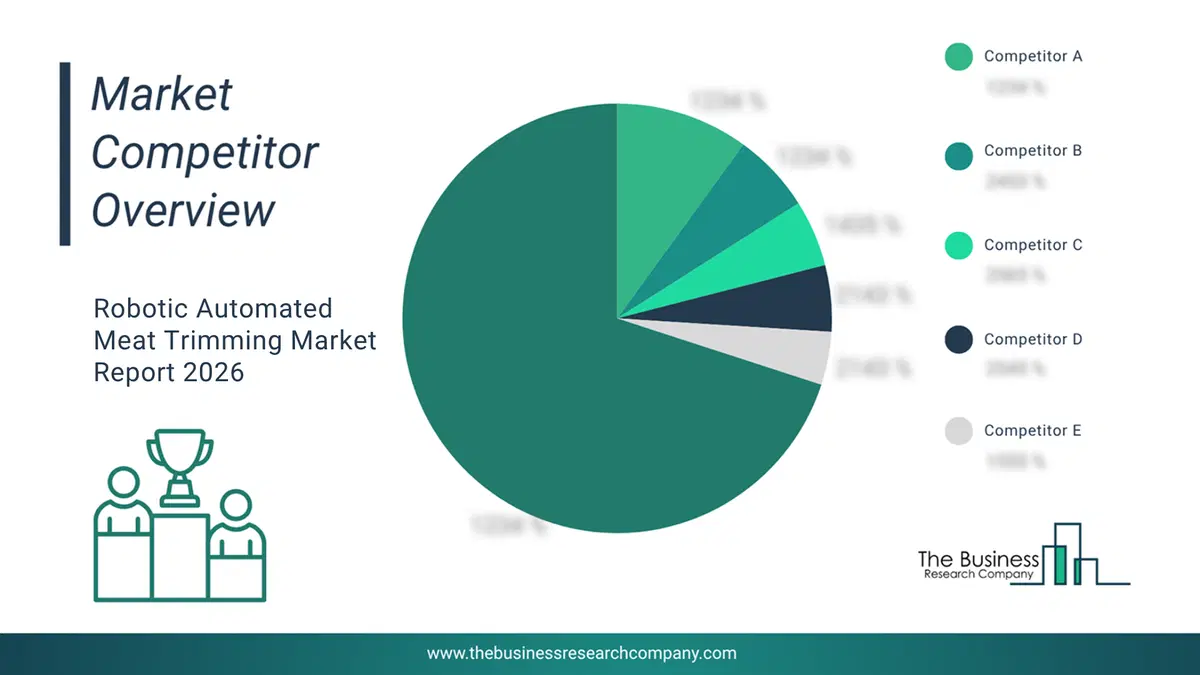
This chart is for illustrative purposes; the full report includes a detailed competitor analysis and comprehensive overview of the top 10 companies in the market.
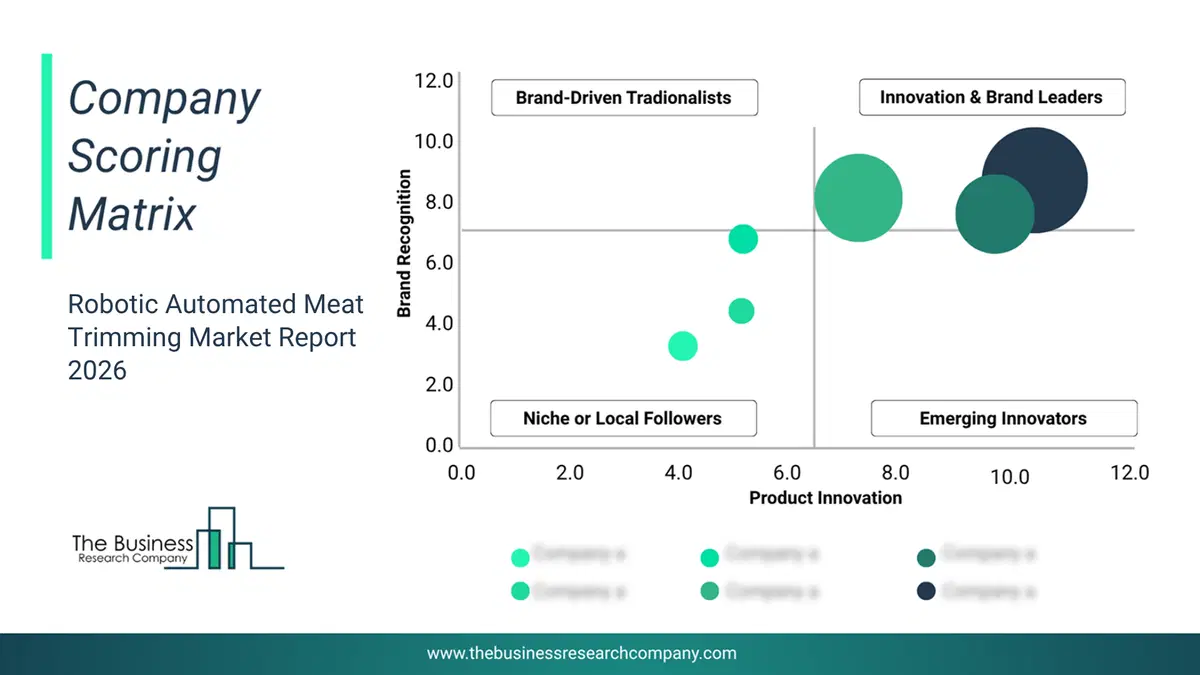
This chart maps companies by product innovation and brand strength, with bubble size indicating relative revenue, helping identify market leaders, challengers, and niche players. This is an illustrative chart; the full report provides a complete and accurate competitive analysis.
What Are Latest Mergers And Acquisitions In The Robotic Automated Meat Trimming Market?
Regional Outlook
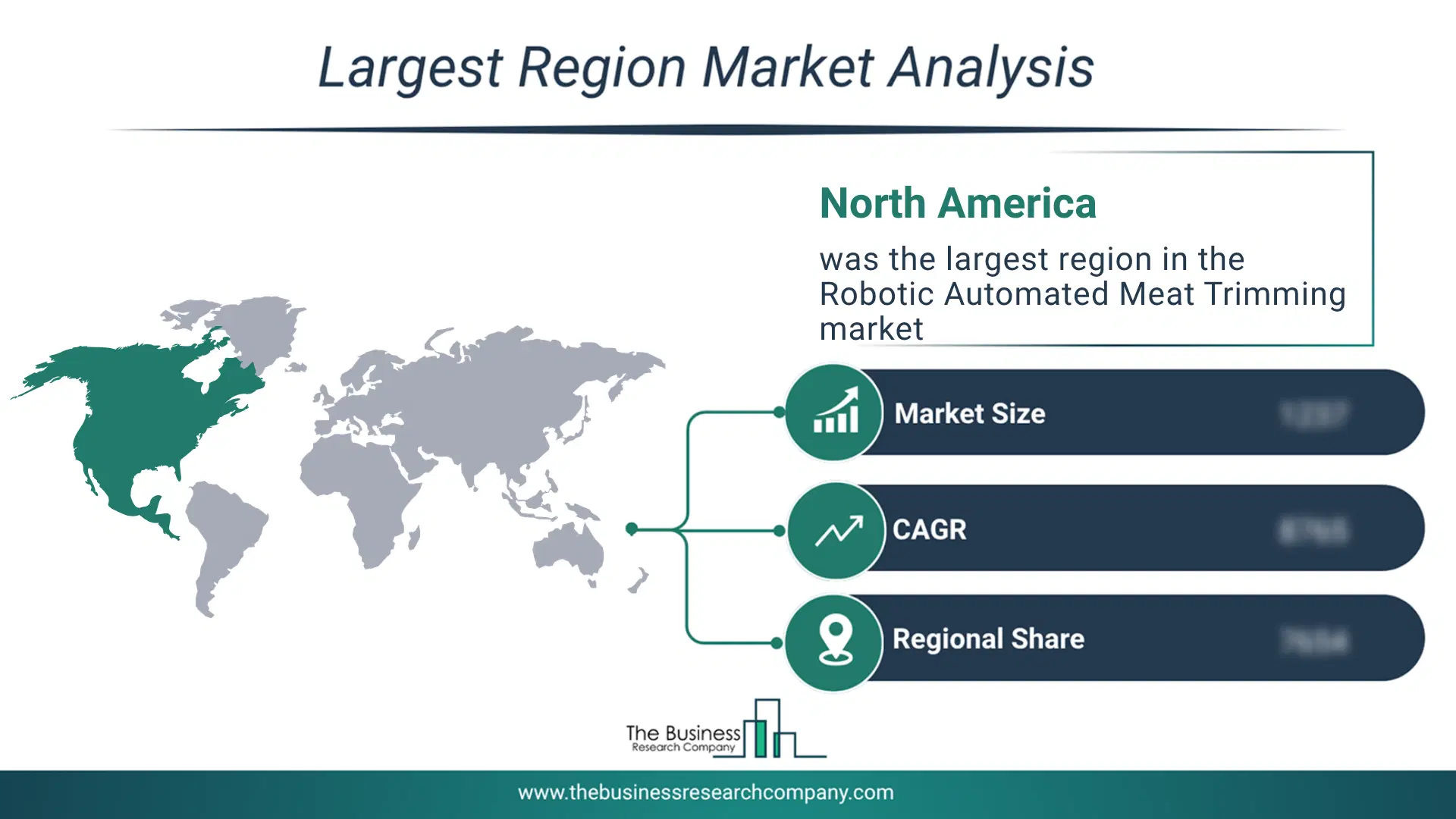
North America was the largest region in the robotic automated meat trimming market in 2025. Asia-Pacific is expected to be the fastest-growing region in the forecast period. The regions covered in this market report are Asia-Pacific, South East Asia, Western Europe, Eastern Europe, North America, South America, Middle East and Africa. The countries covered in this market report are Australia, Brazil, China, France, Germany, India, Indonesia, Japan, Taiwan, Russia, South Korea, UK, USA, Italy, Spain, CanadaWhat Defines the Robotic Automated Meat Trimming Market?
The robotic automated meat trimming market consists of sales of automated tendon and sinew removal robots, bone detection and separation robots, robotic meat portioning machines, precision meat slicing robots, and automated gristle removal machines. Values in this market are ‘factory gate’ values, that is, the value of goods sold by the manufacturers or creators of the goods, whether to other entities (including downstream manufacturers, wholesalers, distributors, and retailers) or directly to end customers. The value of goods in this market includes related services sold by the creators of the goods.How is Market Value Defined and Measured?
The market value is defined as the revenues that enterprises gain from the sale of goods and/or services within the specified market and geography through sales, grants, or donations in terms of the currency (in USD unless otherwise specified). The revenues for a specified geography are consumption values that are revenues generated by organizations in the specified geography within the market, irrespective of where they are produced. It does not include revenues from resales along the supply chain, either further along the supply chain or as part of other products.
This chart presents market attractiveness based on a quantitative evaluation of growth, competition, strategic alignment, and risk, offering a clear view of opportunity areas for decision-making. This chart is for illustrative purposes; the full report contains the complete analysis.

This chart highlights the Total Addressable Market (TAM) by estimating the maximum revenue opportunity using an assumption-driven approach, supporting strategic planning and opportunity sizing across markets. The chart is illustrative; the full report provides a more comprehensive analysis.
What Key Data and Analysis Are Included in the Robotic Automated Meat Trimming Market Report 2026?
The robotic automated meat trimming market research report is one of a series of new reports from The Business Research Company that provides market statistics, including industry global market size, regional shares, competitors with the market share, detailed market segments, market trends and opportunities, and any further data you may need to thrive in the robotic automated meat trimming industry. The market research report delivers a complete perspective of everything you need, with an in-depth analysis of the current and future state of the industry.Robotic Automated Meat Trimming Market Report Forecast Analysis
| Report Attribute | Details |
|---|---|
| Market Size Value In 2026 | $2 billion |
| Revenue Forecast In 2030 | $3.17 billion |
| Growth Rate | CAGR of 12.4% from 2026 to 2030 |
| Base Year For Estimation | 2025 |
| Actual Estimates/Historical Data | 2020-2025 |
| Forecast Period | 2026 - 2030 |
| Market Representation | Revenue in USD Billion and CAGR from 2026 to 2030 |
| Segments Covered | Product, Automation Level, Distribution Channel, Application, End-User |
| Regional Scope | Asia-Pacific, Western Europe, Eastern Europe, North America, South America, Middle East, Africa |
| Country Scope | The countries covered in the report are Australia, Brazil, China, France, Germany, India, Indonesia, Japan, Taiwan, Russia, South Korea, UK, USA, Canada, Italy, Spain. |
| Key Companies Profiled | DENSO Robotics, ABB Ltd., Rockwell Automation Inc., FANUC Corporation, KUKA AG, Yaskawa Electric Corporation, Stäubli International AG, John Bean Technologies Corporation, Marel hf., Bizerba SE & Co. KG, BAADER Co., Meyn Food Processing Technology B.V., Reiser & Co., Scott Technology Limited, Bettcher Industries Inc., Mayekawa Mfg. Co. Ltd., EVS Intelligent Technologies, Marble Technologies Inc., Robots Done Right LLC, Soft Robotics Inc. |
| Customization Scope | Request for Customization |
| Pricing And Purchase Options | Explore Purchase Options |