
Robotic Balance Training Systems Market Report 2026
Global Outlook – By Product Type (Treadmill-Based Systems, Platform-Based Systems, Wearable Systems, Others Product Types), By Technology (Sensor-Based, AI-Enabled, Virtual Reality Integrated, Others Technology), By Distribution Or Channel Type (Direct Sales, Distributor-Based Sales, Online Or Partner-Based Procurement Channels), By Application (Rehabilitation Centers, Hospitals And Clinics, Home Care Settings, Others Application), By End User (Hospitals, Physical Therapy Clinics, Sports Facilities, Home Care) – Market Size, Trends, Strategies, and Forecast to 2030
Robotic Balance Training Systems Market Overview
• Robotic Balance Training Systems market size has reached to $1.50 billion in 2025 • Expected to grow to $3.25 billion in 2030 at a compound annual growth rate (CAGR) of 16.7% • Growth Driver: Rising Prevalence Of Neurological Disorders Fueling The Growth Of The Market Due To The Need For Targeted Rehabilitation And Improved Motor Function Recovery • Market Trend: Advanced 3D Robotic Systems Enable Full-Range Mobility During Rehabilitation • North America was the largest region in 2025 and Asia-Pacific is the fastest growing region.What Is Covered Under Robotic Balance Training Systems Market?
Robotic balance training systems are advanced rehabilitation technologies that use robotic mechanisms and sensors to help individuals improve stability and coordination. They provide controlled, repetitive, and precise balance exercises that adapt to a user’s performance. These systems enhance training effectiveness by offering real-time feedback and measurable progress tracking. The main product types of robotic balance training systems are treadmill-based systems, platform-based systems, wearable systems, and others. Treadmill-based systems are robotic rehabilitation platforms designed to improve balance, coordination, and gait stability through controlled movement and feedback mechanisms. These systems are based on sensor-based, artificial intelligence-enabled, virtual reality integrated, and other technologies, distributed through direct sales, distributor-based sales, and online or partner-based procurement channels, used in rehabilitation centers, hospitals and clinics, home care settings, and others, among end users including hospitals, physical therapy clinics, sports facilities, and home care users.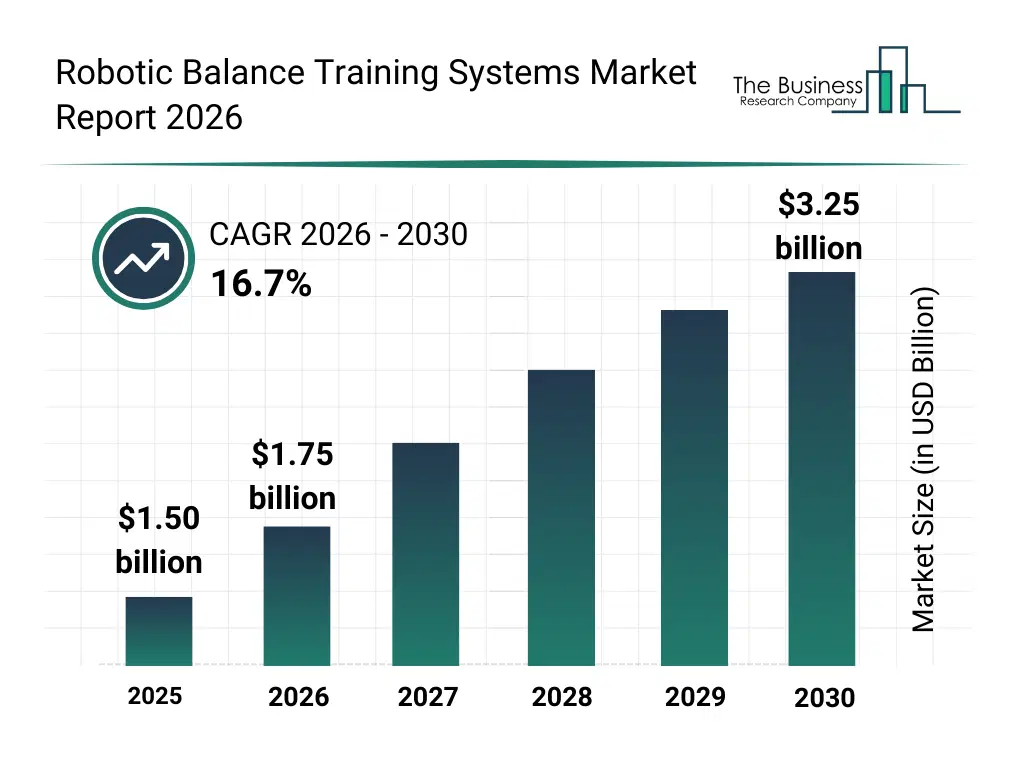
What Is The Robotic Balance Training Systems Market Size and Share 2026?
The robotic balance training systems market size has grown rapidly in recent years. It will grow from $1.50 billion in 2025 to $1.75 billion in 2026 at a compound annual growth rate (CAGR) of 17.0%. The growth in the historic period can be attributed to increasing prevalence of balance and mobility disorders, growing adoption of robotic rehabilitation technologies, rising demand for measurable therapy outcomes, expanding rehabilitation infrastructure investments, increasing focus on fall-prevention programs.What Is The Robotic Balance Training Systems Market Growth Forecast?
The robotic balance training systems market size is expected to see rapid growth in the next few years. It will grow to $3.25 billion in 2030 at a compound annual growth rate (CAGR) of 16.7%. The growth in the forecast period can be attributed to growing aging population worldwide, rising adoption of AI-enabled rehabilitation systems, increasing integration of robotics in clinical workflows, expanding availability of service and support ecosystems, growing demand for advanced post-acute rehabilitation solutions. Major trends in the forecast period include advancements in AI-driven adaptive training algorithms, innovations in vr and AR-based immersive rehabilitation, developments in multi-sensor fusion technologies, research and development in compact robotic system design, advancements in cloud-connected rehabilitation platforms.
Global Robotic Balance Training Systems Market Segmentation
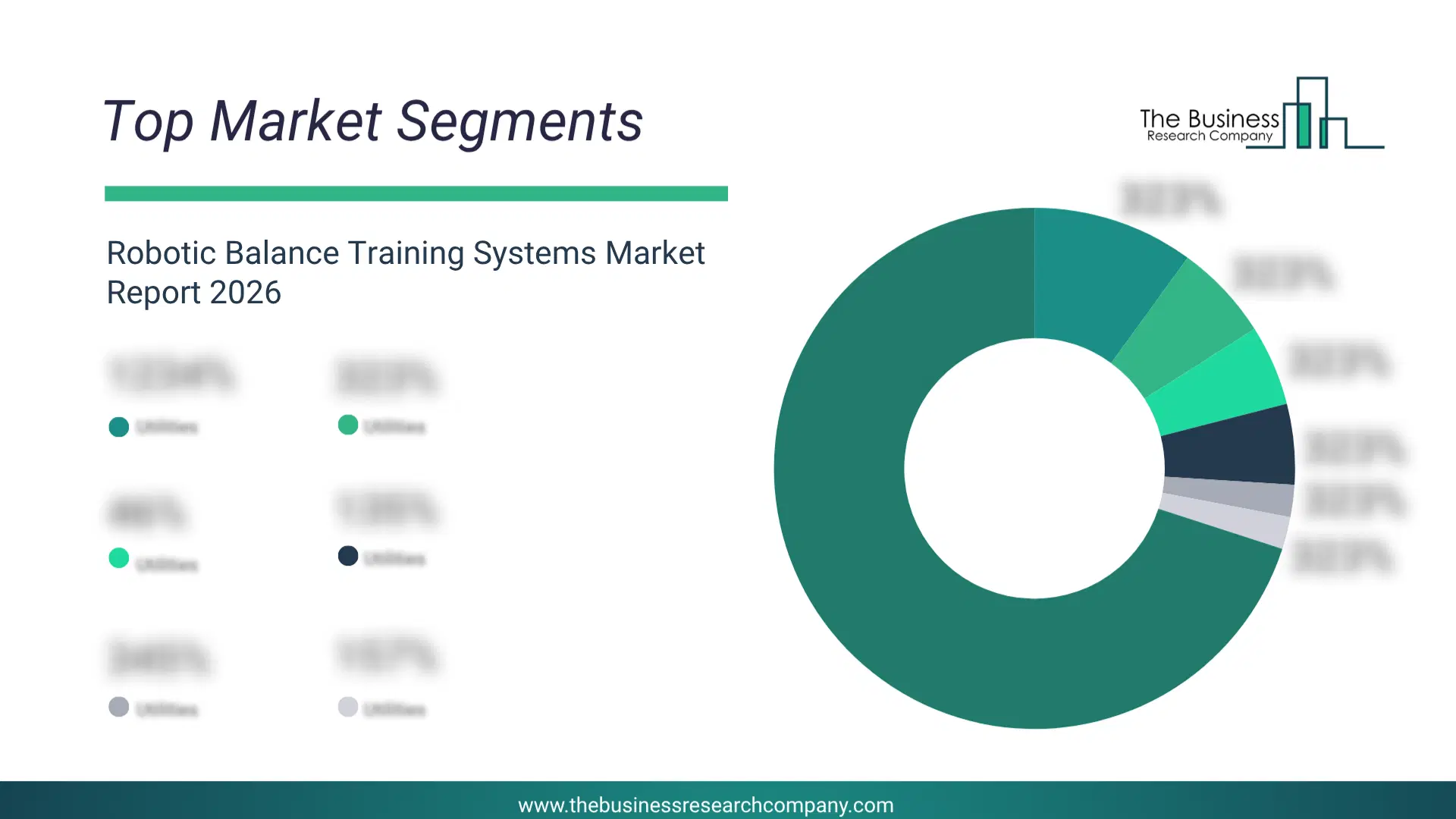
1) By Product Type: Treadmill-Based Systems, Platform-Based Systems, Wearable Systems, Others Product Types 2) By Technology: Sensor-Based, AI-Enabled, Virtual Reality Integrated, Others Technology 3) By Distribution Or Channel Type: Direct Sales, Distributor-Based Sales, Online Or Partner-Based Procurement Channels 4) By Application: Rehabilitation Centers, Hospitals And Clinics, Home Care Settings, Others Application 5) By End User: Hospitals, Physical Therapy Clinics, Sports Facilities, Home Care Subsegments: 1) By Treadmill-Based Systems: Body Weight Support Treadmill, Fixed Speed Treadmill, Adjustable Speed Treadmill, Split Belt Treadmill 2) By Platform-Based Systems: Static Platform Systems, Dynamic Platform Systems, Force Plate Systems, Multi-Axis Balance Platforms 3) By Wearable Systems: Lower Limb Exoskeleton, Full Body Exoskeleton, Ankle And Foot Orthosis, Hip And Knee Support Devices 4) By Other Product Types: Robotic Walker Systems, Hybrid Balance Training Devices, Multi-Modal Rehabilitation Devices, Assistive Balance RobotsWhat Is The Driver Of The Robotic Balance Training Systems Market?
The increasing prevalence of neurological disorders is expected to propel the growth of the robotic balance training systems market going forward. Neurological disorders are medical conditions that affect the brain, spinal cord, and nerves, disrupting normal nervous system function and leading to impairments in movement, cognition, sensation, behavior, or overall bodily control. The increasing prevalence of neurological disorders is due to unhealthy lifestyle habits, including poor diet, physical inactivity, smoking, excessive alcohol consumption, and chronic stress. Robotic balance training systems help in neurological disorder management by providing guided, repetitive, and controlled exercises to improve stability, coordination, and motor function. They enhance patient recovery by supporting neuroplasticity, reducing fall risk, and accelerating rehabilitation outcomes. For instance, in June 2025, according to Brain Research UK, a United Kingdom-based neurological charity, the prevalence of neurological conditions increased from 10.5?million people in 2024 to an estimated 11?million in 2025, marking a 4.8?% rise year over year. Therefore, the rising demand for targeted CNS drug delivery is driving the growth of the robotic balance training systems industry.Key Players In The Global Robotic Balance Training Systems Market
Major companies operating in the robotic balance training systems market are Yaskawa Electric Corporation, Fourier Intelligence Co. Ltd., Reha Technology AG, Stereotaxis Inc., Cyberdyne Inc., Genrobotics Medical & Mobility Co. Ltd., Neofect Co. Ltd., Ekso Bionics Holdings Inc., Tyromotion GmbH, ReWalk Robotics Ltd., Bertec Corporation, DIH Medical Group, Rex Bionics Ltd., Bionik Laboratories Corp., Aretech LLC, Kinestica d.o.o., Shenzhen Milebot Robotics Co. Ltd., Guangzhou Yikang Medical Equipment Co. Ltd., Balance International Innovations GmbH, Motorika USA Inc.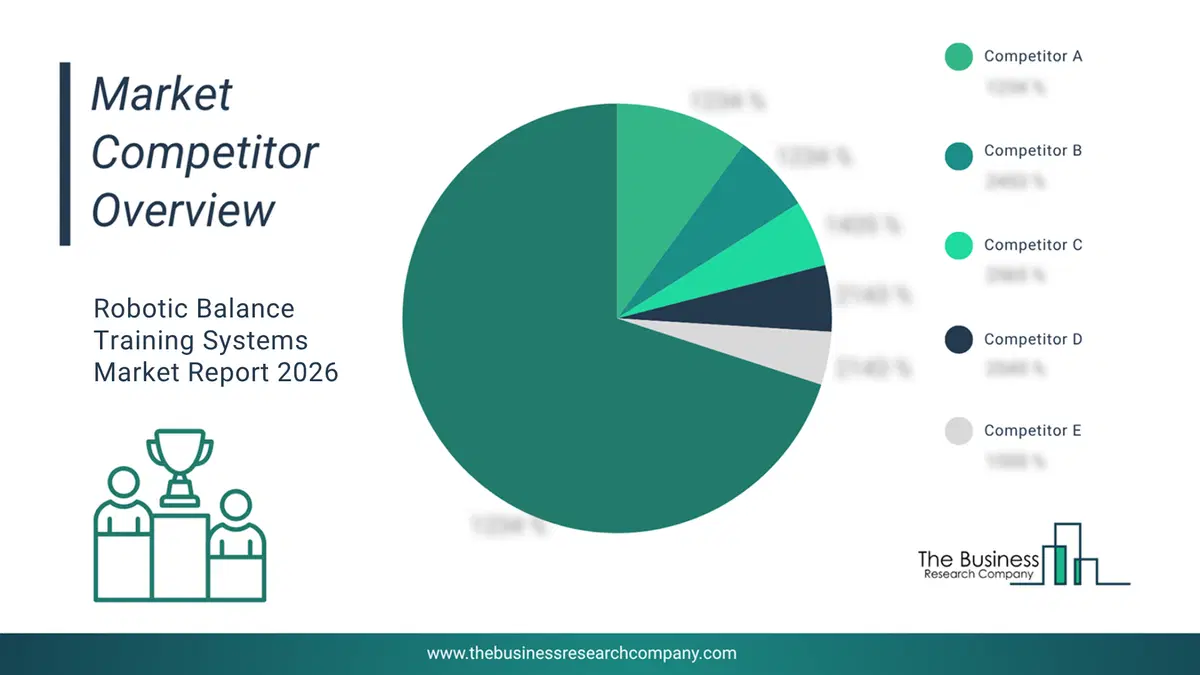
This chart is for illustrative purposes; the full report includes a detailed competitor analysis and comprehensive overview of the top 10 companies in the market.
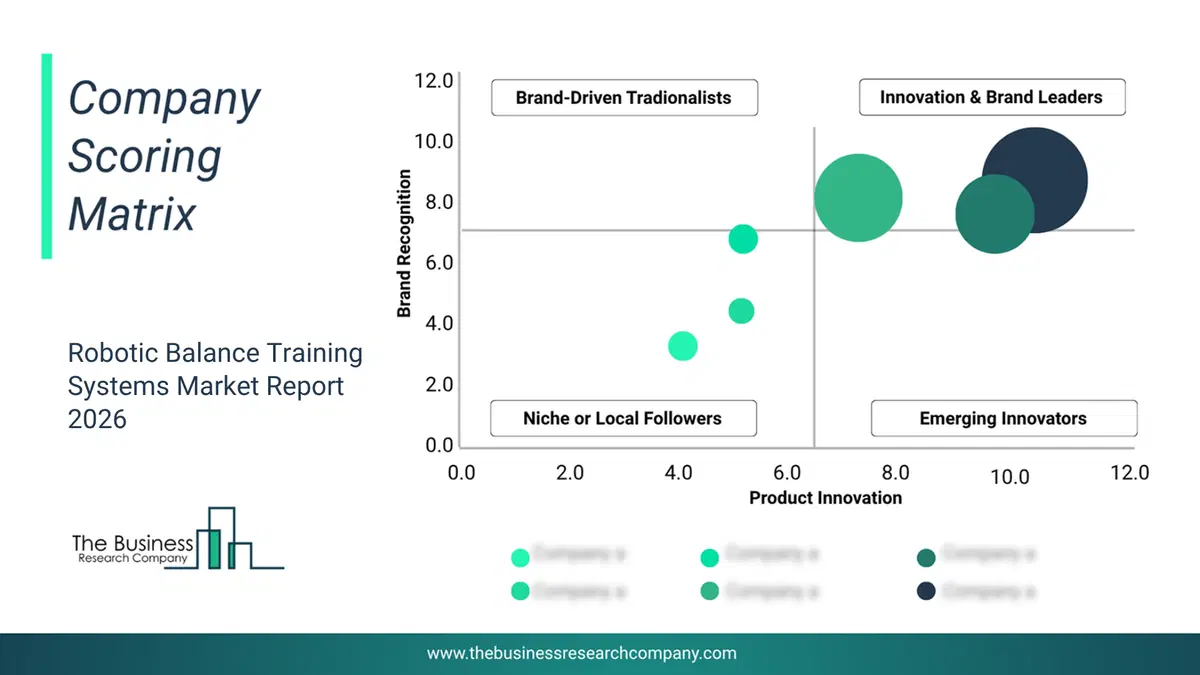
This chart maps companies by product innovation and brand strength, with bubble size indicating relative revenue, helping identify market leaders, challengers, and niche players. This is an illustrative chart; the full report provides a complete and accurate competitive analysis.
Global Robotic Balance Training Systems Market Trends and Insights
Major companies operating in the robotic balance training systems market are focusing on developing advanced robotic systems, such as 3D robotic body-weight support systems, to provide unrestricted mobility during rehabilitation exercises. 3D Robotic Body-Weight Support Systems refer to rehabilitation devices that assist patients in walking or performing motor exercises by partially supporting their body weight in three dimensions. For instance, in March 2023, Aretech LLC, a US-based developer of advanced rehabilitation technologies, introduced ZeroG 3D. The platform is designed to support patients up to 450 pounds while allowing free movement in any direction, incorporating customizable boundaries and multi-directional tracking. The solution also provides dynamic body-weight support of up to 200 pounds and adaptable workspaces for training on treadmills or stairs, accelerating the effectiveness of gait and balance therapy in clinical settings.What Are Latest Mergers And Acquisitions In The Robotic Balance Training Systems Market?
In June 2024, Ekso Bionics Holdings Inc., a US-based exoskeleton technology company, announced a research partnership with Shepherd Center to co-develop research and training protocols that advance exoskeleton use from hospital to home for people with mobility impairments. With this partnership, Ekso Bionics sought to expand the use of its EksoNR and Ekso Indego devices in clinical and community settings by co-designing research and training programs that establish best practices for robotic rehabilitation. Shepherd Center is a US-based not-for-profit hospital specializing in medical treatment, research, and rehabilitation for people with neuromuscular conditions.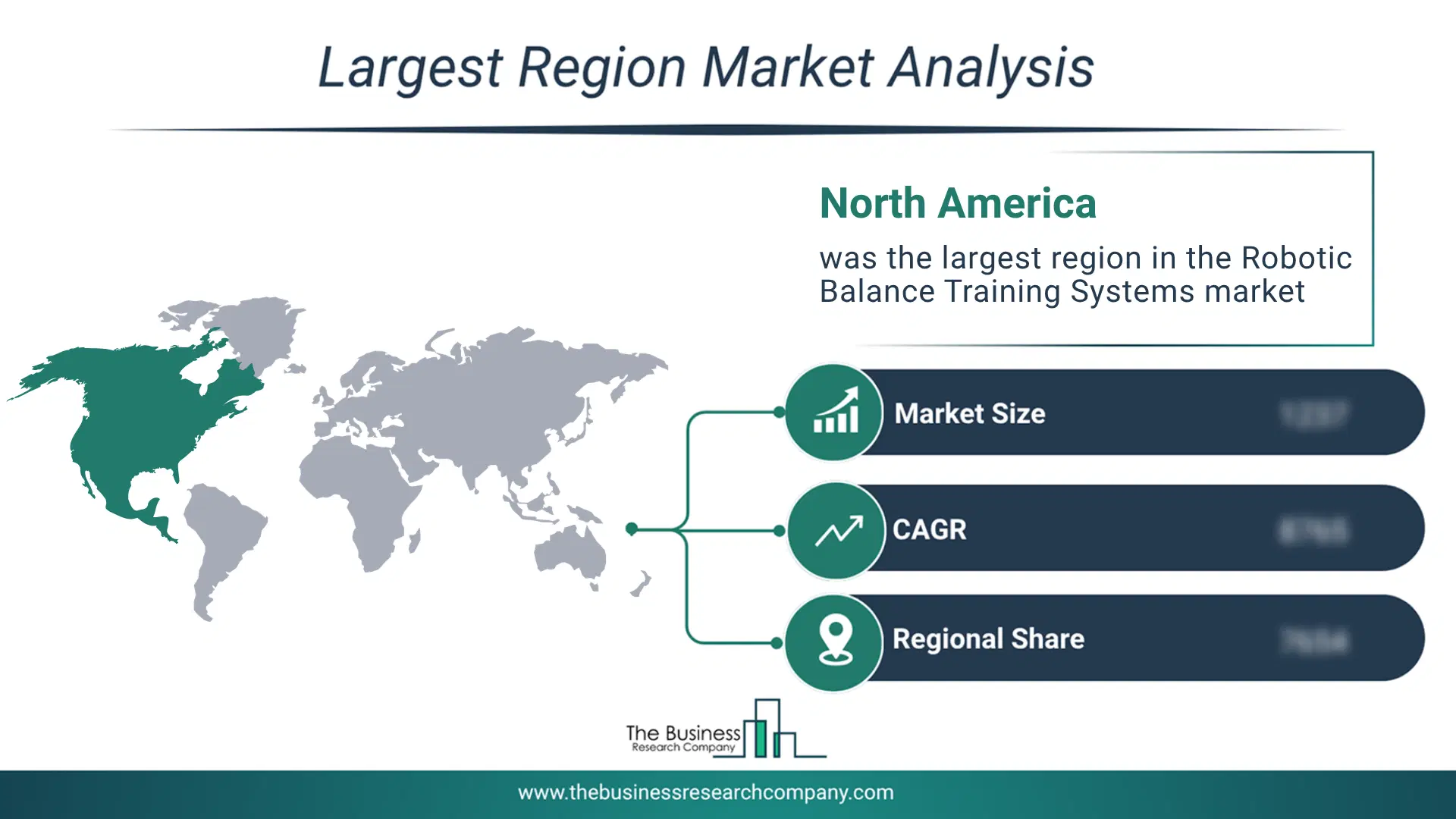
Regional Insights
North America was the largest region in the robotic balance training systems market in 2025. Asia-Pacific is expected to be the fastest-growing region in the forecast period. The regions covered in this market report are Asia-Pacific, South East Asia, Western Europe, Eastern Europe, North America, South America, Middle East, Africa. The countries covered in this market report are Australia, Brazil, China, France, Germany, India, Indonesia, Japan, Taiwan, Russia, South Korea, UK, USA, Canada, Italy, Spain.What Defines the Robotic Balance Training Systems Market?
The robotic balance training systems market consist of sales of robotic-assisted balance training platforms, sensor-equipped rehabilitation robots, postural control and gait training systems, balance assessment devices, and integrated software for therapy customization and progress monitoring. Values in this market are ‘factory gate’ values, that is, the value of goods sold by the manufacturers or creators of the goods, whether to other entities (including downstream manufacturers, wholesalers, distributors, and retailers) or directly to end customers. The value of goods in this market includes related services sold by the creators of the goods.How is Market Value Defined and Measured?
The market value is defined as the revenues that enterprises gain from the sale of goods and/or services within the specified market and geography through sales, grants, or donations in terms of the currency (in USD unless otherwise specified). The revenues for a specified geography are consumption values that are revenues generated by organizations in the specified geography within the market, irrespective of where they are produced. It does not include revenues from resales along the supply chain, either further along the supply chain or as part of other products.
This chart presents market attractiveness based on a quantitative evaluation of growth, competition, strategic alignment, and risk, offering a clear view of opportunity areas for decision-making. This chart is for illustrative purposes; the full report contains the complete analysis.

This chart highlights the Total Addressable Market (TAM) by estimating the maximum revenue opportunity using an assumption-driven approach, supporting strategic planning and opportunity sizing across markets. The chart is illustrative; the full report provides a more comprehensive analysis.
What Key Data and Analysis Are Included in the Robotic Balance Training Systems Market Report 2026?
The robotic balance training systems market research report is one of a series of new reports from The Business Research Company that provides market statistics, including industry global market size, regional shares, competitors with the market share, detailed market segments, market trends and opportunities, and any further data you may need to thrive in the robotic balance training systems industry. The market research report delivers a complete perspective of everything you need, with an in-depth analysis of the current and future state of the industry.Robotic Balance Training Systems Market Report Forecast Analysis
| Report Attribute | Details |
|---|---|
| Market Size Value In 2026 | $1.75 billion |
| Revenue Forecast In 2030 | $3.25 billion |
| Growth Rate | CAGR of 16.7% from 2026 to 2030 |
| Base Year For Estimation | 2025 |
| Actual Estimates/Historical Data | 2020-2025 |
| Forecast Period | 2026 - 2030 |
| Market Representation | Revenue in USD Billion and CAGR from 2026 to 2030 |
| Segments Covered | Product Type, Technology, Distribution Or Channel Type, Application, End User |
| Regional Scope | Asia-Pacific, Western Europe, Eastern Europe, North America, South America, Middle East, Africa |
| Country Scope | The countries covered in the report are Australia, Brazil, China, France, Germany, India, Indonesia, Japan, Taiwan, Russia, South Korea, UK, USA, Canada, Italy, Spain. |
| Key Companies Profiled | Yaskawa Electric Corporation, Fourier Intelligence Co. Ltd., Reha Technology AG, Stereotaxis Inc., Cyberdyne Inc., Genrobotics Medical & Mobility Co. Ltd., Neofect Co. Ltd., Ekso Bionics Holdings Inc., Tyromotion GmbH, ReWalk Robotics Ltd., Bertec Corporation, DIH Medical Group, Rex Bionics Ltd., Bionik Laboratories Corp., Aretech LLC, Kinestica d.o.o., Shenzhen Milebot Robotics Co. Ltd., Guangzhou Yikang Medical Equipment Co. Ltd., Balance International Innovations GmbH, Motorika USA Inc. |
| Customization Scope | Request for Customization |
| Pricing And Purchase Options | Explore Purchase Options |