
Robotic Cable Harnesses Market Report 2026
Global Outlook – By Product Type (Flexible Cable Harnesses, Rigid Cable Harnesses, Custom Cable Harnesses, Standard Cable Harnesses ), By Material (Copper, Aluminum, Fiber Optic, Hybrid, Other Materials ), By Distribution Channel (Direct Sales, Distributors, Online Sales, Other Distribution Channels ), By Application (Industrial Robots, Medical Robots, Service Robots, Collaborative Robots, Other Applications ), By End-Use Industry (Automotive, Electronics, Healthcare, Aerospace And Defense, Manufacturing, Other End-Use Industries ) – Market Size, Trends, Strategies, and Forecast to 2030
Robotic Cable Harnesses Market Overview
• Robotic Cable Harnesses market size has reached to $2.25 billion in 2025 • Expected to grow to $3.59 billion in 2030 at a compound annual growth rate (CAGR) of 9.8% • Growth Driver: Surge In Adoption Of Industrial Automation Fueling The Growth Of The Market Due To Rising Demand For Reliable Power And Signal Transmission In Automated Systems • Market Trend: Launch Of Advanced High-Performance Robotic Cable System For Industrial Automation • Asia-Pacific was the largest region and fastest growing region.What Is Covered Under Robotic Cable Harnesses Market?
Robotic cable harnesses are specialized assemblies of electrical wires, connectors, and protective coverings designed to transmit power, control signals, and data within robotic systems. They are engineered to endure continuous movement, vibration, torsion, and demanding industrial conditions while maintaining reliable electrical performance and signal integrity. Robotic cable harnesses improve operational safety, minimize cable wear and failure risks, and ensure organized and efficient internal wiring in robotic and automated equipment. The main product types of robotic cable harnesses include flexible cable harnesses, rigid cable harnesses, custom cable harnesses, and standard cable harnesses. Flexible cable harnesses are designed to withstand continuous movement and bending, making them suitable for dynamic robotic applications. The various materials used include copper, aluminum, fiber optic, and hybrid and the distribution channels are categorized into direct sales, distributors, and online sales. The various applications involved are industrial robots, medical robots, service robots, collaborative robots, and other applications, and they are used by several end users such as automotive, electronics, healthcare, aerospace and defense, manufacturing, and other end-use industries.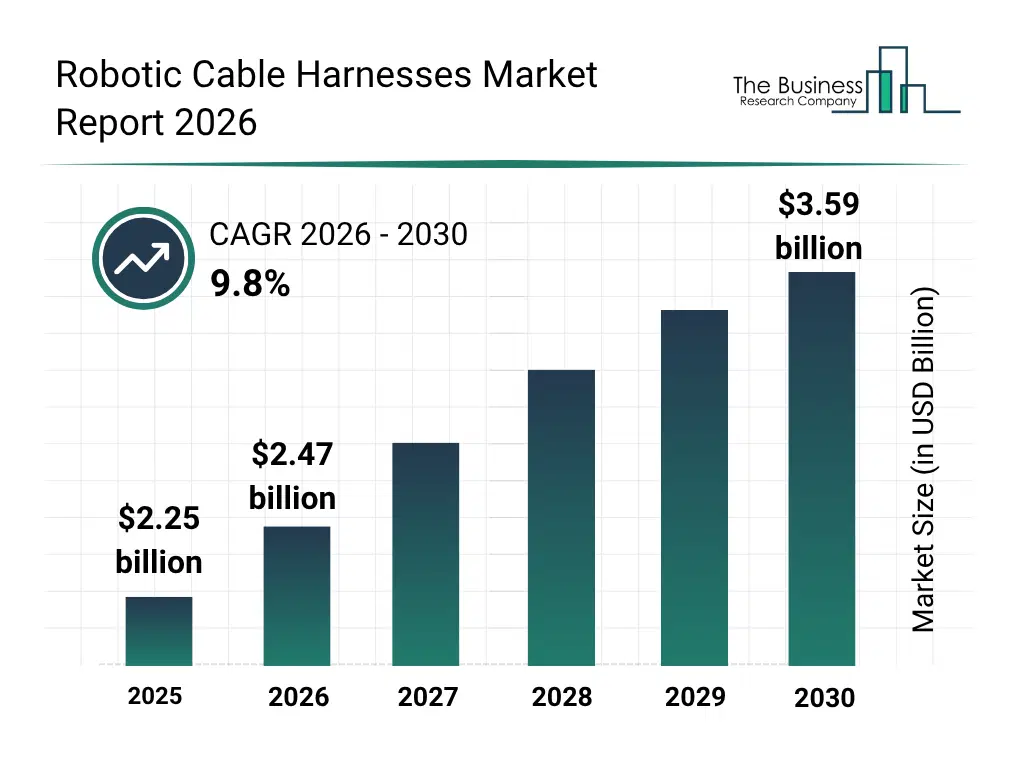
What Is The Robotic Cable Harnesses Market Size and Share 2026?
The robotic cable harnesses market size has grown strongly in recent years. It will grow from $2.25 billion in 2025 to $2.47 billion in 2026 at a compound annual growth rate (CAGR) of 9.6%. The growth in the historic period can be attributed to increasing industrial automation, growing adoption of robotic systems in manufacturing, rising demand in automotive robotics, expansion of aerospace and defense robotics, need for durable cable management solutions.What Is The Robotic Cable Harnesses Market Growth Forecast?
The robotic cable harnesses market size is expected to see strong growth in the next few years. It will grow to $3.59 billion by 2030 at a compound annual growth rate (CAGR) of 9.8%. The growth in the forecast period can be attributed to growing deployment of collaborative robots, rising integration of medical and service robots, increasing use of fiber optic and hybrid cables, expansion of electronics and healthcare robotics applications, rising demand for high-temperature and high-voltage harnesses. Major trends in the forecast period include increasing demand for high-flexibility cable harnesses, rising adoption of shielded and armored harnesses for industrial safety, growing use of custom cable harnesses for application-specific needs, expansion of fiber optic and hybrid material harnesses, rising focus on reliable signal integrity in continuous motion environments.
Global Robotic Cable Harnesses Market Segmentation
1) By Product Type: Flexible Cable Harnesses, Rigid Cable Harnesses, Custom Cable Harnesses, Standard Cable Harnesses 2) By Material: Copper, Aluminum, Fiber Optic, Hybrid, Other Materials 3) By Distribution Channel: Direct Sales, Distributors, Online Sales, Other Distribution Channels 4) By Application: Industrial Robots, Medical Robots, Service Robots, Collaborative Robots, Other Applications 5) By End-Use Industry: Automotive, Electronics, Healthcare, Aerospace And Defense, Manufacturing, Other End-Use Industries Subsegments: 1) By Flexible Cable Harnesses: Single Core Flexible Harness, Multi Core Flexible Harness, Shielded Flexible Harness, High Temperature Flexible Harness 2) By Rigid Cable Harnesses: Single Core Rigid Harness, Multi Core Rigid Harness, Armored Rigid Harness, High Voltage Rigid Harness 3) By Custom Cable Harnesses: Tailored Length Harness, Special Connector Harness, Hybrid Material Harness, Application Specific Harness 4) By Standard Cable Harnesses: Predefined Length Harness, Standard Connector Harness, Modular Harness, General Purpose HarnessWhat Are The Drivers Of The Robotic Cable Harnesses Market?
The increasing adoption of industrial automation is expected to propel the growth of the robotic cable harnesses forward. Industrial automation refers to the use of control systems, machinery, and information technologies to operate industrial processes with minimal human intervention, improving efficiency, productivity, and safety. The increasing adoption of industrial automation is driven by the need for higher operational efficiency, as it reduces manual intervention, minimizes errors, and enhances production speed and consistency across manufacturing processes. Robotic cable harnesses support the adoption of industrial automation by ensuring reliable power and signal transmission within automated systems, reducing downtime, enhancing precision in robotic movements, and enabling seamless integration of sensors, controllers, and robotic arms across complex manufacturing environments. For instance, in April 2024, according to the International Federation of Robotics, a Germany-based non-profit organization, in 2023, manufacturing saw a 12% rise in industrial robot installations, totaling 44,303 units. Therefore, increasing adoption of industrial automation is driving the growth of the robotic cable harnesses industry. The growing vehicle production is expected to propel the growth of the robotic cable harnesses market going forward. Vehicle production refers to the manufacturing of automobiles and commercial vehicles by automakers across global production facilities. The rise in vehicle production is largely driven by the recovery of global automotive supply chains following pandemic-era disruptions, enabling manufacturers to scale up output steadily and meet pent-up consumer demand. This surge in vehicle production directly increases the demand for robotic cable harnesses, as each vehicle requires complex wiring systems that are efficiently assembled using robotic automation. For instance, in March 2024, according to the International Organization of Motor Vehicle Manufacturers (OICA), a France-based international trade association representing the world's automobile manufacturers, global motor vehicle production rose from 85,016,728 units in 2022 to 93,546,599 units in 2023, reflecting an increase of approximately 8.5 million vehicles. Therefore, rising vehicle production is driving the growth of the robotic cable harnesses industry.Key Players In The Global Robotic Cable Harnesses Market
Major companies operating in the robotic cable harnesses market are Sumitomo Electric Industries Ltd., Aptiv PLC, Prysmian Group, TE Connectivity Ltd., Yazaki Corporation, Amphenol Corporation, Samvardhana Motherson International Ltd., Nexans S.A., Furukawa Electric Co. Ltd., Phoenix Contact GmbH & Co. KG, Samtec Inc., BizLink Holding Inc., Lapp Group, HUBER+SUHNER AG, HELUKABEL GmbH, Axon Cable S.A.S., OurPCB Tech Ltd., Epec Engineered Technologies, igus GmbH, WellPCB, Meridian Cable Assemblies, JEM Electronics Inc., Custom Wire Industries Inc., QL Custom Technology Co. Ltd., Cloom Tech Co. Ltd.
This chart is for illustrative purposes; the full report includes a detailed competitor analysis and comprehensive overview of the top 10 companies in the market.
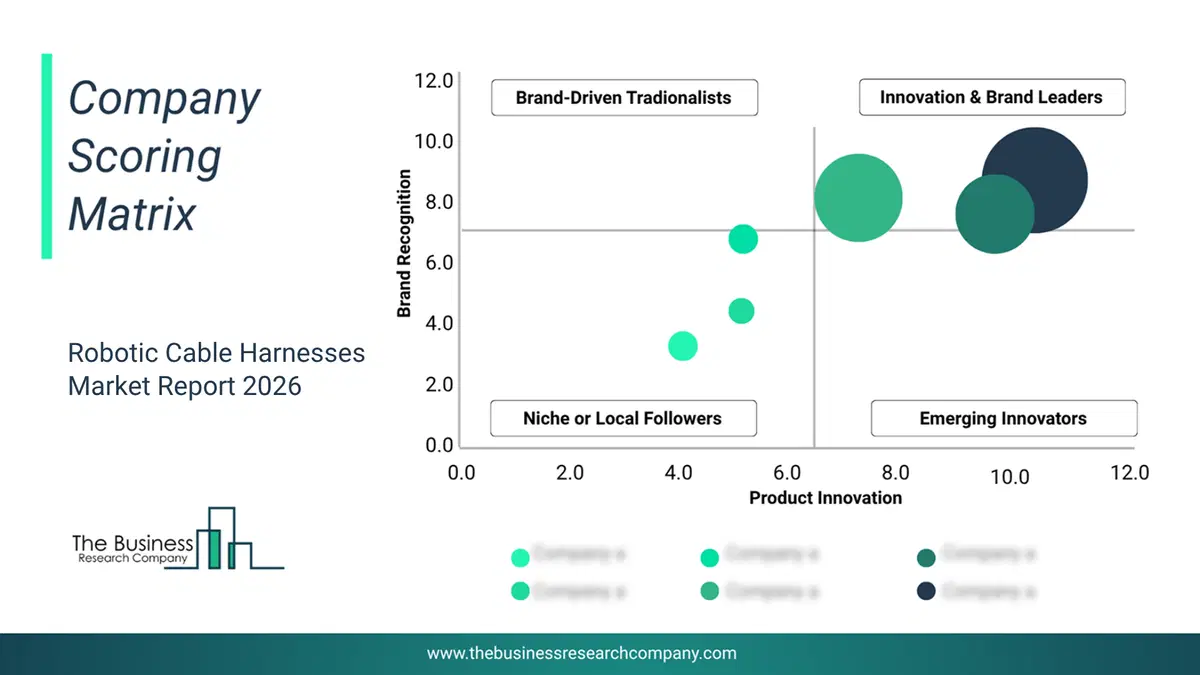
This chart maps companies by product innovation and brand strength, with bubble size indicating relative revenue, helping identify market leaders, challengers, and niche players. This is an illustrative chart; the full report provides a complete and accurate competitive analysis.
Global Robotic Cable Harnesses Market Trends and Insights
Major companies operating in the robotic cable harnesses market are focusing on developing advanced solutions, such as high-performance robotic cable, to enhance durability, improve signal reliability, and support high-speed automated operations in industrial environments. High-performance robotic cables refer to specially engineered cable systems designed to withstand continuous torsion, bending, and mechanical stress in robotic applications, ensuring stable power transmission and data connectivity in dynamic automation settings. For instance, in January 2026, Robotics Cable Assembly, a US-based automation cable manufacturer, introduced a new line of high-precision robotic cable assemblies engineered for complex robotic systems in automotive and electronics manufacturing. It is designed to assist system integrators and industrial automation providers and features enhanced abrasion resistance, electromagnetic interference shielding, oil and chemical resistance, and extended flex life performance, enabling improved operational efficiency, reduced downtime, and reliable performance in high-performance robotic applications.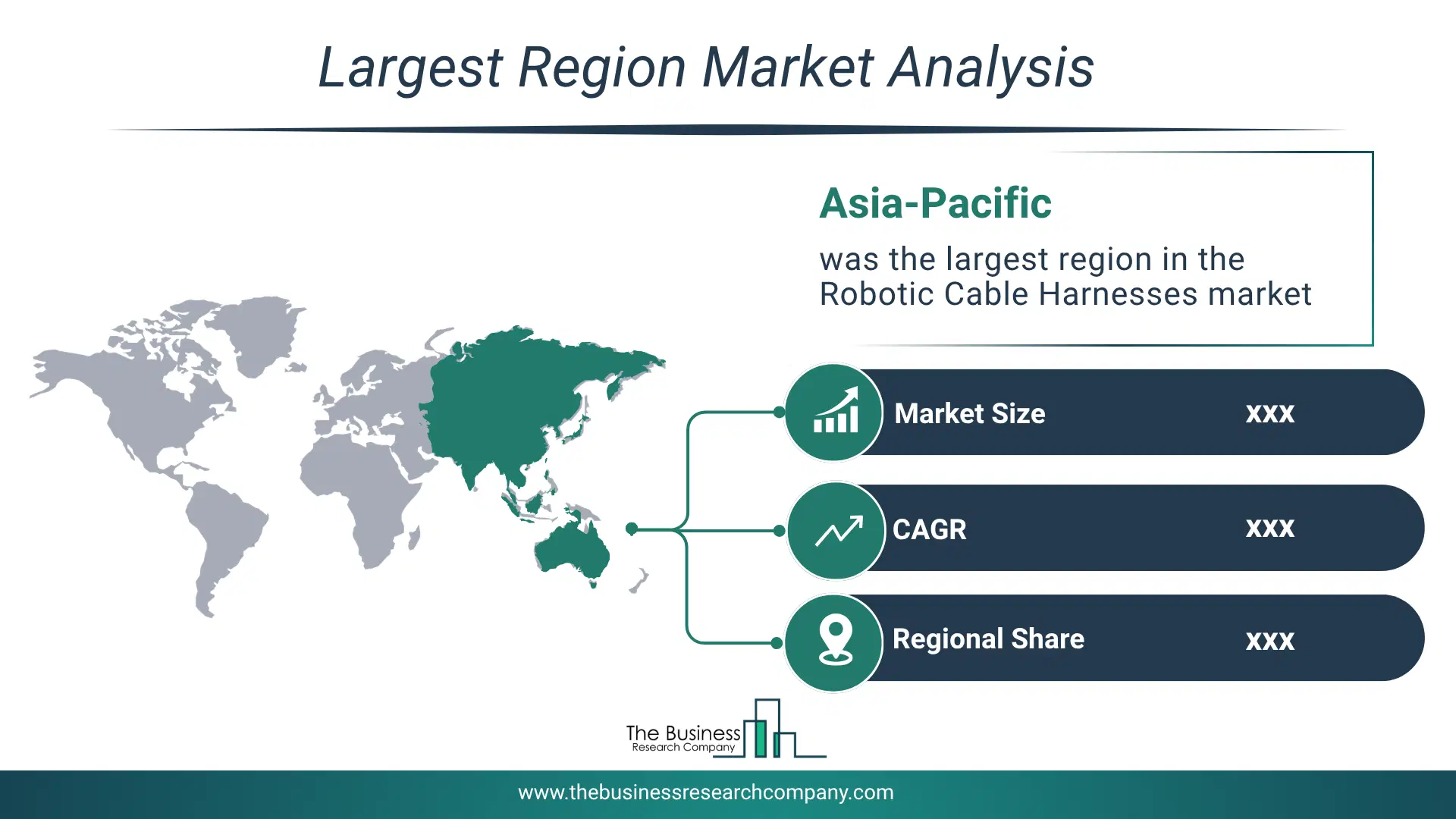
Regional Insights
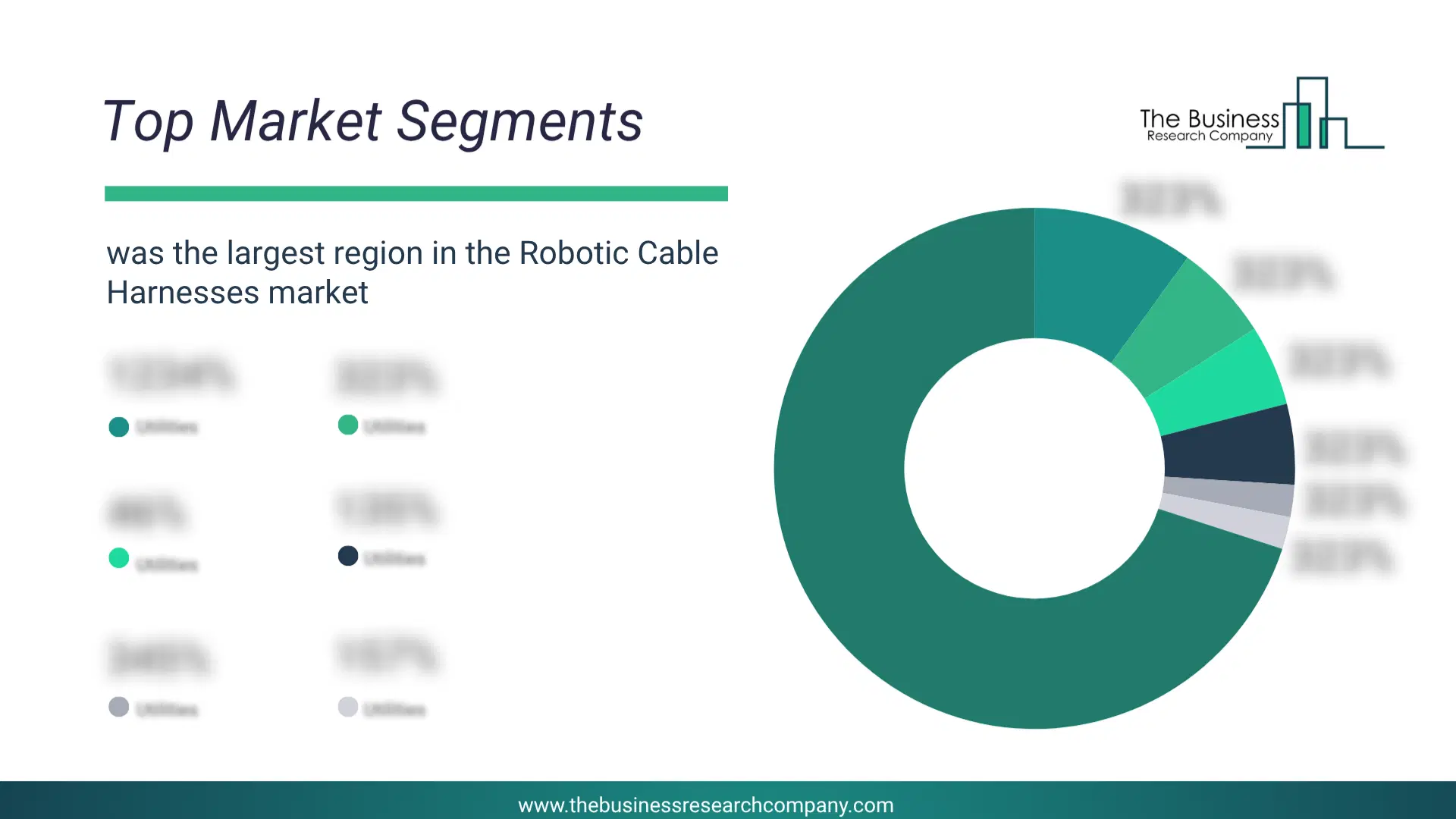
Asia-Pacific was the largest region in the robotic cable harnesses market in 2025. Asia-Pacific is expected to be the fastest-growing region in the forecast period. The regions covered in this market report are Asia-Pacific, South East Asia, Western Europe, Eastern Europe, North America, South America, Middle East, Africa. The countries covered in this market report are Australia, Brazil, China, France, Germany, India, Indonesia, Japan, Taiwan, Russia, South Korea, UK, USA, Canada, Italy, Spain.What Defines the Robotic Cable Harnesses Market?
The robotic cable harnesses market consists of sales of high-flex cable harnesses, torsion-resistant cable harnesses, shielded signal cable harnesses, and hybrid power and data cable harnesses. Values in this market are ‘factory gate’ values, that is, the value of goods sold by the manufacturers or creators of the goods, whether to other entities (including downstream manufacturers, wholesalers, distributors, and retailers) or directly to end customers. The value of goods in this market includes related services sold by the creators of the goods.How is Market Value Defined and Measured?
The market value is defined as the revenues that enterprises gain from the sale of goods and/or services within the specified market and geography through sales, grants, or donations in terms of the currency (in USD unless otherwise specified). The revenues for a specified geography are consumption values that are revenues generated by organizations in the specified geography within the market, irrespective of where they are produced. It does not include revenues from resales along the supply chain, either further along the supply chain or as part of other products.
This chart presents market attractiveness based on a quantitative evaluation of growth, competition, strategic alignment, and risk, offering a clear view of opportunity areas for decision-making. This chart is for illustrative purposes; the full report contains the complete analysis.

This chart highlights the Total Addressable Market (TAM) by estimating the maximum revenue opportunity using an assumption-driven approach, supporting strategic planning and opportunity sizing across markets. The chart is illustrative; the full report provides a more comprehensive analysis.
What Key Data and Analysis Are Included in the Robotic Cable Harnesses Market Report 2026?
The robotic cable harnesses market research report is one of a series of new reports from The Business Research Company that provides market statistics, including industry global market size, regional shares, competitors with the market share, detailed market segments, market trends and opportunities, and any further data you may need to thrive in the robotic cable harnesses industry. The market research report delivers a complete perspective of everything you need, with an in-depth analysis of the current and future state of the industry.Robotic Cable Harnesses Market Report Forecast Analysis
| Report Attribute | Details |
|---|---|
| Market Size Value In 2026 | $2.47 billion |
| Revenue Forecast In 2030 | $3.59 billion |
| Growth Rate | CAGR of 9.6% from 2026 to 2030 |
| Base Year For Estimation | 2025 |
| Actual Estimates/Historical Data | 2020-2025 |
| Forecast Period | 2026 - 2030 |
| Market Representation | Revenue in USD Billion and CAGR from 2026 to 2030 |
| Segments Covered | Product Type, Material, Distribution Channel, Application, End-Use Industry |
| Regional Scope | Asia-Pacific, Western Europe, Eastern Europe, North America, South America, Middle East, Africa |
| Country Scope | The countries covered in the report are Australia, Brazil, China, France, Germany, India, Indonesia, Japan, Taiwan, Russia, South Korea, UK, USA, Canada, Italy, Spain. |
| Key Companies Profiled | Sumitomo Electric Industries Ltd., Aptiv PLC, Prysmian Group, TE Connectivity Ltd., Yazaki Corporation, Amphenol Corporation, Samvardhana Motherson International Ltd., Nexans S.A., Furukawa Electric Co. Ltd., Phoenix Contact GmbH & Co. KG, Samtec Inc., BizLink Holding Inc., Lapp Group, HUBER+SUHNER AG, HELUKABEL GmbH, Axon Cable S.A.S., OurPCB Tech Ltd., Epec Engineered Technologies, igus GmbH, WellPCB, Meridian Cable Assemblies, JEM Electronics Inc., Custom Wire Industries Inc., QL Custom Technology Co. Ltd., Cloom Tech Co. Ltd. |
| Customization Scope | Request for Customization |
| Pricing And Purchase Options | Explore Purchase Options |