
Robotic Catheter System Market Report 2026
Global Outlook – By Product Type (Ablation Catheter Systems, Mapping Catheter Systems, Navigation Catheter Systems, Steerable Catheters, Other Robotic Catheter Systems), By System Type (Multi Speciality Systems, Single Speciality Systems), By Technology (Electromechanical Systems, Magnetic Guided Systems, Fully Automated Systems, Semi Automated Systems), By Application (Cardiology, Electrophysiology, Neurovascular Procedures, Peripheral Vascular Procedures, Urology, Gastroenterology), By End Users (Hospitals, Catheterization Laboratories, Ambulatory Surgical Centers, Specialty Clinics, Research And Academic Institutes) – Market Size, Trends, Strategies, and Forecast to 2030
Robotic Catheter System Market Overview
• Robotic Catheter System market size has reached to $0.9 billion in 2025 • Expected to grow to $1.75 billion in 2030 at a compound annual growth rate (CAGR) of 14.3% • Growth Driver: Rising Prevalence Of Cardiovascular Diseases Fueling The Growth Of The Market Due To Increasing Demand For Precision-guided Minimally Invasive Cardiac Procedures • North America was the largest region in 2025 and Asia-Pacific is the fastest growing region.What Is Covered Under Robotic Catheter System Market?
A robotic catheter system is a medical technology that uses robotic control to assist physicians in navigating and positioning catheters inside the body during minimally invasive procedures. It improves precision, stability, and control compared to manual catheter manipulation. These systems are commonly used in cardiovascular, neurovascular, and electrophysiology interventions. They help reduce radiation exposure for clinicians and improve patient safety and procedural accuracy. The main product types of robotic catheter system include ablation catheter systems, mapping catheter systems, navigation catheter systems, steerable catheters, and other robotic catheter systems. Ablation catheter systems refer to robotic-assisted catheter platforms designed to deliver targeted energy for treating abnormal heart rhythms and related conditions. These systems are categorized by system type including multi speciality systems and single speciality systems, and use technologies such as electromechanical systems, magnetic guided systems, fully automated systems, and semi automated systems. They find application in cardiology, electrophysiology, neurovascular procedures, peripheral vascular procedures, urology, and gastroenterology, serving end users including hospitals, catheterization laboratories, ambulatory surgical centers, specialty clinics, and research and academic institutes.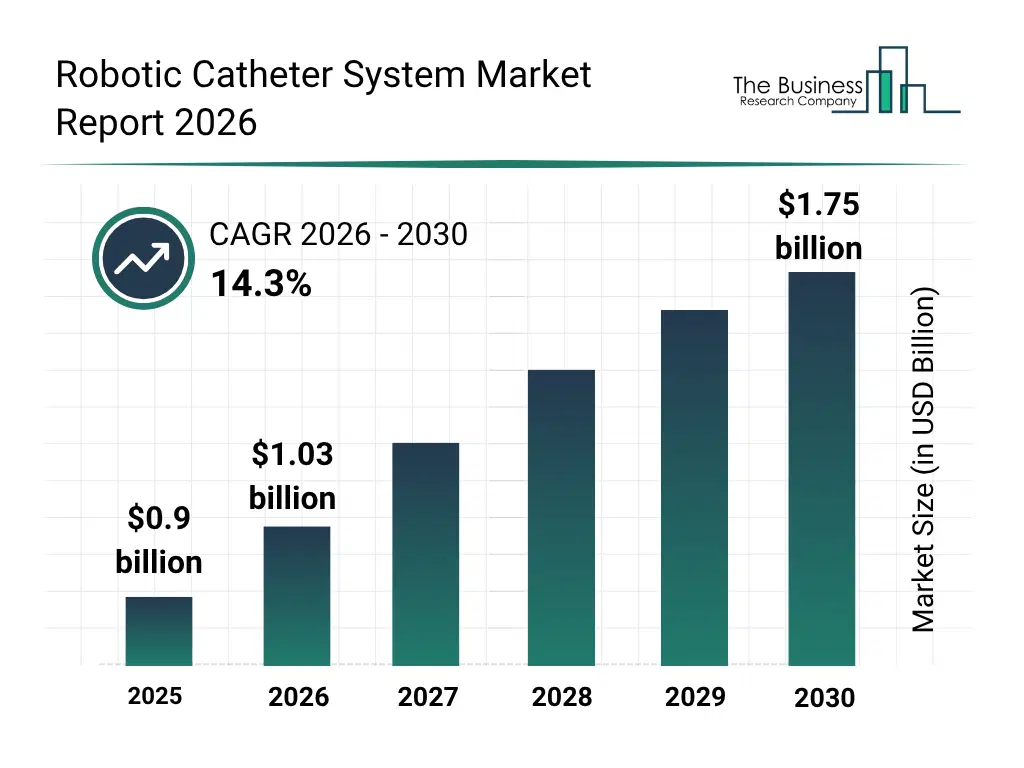
What Is The Robotic Catheter System Market Size and Share 2026?
The robotic catheter system market size has grown rapidly in recent years. It will grow from $0.9 billion in 2025 to $1.03 billion in 2026 at a compound annual growth rate (CAGR) of 14.1%. The growth in the historic period can be attributed to rise in cardiovascular and neurovascular disease prevalence, adoption of minimally invasive catheter-based procedures, development of electrophysiology and ablation technologies, expansion of hospital catheterization laboratory infrastructure, increasing physician training in interventional procedures.What Is The Robotic Catheter System Market Growth Forecast?
The robotic catheter system market size is expected to see rapid growth in the next few years. It will grow to $1.75 billion in 2030 at a compound annual growth rate (CAGR) of 14.3%. The growth in the forecast period can be attributed to growth in robotic-assisted surgical systems adoption, integration of ai powered navigation and imaging systems, expansion of outpatient interventional procedures, rising demand for precision and patient-specific interventions, increasing investment in advanced healthcare robotics infrastructure. Major trends in the forecast period include increasing adoption of minimally invasive robotic catheter procedures in cardiology and electrophysiology, rising demand for steerable and highly flexible catheter systems for complex anatomies, expansion of robotic-assisted catheterization laboratories in advanced healthcare facilities, growing preference for reduced radiation exposure technologies for clinicians, increasing use of mapping and navigation catheter systems for improved procedural outcomes.
Global Robotic Catheter System Market Segmentation
1) By Product Type: Ablation Catheter Systems; Mapping Catheter Systems; Navigation Catheter Systems; Steerable Catheters; Other Robotic Catheter Systems 2) By System Type: Multi Speciality Systems; Single Speciality Systems 3) By Technology: Electromechanical Systems; Magnetic Guided Systems; Fully Automated Systems; Semi Automated Systems 4) By Application: Cardiology; Electrophysiology; Neurovascular Procedures; Peripheral Vascular Procedures; Urology; Gastroenterology 5) By End Users: Hospitals; Catheterization Laboratories; Ambulatory Surgical Centers; Specialty Clinics; Research And Academic Institutes Subsegments: 1) By Ablation Catheter Systems: Radiofrequency Ablation Catheter Systems; Cryoablation Catheter Systems; Laser Ablation Catheter Systems; Ultrasound Ablation Catheter Systems; Microwave Ablation Catheter Systems 2) By Mapping Catheter Systems: Electroanatomical Mapping Catheter Systems; Three Dimensional Mapping Catheter Systems; Magnetic Mapping Catheter Systems; Impedance Based Mapping Catheter Systems; Diagnostic Mapping Catheter Systems 3) By Navigation Catheter Systems: Remote Navigation Catheter Systems; Magnetic Navigation Catheter Systems; Image Guided Navigation Catheter Systems; Sensor Based Navigation Catheter Systems; Robotic Assisted Navigation Catheter Systems 4) By Steerable Catheters: Single Direction Steerable Catheters; Dual Direction Steerable Catheters; Multi Direction Steerable Catheters; Deflectable Tip Catheters; Articulating Catheters 5) By Other Robotic Catheter Systems: Diagnostic Robotic Catheter Systems; Therapeutic Robotic Catheter Systems; Hybrid Robotic Catheter Systems; Micro Robotic Catheter Systems; Flexible Robotic Catheter SystemsWhat Are The Drivers Of The Robotic Catheter System Market?
The rising prevalence of cardiovascular diseases is expected to propel growth of the robotic catheter system market going forward. Cardiovascular diseases refer to a group of disorders affecting the heart and blood vessels, including coronary artery disease, heart failure, arrhythmias, and stroke. The rising prevalence of cardiovascular diseases is increasing due to the growing incidence of obesity. Robotic catheter systems help address the growing burden of cardiovascular diseases by enabling precise navigation and control during minimally invasive cardiac procedures, improving procedural accuracy, reducing complications, and enhancing patient outcomes. For instance, in September 2025, according to the Heart Failure Society of America, a US-based cardiovascular health organization, approximately 6.7 million Americans aged above 20 years were living with heart failure in 2025, and the prevalence is projected to increase to 8.7 million by 2030, 10.3 million by 2040, and 11.4 million by 2050. Therefore, the rising prevalence of cardiovascular diseases is driving the growth of the robotic catheter system industry. The growing demand for minimally invasive procedures is expected to propel the growth of the robotic catheter system market going forward. Minimally invasive procedures are medical interventions performed through small incisions or natural body openings using specialized instruments and imaging technologies to reduce tissue damage, pain, and recovery time. Minimally invasive procedures are rising due to the growing preference for faster patient recovery, as these techniques typically result in shorter hospital stays, lower postoperative pain, and quicker return to normal activities compared to traditional open surgeries. Robotic catheter systems improve minimally invasive procedures by providing highly precise and stable catheter navigation, allowing physicians to treat complex anatomical areas more accurately while minimizing procedural risks and complications. For instance, in June 2024, according to the American Society of Plastic Surgeons, a US-based organization of board-certified plastic surgeon, minimally invasive procedures increased by 7% in 2023, exceeding the growth rate of surgical procedures, which rose by 2%. Therefore, the growing demand for minimally invasive procedures is driving the growth of the robotic catheter system industry. The rising healthcare expenditure is expected to propel the growth of the robotic catheter system market going forward. Healthcare expenditure refers to the total amount of financial resources spent on medical services, healthcare infrastructure, medications, preventive care, and related health activities within a specific period. Healthcare expenditure is rising due to the increasing prevalence of chronic diseases, which requires long-term medical treatment, frequent hospital visits, advanced diagnostic services, and continuous patient care. Higher healthcare expenditure supports robotic catheter systems by enabling hospitals and healthcare providers to invest in advanced robotic technologies that improve procedural precision, patient outcomes, and operational efficiency. For instance, in April 2025, according to the Office for National Statistics, a UK-based government agency, healthcare spending increased by 6.5% from 2023 to 2024, higher than the 6.3% growth recorded during 2023. Therefore, the rising healthcare expenditure is driving the growth of the robotic catheter system industry.Key Players In The Global Robotic Catheter System Market
Major companies operating in the robotic catheter system market are Johnson & Johnson; Siemens Healthineers AG; MicroPort Scientific Corporation; Stereotaxis Inc.; Robocath SAS; Microbot Medical Inc.; Magnetecs Corporation; Intuitive Surgical; Medtronic plc; Nanoflex Robotics AG; XCath Inc.Regional Outlook
North America was the largest region in the robotics catheter system market in 2025. Asia-Pacific is expected to be the fastest-growing region in the forecast period. The regions covered in this market report are Asia-Pacific, South East Asia, Western Europe, Eastern Europe, North America, South America, Middle East, Africa. The countries covered in this market report are Australia, Brazil, China, France, Germany, India, Indonesia, Japan, Taiwan, Russia, South Korea, UK, USA, Canada, Italy, Spain.What Defines the Robotic Catheter System Market?
The robotic catheter system market consists of sales of catheter control consoles, robotic drive units, and associated disposable or compatible interventional catheters. Values in this market are ‘factory gate’ values, that is the value of goods sold by the manufacturers or creators of the goods, whether to other entities (including downstream manufacturers, wholesalers, distributors and retailers) or directly to end customers. The value of goods in this market includes related services sold by the creators of the goods.How is Market Value Defined and Measured?
The market value is defined as the revenues that enterprises gain from the sale of goods and/or services within the specified market and geography through sales, grants, or donations in terms of the currency (in USD unless otherwise specified). The revenues for a specified geography are consumption values that are revenues generated by organizations in the specified geography within the market, irrespective of where they are produced. It does not include revenues from resales along the supply chain, either further along the supply chain or as part of other products.What Key Data and Analysis Are Included in the Robotic Catheter System Market Report 2026?
The robotic catheter system market research report is one of a series of new reports from The Business Research Company that provides market statistics, including industry global market size, regional shares, competitors with the market share, detailed market segments, market trends and opportunities, and any further data you may need to thrive in the robotic catheter system industry. The market research report delivers a complete perspective of everything you need, with an in-depth analysis of the current and future state of the industry.Robotic Catheter System Market Report Forecast Analysis
| Report Attribute | Details |
|---|---|
| Market Size Value In 2026 | $1.03 billion |
| Revenue Forecast In 2030 | $1.75 billion |
| Growth Rate | CAGR of 14.3% from 2026 to 2030 |
| Base Year For Estimation | 2025 |
| Actual Estimates/Historical Data | 2020-2025 |
| Forecast Period | 2026 - 2030 |
| Market Representation | Revenue in USD Billion and CAGR from 2026 to 2030 |
| Segments Covered | Product Type, System Type, Technology, Application, End Users |
| Regional Scope | Asia-Pacific, Western Europe, Eastern Europe, North America, South America, Middle East, Africa |
| Country Scope | The countries covered in the report are Australia, Brazil, China, France, Germany, India, ... |
| Key Companies Profiled | Johnson & Johnson; Siemens Healthineers AG; MicroPort Scientific Corporation; Stereotaxis Inc.; Robocath SAS; Microbot Medical Inc.; Magnetecs Corporation; Intuitive Surgical; Medtronic plc; Nanoflex Robotics AG; XCath Inc. |
| Customization Scope | Request for Customization |
| Pricing And Purchase Options | Explore Purchase Options |