
Robotic Cutting, Deburring, And Finishing Market Report 2026
Global Outlook – By Type (6-Axis And 7-Axis, 3-Axis To 5-Axis), By Robot Type (Articulated Robots, Selective Compliance Articulated Robot Arm (SCARA) Robots, Delta Robots, Collaborative Robots (Cobots) ), By Functionality (Automated Systems, Semi-Automated Systems), By Application (Cutting, Deburring, Finishing), By End-User Industry (Aerospace, Automotive, Metal Fabrication, Electronics, Consumer Goods, Shipbuilding) – Market Size, Trends, Strategies, and Forecast to 2030
Robotic Cutting, Deburring, And Finishing Market Overview
• Robotic Cutting, Deburring, And Finishing market size has reached to $3.48 billion in 2025 • Expected to grow to $6.2 billion in 2030 at a compound annual growth rate (CAGR) of 12.2% • Growth Driver: Rising Demand For Automation Fueling The Growth Of The Market Due To Increasing Need For Efficiency And Precision In Manufacturing Processes • Market Trend: Integration Of Advanced Automation Enhancing Precision And Efficiency In Metal Finishing • North America was the largest region in 2025 and Asia-Pacific is the fastest growing region.What Is Covered Under Robotic Cutting, Deburring, And Finishing Market?
Robotic cutting, deburring, and finishing refer to the automated process of removing excess material, burrs, and surface imperfections from components using industrial robots. These robots perform precision material removal and surface refinement to ensure uniformity, accuracy, and high-quality finishes. The technology enhances productivity, consistency, and safety by replacing manual finishing operations with fully automated solutions. The main types of robotic cutting, deburring, and finishing are 6-axis and 7-axis and 3-axis to 5-axis. The 6-axis and 7-axis robots provide motion across six or seven degrees of freedom, enabling highly flexible and precise operations across multiple planes. Robot types used in this include articulated robots, selective compliance articulated robot arm (SCARA) robots, delta robots, and collaborative robots (cobots). Based on functionality, these systems are categorized into automated systems, semi-automated systems, and manual systems. They are widely used in applications for cutting, deburring, and finishing across industries such as aerospace, automotive, metal fabrication, electronics, consumer goods, and shipbuilding.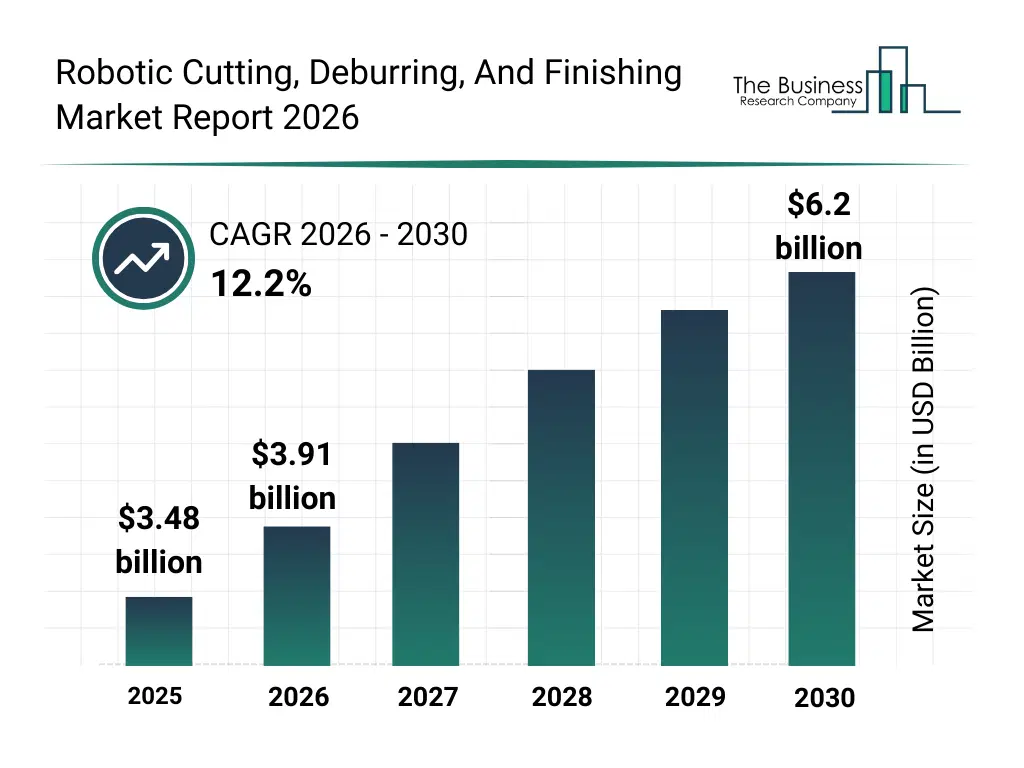
What Is The Robotic Cutting, Deburring, And Finishing Market Size and Share 2026?
The robotic cutting, deburring, and finishing market size has grown rapidly in recent years. It will grow from $3.48 billion in 2025 to $3.91 billion in 2026 at a compound annual growth rate (CAGR) of 12.5%. The growth in the historic period can be attributed to expansion of metal fabrication activities, growth in aerospace and automotive production, increasing demand for consistent surface finishes, availability of advanced robotic tools, rising labor cost pressures.What Is The Robotic Cutting, Deburring, And Finishing Market Growth Forecast?
The robotic cutting, deburring, and finishing market size is expected to see rapid growth in the next few years. It will grow to $6.2 billion in 2030 at a compound annual growth rate (CAGR) of 12.2%. The growth in the forecast period can be attributed to increasing integration of AI-driven robotic control, expansion of high-mix low-volume manufacturing, rising demand for defect-free components, growing automation in finishing operations, focus on flexible robotic cells. Major trends in the forecast period include increasing adoption of automated finishing cells, rising demand for precision surface quality, expansion of multi-axis robotic systems, growing use of vision-guided finishing, enhanced focus on worker safety.Tariff Impact On Robotic Cutting, Deburring, And Finishing Market
Tariffs are impacting the robotic cutting, deburring, and finishing market by increasing the cost of imported industrial robots, spindles, abrasive tools, sensors, and control systems. Aerospace, automotive, and metal fabrication industries in North America and Europe are most affected due to reliance on imported robotic platforms. These tariffs are increasing system integration costs and slowing capital investments. However, they are also driving local robot integration capabilities, encouraging domestic tooling innovation, and accelerating the adoption of flexible and modular robotic finishing solutions.
Global Robotic Cutting, Deburring, And Finishing Market Segmentation
1) By Type: 6-Axis And 7-Axis, 3-Axis To 5-Axis 2) By Robot Type: Articulated Robots, Selective Compliance Articulated Robot Arm (SCARA) Robots, Delta Robots, Collaborative Robots (Cobots) 3) By Functionality: Automated Systems, Semi-Automated Systems 4) By Application: Cutting, Deburring, Finishing 5) By End-User Industry: Aerospace, Automotive, Metal Fabrication, Electronics, Consumer Goods, Shipbuilding Subsegments: 1) By 6-Axis and 7-Axis: Articulated 6-Axis Wrist Robots, Redundant 7-Axis Articulated Robots, 6-Axis High-Payload Robots, 6-Axis High-Precision Robots, 6-Axis Long-Reach Robots, 6-Axis Compact Or Mini Robots, 6-Axis Collaborative Robots (Cobots), 6-Axis CNC-Integrated Machining Robots, 6-Axis Vision-Guided Or Robot-Vision Systems, 7-Axis Linear-Track Or Rail-Mounted Systems 2) By 3-Axis to 5-Axis: 3-Axis Gantry Robots, 3-Axis Tabletop Or Bench Robots, 3-Axis Articulated Or Basic Machining Robots, 4-Axis Indexing Or Rotary-Table Systems, 4-Axis Tilting-Head Systems, 5-Axis Simultaneous Trunnion-Table Systems, 5-Axis Tilting-Table Or Tilt-Rotary Head Systems, 5-Axis Gantry Or Multi-Axis Gantry Systems, 3–5-Axis CNC-Integrated Robotic Cells, 3–5-Axis Portable Or Fixture-Mounted UnitsWhat Is The Driver Of The Robotic Cutting, Deburring, And Finishing Market?
The increasing demand for automation is expected to propel the growth of the robotic cutting, deburring, and finishing market going forward. Automation is the use of technology, machines, or systems to perform tasks with minimal human intervention, improving efficiency and accuracy. The demand for automation is rising as companies aim to boost efficiency, lower human errors, and cut operational expenses while maintaining high-quality output. Robotic cutting, deburring, and finishing are used in automation to streamline material processing tasks with high precision, speed, and consistency while minimizing human involvement. For instance, in September 2024, the International Federation of Robotics (IFR), a Germany-based non-profit organization, reported that industrial robot installations in the UK rose by 51%, reaching 3,830 units, while in the Americas, over 50,000 units were installed for the third consecutive year, totaling 55,389 units in 2023. Therefore, the increasing demand for automation is driving the growth of the robotic cutting, deburring, and finishing industry.Key Players In The Global Robotic Cutting, Deburring, And Finishing Market
Major companies operating in the robotic cutting, deburring, and finishing market are ABB Ltd., FANUC Corporation, Yaskawa Electric Corporation (MOTOMAN), Kawasaki Heavy Industries, Ltd., DAIHEN Corporation, Stäubli International AG, Comau S.p.A., Dürr AG, DENSO Corporation, Seiko Epson Corporation, Mitsubishi Electric Corporation, Omron Corporation, Hyundai Robotics Co., Ltd., KC Robotics Inc., AV&R S.A.S., Wolf Robotics, Fastems Oy Ab, Robot System Products AB, AVR-Global, Applied Robotics, Romheld Automation Pty Ltd, Geometrix Automation and Robotics Pvt. Ltd., Hammond Roto-Finish, Cyan-TEC, KC Engineering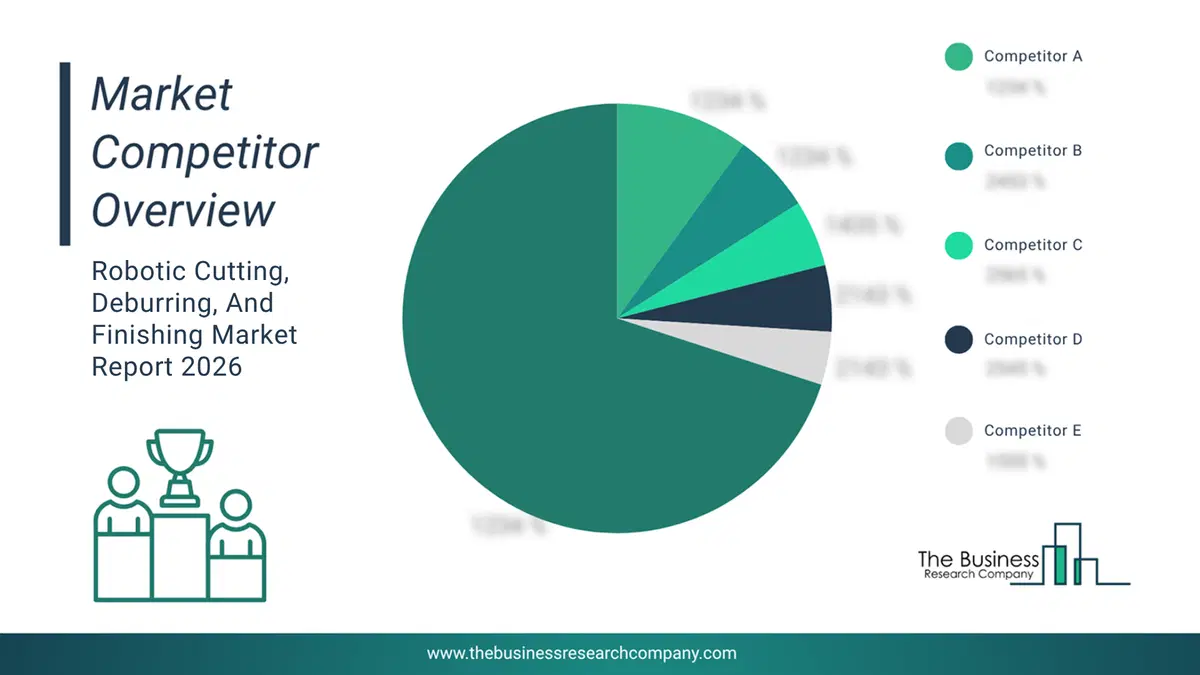
This chart is for illustrative purposes; the full report includes a detailed competitor analysis and comprehensive overview of the top 10 companies in the market.
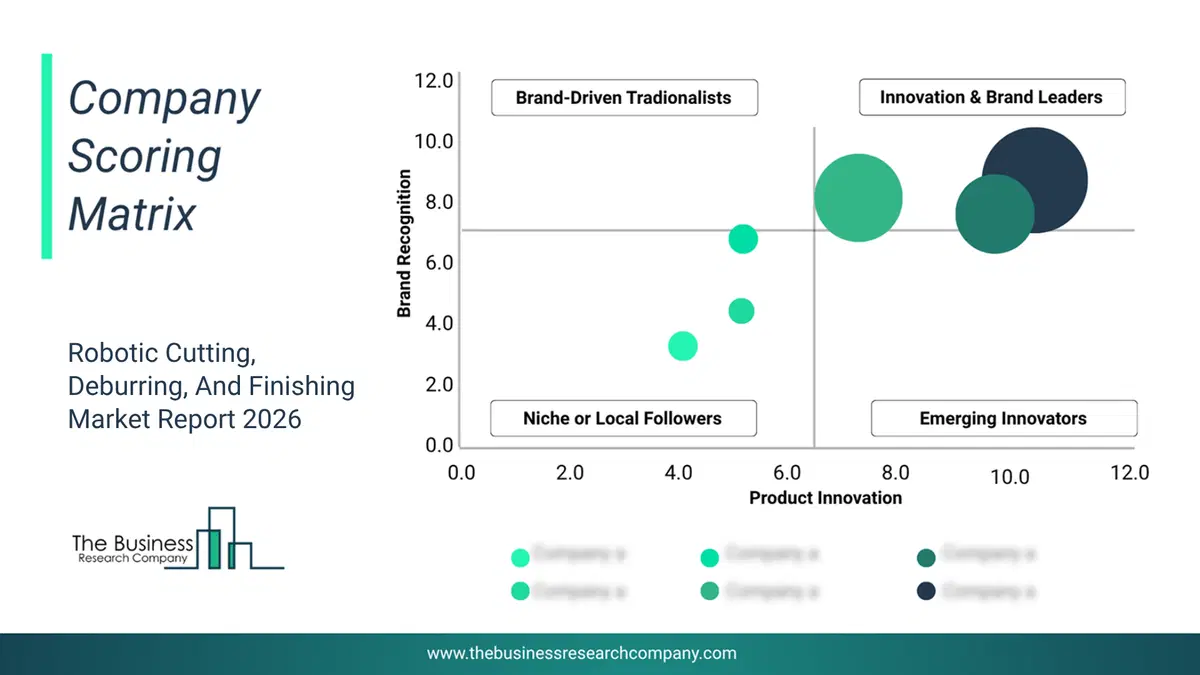
This chart maps companies by product innovation and brand strength, with bubble size indicating relative revenue, helping identify market leaders, challengers, and niche players. This is an illustrative chart; the full report provides a complete and accurate competitive analysis.
Global Robotic Cutting, Deburring, And Finishing Market Trends and Insights
Major companies operating in the robotic cutting, deburring, and finishing market are focusing on developing compact, energy-efficient, and user-friendly machines such as the 4DD processing system to enhance precision, productivity, and operational safety. The 4DD processing system uses four discs, two in the front and two at the back, to handle rough deburring and final polishing at once, improving speed, precision, and overall processing efficiency. For instance, in November 2024, Murata Machinery Ltd. (Muratec), a Japan-based industrial machinery manufacturing company, launched the DB1000H deburring machine, designed for high-quality and efficient metal finishing. Featuring a 4DD processing system with dual front and back discs, it performs deburring, polishing, and chamfering in a single process. The machine offers a compact design occupying only 2.65 ㎡ of floor space, improved energy efficiency with just 4.7 kVA power use, and simple operation through automatic thickness detection and NC data updates. Additional features include barcode-based tool management, rear operation buttons, and a full open-door design for easy maintenance, making the DB1000H a smart, space-saving solution for modern manufacturing automation.What Are Latest Mergers And Acquisitions In The Robotic Cutting, Deburring, And Finishing Market?
In May 2025, DiFACTO Robotics and Automation Pvt. Ltd., an India-based automation machinery manufacturing company, acquired the RoboFinish division from Grind Master Machines Pvt. Ltd. for an undisclosed amount. With this acquisition, DiFACTO strengthens its technological capability in robotic surface finishing, specifically grinding, deburring, and polishing, to expand its automation offerings for the automotive, foundry, and manufacturing sectors. Grind Master Machines is an India-based machinery manufacturing company that specializes in providing metal-finishing solutions, including robotic grinding, finishing, deburring, and machining technologies developed under its RoboFinish division.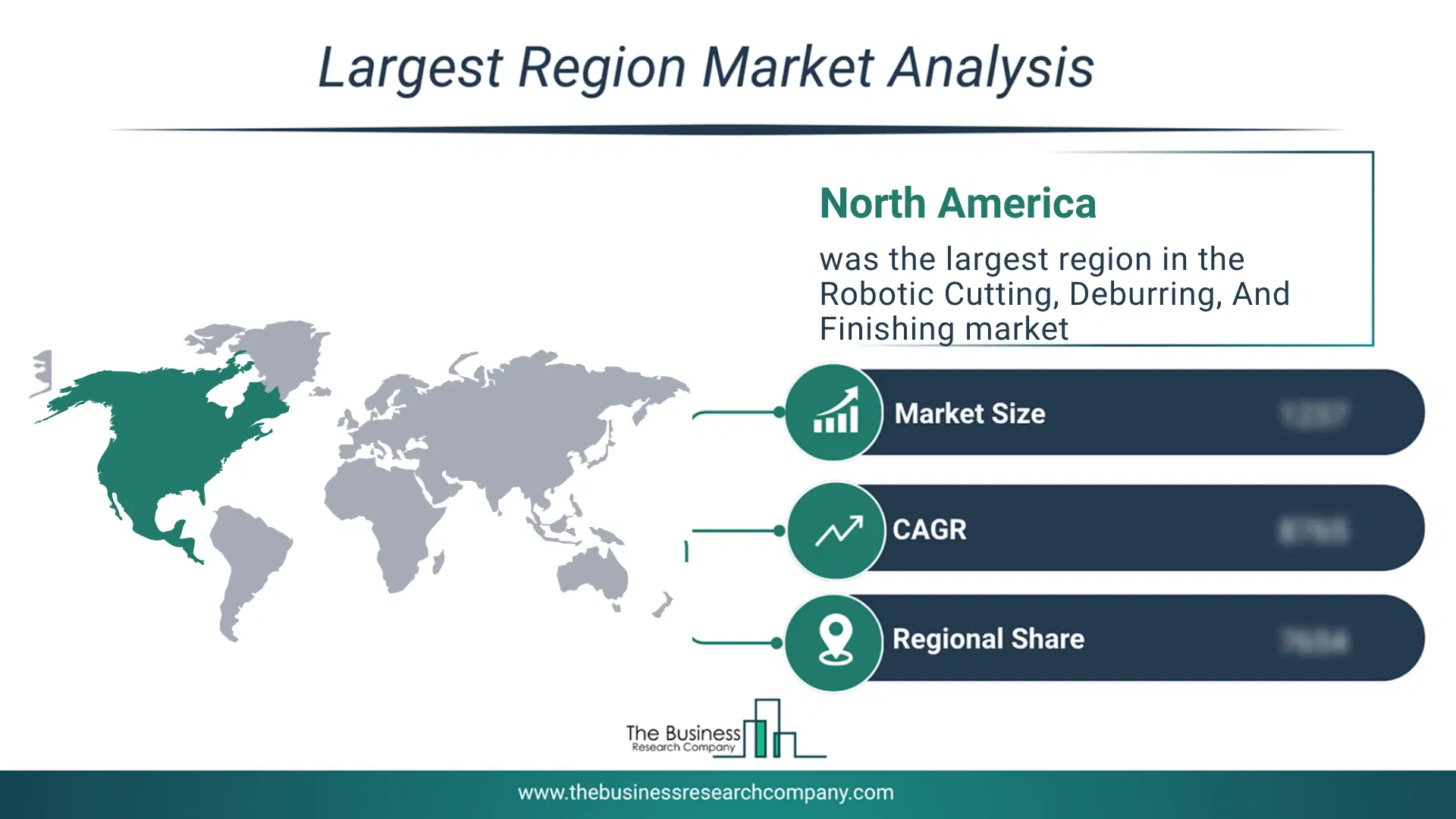
Regional Outlook
North America was the largest region in the robotic cutting, deburring, and finishing market in 2025. Asia-Pacific is expected to be the fastest-growing region in the forecast period. The regions covered in this market report are Asia-Pacific, South East Asia, Western Europe, Eastern Europe, North America, South America, Middle East, Africa The countries covered in this market report are Australia, Brazil, China, France, Germany, India, Indonesia, Japan, Taiwan, Russia, South Korea, UK, USA, Canada, Italy, Spain.What Defines the Robotic Cutting, Deburring, And Finishing Market?
The robotic cutting, deburring, and finishing market consists of sales of robotic cutting machines, robotic deburring cells, robotic finishing systems, cutting tools, and end-effectors. Values in this market are ‘factory gate’ values, that is the value of goods sold by the manufacturers or creators of the goods, whether to other entities (including downstream manufacturers, wholesalers, distributors and retailers) or directly to end customers. The value of goods in this market includes related services sold by the creators of the goods.How is Market Value Defined and Measured?
The market value is defined as the revenues that enterprises gain from the sale of goods and/or services within the specified market and geography through sales, grants, or donations in terms of the currency (in USD unless otherwise specified). The revenues for a specified geography are consumption values that are revenues generated by organizations in the specified geography within the market, irrespective of where they are produced. It does not include revenues from resales along the supply chain, either further along the supply chain or as part of other products.
This chart presents market attractiveness based on a quantitative evaluation of growth, competition, strategic alignment, and risk, offering a clear view of opportunity areas for decision-making. This chart is for illustrative purposes; the full report contains the complete analysis.

This chart highlights the Total Addressable Market (TAM) by estimating the maximum revenue opportunity using an assumption-driven approach, supporting strategic planning and opportunity sizing across markets. The chart is illustrative; the full report provides a more comprehensive analysis.
What Key Data and Analysis Are Included in the Robotic Cutting, Deburring, And Finishing Market Report 2026?
The robotic cutting, deburring, and finishing market research report is one of a series of new reports from The Business Research Company that provides market statistics, including industry global market size, regional shares, competitors with the market share, detailed market segments, market trends and opportunities, and any further data you may need to thrive in the robotic cutting, deburring, and finishing industry. The market research report delivers a complete perspective of everything you need, with an in-depth analysis of the current and future state of the industry.Robotic Cutting Deburring And Finishing Market Report Forecast Analysis
| Report Attribute | Details |
|---|---|
| Market Size Value In 2026 | $3.91 billion |
| Revenue Forecast In 2030 | $6.2 billion |
| Base Year For Estimation | 2025 |
| Actual Estimates/Historical Data | 2020-2025 |
| Forecast Period | 2026 - 2030 |
| Market Representation | Revenue in USD Billion and CAGR from 2026 to 2030 |
| Segments Covered | Type, Robot Type, Functionality, Application, End-User Industry |
| Regional Scope | Asia-Pacific, Western Europe, Eastern Europe, North America, South America, Middle East, Africa |
| Key Companies Profiled | ABB Ltd., FANUC Corporation, Yaskawa Electric Corporation (MOTOMAN), Kawasaki Heavy Industries, Ltd., DAIHEN Corporation, Stäubli International AG, Comau S.p.A., Dürr AG, DENSO Corporation, Seiko Epson Corporation, Mitsubishi Electric Corporation, Omron Corporation, Hyundai Robotics Co., Ltd., KC Robotics Inc., AV&R S.A.S., Wolf Robotics, Fastems Oy Ab, Robot System Products AB, AVR-Global, Applied Robotics, Romheld Automation Pty Ltd, Geometrix Automation and Robotics Pvt. Ltd., Hammond Roto-Finish, Cyan-TEC, KC Engineering |
| Customization Scope | Request for Customization |
| Pricing And Purchase Options | Explore Purchase Options |