
Robotic Laser Welding Cells Market Report 2026
Global Outlook – By Component (Robot Arm, Laser Source, Controller, Safety Enclosure, Other Components), By Cell Type (Standalone Cells, Integrated Cells, Modular Cells), By Laser Type (Fiber Laser, Carbon Dioxide (CO₂) Laser, Diode Laser, Other Laser Types), By Payload Capacity (Low, Medium, High), By End-User (Automotive, Aerospace, Electronics, Metal Fabrication, Heavy Machinery, Other End-Users) – Market Size, Trends, Strategies, and Forecast to 2030
Robotic Laser Welding Cells Market Overview
• Robotic Laser Welding Cells market size has reached to $2.33 billion in 2025 • Expected to grow to $3.87 billion in 2030 at a compound annual growth rate (CAGR) of 10.6% • Growth Driver: Rising Demand For Industrial Automation Fueling The Growth Of The Market Due To Enhancing Efficiency And Precision In Large-Scale Industrial Applications • Market Trend: Advanced Cobot Welding Cell Enhances Precision, Efficiency, And Flexibility • Asia-Pacific was the largest region in 2025 and North America is the fastest growing region.What Is Covered Under Robotic Laser Welding Cells Market?
Robotic laser welding cells are automated systems that use industrial robots combined with high-precision laser technology to perform welding tasks with speed and accuracy. These cells are built to deliver consistent weld quality, reduced heat distortion, and faster processing compared to conventional welding methods. They help manufacturers increase throughput, lower labor dependence, and maintain high repeatability in complex welding operations. The main components of the robotic laser welding cells include robot arms, laser sources, controllers, safety enclosures, and others. Robot arm refers to the articulated mechanical manipulator that moves the welding head and part, defined by its axes, reach, payload capacity, and motion control systems, which together determine how precisely and quickly the weld torch can be positioned. These systems are available in various cell types, including standalone cells, integrated cells, and modular cells, enabling manufacturers to select configurations that match their production layouts and scalability needs. The key laser types used in these cells include fiber lasers, carbon dioxide (CO?) lasers, diode lasers, and others. The various payload capacities involved are low, medium, and high and are used by several end users such as automotive, aerospace, electronics, metal fabrication, heavy machinery, and others.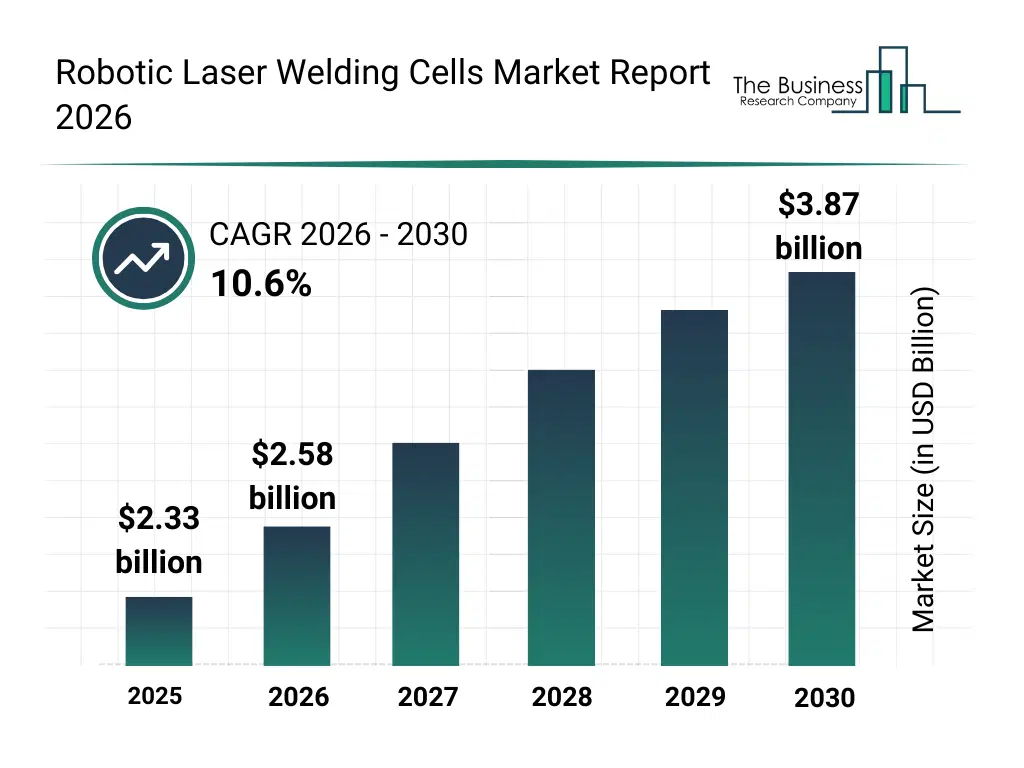
What Is The Robotic Laser Welding Cells Market Size and Share 2026?
The robotic laser welding cells market size has grown rapidly in recent years. It will grow from $2.33 billion in 2025 to $2.58 billion in 2026 at a compound annual growth rate (CAGR) of 10.9%. The growth in the historic period can be attributed to increasing automation adoption in automotive manufacturing, rising demand for precision welding in electronics, a growing shift from manual to robotic welding, expansion of industrial laser integration, and increasing focus on production efficiency.What Is The Robotic Laser Welding Cells Market Growth Forecast?
The robotic laser welding cells market size is expected to see rapid growth in the next few years. It will grow to $3.87 billion in 2030 at a compound annual growth rate (CAGR) of 10.6%. The growth in the forecast period can be attributed to growing investments in factory automation, rising demand for high-precision laser welding in e-mobility, increasing adoption of automated welding in metal fabrication, expansion of robotics in small and mid-sized factories, and a rising shift toward zero-defect manufacturing. Major trends in the forecast period include advancements in laser power and beam delivery technology, innovations in compact robotic welding cells, developments in AI-based weld monitoring, research and development in adaptive laser welding, and integration of digital twins in welding cells.
Global Robotic Laser Welding Cells Market Segmentation
1) By Component: Robot Arm, Laser Source, Controller, Safety Enclosure, Other Components 2) By Cell Type: Standalone Cells, Integrated Cells, Modular Cells 3) By Laser Type: Fiber Laser, Carbon Dioxide (CO?) Laser, Diode Laser, Other Laser Types 4) By Payload Capacity: Low, Medium, High 5) By End-User: Automotive, Aerospace, Electronics, Metal Fabrication, Heavy Machinery, Other End-Users Subsegments: 1) By Robot Arm: Articulated Robot Arm, Cartesian Robot Arm, Delta Robot Arm, Gantry Robot Arm, Parallel Robot Arm, Collaborative Robot Arm 2) By Laser Source: Fiber Laser Source, Carbon Dioxide Laser Source, Diode Laser Source, Solid State Crystal Laser Source, Disk Laser Source, Ultrafast Pulsed Laser Source 3) By Controller: Programmable Logic Controller, Robot Motion Controller, Laser Process Controller, Human–Machine Interface, Distributed Control System, Safety Interlock Controller 4) By Safety Enclosure: Fixed Safety Enclosure, Interlocked Safety Door, Protective Shielding Enclosure, Fume Extraction Enclosure, Access Control System, Light Curtain Protection 5) By Other Components: Fixturing And Workholding, Vision Inspection System, Tool Changer Unit, Cooling And Chiller System, Fume Extraction Unit, Material Handling Conveyor, Sensors And Monitoring Devices, Electrical Cabling And ConnectorsWhat Is The Driver Of The Robotic Laser Welding Cells Market?
The rising demand for industrial automation is expected to propel the growth of the robotic laser welding cells market going forward. Industrial automation refers to the use of control systems, machinery, software, and robotics to operate and monitor industrial processes with minimal human intervention. The demand for industrial automation is rising due to the need for increased operational efficiency as businesses aim to reduce costs, minimize errors, and boost productivity. Rising infrastructure development enhances robotic laser welding cells by enabling precise and high-speed welding for large-scale construction and industrial projects, making them ideal for modern infrastructure applications. They improve construction efficiency by delivering consistent, accurate welds, reducing manual labor and project timelines. For instance, in September 2025, according to the International Federation of Robotics, a Germany-based non-profit organization, there were 4,664,000 robotic units operating in factories globally in 2024, marking a 9% increase from 4,281,585 units in 2023. Therefore, the rising demand for industrial automation is driving the growth of the robotic laser welding cells industry.Key Players In The Global Robotic Laser Welding Cells Market
Major companies operating in the robotic laser welding cells market are Panasonic Corporation, Mitsubishi Electric Corporation, ABB Ltd., Kawasaki Heavy Industries Ltd., Trumpf Group, FANUC Corporation, Lincoln Electric Holdings Inc., Yaskawa Electric Corporation, Amada Holdings Co. Ltd., Han's Laser Technology Industry Group Co. Ltd., Nachi-Fujikoshi Corp., Daihen Corporation, IPG Photonics Corporation, Miller Electric Mfg. LLC, Prima Power, Fronius International GmbH, Mazak Optonics Corporation, IGM Robotersysteme AG, Wuhan Golden Laser Co. Ltd., Jenoptik AG, ERLAS Erlanger Lasertechnik GmbH, SENFENG Laser, Alpha Laser GmbH, HSG Laser Co. Ltd., INNO Robotics Co. Ltd.
This chart is for illustrative purposes; the full report includes a detailed competitor analysis and comprehensive overview of the top 10 companies in the market.
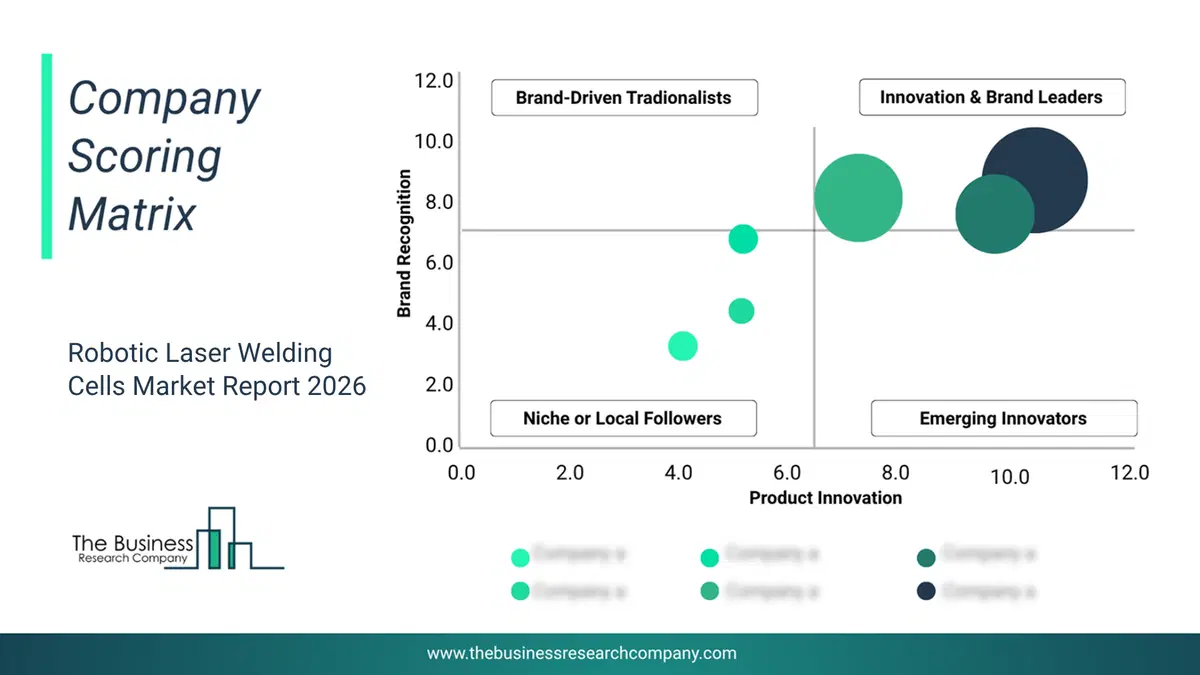
This chart maps companies by product innovation and brand strength, with bubble size indicating relative revenue, helping identify market leaders, challengers, and niche players. This is an illustrative chart; the full report provides a complete and accurate competitive analysis.
Global Robotic Laser Welding Cells Market Trends and Insights
Major companies operating in the robotic laser welding cells market are focusing on developing advanced systems, such as cobot laser welding systems, to boost efficiency, enhance flexibility, and reduce manual effort and production costs. Cobot laser welding systems refer to collaborative robotic cells that combine high-speed laser processing with intuitive, safe human-robot interaction for precise joining and surface cleaning applications. For instance, in May 2024, IPG Photonics Corporation, a US-based manufacturer of high-performance fiber lasers and laser systems, launched the LightWELD Cobot Laser Welding and Cleaning System. It is a fully integrated, portable system featuring a collaborative robot arm paired with IPG’s proprietary LightWELD laser welder. The system includes a patented vision-based alignment tool that simplifies programming and ensures precise weld placement, drastically reducing setup time and the risk of rework. It also incorporates automated parameter selection and a safety-rated, contactless scanning system, enabling rapid switching between welding and cleaning functions without operator intervention.What Are Latest Mergers And Acquisitions In The Robotic Laser Welding Cells Market?
In October 2025, SoftBank Group, a Japan-based investment holding company, acquired ABB Group's robotics business unit for approximately $5.375 billion. With this acquisition, SoftBank significantly bulked up its robotics portfolio, integrating ABB’s industrial robotics unit to enhance its capabilities in automation and intelligent machines. ABB Group is a Switzerland-based industrial automation and robotics company that provides turnkey robotic laser‑welding cells and other robotic welding solutions.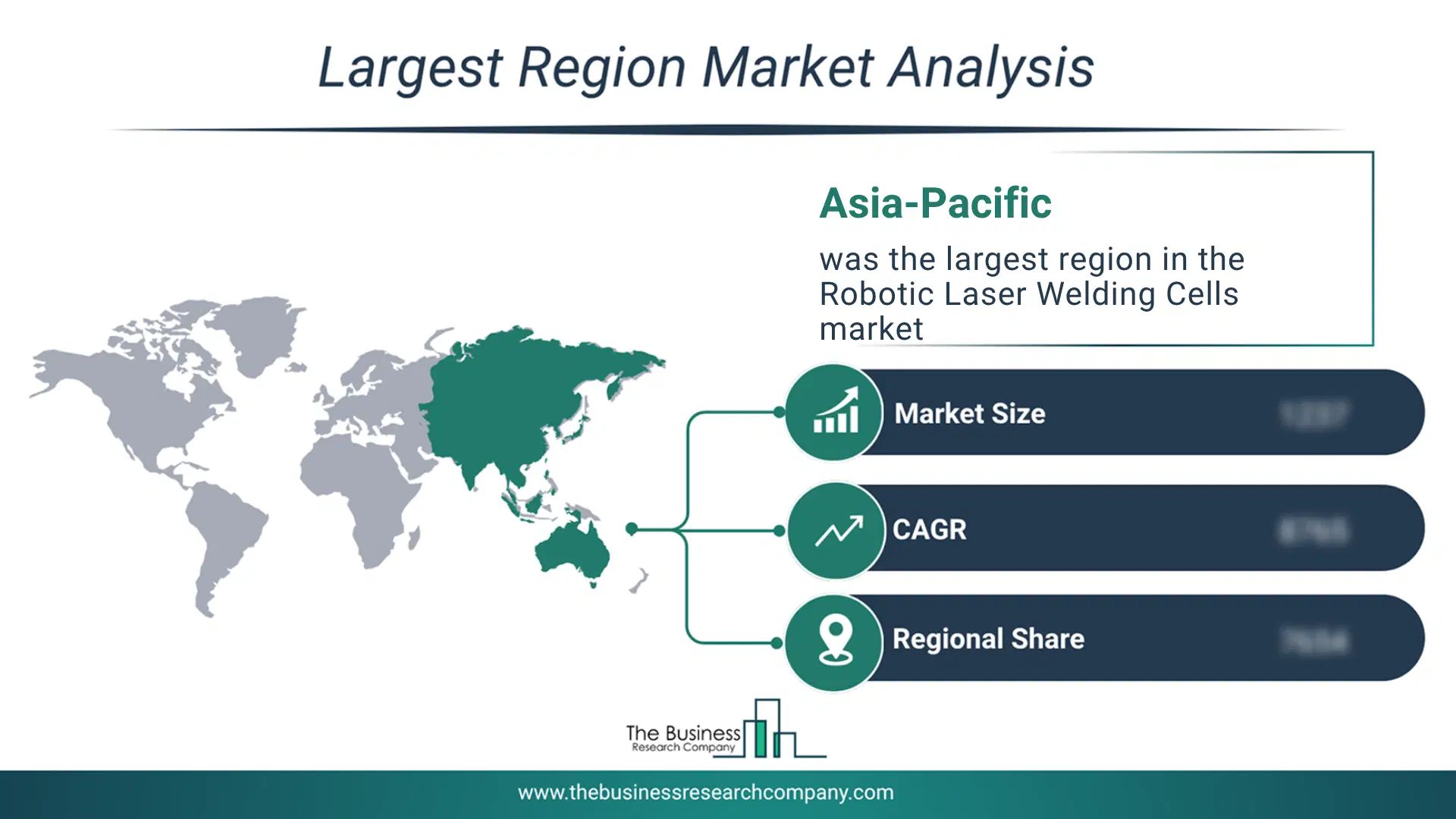
Regional Insights
Asia-Pacific was the largest region in the robotic laser welding cells market in 2025. North America is expected to be the fastest-growing region in the forecast period. The regions covered in this market report are Asia-Pacific, South East Asia, Western Europe, Eastern Europe, North America, South America, Middle East, Africa. The countries covered in this market report are Australia, Brazil, China, France, Germany, India, Indonesia, Japan, Taiwan, Russia, South Korea, UK, USA, Canada, Italy, Spain.What Defines the Robotic Laser Welding Cells Market?
The robotic laser welding cells market consists of sales of complete welding cells, laser sources, robotic arms, control units, and safety enclosures used to perform high-precision welding tasks. Values in this market are ‘factory gate’ values, that is, the value of goods sold by the manufacturers or creators of the goods, whether to other entities (including downstream manufacturers, wholesalers, distributors, and retailers) or directly to end customers. The value of goods in this market includes related services sold by the creators of the goods.How is Market Value Defined and Measured?
The market value is defined as the revenues that enterprises gain from the sale of goods and/or services within the specified market and geography through sales, grants, or donations in terms of the currency (in USD unless otherwise specified). The revenues for a specified geography are consumption values that are revenues generated by organizations in the specified geography within the market, irrespective of where they are produced. It does not include revenues from resales along the supply chain, either further along the supply chain or as part of other products.
This chart presents market attractiveness based on a quantitative evaluation of growth, competition, strategic alignment, and risk, offering a clear view of opportunity areas for decision-making. This chart is for illustrative purposes; the full report contains the complete analysis.

This chart highlights the Total Addressable Market (TAM) by estimating the maximum revenue opportunity using an assumption-driven approach, supporting strategic planning and opportunity sizing across markets. The chart is illustrative; the full report provides a more comprehensive analysis.
What Key Data and Analysis Are Included in the Robotic Laser Welding Cells Market Report 2026?
The robotic laser welding cells market research report is one of a series of new reports from The Business Research Company that provides market statistics, including industry global market size, regional shares, competitors with the market share, detailed market segments, market trends and opportunities, and any further data you may need to thrive in the robotic laser welding cells industry. The market research report delivers a complete perspective of everything you need, with an in-depth analysis of the current and future state of the industry.Robotic Laser Welding Cells Market Report Forecast Analysis
| Report Attribute | Details |
|---|---|
| Market Size Value In 2026 | $2.58 billion |
| Revenue Forecast In 2030 | $3.87 billion |
| Growth Rate | CAGR of 10.6% from 2026 to 2030 |
| Base Year For Estimation | 2025 |
| Actual Estimates/Historical Data | 2020-2025 |
| Forecast Period | 2026 - 2030 |
| Market Representation | Revenue in USD Billion and CAGR from 2026 to 2030 |
| Segments Covered | Component, Cell Type, Laser Type, Payload Capacity, End-User |
| Regional Scope | Asia-Pacific, Western Europe, Eastern Europe, North America, South America, Middle East, Africa |
| Key Companies Profiled | Panasonic Corporation, Mitsubishi Electric Corporation, ABB Ltd., Kawasaki Heavy Industries Ltd., Trumpf Group, FANUC Corporation, Lincoln Electric Holdings Inc., Yaskawa Electric Corporation, Amada Holdings Co. Ltd., Han's Laser Technology Industry Group Co. Ltd., Nachi-Fujikoshi Corp., Daihen Corporation, IPG Photonics Corporation, Miller Electric Mfg. LLC, Prima Power, Fronius International GmbH, Mazak Optonics Corporation, IGM Robotersysteme AG, Wuhan Golden Laser Co. Ltd., Jenoptik AG, ERLAS Erlanger Lasertechnik GmbH, SENFENG Laser, Alpha Laser GmbH, HSG Laser Co. Ltd., INNO Robotics Co. Ltd. |
| Customization Scope | Request for Customization |
| Pricing And Purchase Options | Explore Purchase Options |