

Robotic Prosthetics Market Report 2026
Global Outlook – By Product Type (Prosthetic Arm, Prosthetic Knee, Prosthetic Feet Or Ankle, Prosthetic Hand, Other Products), By Technology (Microprocessor-Controlled Prosthetics, Myoelectric Prosthetics), By Extremity (Lower Body Prosthetics, Upper Body Prosthetics), By End User (Hospitals, Specialty Clinics, Other End Users) - Market Size, Trends, Strategies, and Forecast to 2030
Robotic Prosthetics Market Overview
• Robotic Prosthetics market size has reached to $1.88 billion in 2025 • Expected to grow to $3.23 billion in 2030 at a compound annual growth rate (CAGR) of 11.7% • Growth Driver: Rising Prevalence Of Orthopedic Diseases Fuels Growth In Robotic Prosthetics Market • Market Trend: Market Leaders Innovate With Advanced Implant Systems In Robotic Prosthetics Market • North America was the largest region in 2025 and Asia-Pacific is the fastest growing region.What Is Covered Under Robotic Prosthetics Market?
Robotic prosthetics are artificial limbs or prostheses designed to replace a missing body part that may have been lost due to trauma, disease, or congenital disability. They are designed to work along with human brain signals and incorporate robotics, electronics and materials science to replicate the functionality and appearance of natural limbs as closely as possible. The main product types of robotic prosthetics are prosthetic arms, prosthetic knees, prosthetic feet or ankles, prosthetic hands and others. A prosthetic arm refers to an artificial device that replaces a missing arm, which may be lost through trauma, disease, or a condition present at birth. The various technology includes microprocessor-controlled prosthetics and myoelectric prosthetics with various extremities such as lower-body prosthetics and upper-body prosthetics. These are used by various end-users such as hospitals, specialty clinics and others.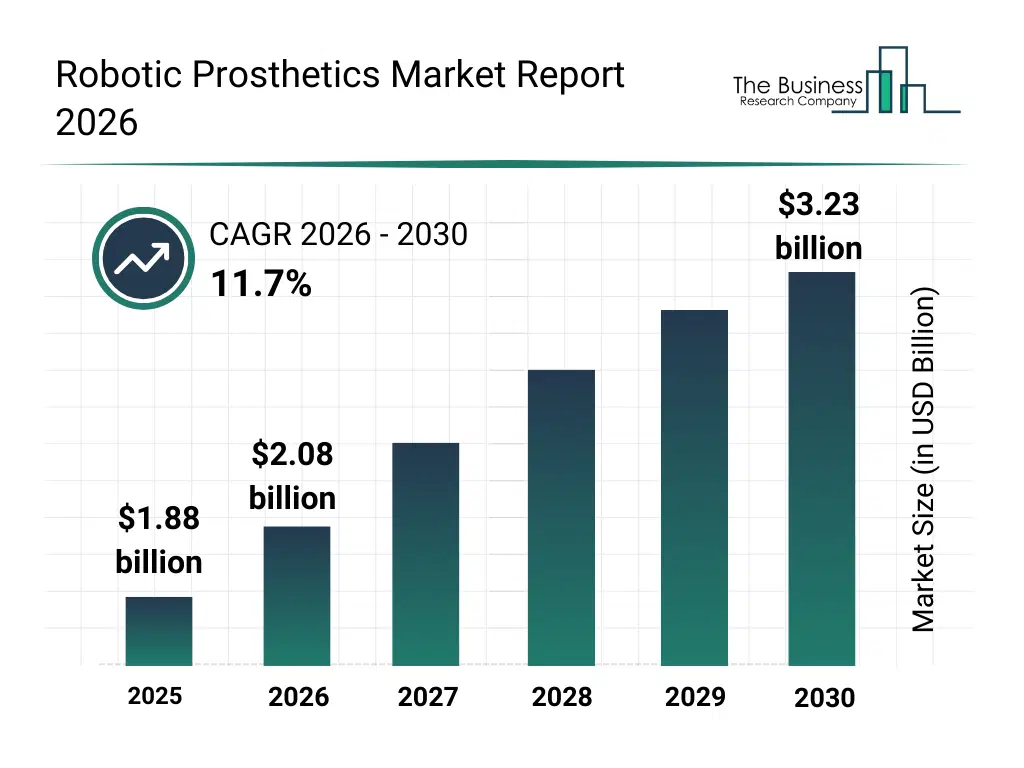
What Is The Robotic Prosthetics Market Size and Share 2026?
The robotic prosthetics market size has grown rapidly in recent years. It will grow from $1.88 billion in 2025 to $2.08 billion in 2026 at a compound annual growth rate (CAGR) of 10.5%. The growth in the historic period can be attributed to rising incidence of limb amputations, increased awareness of advanced prosthetic solutions, growth of rehabilitation centers, availability of government reimbursement programs, technological improvements in prosthetic components.What Is The Robotic Prosthetics Market Growth Forecast?
The robotic prosthetics market size is expected to see rapid growth in the next few years. It will grow to $3.23 billion in 2030 at a compound annual growth rate (CAGR) of 11.7%. The growth in the forecast period can be attributed to growing integration of ai-driven control systems, rising demand for personalized prosthetic solutions, expansion of bionic and smart prosthetics, increasing investments in rehabilitation technologies, growing adoption of connected prosthetic devices. Major trends in the forecast period include increasing adoption of myoelectric prosthetic devices, rising demand for microprocessor-controlled limbs, growing focus on neuro-controlled prosthetics, expansion of advanced materials in prosthetic design, enhanced emphasis on functional and aesthetic outcomes.
Global Robotic Prosthetics Market Segmentation
1) By Product Type: Prosthetic Arm, Prosthetic Knee, Prosthetic Feet Or Ankle, Prosthetic Hand, Other Products 2) By Technology: Microprocessor-Controlled Prosthetics, Myoelectric Prosthetics 3) By Extremity: Lower Body Prosthetics, Upper Body Prosthetics 4) By End User: Hospitals, Specialty Clinics, Other End Users Subsegments: 1) By Prosthetic Arm: Upper Limb Prosthetics, Body-Powered Prosthetics, Electrically Controlled Prosthetics 2) By Prosthetic Knee: Mechanical Knee Prosthetics, Microprocessor-Controlled Knee Prosthetics, Hydraulic Knee Prosthetics 3) By Prosthetic Feet Or Ankle: Energy-Storing Feet, Multi-Axis Feet, Microprocessor-Controlled Feet 4) By Prosthetic Hand: Mechanical Hand Prosthetics, Myoelectric Hand Prosthetics, Hybrid Hand Prosthetics 5) By Other Products: Exoskeletons, Adaptive Devices, Assistive TechnologiesWhat Is The Driver Of The Robotic Prosthetics Market?
The growing prevalence of orthopedic diseases is expected to propel the growth of the robotic prosthetics market going forward. Orthopedic diseases refer to conditions and disorders that affect the musculoskeletal system, which includes the muscles, bones, nerves and joints. Robotic prosthetics have a range of essential applications in orthopedics, focusing on treating and correcting musculoskeletal disorders and injuries by limb replacement, gait rehabilitation and enhanced precision in orthopedic surgical processes. For instance, in January 2024, according to the Office for Health Improvement and Disparities, a UK-based government department, in 2023, 18.4% of people aged 16 and over reported having a long-term musculoskeletal condition, up slightly from 17.6% in 2022. These conditions were reported less frequently by males (15.8%) compared with females (20.9%). Therefore, the growing prevalence of orthopedic diseases is driving the growth of the robotic prosthetics industry.Key Players In The Global Robotic Prosthetics Market
Major companies operating in the robotic prosthetics market are Ottobock SE And Co KGaA, Ossur hf, Blatchford Limited, DEKA Research And Development Corp, Cyberdyne Inc, College Park Industries Inc, Touch Bionics Ltd, Myomo Inc, Kinova Inc, Open Bionics Ltd, Sarcos Technology And Robotics Corporation, SynTouch LLC, Ekso Bionics Holdings Inc, Fillauer LLC, WillowWood Global LLC, Shadow Robot Company Limited, Infinite Biomedical Technologies LLC, Marsi Bionics SL, Aether Biomedical Pvt Ltd, Coapt LLC, Esper Bionics Inc, Psyonic Inc, Vincent Systems GmbH, Steeper Group Ltd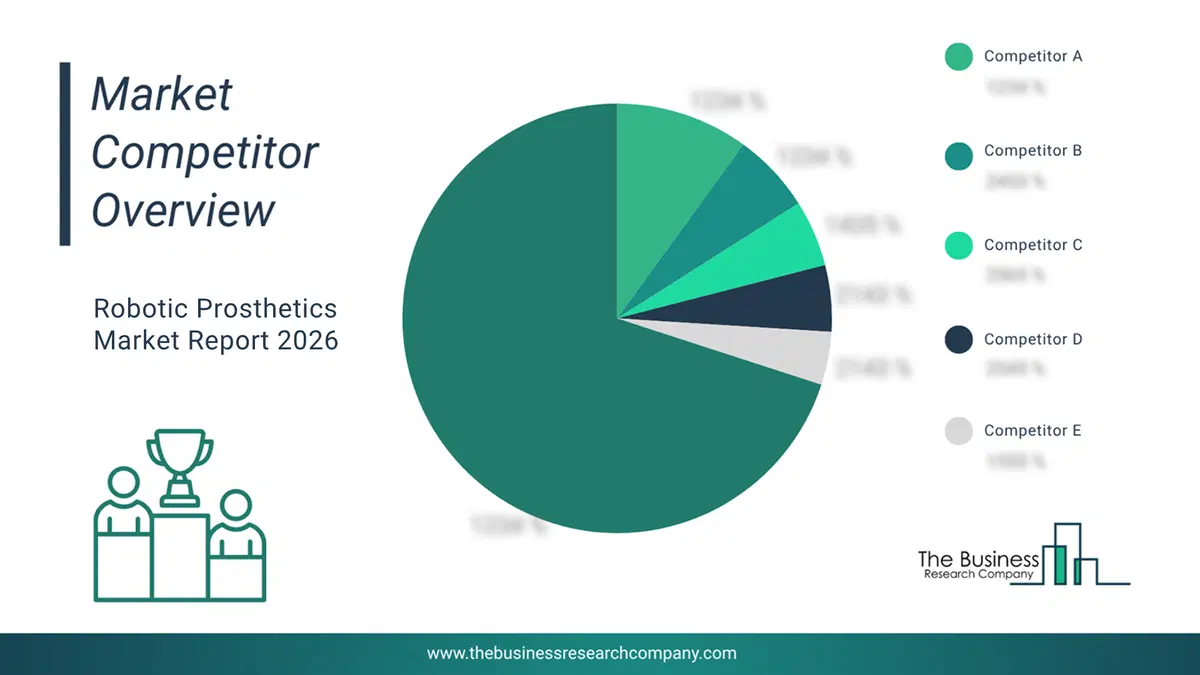
This chart is for illustrative purposes; the full report includes a detailed competitor analysis and comprehensive overview of the top 10 companies in the market.
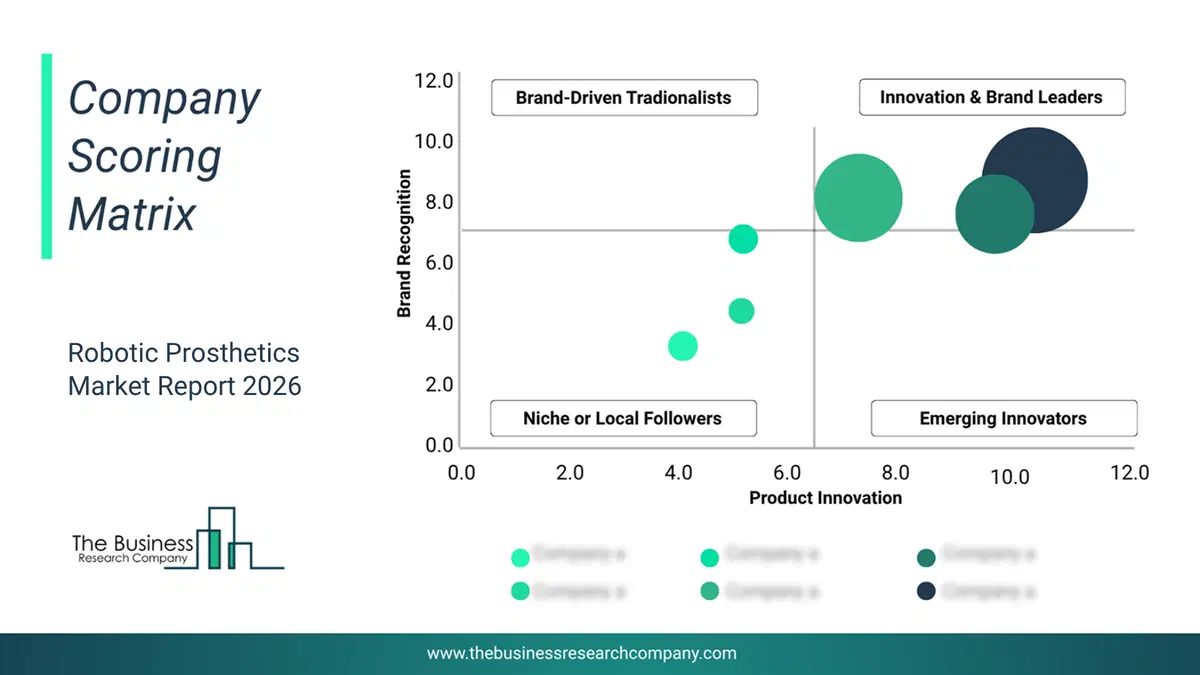
This chart maps companies by product innovation and brand strength, with bubble size indicating relative revenue, helping identify market leaders, challengers, and niche players. This is an illustrative chart; the full report provides a complete and accurate competitive analysis.
Global Robotic Prosthetics Market Trends and Insights
Major companies operating in the robotic prosthetics market are focusing on developing innovative products such as osseointegrated bone-anchored prosthetic systems to enhance mobility, comfort, and long-term functionality for amputees. Osseointegrated bone-anchored prosthetic systems refer to advanced implant-based prosthetic technologies that directly connect an artificial limb to the skeletal structure, enabling improved stability, sensory feedback, and range of motion compared to traditional socket-based prosthetics. For instance, in April 2023, Integrum, a Sweden-based company that manufactures medical equipment, received approval for its OPRA Implant System in Australia. OPRA Implant System is a unique bone-anchored prosthesis that uses osseointegration to attach the prosthesis to the human body and is an innovative method that allows the direct connection of an artificial limb to the skeleton. Additionally, the patent claims of the product extend beyond transfemoral applications to include treatment in other types of long bone prosthetic applications, such as the upper arm or lower leg.What Are Latest Mergers And Acquisitions In The Robotic Prosthetics Market?
In April 2023, ARCH Medical Solutions, a US-based provider of precision medical device contract manufacturing services, acquired American Prosthetic Components for an undisclosed amount. With this acquisition, ARCH Medical Solutions aims to expand its product diversification and strengthen its position in the prosthetic components market by adding high-quality modular prosthetic systems to its broader medical manufacturing portfolio. American Prosthetic Components is a US-based provider of engineered modular prosthetic components manufactured in aluminum, stainless steel, titanium, and plastics and designed to meet ISO and CE performance standards for global distribution.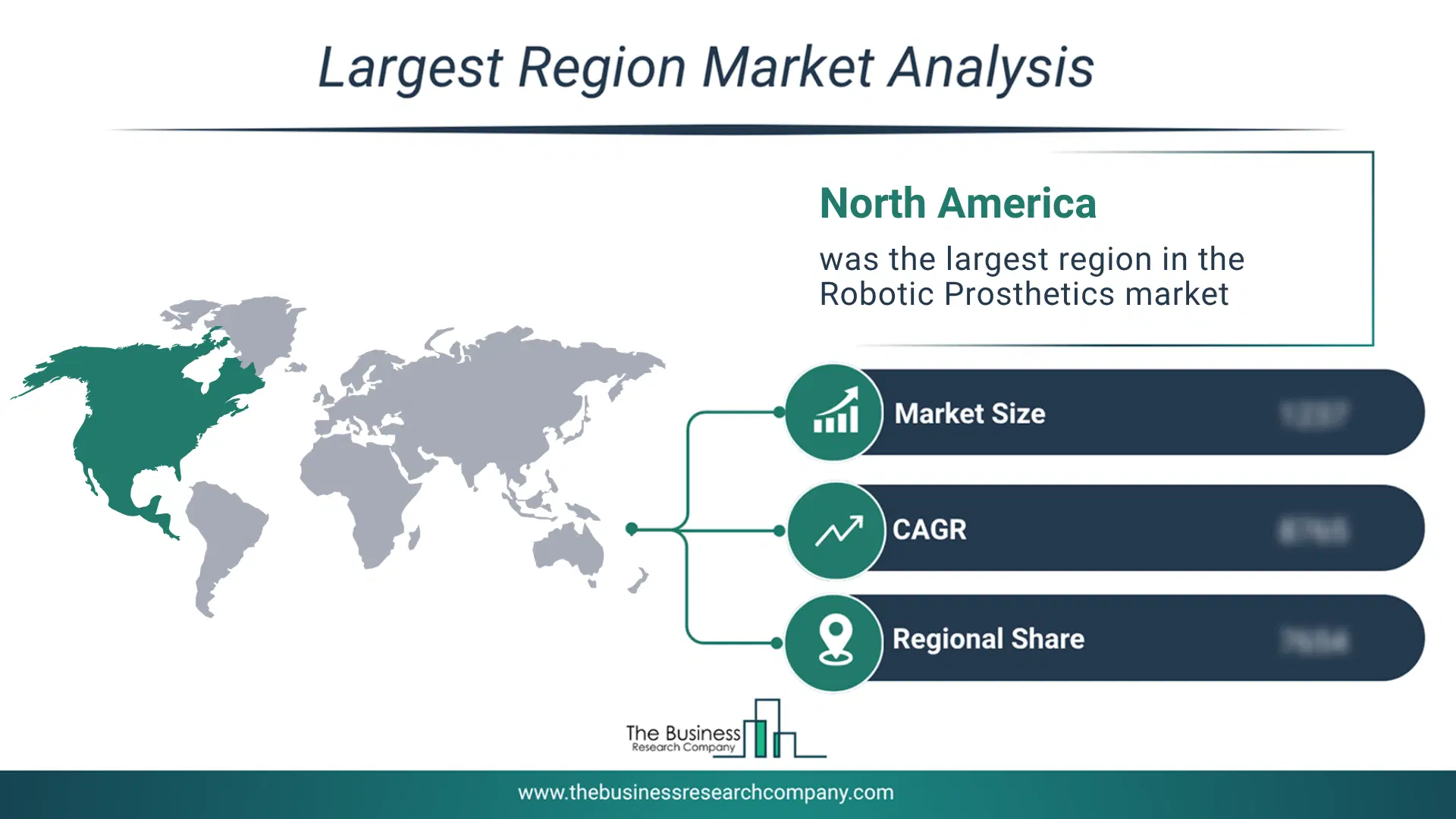
Regional Outlook
North America was the largest region in the robotic prosthetics market in 2025. Asia-Pacific is expected to be the fastest-growing region in the forecast period. The regions covered in this market report are Asia-Pacific, South East Asia, Western Europe, Eastern Europe, North America, South America, Middle East, Africa. The countries covered in this market report are Australia, Brazil, China, France, Germany, India, Indonesia, Japan, Taiwan, Russia, South Korea, UK, USA, Canada, Italy, Spain.What Defines the Robotic Prosthetics Market?
The robotic prosthetics market consists of revenues earned by entities by providing prosthetic maintenance and support such as training and rehabilitation and regular checkups. The market value includes the value of related goods sold by the service provider or included within the service offering. The robotic prosthetics market also includes sales of bionic limbs, upper limb prosthetics, lower limb prosthetics and microprocessor-controlled prosthetics. Values in this market are ‘factory gate’ values, that is the value of goods sold by the manufacturers or creators of the goods, whether to other entities (including downstream manufacturers, wholesalers, distributors and retailers) or directly to end customers. The value of goods in this market includes related services sold by the creators of the goods.How is Market Value Defined and Measured?
The market value is defined as the revenues that enterprises gain from the sale of goods and/or services within the specified market and geography through sales, grants, or donations in terms of the currency (in USD unless otherwise specified). The revenues for a specified geography are consumption values that are revenues generated by organizations in the specified geography within the market, irrespective of where they are produced. It does not include revenues from resales along the supply chain, either further along the supply chain or as part of other products.
This chart presents market attractiveness based on a quantitative evaluation of growth, competition, strategic alignment, and risk, offering a clear view of opportunity areas for decision-making. This chart is for illustrative purposes; the full report contains the complete analysis.

This chart highlights the Total Addressable Market (TAM) by estimating the maximum revenue opportunity using an assumption-driven approach, supporting strategic planning and opportunity sizing across markets. The chart is illustrative; the full report provides a more comprehensive analysis.
What Key Data and Analysis Are Included in the Robotic Prosthetics Market Report 2026?
The robotic prosthetics market research report is one of a series of new reports from The Business Research Company that provides market statistics, including industry global market size, regional shares, competitors with the market share, detailed market segments, market trends and opportunities, and any further data you may need to thrive in the robotic prosthetics industry. The market research report delivers a complete perspective of everything you need, with an in-depth analysis of the current and future state of the industry.Robotic Prosthetics Market Report Forecast Analysis
| Report Attribute | Details |
|---|---|
| Market Size Value In 2026 | $2.08 billion |
| Revenue Forecast In 2030 | $3.23 billion |
| Growth Rate | CAGR of 11.7% from 2026 to 2030 |
| Base Year For Estimation | 2025 |
| Actual Estimates/Historical Data | 2020-2025 |
| Forecast Period | 2026 - 2030 |
| Market Representation | Revenue in USD Billion and CAGR from 2026 to 2030 |
| Segments Covered | Product Type, Technology, Extremity, End User |
| Regional Scope | Asia-Pacific, Western Europe, Eastern Europe, North America, South America, Middle East, Africa |
| Country Scope | The countries covered in the report are Australia, Brazil, China, France, Germany, India, Indonesia, Japan, Taiwan, Russia, South Korea, UK, USA, Canada, Italy, Spain |
| Key Companies Profiled | Ottobock SE And Co KGaA, Ossur hf, Blatchford Limited, DEKA Research And Development Corp, Cyberdyne Inc, College Park Industries Inc, Touch Bionics Ltd, Myomo Inc, Kinova Inc, Open Bionics Ltd, Sarcos Technology And Robotics Corporation, SynTouch LLC, Ekso Bionics Holdings Inc, Fillauer LLC, WillowWood Global LLC, Shadow Robot Company Limited, Infinite Biomedical Technologies LLC, Marsi Bionics SL, Aether Biomedical Pvt Ltd, Coapt LLC, Esper Bionics Inc, Psyonic Inc, Vincent Systems GmbH, Steeper Group Ltd |
| Customization Scope | Request for Customization |
| Pricing And Purchase Options | Explore Purchase Options |