

Robotic Vision Market Report 2026
Global Outlook – By Component (Hardware, Software), By Technology (2D Vision, 3D Vision), By Industry (Electrical And Electronics, Metals And Machinery, Precision Engineering And Optics, Automotive, Pharmaceuticals And Cosmetics, Food And Beverages, Chemical, Rubber, And Plastic, Other Industries) – Market Size, Trends, Strategies, and Forecast to 2030
Robotic Vision Market Overview
• Robotic Vision market size has reached to $2.73 billion in 2025 • Expected to grow to $4.36 billion in 2030 at a compound annual growth rate (CAGR) of 9.6% • Growth Driver: The Booming Demand For Smart Cameras Fuels The Evolution Of Robotic Vision • Market Trend: The Technological Evolution Of Robotic Vision • Asia-Pacific was the largest region in 2025 and North America is the fastest growing region.What Is Covered Under Robotic Vision Market?
Robotic vision enables a robot to see, which includes a number of calibrated algorithms, calibration, and even temperature detection sensors, all of which have different levels of complexity and use. The main robotic vision components include hardware and software. Hardware is used for sensing and digitizing tasks that need the input of visual data using a camera that is trained on the object of interest. The hardware refers to the tangible elements of a computer and similar gadgets are their physical components. The different robotic vision technologies include 2D vision and 3D vision, used by industries including electrical and electronics, metals and machinery, precision engineering and optics, automotive, pharmaceuticals and cosmetics, food and beverages, chemical, rubber, and plastic and others.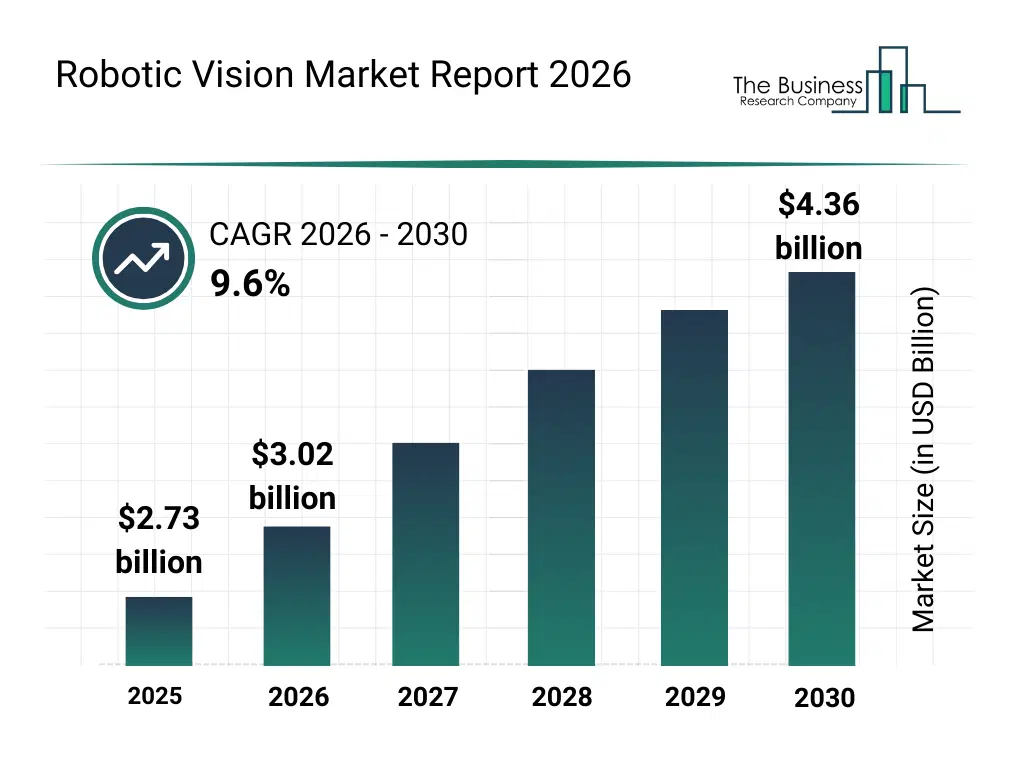
What Is The Robotic Vision Market Size and Share 2026?
The robotic vision market size has grown rapidly in recent years. It will grow from $2.73 billion in 2025 to $3.02 billion in 2026 at a compound annual growth rate (CAGR) of 10.4%. The growth in the historic period can be attributed to automation of manufacturing processes, rising demand for quality inspection systems, advancements in camera and sensor technologies, increasing use of robotics in production lines, expansion of industrial automation.What Is The Robotic Vision Market Growth Forecast?
The robotic vision market size is expected to see strong growth in the next few years. It will grow to $4.36 billion in 2030 at a compound annual growth rate (CAGR) of 9.6%. The growth in the forecast period can be attributed to increasing investments in smart factories, rising demand for vision-enabled autonomous robots, expansion of ai-driven inspection systems, growing adoption of real-time image analytics, increasing integration of machine vision with industrial iot platforms. Major trends in the forecast period include increasing deployment of ai-based machine vision systems, rising adoption of 3D vision technologies, growing integration of vision-guided robotics, expansion of edge-based image processing solutions, enhanced focus on high-precision inspection.
Global Robotic Vision Market Segmentation
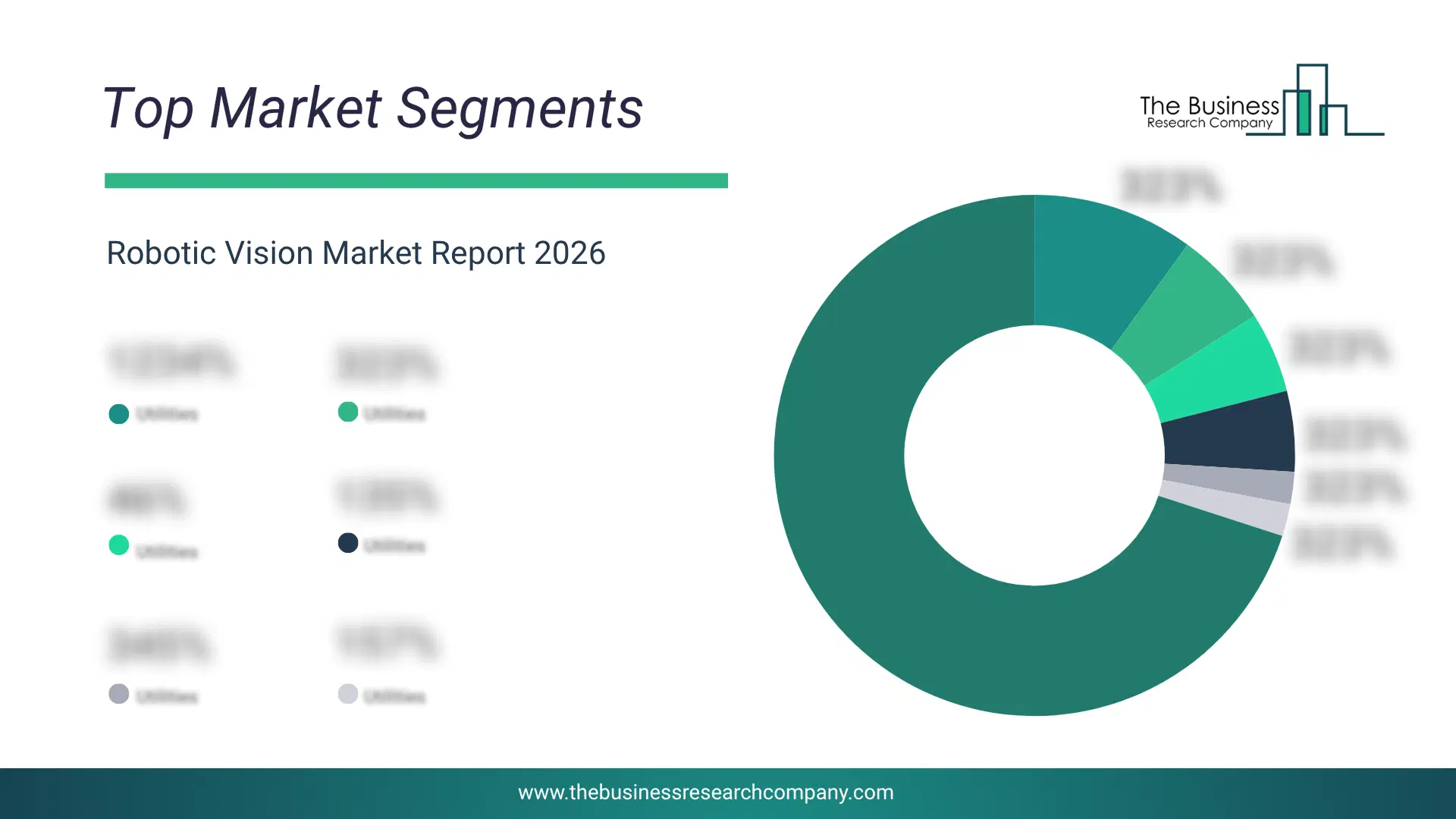
1) By Component: Hardware, Software 2) By Technology: 2D Vision, 3D Vision 3) By Industry: Electrical And Electronics, Metals And Machinery, Precision Engineering And Optics, Automotive, Pharmaceuticals And Cosmetics, Food And Beverages, Chemical, Rubber, And Plastic, Other Industries Subsegments: 1) By Hardware: Cameras (2D And 3D), Image Sensors, Lighting Systems, Processing Units, Lenses And Optics 2) By Software: Image Processing Software, Machine Learning Algorithms, Computer Vision Software, Integration Software, Development PlatformsWhat Is The Driver Of The Robotic Vision Market?
The surging demand for smart cameras in robotic vision propels the growth of the robotic vision market. Smart cameras refer to the standard wireless cameras that are employed for more than recording video, taking pictures, and sending the content over a Wi-Fi network to a smartphone or cloud storage for archival purposes. For many common factory applications, smart camera devices provide a modular, standalone robotic vision solution that is straightforward to use and integrate. For instance, in July 2023, according to a report published by DataProt, a US-based platform that is dedicated to cybersecurity and online protection, smart home camera systems have been growing in popularity across the globe, with almost 98.8 million households worldwide using them. This number is expected to double by 2027 to about 180.7 million households. Thus, the surging demand for smart cameras in robotic vision is driving the growth of the robotic vision industry.Key Players In The Global Robotic Vision Market
Major companies operating in the robotic vision market are Cognex Corporation; Omron Corporation; Keyence Corporation; Teledyne DALSA; Tordivel AS; ISRA VISION AG; Basler AG; SICK AG; Hexagon AB; Yaskawa Electric Corporation; Fanuc America Corporation; ABB Ltd.; MVTEC Software GmbH; Kawasaki Heavy Industries Ltd.; Acieta LLC; Nikon Metrology NV; KUKA AG; Robert Bosch; Intel Corporation; National Instruments Corporation; DENSO Corporation; Mitsubishi Electric Corporation; Universal Robots A/S; Nachi Fujikoshi Corp.; Stäubli International AG; Yamaha Robotics; Toshiba Machine Co. Ltd.; Adept Technology Inc.; Scape Technologies A/S; Blue River Technology Inc.; Sight Machine Inc.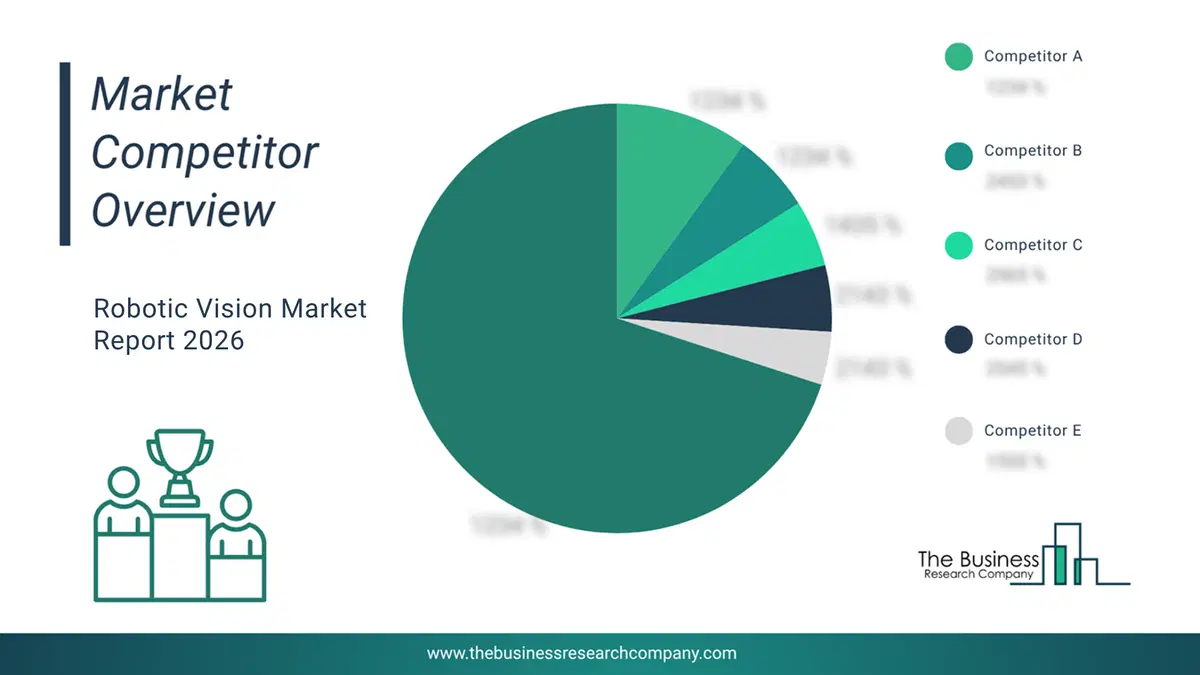
This chart is for illustrative purposes; the full report includes a detailed competitor analysis and comprehensive overview of the top 10 companies in the market.
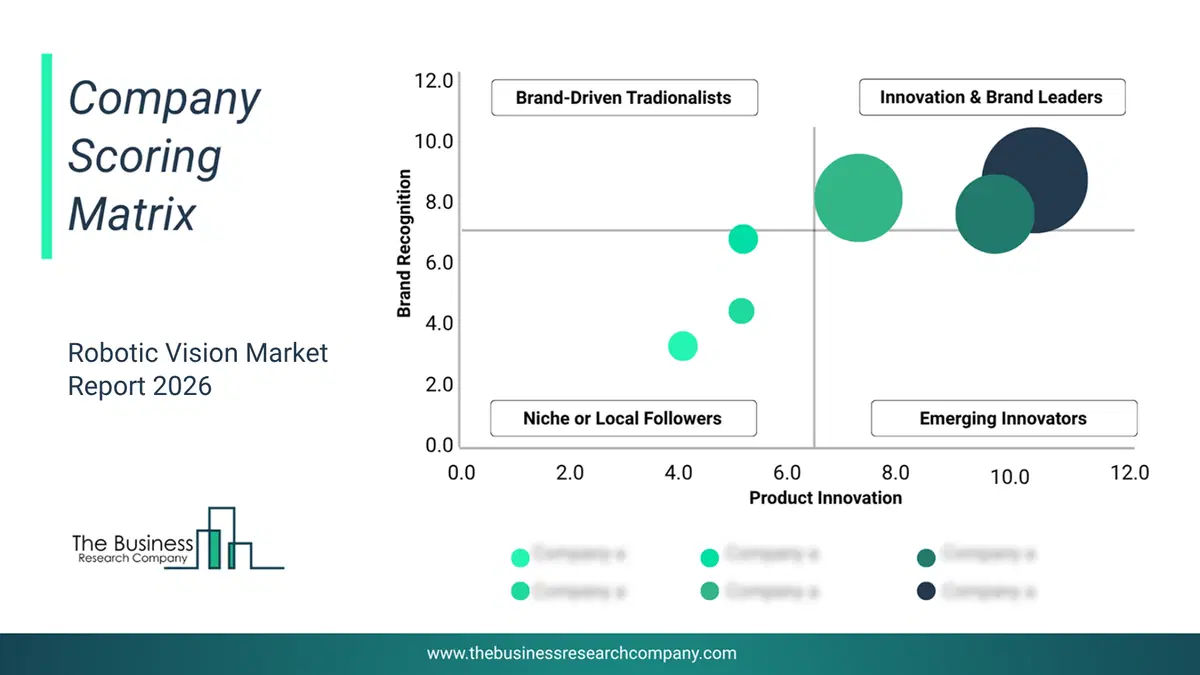
This chart maps companies by product innovation and brand strength, with bubble size indicating relative revenue, helping identify market leaders, challengers, and niche players. This is an illustrative chart; the full report provides a complete and accurate competitive analysis.
Global Robotic Vision Market Trends and Insights
Major companies operating in the robotic vision market are focused on introducing advanced industrial robot vision systems designed to enhance automation in manufacturing. An advanced industrial robot vision system refers to a sophisticated technology integrated into industrial robots that enables them to "see" and interpret their surroundings. The system functions at high speeds, boasts exceptional recognition abilities, and is user-friendly thanks to its innovative high-speed sensing technology. For instance, in May 2024, Nikon Corporation, a Japan-based company, launched NSP-150-1, NSP-250-1, and NSP-500-1, advanced industrial robot vision systems. The system utilizes image processing technology to attain high-speed measurements of up to 250 frames per second (fps) in both 2D and 3D formats. The system supports offline operations through cloud connectivity, allowing for centralized management of multiple robot vision systems.What Are Latest Mergers And Acquisitions In The Robotic Vision Market?
In March 2025, Zebra Technologies, a US-based technology company, acquired Photoneo for an undisclosed amount. Through this acquisition, Zebra aims to expand its presence in the 3D machine vision market and strengthen its capabilities in vision-guided robotics and intelligent automation. Photoneo is a Slovakia-based developer and manufacturer of 3D machine vision and intelligent automation solutions.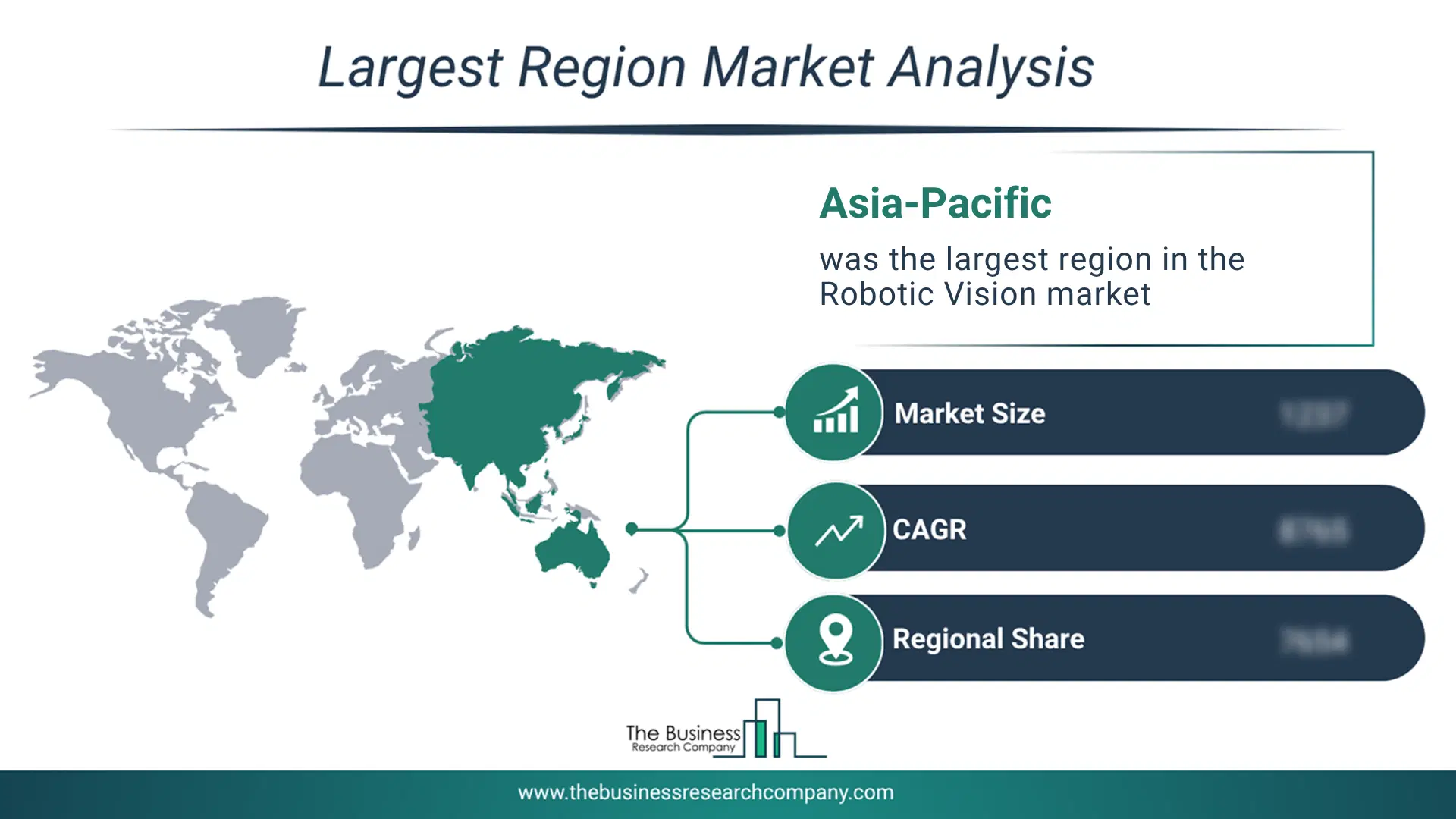
Regional Insights
Asia-Pacific was the largest region in the robotic vision market share in 2025. North America is expected to be the fastest-growing region in the forecast period. The regions covered in this market report are Asia-Pacific, South East Asia, Western Europe, Eastern Europe, North America, South America, Middle East, Africa. The countries covered in this market report are Australia, Brazil, China, France, Germany, India, Indonesia, Japan, Taiwan, Russia, South Korea, UK, USA, Canada, Italy, SpainWhat Defines the Robotic Vision Market?
The robotic vision market consists of revenues earned by entities by providing robotic vision products and services that are used by automated robotics to enhance object recognition, navigation, object discovery, inspection, and handling capabilities prior to application. The market value includes the value of related goods sold by the service provider or included within the service offering. The robotic vision market also includes the sales of one or more 2D area-scan or 3D camera units, defined LED/laser lighting, and vision software. Values in this market are ‘factory gate’ values, that is the value of goods sold by the manufacturers or creators of the goods, whether to other entities (including downstream manufacturers, wholesalers, distributors, and retailers) or directly to end customers. The value of goods in this market includes related services sold by the creators of the goods.How is Market Value Defined and Measured?
The market value is defined as the revenues that enterprises gain from the sale of goods and/or services within the specified market and geography through sales, grants, or donations in terms of the currency (in USD unless otherwise specified). The revenues for a specified geography are consumption values that are revenues generated by organizations in the specified geography within the market, irrespective of where they are produced. It does not include revenues from resales along the supply chain, either further along the supply chain or as part of other products.
This chart presents market attractiveness based on a quantitative evaluation of growth, competition, strategic alignment, and risk, offering a clear view of opportunity areas for decision-making. This chart is for illustrative purposes; the full report contains the complete analysis.

This chart highlights the Total Addressable Market (TAM) by estimating the maximum revenue opportunity using an assumption-driven approach, supporting strategic planning and opportunity sizing across markets. The chart is illustrative; the full report provides a more comprehensive analysis.
What Key Data and Analysis Are Included in the Robotic Vision Market Report 2026?
The robotic vision market research report is one of a series of new reports from The Business Research Company that provides market statistics, including industry global market size, regional shares, competitors with the market share, detailed market segments, market trends and opportunities, and any further data you may need to thrive in the robotic vision industry. The market research report delivers a complete perspective of everything you need, with an in-depth analysis of the current and future state of the industry.Robotic Vision Market Report Forecast Analysis
| Report Attribute | Details |
|---|---|
| Market Size Value In 2026 | $3.02 billion |
| Revenue Forecast In 2030 | $4.36 billion |
| Growth Rate | CAGR of 9.6% from 2026 to 2030 |
| Base Year For Estimation | 2025 |
| Actual Estimates/Historical Data | 2020-2025 |
| Forecast Period | 2026 - 2030 |
| Market Representation | Revenue in USD Billion and CAGR from 2026 to 2030 |
| Segments Covered | Component, Technology, Industry |
| Regional Scope | Asia-Pacific, Western Europe, Eastern Europe, North America, South America, Middle East, Africa |
| Country Scope | The Countries Covered In This Market Report Are Australia, Brazil, China, France, Germany, India, Indonesia, Japan, Taiwan, Russia, South Korea, Uk, Usa, Canada, Italy, Spain. |
| Key Companies Profiled | Cognex Corporation, Omron Corporation, Keyence Corporation, Teledyne DALSA, Tordivel AS, ISRA VISION AG, Basler AG, SICK AG, Hexagon AB, Yaskawa Electric Corporation, Fanuc America Corporation, ABB Ltd., MVTEC Software GmbH, Kawasaki Heavy Industries Ltd., Acieta LLC, Nikon Metrology NV, KUKA AG, Robert Bosch, Intel Corporation, National Instruments Corporation, DENSO Corporation, Mitsubishi Electric Corporation, Universal Robots A/S, Nachi Fujikoshi Corp., Stäubli International AG, Yamaha Robotics, Toshiba Machine Co. Ltd., Adept Technology Inc., Scape Technologies A/S, Blue River Technology Inc., Sight Machine Inc. |
| Customization Scope | Request for Customization |
| Pricing And Purchase Options | Explore Purchase Options |