
Robotic Warfare Market Report 2026
Global Outlook – By Type (Unmanned Platforms And Systems, Exoskeleton And Wearables, Target Acquisition Systems, Turret And Weapon Systems, Other Types), By Mode Of Operation (Autonomous, Semi Autonomous), By Platform (Land, Marine, Airborne), By Application (Intelligence, Surveillance And Reconnaissance, Combat Operations, Search And Rescue, Transportation, Mine Clearance, Explosive Ordnance Disposal, Firefighting), By End User (Military Forces, Homeland Security, Law Enforcement, Special Forces, Fire Departments) – Market Size, Trends, Strategies, and Forecast to 2030
Robotic Warfare Market Overview
• Robotic Warfare market size has reached to $37.59 billion in 2025 • Expected to grow to $59.38 billion in 2030 at a compound annual growth rate (CAGR) of 9.5% • Growth Driver: The Rise In Geopolitical Tensions Drives The Growth Of The Market Due To Escalating Global Conflicts And National Security Priorities • Market Trend: Cryptographically Secure Optical Identification Solution Enhances Battlefield Security • North America was the largest region and fastest growing region.What Is Covered Under Robotic Warfare Market?
Robotic warfare refers to the use of autonomous or remotely operated robotic systems in military operations for combat, surveillance, logistics, and support roles. These systems enhance battlefield efficiency while reducing human risk by performing tasks such as reconnaissance, target acquisition, and direct engagement. The main types of robotic warfare are unmanned platforms and systems, exoskeletons and wearables, target acquisition systems, turrets and weapon systems, and other types. Unmanned platforms and systems refer to vehicles or devices that operate without direct human control, typically using remote control, automation, or artificial intelligence for tasks in air, land, sea, or space environments. These systems can operate autonomously or semi-autonomously across land, sea, air, and even space domains. They are employed in a variety of missions, such as intelligence, surveillance, and reconnaissance (ISR), combat operations, search and rescue, transportation, mine clearance, explosive ordnance disposal (EOD), and firefighting. These technologies serve a wide range of end users, including military forces, homeland security agencies, law enforcement, special operations units, and fire departments.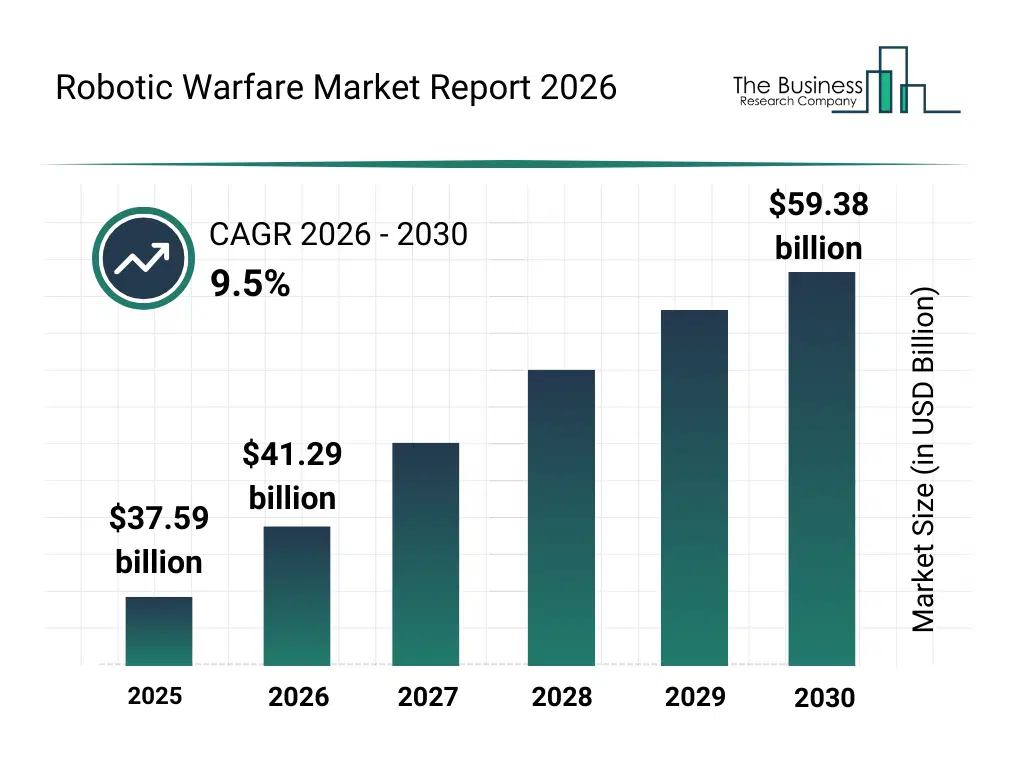
What Is The Robotic Warfare Market Size and Share 2026?
The robotic warfare market size has grown strongly in recent years. It will grow from $37.59 billion in 2025 to $41.29 billion in 2026 at a compound annual growth rate (CAGR) of 9.8%. The growth in the historic period can be attributed to increasing adoption of unmanned combat systems, rising investment in autonomous battlefield technologies, expansion of surveillance and reconnaissance robotics, reliance on imported electronic subsystems, growing demand for robotic logistics platforms.What Is The Robotic Warfare Market Growth Forecast?
The robotic warfare market size is expected to see strong growth in the next few years. It will grow to $59.38 billion in 2030 at a compound annual growth rate (CAGR) of 9.5%. The growth in the forecast period can be attributed to increasing development of AI powered combat platforms, rising integration of multi domain robotic systems, expansion of defense modernization programs, growth in autonomous mission support robotics, increasing innovation in secure robotic communication systems. Major trends in the forecast period include expansion of AI-driven combat autonomy, growth in multi-domain robotic platforms, deployment of secure cloud-connected warfare systems, adoption of advanced robotic manufacturing techniques, integration of IOT-enabled battlefield robotics.
Global Robotic Warfare Market Segmentation
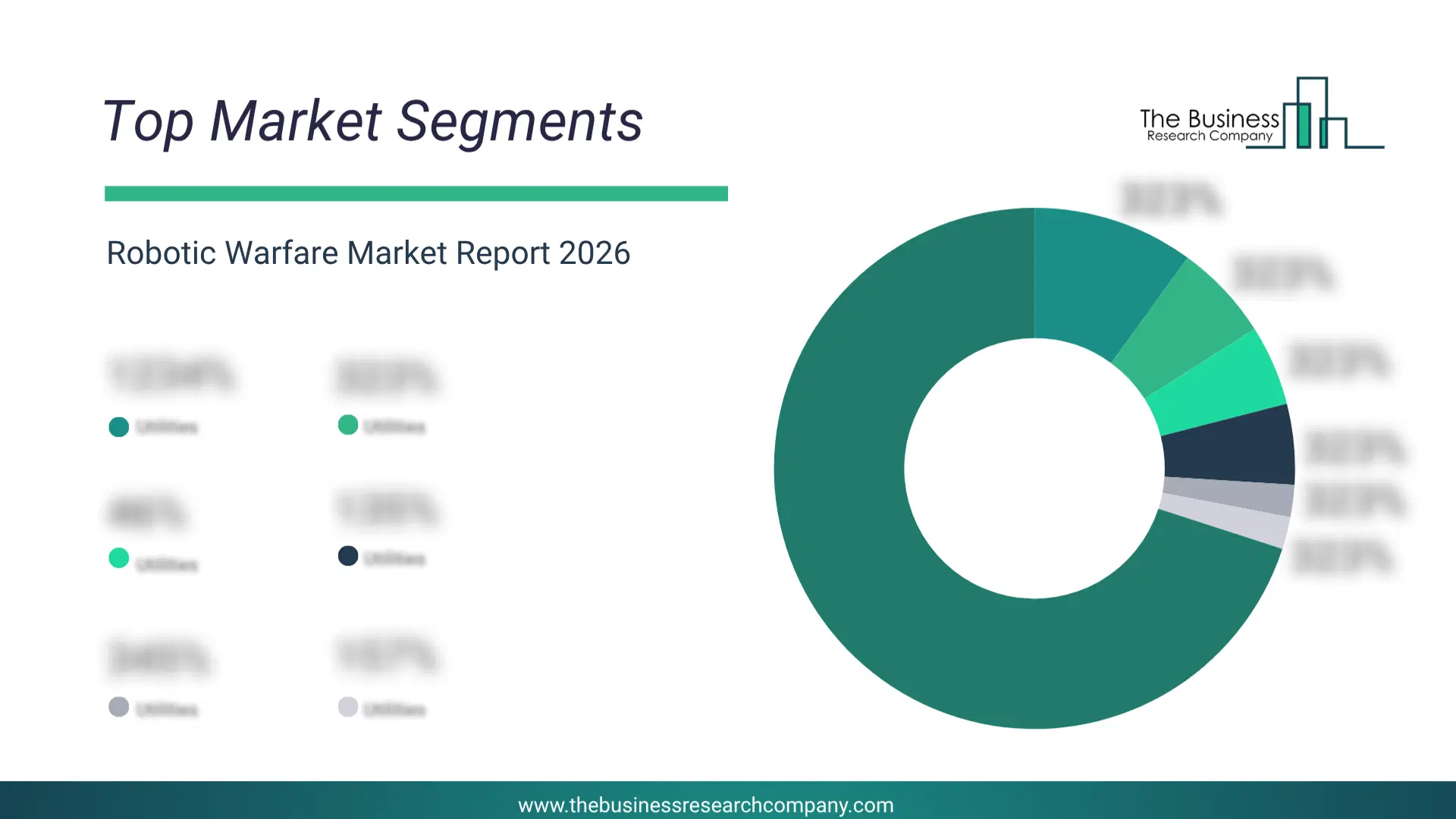
1) By Type: Unmanned Platforms And Systems, Exoskeleton And Wearables, Target Acquisition Systems, Turret And Weapon Systems, Other Types 2) By Mode Of Operation: Autonomous, Semi Autonomous 3) By Platform: Land, Marine, Airborne 4) By Application: Intelligence, Surveillance And Reconnaissance, Combat Operations, Search And Rescue, Transportation, Mine Clearance, Explosive Ordnance Disposal, Firefighting 5) By End User: Military Forces, Homeland Security, Law Enforcement, Special Forces, Fire Departments Subsegments: 1) By Unmanned Platforms And Systems: Autonomous Unmanned Ground Vehicles, Unmanned Aerial Vehicles (UAVs) Or Drones, Unmanned Surface Vehicles, Unmanned Underwater Vehicles, Hybrid Or Multidomain Robotic Systems 2) By Exoskeleton And Wearables: Powered Combat Exoskeletons, Load-Bearing Exosuits, Augmented Reality (AR) Combat Helmets, Sensor-Integrated Combat Wearables, Medical Or Support Wearables 3) By Target Acquisition Systems: Autonomous Target Recognition Systems, Electro-Optical Targeting Pods, Artificial Intelligence-Driven Surveillance Drones, Infrared And Thermal Imaging Systems, Radar-Based Targeting Systems 4) By Turret And Weapon Systems: Remote Weapon Stations (RWS), Autonomous Turret Systems, Artificial Intelligence-Based Fire Control Systems, Loitering Munitions (Suicide Drones), Robotic Sniper Platforms 5) By Other Types: Combat Robotics Software, C2 (Command and Control) Robotic Interfaces, Robotic Mine Clearance Systems, Logistics And Supply Robots, Training And Simulation RobotsWhat Is The Driver Of The Robotic Warfare Market?
The rising geopolitical tensions are expected to propel the growth of the robotic warfare market going forward. Geopolitical tensions refer to strained political, economic, or military relations between countries or regions, often arising from conflicting national interests, territorial disputes, or power struggles. Rising geopolitical tensions are due to territorial disputes that fuel national rivalries, military buildups, and diplomatic confrontations over contested borders or regions. Robotic warfare enhances a nation's military capabilities with advanced autonomous systems, thereby influencing power balances and acting as a strategic tool in managing or escalating geopolitical tensions. For instance, in January 2025, according to Euronews SA, a France-based television network, in 2024, global conflicts intensified, with political violence increasing by 25% compared to 2023, affecting one in eight people and resulting in around 223,000 deaths, alongside a 37% rise in overall fatalities. Therefore, the rising geopolitical tensions are driving the growth of the robotic warfare industry.Key Players In The Global Robotic Warfare Market
Major companies operating in the robotic warfare market are Raytheon Technologies Corporation, Lockheed Martin Corporation, Airbus Defence and Space GmbH, BAE Systems plc, Northrop Grumman Systems Corporation, Thales Group, Leonardo S.p.A., Textron Inc., Rheinmetall AG, Elbit Systems Ltd., Israel Aerospace Industries Ltd., Kongsberg Defence And Aerospace AS, QinetiQ Group plc, General Dynamics Land Systems Inc., Saab AB, Anduril Industries Inc., AeroVironment Inc., Shield AI Inc., Hanwha Defense Co. Ltd., Ghost Robotics Inc.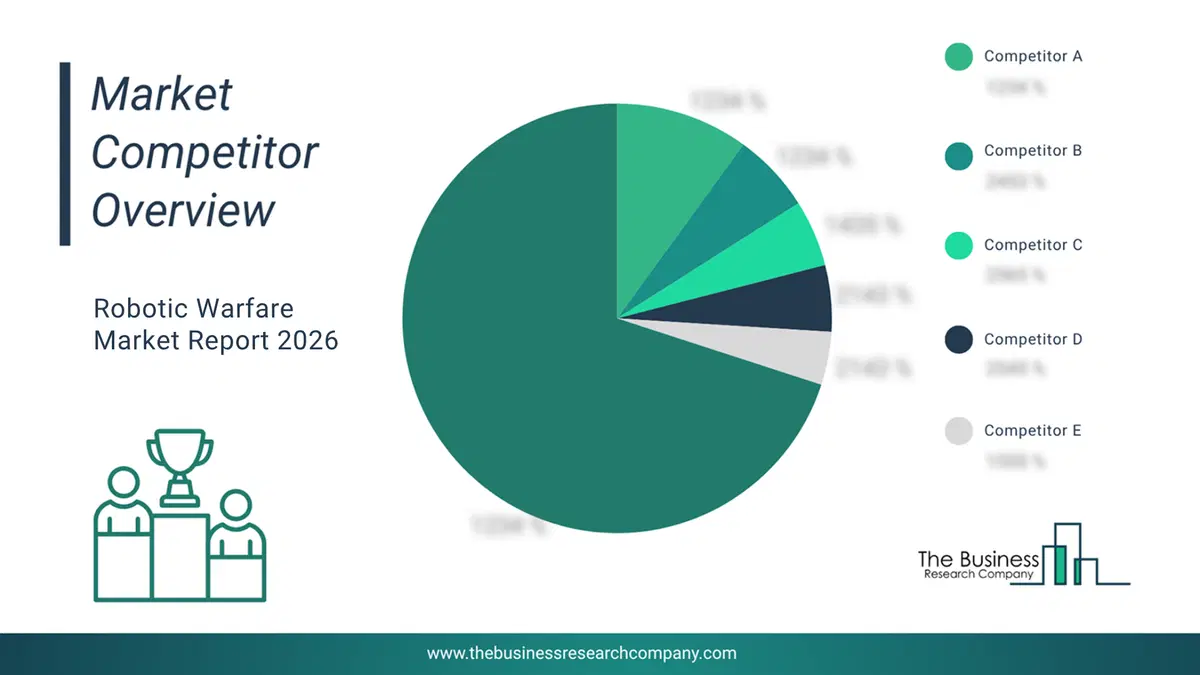
This chart is for illustrative purposes; the full report includes a detailed competitor analysis and comprehensive overview of the top 10 companies in the market.
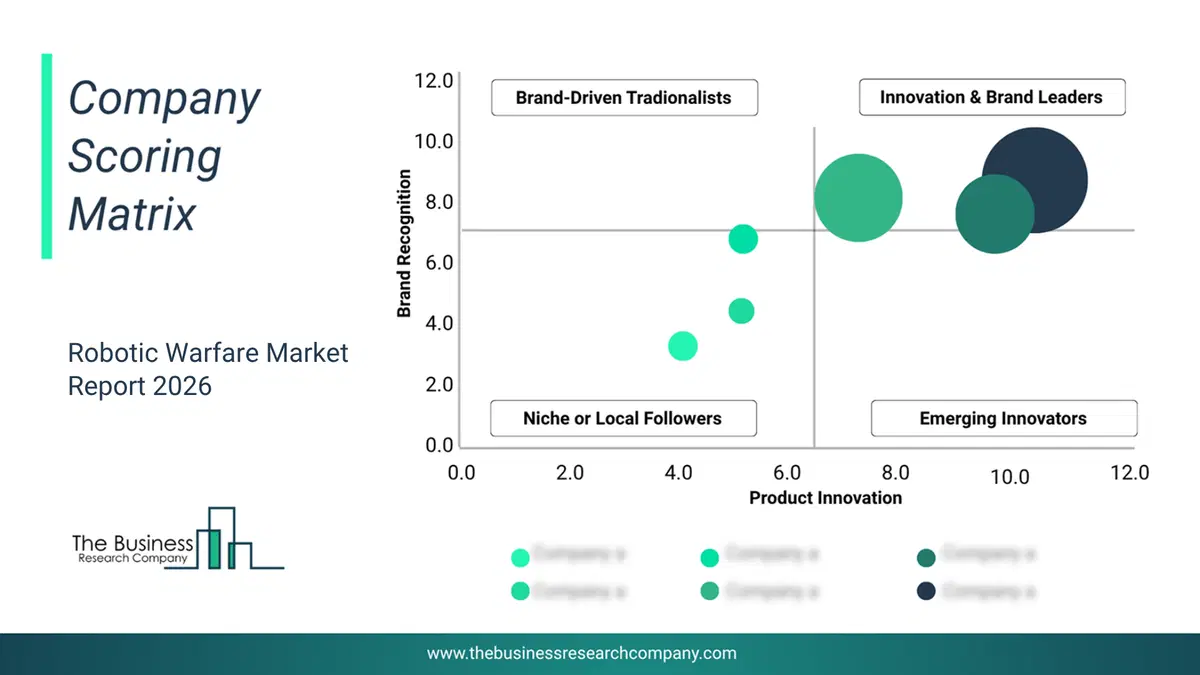
This chart maps companies by product innovation and brand strength, with bubble size indicating relative revenue, helping identify market leaders, challengers, and niche players. This is an illustrative chart; the full report provides a complete and accurate competitive analysis.
Global Robotic Warfare Market Trends and Insights
Major companies in the robotic warfare market are developing advanced solutions such as first-of-its-kind cryptographically secure systems to enable instantaneous and secure optical identification of drones and other unmanned platforms, addressing the vulnerabilities of traditional radio frequency (RF) identification methods that are prone to jamming, spoofing, and detection. The term refers to a pioneering system that employs advanced encryption to ensure trusted and tamper-proof operations. For example, in October 2025, Allen Control Systems, a U.S.-based defense technology company, launched the Friend and Foe Operating System (FAFOS)—a cryptographically secure, radio-silent, long-range optical drone identification solution. FAFOS uses modulated near-infrared optical signals to identify drones in under 200 milliseconds at distances of up to 2 kilometers, operating effectively in contested electromagnetic environments without relying on vulnerable RF channels. Designed for integration across multiple platforms, it offers a cost-effective, scalable solution that can reduce drone deconfliction challenges, enhance battlefield security, minimize friendly-fire risks, and complement ACS’s existing autonomous defense technologies like the Bullfrog weapon system.What Are Latest Mergers And Acquisitions In The Robotic Warfare Market?
In March 2023, SIG Sauer, Inc., a US-based defense and firearms company, acquired General Robotics for an undisclosed amount. With this acquisition, SIG Sauer, Inc., aims to become a comprehensive defense technology provider by integrating advanced firearms with robotic weapon systems to enhance battlefield mobility, lethality, and autonomy. General Robotics Ltd. is an Israeli-based defense technology company that specializes in developing tactical robotic systems for military, law enforcement, and homeland security applications.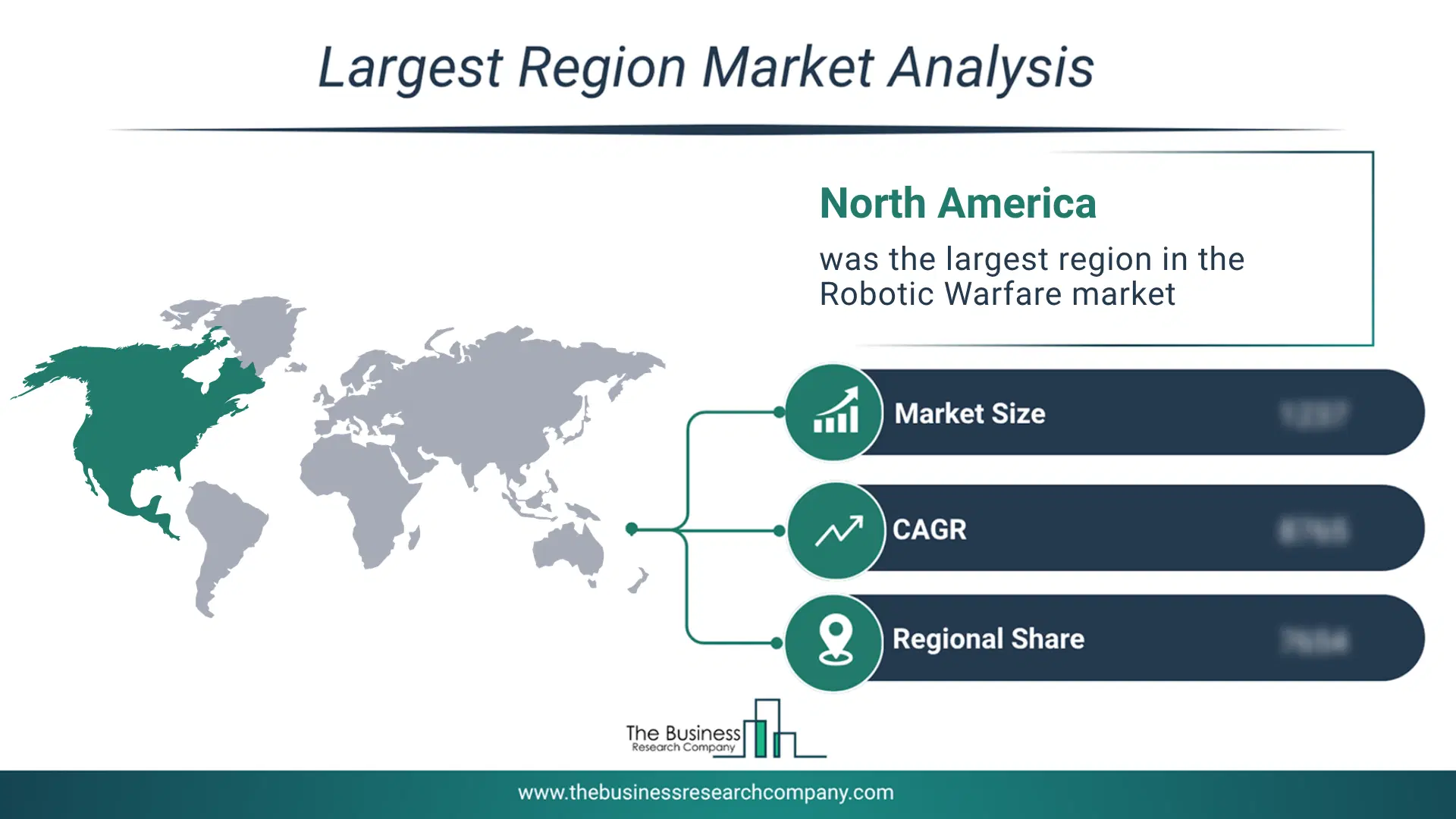
Regional Insights
North America was the largest region in the robotic warfare market in 2025. Asia-Pacific is expected to be the fastest-growing region in the forecast period. The regions covered in this market report are Asia-Pacific, South East Asia, Western Europe, Eastern Europe, North America, South America, Middle East, Africa. The countries covered in this market report are Australia, Brazil, China, France, Germany, India, Indonesia, Japan, Taiwan, Russia, South Korea, UK, USA, Canada, Italy, Spain.What Defines the Robotic Warfare Market?
The robotic warfare market consists of revenues earned by entities by providing services such as training and simulation, maintenance, repair, overhaul, and system integration services. The market value includes the value of related goods sold by the service provider or included within the service offering. The robotic warfare market also includes sales of autonomous ground combat robots, robotic mules and logistics carriers, underwater unmanned vehicles, swarm robots. Values in this market are ‘factory gate’ values, that is the value of goods sold by the manufacturers or creators of the goods, whether to other entities (including downstream manufacturers, wholesalers, distributors and retailers) or directly to end customers. The value of goods in this market includes related services sold by the creators of the goods.How is Market Value Defined and Measured?
The market value is defined as the revenues that enterprises gain from the sale of goods and/or services within the specified market and geography through sales, grants, or donations in terms of the currency (in USD unless otherwise specified). The revenues for a specified geography are consumption values that are revenues generated by organizations in the specified geography within the market, irrespective of where they are produced. It does not include revenues from resales along the supply chain, either further along the supply chain or as part of other products.
This chart presents market attractiveness based on a quantitative evaluation of growth, competition, strategic alignment, and risk, offering a clear view of opportunity areas for decision-making. This chart is for illustrative purposes; the full report contains the complete analysis.

This chart highlights the Total Addressable Market (TAM) by estimating the maximum revenue opportunity using an assumption-driven approach, supporting strategic planning and opportunity sizing across markets. The chart is illustrative; the full report provides a more comprehensive analysis.
What Key Data and Analysis Are Included in theRobotic Warfare Market Report 2026?
The robotic warfare market research report is one of a series of new reports from The Business Research Company that provides market statistics, including industry global market size, regional shares, competitors with the market share, detailed market segments, market trends and opportunities, and any further data you may need to thrive in the robotic warfare industry. The market research report delivers a complete perspective of everything you need, with an in-depth analysis of the current and future state of the industry.Robotic Warfare Market Report Forecast Analysis
| Report Attribute | Details |
|---|---|
| Market Size Value In 2026 | $41.29 billion |
| Revenue Forecast In 2030 | $59.38 billion |
| Growth Rate | CAGR of 9.8% from 2026 to 2030 |
| Base Year For Estimation | 2025 |
| Actual Estimates/Historical Data | 2020-2025 |
| Forecast Period | 2026 - 2030 |
| Market Representation | Revenue in USD Billion and CAGR from 2026 to 2030 |
| Segments Covered | Type, Mode Of Operation, Platform, Application, End User |
| Regional Scope | Asia-Pacific, Western Europe, Eastern Europe, North America, South America, Middle East, Africa |
| Country Scope | The countries covered in this market report are Australia, Brazil, China, France, Germany, India, Indonesia, Japan, Taiwan, Russia, South Korea, UK, USA, Canada, Italy, Spain |
| Key Companies Profiled | Raytheon Technologies Corporation, Lockheed Martin Corporation, Airbus Defence and Space GmbH, BAE Systems plc, Northrop Grumman Systems Corporation, Thales Group, Leonardo S.p.A., Textron Inc., Rheinmetall AG, Elbit Systems Ltd., Israel Aerospace Industries Ltd., Kongsberg Defence And Aerospace AS, QinetiQ Group plc, General Dynamics Land Systems Inc., Saab AB, Anduril Industries Inc., AeroVironment Inc., Shield AI Inc., Hanwha Defense Co. Ltd., Ghost Robotics Inc. |
| Customization Scope | Request for Customization |
| Pricing And Purchase Options | Explore Purchase Options |