
Robotic Welding Cell Market Report 2026
Global Outlook – By Cell Type (Pre-Engineered Modular Welding Cells, Custom Bespoke Welding Cells, Cell-As-A-Service Managed Automation), By Welding Process (Arc Welding, Resistance (Spot) Welding, Laser Or Plasma Welding), By Type Of Robot (Articulated Robots, SCARA Robots, Cartesian Robots, Collaborative Robots (Cobots) ), By Deployment Mode (Greenfield Integrated Lines, Retrofit Add-On Cells, Lease Managed Service) – Market Size, Trends, Strategies, and Forecast to 2030
Robotic Welding Cell Market Overview
• Robotic Welding Cell market size has reached to $3.84 billion in 2025 • Expected to grow to $7.08 billion in 2030 at a compound annual growth rate (CAGR) of 12.9% • Growth Driver: Rising Demand For Automation Fueling The Growth Of The Market Due To Need For Increasing Efficiency And Productivity • Market Trend: Next-Generation Welding Solution Boosts Automation And Quality • North America was the largest region in 2025 and Asia-Pacific is the fastest growing region.What Is Covered Under Robotic Welding Cell Market?
Robotic welding cells are automated workstations where robotic arms perform welding operations on components with high precision and consistency. They are typically enclosed or safety-monitored setups designed to handle repetitive welding tasks. These cells are used to increase production efficiency, ensure uniform weld quality, and reduce human exposure to hazardous welding environments. The main cell types of the robotic welding cell include pre-engineered modular welding cells, custom bespoke welding cells, and cell-as-a-service managed automation. Pre-engineered modular welding cells refer to standardized, ready-to-deploy robotic workstations designed for quick installation and integration into manufacturing lines, offering consistent performance, flexibility for multiple welding tasks, and optimized efficiency for small to medium production volumes. Multiple welding processes are arc welding, resistance (spot) welding, and laser or plasma welding. Various robot types are articulated robots, SCARA robots, Cartesian robots, and collaborative robots (cobots), and they are used by several deployment modes such as greenfield integrated lines, retrofit add-on cells, and lease managed service.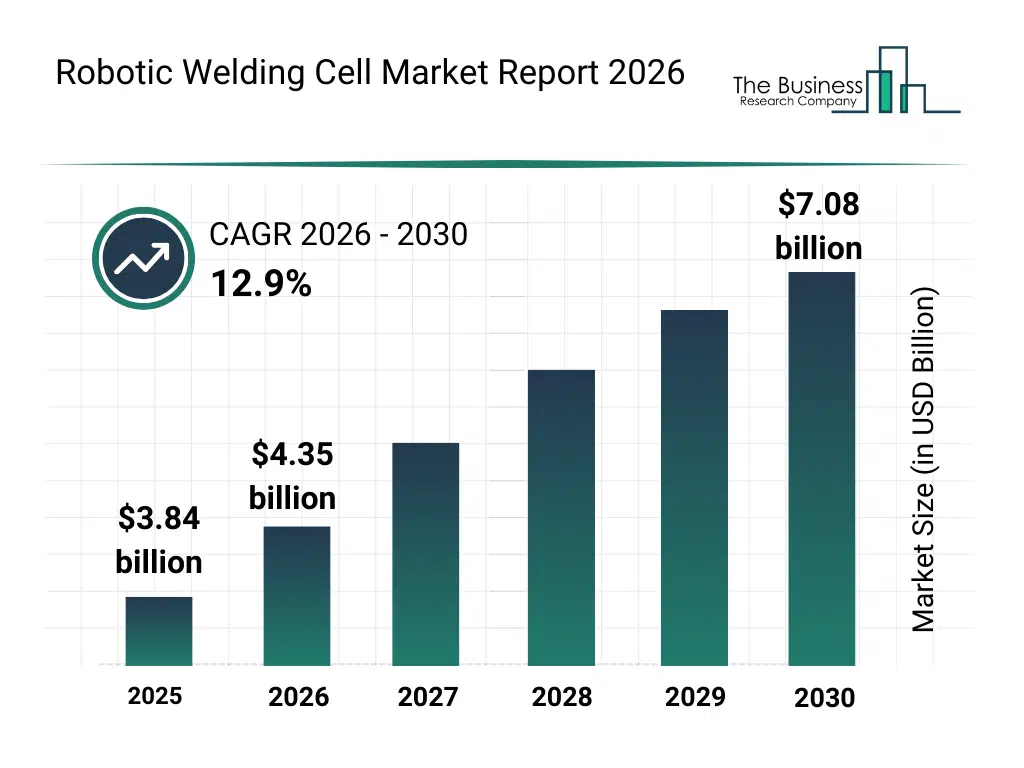
What Is The Robotic Welding Cell Market Size and Share 2026?
The robotic welding cell market size has grown rapidly in recent years. It will grow from $3.84 billion in 2025 to $4.35 billion in 2026 at a compound annual growth rate (CAGR) of 13.2%. The growth in the historic period can be attributed to Acute Labor Shortages and Skills Gap, Demand for High, Consistent Weld Quality, Adoption of Industry 4.0 and Smart Manufacturing, Cost Reduction and Increased Productivity, Focus on Workplace Safety and Compliance.What Is The Robotic Welding Cell Market Growth Forecast?
The robotic welding cell market size is expected to see rapid growth in the next few years. It will grow to $7.08 billion in 2030 at a compound annual growth rate (CAGR) of 12.9%. The growth in the forecast period can be attributed to Labor Shortages and Skills Gap, Rising Demand for High-Quality Welds, Growing Focus on Safety and Compliance, Increasing Automation (Industry 4.0) in Manufacturing, Technological Advancements (AI/ML) in Robotics. Major trends in the forecast period include rise of collaborative robots (Cobots), Real-Time Weld Defect Detection via AI/ML, Advanced Sensor Fusion and Adaptive Welding, Integration of Laser and Hybrid Welding, Off-Line Programming and Simulation.
Global Robotic Welding Cell Market Segmentation
1) By Cell Type: Pre-Engineered Modular Welding Cells, Custom Bespoke Welding Cells, Cell-As-A-Service Managed Automation 2) By Welding Process: Arc Welding, Resistance (Spot) Welding, Laser Or Plasma Welding 3) By Type Of Robot: Articulated Robots, SCARA Robots, Cartesian Robots, Collaborative Robots (Cobots) 4) By Deployment Mode: Greenfield Integrated Lines, Retrofit Add-On Cells, Lease Managed Service Subsegments: 1) By Pre Engineered Modular Welding Cells, Standard Single Robot Welding Cell, Dual Robot Welding Cell, Compact Footprint Welding Cell, High Throughput Production Welding Cell 2) By Custom Bespoke Welding Cells, Large Structure Welding Cell, Multi Process Welding Cell, Heavy Duty Industrial Welding Cell, Flexible Reconfigurable Welding Cell 3) By Cell As A Service Managed Automation, Subscription Based Welding Cell, Performance Based Welding Cell, Fully Managed Robotic Welding Cell, Scalable On Demand Welding CellWhat Is The Driver Of The Robotic Welding Cell Market?
The rising demand for automation is expected to propel the growth of the robotic welding cells market going forward. Automation refers to the use of technology or machines to perform tasks with minimal or no human intervention. The demand for automation is rising due to the need for increased operational efficiency as businesses aim to reduce costs, minimize errors, and boost productivity. Robotic welding cells enhance manufacturing automation by providing precise and consistent welding operations, making them ideal for high-volume and complex production environments. They reduce manual labor and errors by performing repetitive tasks efficiently, improving productivity and product quality. For instance, in September 2024, according to the International Federation of Robotics, a Germany-based non-profit organization, there were 4,281,585 robotic units operating in factories globally in 2023, marking a 10% increase from 3,904,000 units in 2022. Therefore, the rising demand for automation is driving the growth of the robotic welding cells industry.Key Players In The Global Robotic Welding Cell Market
Major companies operating in the robotic welding cell market are Siasun Robot & Automation Co. Ltd., Miller Electric Mfg. LLC, Panasonic Corporation, Mitsubishi Electric Corporation, ABB Ltd., AGR Robotics, Valk Welding B.V., SERVO-ROBOT Inc., Kawasaki Heavy Industries Ltd., Tiesse Robot S.p.A., FANUC Corporation, Cloos Robotic Welding Inc., Lincoln Electric Holdings Inc., Yaskawa Electric Corporation, KUKA AG, Staubli International AG, Nachi-Fujikoshi Corp., Daihen Corporation, Comau S.p.A., IGM Robotersysteme AG
This chart is for illustrative purposes; the full report includes a detailed competitor analysis and comprehensive overview of the top 10 companies in the market.
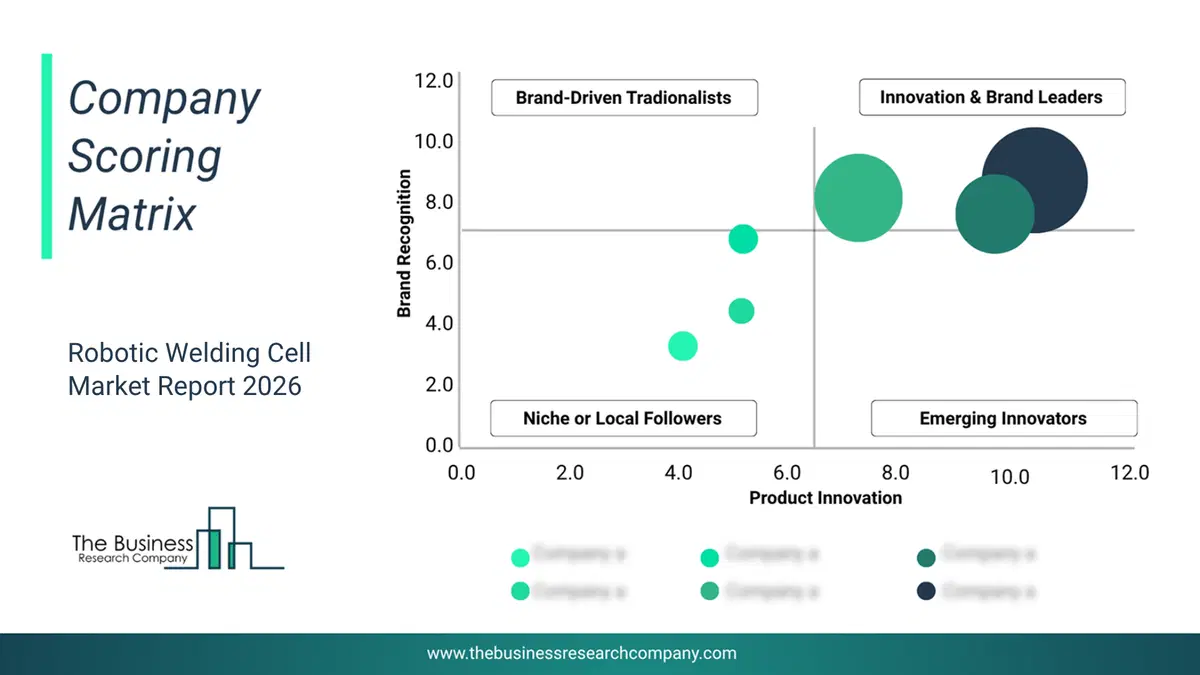
This chart maps companies by product innovation and brand strength, with bubble size indicating relative revenue, helping identify market leaders, challengers, and niche players. This is an illustrative chart; the full report provides a complete and accurate competitive analysis.
Global Robotic Welding Cell Market Trends and Insights
Major companies operating in the robotic welding cells market are focusing on developing advanced systems, such as AI-powered adaptive welding solutions, to boost efficiency, enhance quality, and reduce manual programming and material waste. AI-powered adaptive welding systems refer to advanced software and sensor suites that enable welding robots to see their environment and make real-time adjustments to parameters such as path, speed, and heat input. For instance, in May 2025, Novarc Technologies Inc., a Canada-based robotics and automation company, launched the NovAI system. It is a comprehensive AI-powered platform designed to bring advanced vision and real-time cognitive adaptation to articulated robotic and collaborative robot (cobot) welding cells. The system features a patented Spool Welding Robot (SWR) integrated with machine vision and AI algorithms that allow the robot to autonomously identify weld joints, calculate optimal torch angles and paths, and dynamically adapt to part variations and thermal distortion during the weld process without human intervention. It also incorporates predictive process analytics and continuous learning capabilities, significantly improving first-pass weld quality and reducing rework and operational costs for manufacturers.What Are Latest Mergers And Acquisitions In The Robotic Welding Cell Market?
In June 2024, The Lincoln Electric Company, a US-based welding and automation solutions company, acquired Inrotech A/S for an undisclosed amount. With this acquisition, Lincoln Electric aims to integrate Inrotech’s automated welding and robotics technology into its portfolio, thereby enhancing its capabilities in advanced fabrication solutions and increasing automation for complex welding applications. Inrotech A/S is a Denmark-based robotics company specializing in robotic welding cells and automated welding solutions.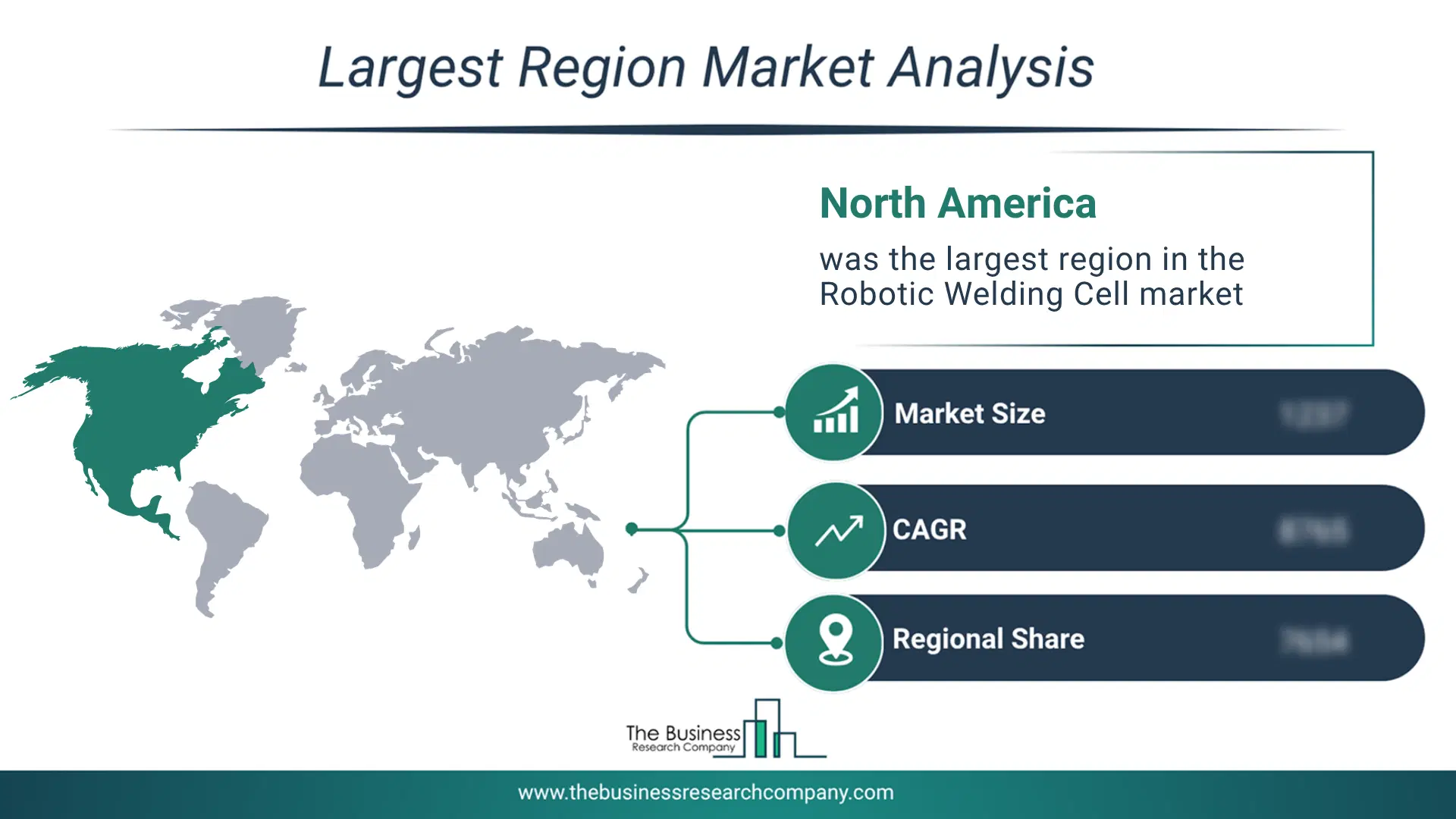
Regional Insights
North America was the largest region in the robotic welding cell market in 2025. Asia-Pacific is expected to be the fastest-growing region in the forecast period. The regions covered in this market report are Asia-Pacific, South East Asia, Western Europe, Eastern Europe, North America, South America, Middle East, Africa. The countries covered in this market report are Australia, Brazil, China, France, Germany, India, Indonesia, Japan, Taiwan, Russia, South Korea, UK, USA, Canada, Italy, Spain.What Defines the Robotic Welding Cell Market?
The robotic welding cells market consists of sales of automated welding robots, robotic arms, welding controllers, welding power sources, torches, fixtures and tooling, safety enclosures, conveyor systems, and related software and accessories. Values in this market are ‘factory gate’ values, that is, the value of goods sold by the manufacturers or creators of the goods, whether to other entities (including downstream manufacturers, wholesalers, distributors, and retailers) or directly to end customers. The value of goods in this market includes related services sold by the creators of the goods.How is Market Value Defined and Measured?
The market value is defined as the revenues that enterprises gain from the sale of goods and/or services within the specified market and geography through sales, grants, or donations in terms of the currency (in USD unless otherwise specified). The revenues for a specified geography are consumption values that are revenues generated by organizations in the specified geography within the market, irrespective of where they are produced. It does not include revenues from resales along the supply chain, either further along the supply chain or as part of other products.
This chart presents market attractiveness based on a quantitative evaluation of growth, competition, strategic alignment, and risk, offering a clear view of opportunity areas for decision-making. This chart is for illustrative purposes; the full report contains the complete analysis.

This chart highlights the Total Addressable Market (TAM) by estimating the maximum revenue opportunity using an assumption-driven approach, supporting strategic planning and opportunity sizing across markets. The chart is illustrative; the full report provides a more comprehensive analysis.
What Key Data and Analysis Are Included in the Robotic Welding Cell Market Report 2026?
The robotic welding cell market research report is one of a series of new reports from The Business Research Company that provides market statistics, including industry global market size, regional shares, competitors with the market share, detailed market segments, market trends and opportunities, and any further data you may need to thrive in the robotic welding cell industry. The market research report delivers a complete perspective of everything you need, with an in-depth analysis of the current and future state of the industry.Robotic Welding Cell Market Report Forecast Analysis
| Report Attribute | Details |
|---|---|
| Market Size Value In 2026 | $4.35 billion |
| Revenue Forecast In 2030 | $7.08 billion |
| Growth Rate | CAGR of 12.9% from 2026 to 2030 |
| Base Year For Estimation | 2025 |
| Actual Estimates/Historical Data | 2020-2025 |
| Forecast Period | 2026 - 2030 |
| Market Representation | Revenue in USD Billion and CAGR from 2026 to 2030 |
| Segments Covered | Cell Type, Welding Process, Type Of Robot, Deployment Mode |
| Regional Scope | Asia-Pacific, Western Europe, Eastern Europe, North America, South America, Middle East, Africa |
| Key Companies Profiled | Siasun Robot & Automation Co. Ltd., Miller Electric Mfg. LLC, Panasonic Corporation, Mitsubishi Electric Corporation, ABB Ltd., AGR Robotics, Valk Welding B.V., SERVO-ROBOT Inc., Kawasaki Heavy Industries Ltd., Tiesse Robot S.p.A., FANUC Corporation, Cloos Robotic Welding Inc., Lincoln Electric Holdings Inc., Yaskawa Electric Corporation, KUKA AG, Staubli International AG, Nachi-Fujikoshi Corp., Daihen Corporation, Comau S.p.A., IGM Robotersysteme AG |
| Customization Scope | Request for Customization |
| Pricing And Purchase Options | Explore Purchase Options |