

Robotic Wheelchairs Market Report 2026
Global Outlook – By Wheelchair (Rear-Wheel Drive, Front-Wheel Drive, Mid-Wheel Drive), By Application (Personal Use, Commercial Use), By Distribution Channel (Home Care Settings, Rehabilitation Centers, Online Sales Channel, Other Channels) - Market Size, Trends, Strategies, and Forecast to 2030
Robotic Wheelchairs Market Overview
• Robotic Wheelchairs market size has reached to $13.24 billion in 2025 • Expected to grow to $19.79 billion in 2030 at a compound annual growth rate (CAGR) of 8.4% • Growth Driver: Rising Patient Pool On The Robotic Wheel Chair Market • Market Trend: Advances in Robotic Wheelchairs Market • North America was the largest region in 2025 and Asia-Pacific is the fastest growing region.What Is Covered Under Robotic Wheelchairs Market?
Robotic wheelchairs are motorized mobility devices equipped with advanced technologies that assist users in navigating their environment. These technologies can include robotics for autonomous navigation, sensors for obstacle detection, and artificial intelligence (AI) for adaptive control and interaction. The primary purpose is to enhance the mobility, independence, and quality of life for individuals with physical disabilities or mobility impairment. The main types of wheelchairs in the robotic wheelchairs are rear-wheel drive, front-wheel drive, and mid-wheel drive. Robotic wheelchairs with rear-wheel drive systems are designed to excel outdoors, offering robust traction and stability on various surfaces such as gravel or grass. The various applications include personal use and commercial use, and distribution channels including home care settings, rehabilitation centers, online sales channel, and others.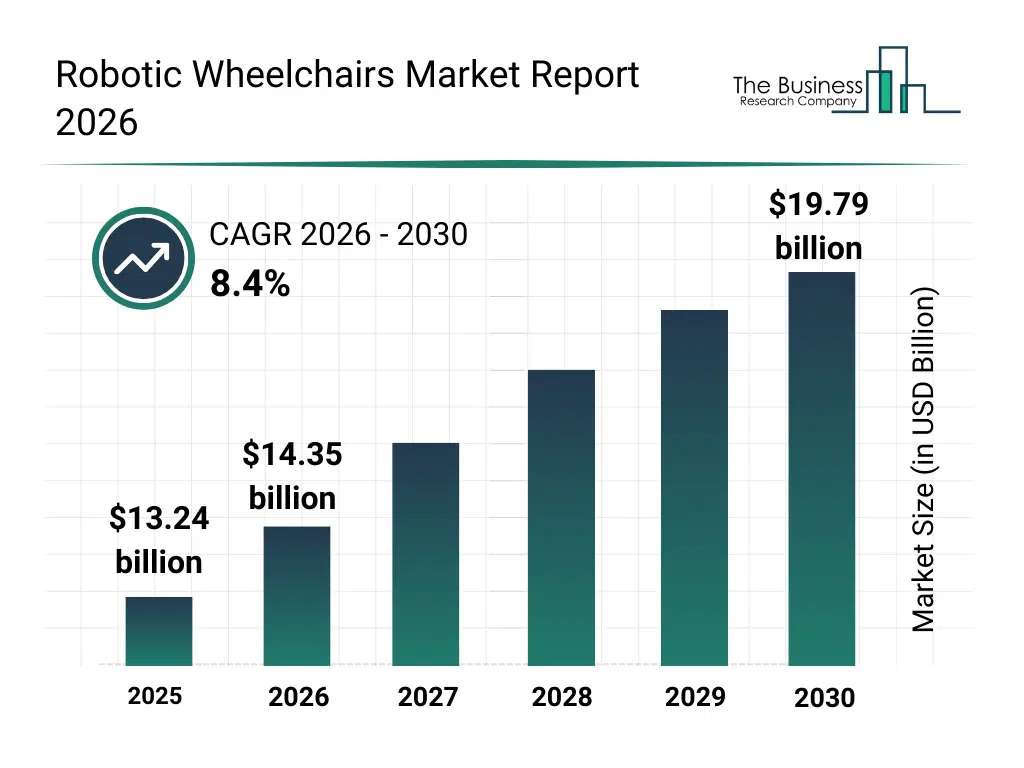
What Is The Robotic Wheelchairs Market Size and Share 2026?
The robotic wheelchairs market size has grown strongly in recent years. It will grow from $13.24 billion in 2025 to $14.35 billion in 2026 at a compound annual growth rate (CAGR) of 8.4%. The growth in the historic period can be attributed to rising prevalence of mobility impairments, increasing aging population, growing demand for assistive mobility devices, advancements in motorized wheelchair technologies, improved access to rehabilitation services.What Is The Robotic Wheelchairs Market Growth Forecast?
The robotic wheelchairs market size is expected to see strong growth in the next few years. It will grow to $19.79 billion in 2030 at a compound annual growth rate (CAGR) of 8.4%. The growth in the forecast period can be attributed to increasing adoption of smart assistive technologies, rising investments in AI-enabled mobility solutions, expansion of home-based care infrastructure, growing demand for personalized assistive devices, integration of cloud-connected mobility platforms. Major trends in the forecast period include increasing adoption of autonomous navigation wheelchairs, rising integration of obstacle detection sensors, growing demand for AI-based adaptive control systems, expansion of connected mobility assistive devices, enhanced focus on user independence and safety.

Global Robotic Wheelchairs Market Segmentation
1) By Wheelchair: Rear-Wheel Drive, Front-Wheel Drive, Mid-Wheel Drive 2) By Application: Personal Use, Commercial Use 3) By Distribution Channel: Home Care Settings, Rehabilitation Centers, Online Sales Channel, Other Channels Subsegments: 1) By Rear-Wheel Drive: Standard Rear-Wheel Drive Wheelchairs, Robotic Rear-Wheel Drive Wheelchairs 2) By Front-Wheel Drive: Standard Front-Wheel Drive Wheelchairs, Robotic Front-Wheel Drive Wheelchairs 3) By Mid-Wheel Drive: Standard Mid-Wheel Drive Wheelchairs, Robotic Mid-Wheel Drive WheelchairsWhat Is The Driver Of The Robotic Wheelchairs Market?
The rising patient pool is expected to propel the growth of the robotic wheelchair market going forward. The patient pool refers to the total number of patients or individuals within a specific demographic or healthcare setting who require medical care or attention. The rising patient pool is driven by factors such as population growth, aging demographics, and increased access to healthcare services. Robotic wheelchairs provide patients with enhanced mobility and independence, enabling them to navigate their environments with adaptive technology that compensates for physical limitations. For instance, in April 2025, according to the Australian Institute of Health and Welfare, an Australia-based government organization, reported that in 2023–24, public hospitals recorded 778,500 admissions from elective surgery waitlists, marking a 5.8% rise compared with 735,500 admissions in 2022–23. Therefore, a rising patient pool will grow the robotic wheelchair industry.Key Players In The Global Robotic Wheelchairs Market
Major companies operating in the robotic wheelchairs market are Honda Motor Co Ltd, Panasonic Corporation, Ottobock SE And Company, Invacare Corporation, Permobil Inc, Sunrise Medical Inc, Pride Mobility Products Corporation, DEKA Research And Development Corporation, Kinova Inc, Hoveround Corporation, Whill Inc, Merits Health Products Co Ltd, Shanghai Bangbang Robotics Co Ltd, Matia Mobility Inc, Karma Medical Products Co Ltd, Cyberworks Robotics Inc, Airwheel Holding Limited, Karman Healthcare Inc, Centaur Robotics Limited, Meyra GmbH, Upnride Robotics, Nino Robotics, LUCI Mobility, Robooter Technology Co Ltd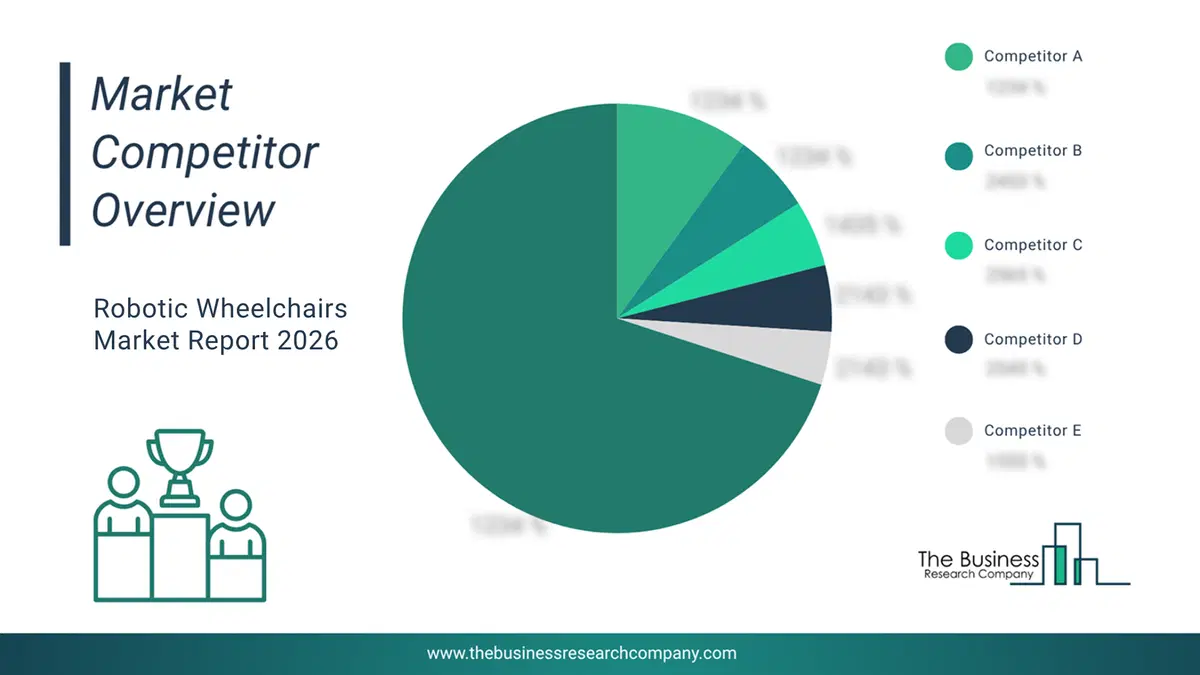
This chart is for illustrative purposes; the full report includes a detailed competitor analysis and comprehensive overview of the top 10 companies in the market.
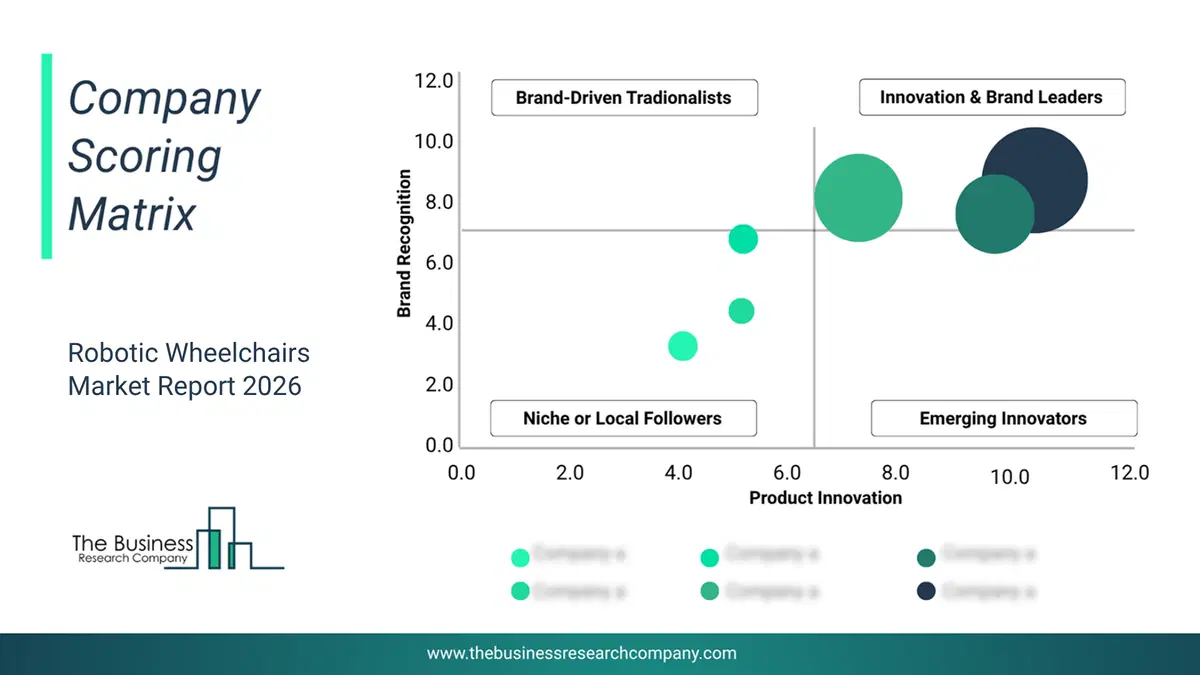
This chart maps companies by product innovation and brand strength, with bubble size indicating relative revenue, helping identify market leaders, challengers, and niche players. This is an illustrative chart; the full report provides a complete and accurate competitive analysis.
Global Robotic Wheelchairs Market Trends and Insights
Major companies operating in the robotic wheelchairs market are developing power wheelchairs with advanced features such as AI integration and autonomous navigation to improve mobility and independence for individuals with disabilities. Power wheelchairs are electrically powered mobility devices that assist individuals with mobility impairments by providing independent mobility. For instance, in January 2024, Robooter, a US-based medical equipment manufacturing company, showcased its innovative power wheelchair X40 at Consumer Electronics Show (CES 2024) in Las Vegas. The X40 is a semi-outdoor, electrically foldable wheelchair designed to address the challenges of lower limb mobility. The X40 includes omnidirectional wheels, remote control, and configurable maximum speed for safety. It provides ample legroom and smooth operation on various terrain without requiring a huge turning radius. It has a long-lasting battery and a user-friendly interface.What Are Latest Mergers And Acquisitions In The Robotic Wheelchairs Market?
In June 2024, Platinum Equity, a US-based private equity company, acquired Sunrise Medical for an undisclosed amount. The acquisition of Sunrise Medical by Platinum Equity aims to invest in advanced clinical mobility solutions tailored to individual needs. Sunrise Medical is a Germany-based medical equipment manufacturing company specializing in designing, manufacturing, and distributing advanced assistive mobility devices and solutions, including robotic wheelchairs.
Regional Outlook
North America was the largest region in the robotic wheelchairs market in 2025. Asia-Pacific is expected to be the fastest-growing region in the forecast period. The regions covered in this market report are Asia-Pacific, South East Asia, Western Europe, Eastern Europe, North America, South America, Middle East, Africa. The countries covered in this market report are Australia, Brazil, China, France, Germany, India, Indonesia, Japan, Taiwan, Russia, South Korea, UK, USA, Canada, Italy, Spain.What Defines the Robotic Wheelchairs Market?
The robotic wheelchairs market consists of sales of powered wheelchairs, smart wheelchairs, and portable wheelchairs. Values in this market are ‘factory gate’ values, that is the value of goods sold by the manufacturers or creators of the goods, whether to other entities (including downstream manufacturers, wholesalers, distributors and retailers) or directly to end customers. The value of goods in this market includes related services sold by the creators of the goods.How is Market Value Defined and Measured?
The market value is defined as the revenues that enterprises gain from the sale of goods and/or services within the specified market and geography through sales, grants, or donations in terms of the currency (in USD unless otherwise specified). The revenues for a specified geography are consumption values that are revenues generated by organizations in the specified geography within the market, irrespective of where they are produced. It does not include revenues from resales along the supply chain, either further along the supply chain or as part of other products.
This chart presents market attractiveness based on a quantitative evaluation of growth, competition, strategic alignment, and risk, offering a clear view of opportunity areas for decision-making. This chart is for illustrative purposes; the full report contains the complete analysis.

This chart highlights the Total Addressable Market (TAM) by estimating the maximum revenue opportunity using an assumption-driven approach, supporting strategic planning and opportunity sizing across markets. The chart is illustrative; the full report provides a more comprehensive analysis.
What Key Data and Analysis Are Included in the Robotic Wheelchairs Market Report 2026?
The robotic wheelchairs market research report is one of a series of new reports from The Business Research Company that provides market statistics, including industry global market size, regional shares, competitors with the market share, detailed market segments, market trends and opportunities, and any further data you may need to thrive in the robotic wheelchairs industry. The market research report delivers a complete perspective of everything you need, with an in-depth analysis of the current and future state of the industry.Robotic Wheelchairs Market Report Forecast Analysis
| Report Attribute | Details |
|---|---|
| Market Size Value In 2026 | $14.35 billion |
| Revenue Forecast In 2030 | $19.79 billion |
| Growth Rate | CAGR of 8.4% from 2026 to 2030 |
| Base Year For Estimation | 2025 |
| Actual Estimates/Historical Data | 2020-2025 |
| Forecast Period | 2026 - 2030 |
| Market Representation | Revenue in USD Billion and CAGR from 2026 to 2030 |
| Segments Covered | Wheelchair, Application, Distribution Channel |
| Regional Scope | Asia-Pacific, Western Europe, Eastern Europe, North America, South America, Middle East, Africa |
| Country Scope | The countries covered in the report are Australia, Brazil, China, France, Germany, India, Indonesia, Japan, Taiwan, Russia, South Korea, UK, USA, Canada, Italy, Spain |
| Key Companies Profiled | Honda Motor Co Ltd, Panasonic Corporation, Ottobock SE And Company, Invacare Corporation, Permobil Inc, Sunrise Medical Inc, Pride Mobility Products Corporation, DEKA Research And Development Corporation, Kinova Inc, Hoveround Corporation, Whill Inc, Merits Health Products Co Ltd, Shanghai Bangbang Robotics Co Ltd, Matia Mobility Inc, Karma Medical Products Co Ltd, Cyberworks Robotics Inc, Airwheel Holding Limited, Karman Healthcare Inc, Centaur Robotics Limited, Meyra GmbH, Upnride Robotics, Nino Robotics, LUCI Mobility, Robooter Technology Co Ltd |
| Customization Scope | Request for Customization |
| Pricing And Purchase Options | Explore Purchase Options |