
Robotics Carrier Boards Market Report 2026
Global Outlook – By Product Type (Single Board, Multi-Board, Custom Carrier Boards ), By Distribution Channel (Direct Sales, Distributors, Online Retail ), By Application (Industrial Robotics, Service Robotics, Medical Robotics, Educational Robotics, Other Applications ), By End-Users (Manufacturing, Healthcare, Automotive, Aerospace And Defense, Research And Academia, Other End-Users ) – Market Size, Trends, Strategies, and Forecast to 2035
Robotics Carrier Boards Market Overview
• Robotics Carrier Boards market size has reached to $1.58 billion in 2025 • Expected to grow to $3.05 billion in 2030 at a compound annual growth rate (CAGR) of 14.1% • Growth Driver: Rising Adoption Of Smart Manufacturing And Industry 4.0 Automation Driving The Market Growth Due To Increasing Demand For Intelligent Embedded Computing Solutions • Market Trend: Advanced Carrier Board Solutions Enable High-Performance AI Robotics Platforms • North America was the largest region in 2025 and Asia-Pacific is the fastest growing region.
What Is Covered Under Robotics Carrier Boards Market?
Robotics carrier boards are interface boards that support embedded computing modules and connect them with key robotic components such as sensors, actuators, and communication systems. They provide power distribution and multiple I/O interfaces, enabling seamless integration and efficient operation of processing units within robotic platforms. The main product types of robotics carrier boards include single board, multi-board, and custom carrier boards. Single board carrier boards integrate essential components on a single platform, offering compact design and ease of integration for robotic systems. The various distribution channels include direct sales, distributors, and online retail. The various applications involved are industrial robotics, service robotics, medical robotics, educational robotics, and other applications, and they are used by several end users such as manufacturing, healthcare, automotive, aerospace and defense, research and academia, and other end-users.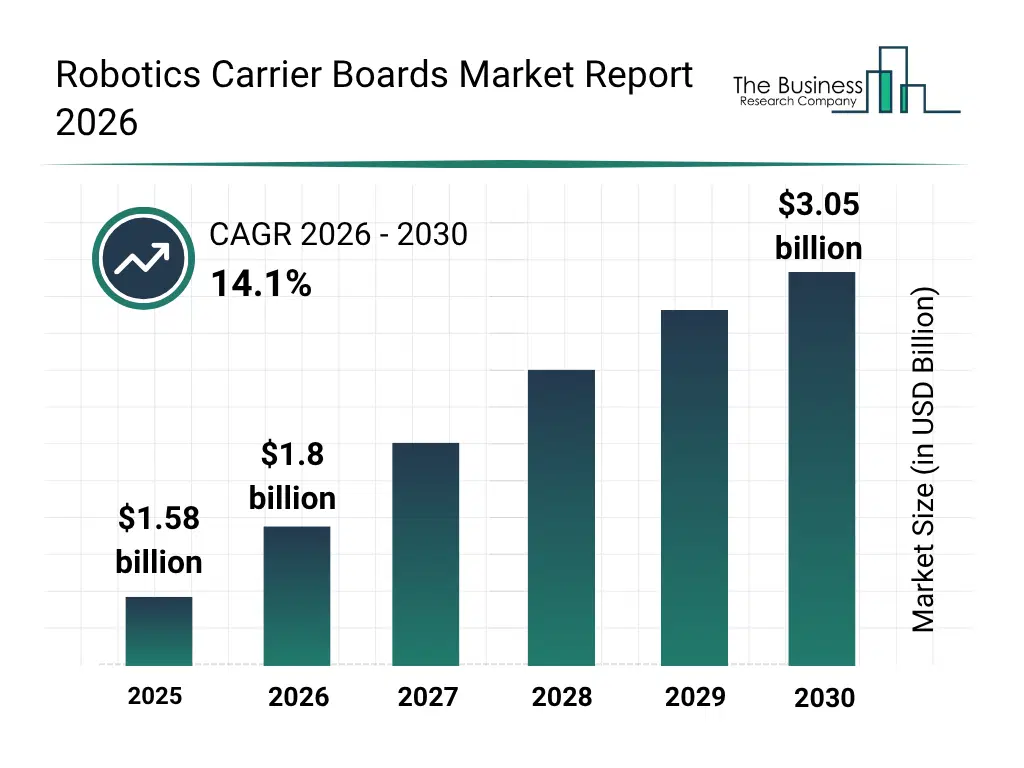
What Is The Robotics Carrier Boards Market Size and Share 2026?
The robotics carrier boards market size has grown rapidly in recent years. It will grow from $1.58 billion in 2025 to $1.8 billion in 2026 at a compound annual growth rate (CAGR) of 13.8%. The growth in the historic period can be attributed to increasing industrial automation, adoption of robotics in manufacturing, growth of educational and research robotics programs, rising demand for service robots, expansion of medical robotics applications.What Is The Robotics Carrier Boards Market Growth Forecast?
The robotics carrier boards market size is expected to see rapid growth in the next few years. It will grow to $3.05 billion by 2030 at a compound annual growth rate (CAGR) of 14.1%. The growth in the forecast period can be attributed to growing deployment of AI-driven robotics, increasing adoption of autonomous mobile robots, rising demand for high-connectivity carrier boards, expansion of aerospace and defense robotics applications, increasing focus on energy-efficient and scalable board designs. Major trends in the forecast period include increasing adoption of modular and stackable carrier boards, rising demand for high-performance computing boards in robotics, growing integration of sensor-optimized carrier boards, expansion of custom and ruggedized carrier boards, rising focus on power-efficient and connectivity-enhanced boards.Global Robotics Carrier Boards Market Segmentation
1) By Product Type: Single Board, Multi-Board, Custom Carrier Boards 2) By Distribution Channel: Direct Sales, Distributors, Online Retail 3) By Application: Industrial Robotics, Service Robotics, Medical Robotics, Educational Robotics, Other Applications 4) By End-Users: Manufacturing, Healthcare, Automotive, Aerospace And Defense, Research And Academia, Other End-Users Subsegments: 1) By Single Board: Low Power Computing Boards, High Performance Computing Boards, Compact Form Factor Boards, Industrial Grade Boards, Development And Evaluation Boards 2) By Multi-Board: Modular Expansion Board Systems, Stackable Interface Board Systems, Distributed Processing Board Systems, High Scalability Board Configurations, Redundant Control Board Systems 3) By Custom Carrier Boards: Application Specific Carrier Boards, Ruggedized Environment Carrier Boards, High Connectivity Carrier Boards, Sensor Integrated Carrier Boards, Power Optimized Carrier BoardsWhat Is The Driver Of The Robotics Carrier Boards Market?
The rising adoption of smart manufacturing and Industry 4.0 automation is expected to propel the growth of the robotics carrier boards market going forward. Smart manufacturing and Industry 4.0 automation refer to the integration of advanced digital technologies into industrial production systems to enable real-time monitoring, autonomous decision-making, and enhanced operational efficiency. The adoption of smart manufacturing and Industry 4.0 automation is being driven by the growing need among manufacturers to reduce reliance on manual labor and improve production precision, as increasing labor shortages and competitive global pressures push industries to automate core processes at scale. Robotics carrier boards enable smart manufacturing and Industry 4.0 automation by connecting processors, sensors, and actuators to support real-time data processing, high-speed communication, and seamless integration of robots within connected factory systems. For instance, in March 2024, according to Rockwell Automation Inc., a US-based automation company, manufacturers consider AI the leading capability for achieving significant business impact, with 83% anticipating the adoption of generative AI (GenAI) in their operations. Furthermore, 95% of manufacturers are either using or evaluating smart manufacturing technologies, up from 84% in 2023. Therefore, the rising adoption of smart manufacturing and Industry 4.0 automation is driving the growth of the robotics carrier boards industry.Key Players In The Global Robotics Carrier Boards Market
Major companies operating in the robotics carrier boards market are NVIDIA Corporation, DENSO Corporation, Mitsubishi Electric Corporation, FANUC Corporation, Yaskawa Electric Corporation, SolidRun Ltd., Advantech Co Ltd, Schunk GmbH & Co KG, Moxa Inc., IEI Integration Corporation, VIA Technologies Inc., SECO S.p.A., Axiomtek Co. Ltd., CompuLab Ltd., Kawasaki Heavy Industries Ltd., Seer Robotics Inc., Seiko Epson Corporation, PHYTEC Messtechnik GmbH, Connect Tech Inc., emtrion GmbH, OMRON Robotics and Safety Technologies Co. Ltd., Auvidea GmbH, Gumstix Inc., Stäubli Robotics AG.Global Robotics Carrier Boards Market Trends and Insights
Major companies operating in the robotics carrier boards market are focusing on developing advanced hardware solutions, such as carrier boards supporting next-generation AI computing platforms, to enhance processing capability, system integration, and performance in autonomous robotics and edge AI applications. Carrier boards supporting AI modules enable seamless integration of sensors, communication interfaces, and power management systems, allowing robotic developers to deploy high-performance embedded computing platforms efficiently. For instance, in August 2025, Auvidea GmbH, a Germany-based embedded systems company, announced support for the NVIDIA Jetson Thor platform as a carrier board manufacturer. The carrier board solution is designed to enable developers and robotics manufacturers to integrate NVIDIA’s high-performance AI computing module into advanced robotic systems, providing high-speed connectivity, expanded I/O interfaces, and optimized power management for robotics, industrial automation, and edge AI applications.What Are Latest Mergers And Acquisitions In The Robotics Carrier Boards Market?
In July 2024, Auvidea GmbH, a Germany-based developer and manufacturer of AI carrier boards, partnered with Panasonic Connect Europe to scale production of its fast-growing AI carrier board business. Through this partnership, Auvidea aims to enhance its in-house manufacturing capabilities by leveraging Panasonic’s advanced surface-mount technology (SMT) production equipment and smart factory solutions to meet increasing demand for customized carrier boards used in AI and robotics applications. Panasonic Connect is a Japan-based technology company that provides manufacturing machinery, automation solutions, and smart factory systems.Regional Insights
North America was the largest region in the robotics carrier boards market in 2025. Asia-Pacific is expected to be the fastest-growing region in the forecast period. The regions covered in this market report are Asia-Pacific, South East Asia, Western Europe, Eastern Europe, North America, South America, Middle East, Africa. The countries covered in this market report are Australia, Brazil, China, France, Germany, India, Indonesia, Japan, Taiwan, Russia, South Korea, UK, USA, Canada, Italy, Spain.What Defines the Robotics Carrier Boards Market?
The robotics carrier boards market consists of sales of Ethernet ports, HDMI or display interfaces, USB expansion ports, and PCIe expansion slots. Values in this market are ‘factory gate’ values, that is, the value of goods sold by the manufacturers or creators of the goods, whether to other entities (including downstream manufacturers, wholesalers, distributors, and retailers) or directly to end customers. The value of goods in this market includes related services sold by the creators of the goods.How is Market Value Defined and Measured?
The market value is defined as the revenues that enterprises gain from the sale of goods and/or services within the specified market and geography through sales, grants, or donations in terms of the currency (in USD unless otherwise specified). The revenues for a specified geography are consumption values that are revenues generated by organizations in the specified geography within the market, irrespective of where they are produced. It does not include revenues from resales along the supply chain, either further along the supply chain or as part of other products.What Key Data and Analysis Are Included in the Robotics Carrier Boards Market Report 2026?
The robotics carrier boards market research report is one of a series of new reports from The Business Research Company that provides market statistics, including industry global market size, regional shares, competitors with the market share, detailed market segments, market trends and opportunities, and any further data you may need to thrive in the robotics carrier boards industry. The market research report delivers a complete perspective of everything you need, with an in-depth analysis of the current and future state of the industry.Robotics Carrier Boards Market Report Forecast Analysis
| Report Attribute | Details |
|---|---|
| Market Size Value In 2026 | $1.8 billion |
| Revenue Forecast In 2035 | $3.05 billion |
| Growth Rate | CAGR of 13.8% from 2026 to 2035 |
| Base Year For Estimation | 2025 |
| Actual Estimates/Historical Data | 2020-2025 |
| Forecast Period | 2026 - 2030 - 2035 |
| Market Representation | Revenue in USD Billion and CAGR from 2026 to 2035 |
| Segments Covered | Product Type, Distribution Channel, Application, End-Users |
| Regional Scope | Asia-Pacific, Western Europe, Eastern Europe, North America, South America, Middle East, Africa |
| Country Scope | The countries covered in the report are Australia, Brazil, China, France, Germany, India, ... |
| Key Companies Profiled | NVIDIA Corporation, DENSO Corporation, Mitsubishi Electric Corporation, FANUC Corporation, Yaskawa Electric Corporation, SolidRun Ltd., Advantech Co Ltd, Schunk GmbH & Co KG, Moxa Inc., IEI Integration Corporation, VIA Technologies Inc., SECO S.p.A., Axiomtek Co. Ltd., CompuLab Ltd., Kawasaki Heavy Industries Ltd., Seer Robotics Inc., Seiko Epson Corporation, PHYTEC Messtechnik GmbH, Connect Tech Inc., emtrion GmbH, OMRON Robotics and Safety Technologies Co. Ltd., Auvidea GmbH, Gumstix Inc., Stäubli Robotics AG. |
| Customization Scope | Request for Customization |
| Pricing And Purchase Options | Explore Purchase Options |