
Rocket Autonomous Navigation Market Report 2026
Global Outlook – By Component (Hardware, Software, Services), By Technology (Global Positioning System (GPS), Inertial Navigation Systems, Sensor Fusion, Other Technologies), By End-User (Aerospace, Defense, Space Exploration, Other End-Users) – Market Size, Trends, Strategies, and Forecast to 2030
Rocket Autonomous Navigation Market Overview
• Rocket Autonomous Navigation market size has reached to $2.61 billion in 2025 • Expected to grow to $4.76 billion in 2030 at a compound annual growth rate (CAGR) of 12.7% • Growth Driver: The Rising Focus On Reusable Rockets Is Fueling Market Growth Due To Increasing Industrialization And Production Needs • Market Trend: Technological Advancements In Autonomous Rocket Recovery Systems Enhance Reusability And Cost Efficiency • North America was the largest region in 2025 and Asia-Pacific is the fastest growing region.What Is Covered Under Rocket Autonomous Navigation Market?
Rocket autonomous navigation refers to the capability of a rocket to guide and control its flight path without human intervention. It uses sensors, onboard computers, and advanced algorithms to determine real-time position, velocity, and trajectory to ensure accurate targeting, efficient fuel use, and safer space missions. The main components of the rocket's autonomous navigation are hardware, software, and services. Hardware refers to the physical components of a computer or electronic system, such as the processor, memory, and motherboard. It uses different technologies such as the global positioning system (GPS), inertial navigation systems, sensor fusion, and others used for a range of end-users, including aerospace companies, defense organizations, space exploration agencies, and others.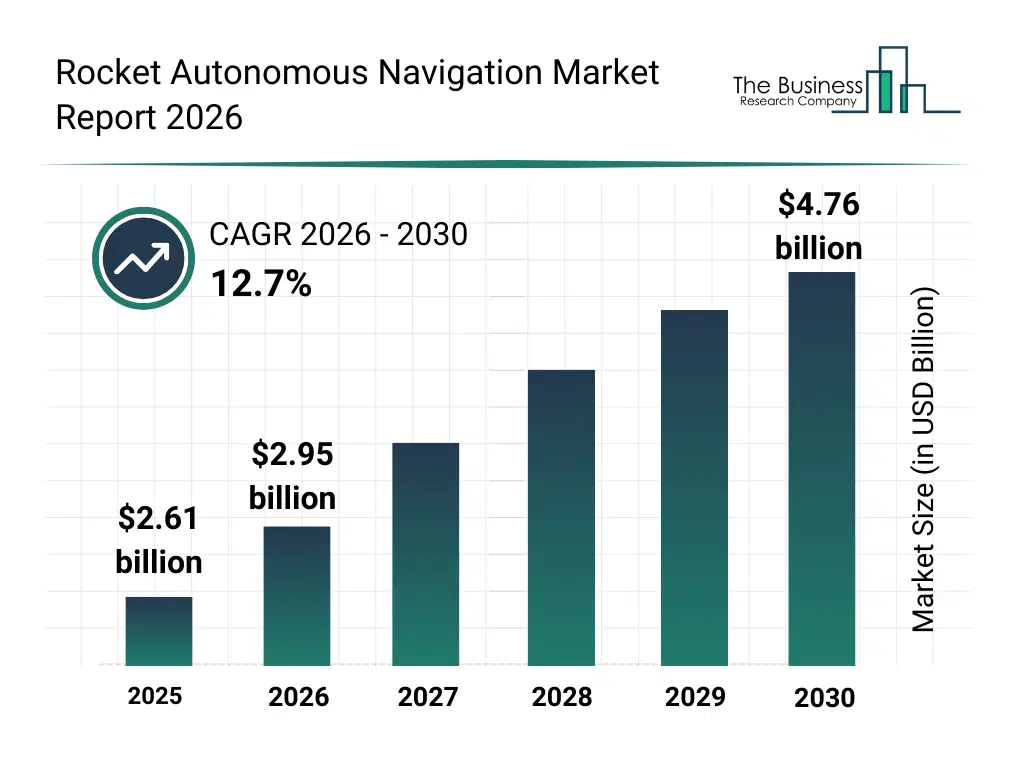
What Is The Rocket Autonomous Navigation Market Size and Share 2026?
The rocket autonomous navigation market size has grown rapidly in recent years. It will grow from $2.61 billion in 2025 to $2.95 billion in 2026 at a compound annual growth rate (CAGR) of 13.0%. The growth in the historic period can be attributed to growing adoption of onboard flight control computers to improve rocket guidance accuracy, increasing integration of star trackers for precise attitude and position determination in space missions, rising reliance on software simulation for validating autonomous navigation algorithms, expansion of testing and validation services as rockets transitioned toward higher autonomy, early development of sensor and data processing systems enabling real-time trajectory adjustments.What Is The Rocket Autonomous Navigation Market Growth Forecast?
The rocket autonomous navigation market size is expected to see rapid growth in the next few years. It will grow to $4.76 billion in 2030 at a compound annual growth rate (CAGR) of 12.7%. The growth in the forecast period can be attributed to rising demand for fully autonomous mission planning to support reusable and deep-space rockets, increasing adoption of advanced navigation algorithms for higher precision and fuel efficiency, growing integration of multi-sensor fusion systems to enhance reliability under complex flight conditions, expansion of commercial launch providers investing in next-generation autonomous navigation technologies, technological advancements improving processing power and miniaturization of flight control computers and star trackers. Major trends in the forecast period include increased adoption of sensor fusion and redundant navigation architectures, growing integration of onboard autonomy and real-time decision making, rising use of miniaturized star trackers and lightweight flight computers, expansion of simulation-driven validation and hardware-in-the-loop testing, surge in demand for radiation-hardened navigation electronics.
Global Rocket Autonomous Navigation Market Segmentation
1) By Component: Hardware, Software, Services 2) By Technology: Global Positioning System (GPS), Inertial Navigation Systems, Sensor Fusion, Other Technologies 3) By End-User: Aerospace, Defense, Space Exploration, Other End-Users Subsegments: 1) By Hardware: Inertial Measurement Units, Global Positioning System Receivers, Accelerometers And Gyroscopes, Flight Control Systems, Onboard Computers, Antennas And Transceivers, Actuators And Control Surfaces 2) By Software: Navigation And Guidance Algorithms, Trajectory Planning Software, Sensor Fusion Algorithms, Real-Time Operating Systems, Fault Detection And Correction Software, Simulation And Modeling Tools 3) By Services: System Integration Services, Maintenance And Repair Services, Calibration And Testing Services, Software Upgrades And Support, Training And Consulting Services, Mission Planning And Analysis ServicesWhat Is Driver Of The Rocket Autonomous Navigation Market?
The rising focus on reusable rockets is expected to propel the growth of the rocket autonomous navigation market going forward. Reusable rockets refer to launch vehicles designed to return to Earth and be flown multiple times, significantly reducing the cost of space missions. The rising focus on reusable rockets is due to increasing demand for cost-effective and sustainable space missions that minimize waste and maximize launch efficiency. Rocket autonomous navigation enables precise guidance, controlled landings, and real-time adjustments of reusable rockets, which support safe recovery and enhance the efficiency of rocket reuse. For instance, in May 2025, according to PatentPC, a US-based artificial intelligence copilot technology development company, SpaceX, a US-based aerospace company, conducted over 90 launches with reusable rockets in 2023, up from fewer than 20 with disposable ones compared to 2022. Therefore, the rising focus on reusable rockets is driving the growth of the rocket autonomous navigation industry.Key Players In The Global Rocket Autonomous Navigation Market
Major companies operating in the rocket autonomous navigation market are Raytheon Technologies Corporation, The Boeing Company, Lockheed Martin Corporation, Airbus Defence and Space, Northrop Grumman Corporation, Honeywell Aerospace, BAE Systems plc, Safran S.A., Thales Group, L3Harris Technologies Inc., Leonardo S.p.A., Space Exploration Technologies Corp., Blue Origin LLC, Moog Inc., Sierra Nevada Corporation, Beyond Gravity Inc., Rocket Lab USA Inc., True Anomaly Inc., KinetX Incorporated, Starfish Space Inc., Xona Space Systems Inc., WeSpace Technologies Inc.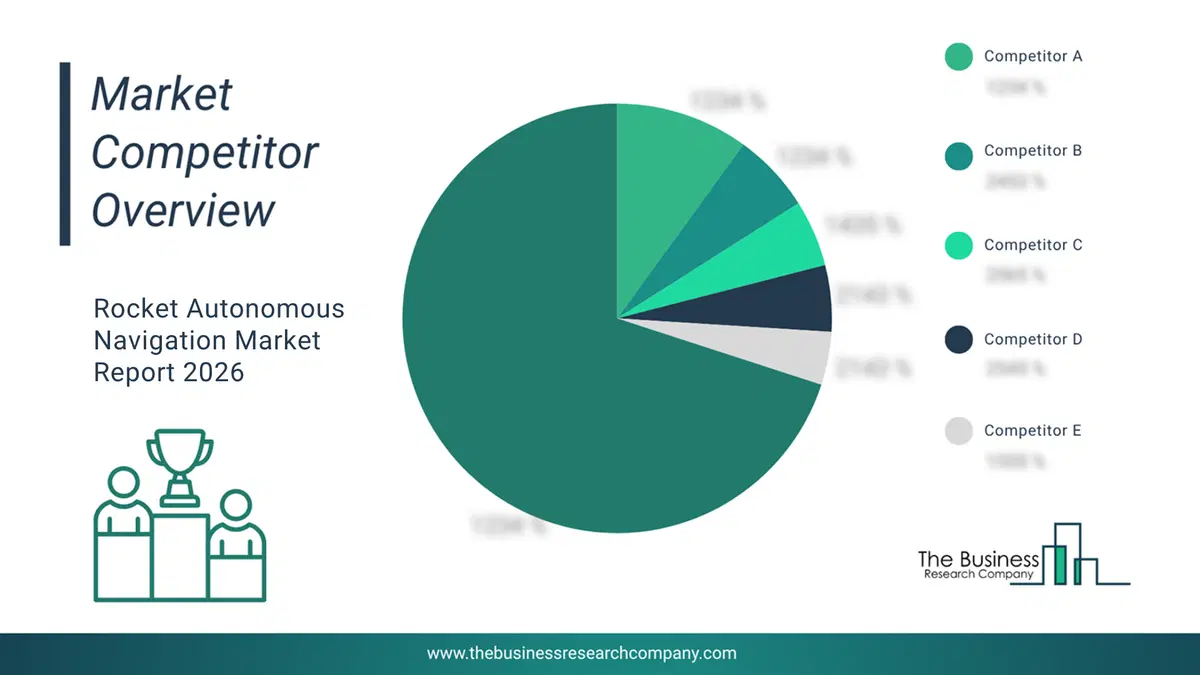
This chart is for illustrative purposes; the full report includes a detailed competitor analysis and comprehensive overview of the top 10 companies in the market.
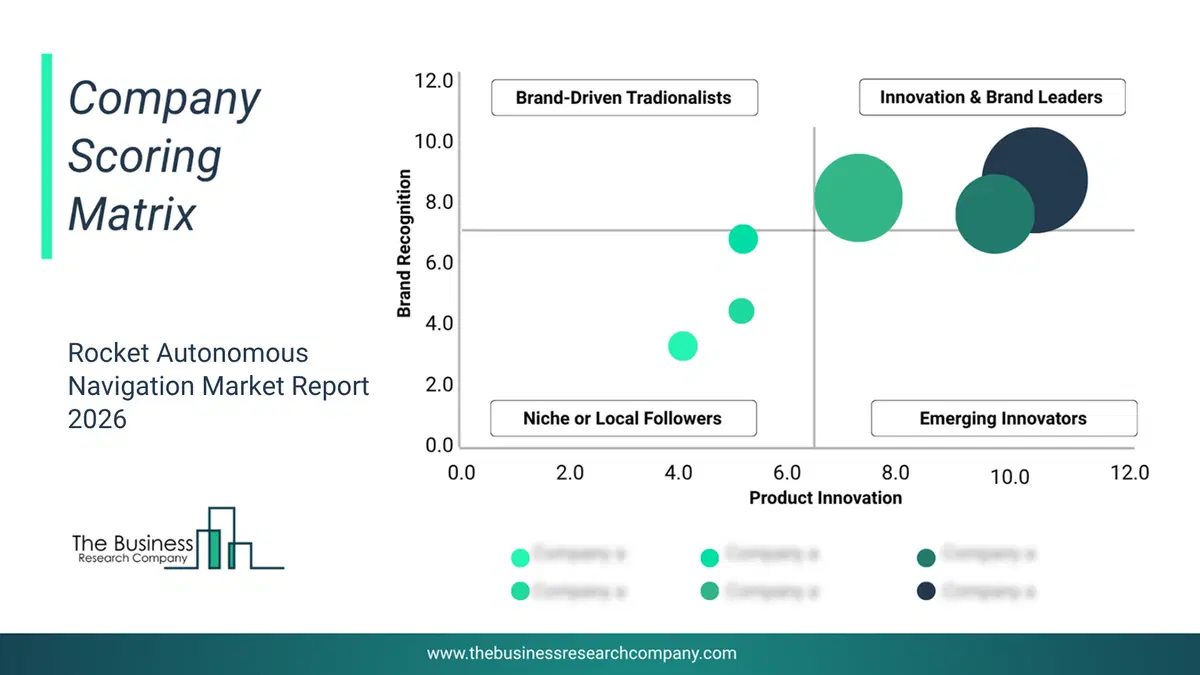
This chart maps companies by product innovation and brand strength, with bubble size indicating relative revenue, helping identify market leaders, challengers, and niche players. This is an illustrative chart; the full report provides a complete and accurate competitive analysis.
Global Rocket Autonomous Navigation Market Trends and Insights
Major companies operating in the Rocket Autonomous Navigation market are focusing on developing technological advancements such as autonomous rocket recovery ships to enhance launch efficiency, reduce recovery costs, and enable reusable launch operations. An autonomous rocket recovery ship refers to an unmanned vessel equipped with advanced navigation and control systems designed to track, approach, and recover rocket boosters or stages after launch without human intervention. For instance, in August 2025, iSpace, a China-based exploration company, launched a Xingji Guihang to develop an autonomous rocket recovery ship aimed at improving rocket retrieval efficiency and supporting reusable launch operations. It is designed to recover reusable rocket boosters at sea, supporting the nation's push for cost-effective space launches. It features a large recovery deck and an advanced dynamic positioning system that allows it to autonomously stabilize and accurately capture rockets even in rough seas. This ship enhances China’s reusable rocket capabilities, reduces launch costs, and strengthens its competitive position in commercial space technology.What Are Latest Mergers And Acquisitions In The Rocket Autonomous Navigation Market? Honeywell Strengthens Autonomous Operations With Acquisition Of Civitanavi Systems
In March 2024, Honeywell International Inc., a U.S.-based manufacturing company, acquired Civitanavi Systems S.p.A. for an undisclosed amount. With this acquisition, Honeywell aims to enhance its autonomous operations capability by integrating Civitanavi’s high-precision inertial navigation and stabilization technologies into its aerospace and industrial navigation portfolio. Civitanavi Systems is an Italy-based manufacturing company that offers rocket autonomous navigation.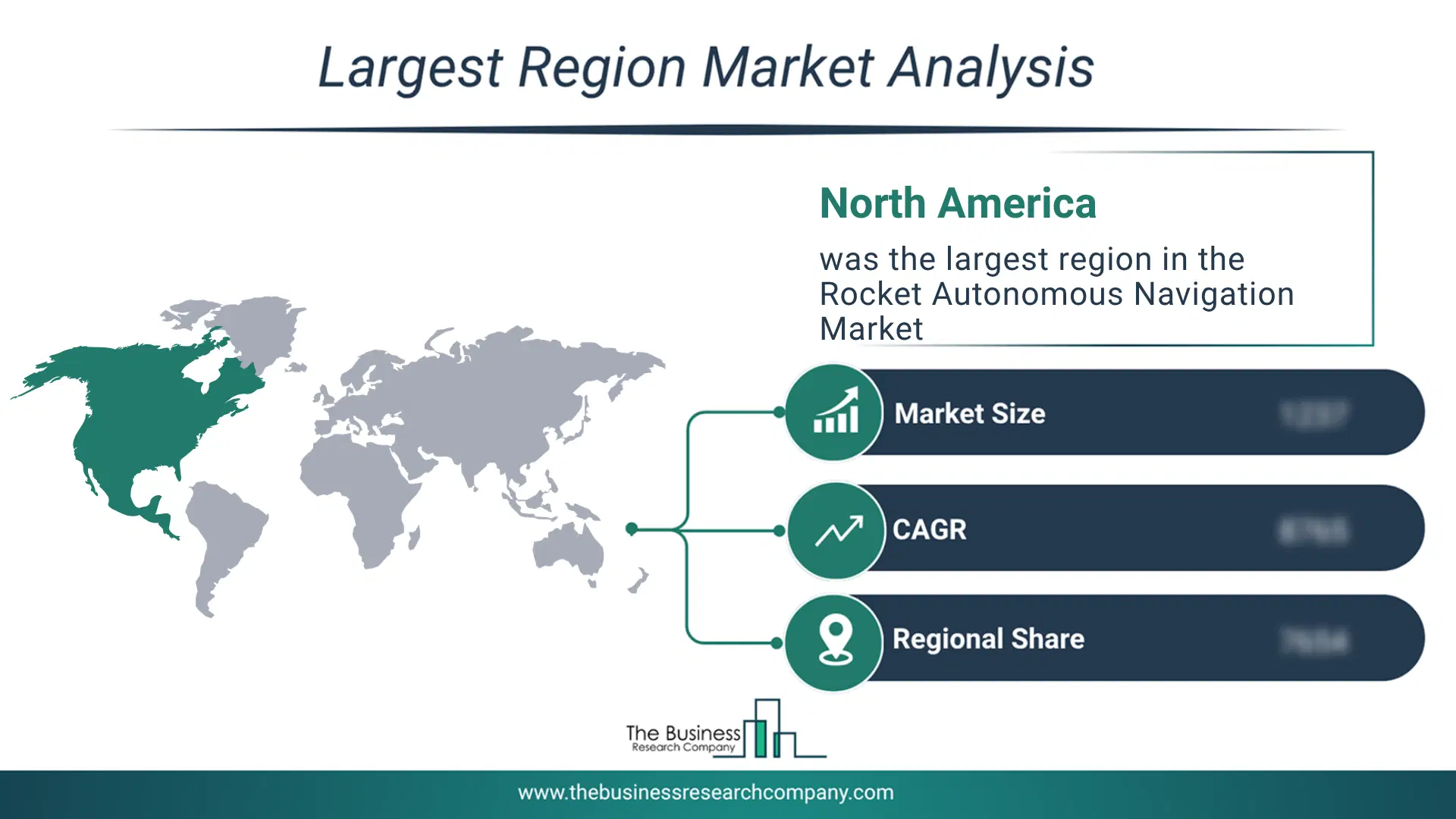
Regional Insights
North America was the largest region in the rocket autonomous navigation market in 2025. Asia-Pacific is expected to be the fastest-growing region in the forecast period. The regions covered in this market report are Asia-Pacific, South East Asia, Western Europe, Eastern Europe, North America, South America, Middle East, Africa. The countries covered in this market report are Australia, Brazil, China, France, Germany, India, Indonesia, Japan, Taiwan, Russia, South Korea, UK, USA, Canada, Italy, SpainWhat Defines the Rocket Autonomous Navigation Market?
The rocket autonomous navigation market consists of revenues earned by entities by providing services such as navigation system design and integration services, software development and simulation, sensor and data processing services, testing and validation, and autonomous mission planning. The market value includes the value of related goods sold by the service provider or included within the service offering. The rocket autonomous navigation market includes sales of star trackers and flight control computers. Values in this market are ‘factory gate’ values, that is, the value of goods sold by the manufacturers or creators of the goods, whether to other entities (including downstream manufacturers, wholesalers, distributors, and retailers) or directly to end customers. The value of goods in this market includes related services sold by the creators of the goods.How is Market Value Defined and Measured?
The market value is defined as the revenues that enterprises gain from the sale of goods and/or services within the specified market and geography through sales, grants, or donations in terms of the currency (in USD unless otherwise specified). The revenues for a specified geography are consumption values that are revenues generated by organizations in the specified geography within the market, irrespective of where they are produced. It does not include revenues from resales along the supply chain, either further along the supply chain or as part of other products.
This chart presents market attractiveness based on a quantitative evaluation of growth, competition, strategic alignment, and risk, offering a clear view of opportunity areas for decision-making. This chart is for illustrative purposes; the full report contains the complete analysis.

This chart highlights the Total Addressable Market (TAM) by estimating the maximum revenue opportunity using an assumption-driven approach, supporting strategic planning and opportunity sizing across markets. The chart is illustrative; the full report provides a more comprehensive analysis.
What Key Data and Analysis Are Included in the Rocket Autonomous Navigation Market Report 2026?
The rocket autonomous navigation market research report is one of a series of new reports from The Business Research Company that provides market statistics, including industry global market size, regional shares, competitors with the market share, detailed market segments, market trends and opportunities, and any further data you may need to thrive in the rocket autonomous navigation industry. The market research report delivers a complete perspective of everything you need, with an in-depth analysis of the current and future state of the industry.Rocket Autonomous Navigation Market Report Forecast Analysis
| Report Attribute | Details |
|---|---|
| Market Size Value In 2026 | $2.95 billion |
| Revenue Forecast In 2030 | $4.76 billion |
| Growth Rate | CAGR of 12.7% from 2026 to 2030 |
| Base Year For Estimation | 2025 |
| Actual Estimates/Historical Data | 2020-2025 |
| Forecast Period | 2026 - 2030 |
| Market Representation | Revenue in USD Billion and CAGR from 2026 to 2030 |
| Segments Covered | Component, Technology, End-User |
| Regional Scope | Asia-Pacific, Western Europe, Eastern Europe, North America, South America, Middle East, Africa |
| Country Scope | The countries covered in the rocket autonomous navigation market report are Australia, Brazil, China, France, Germany, India, Indonesia, Japan, Taiwan, Russia, South Korea, UK, USA, Canada, Italy, Spain |
| Key Companies Profiled | Raytheon Technologies Corporation, The Boeing Company, Lockheed Martin Corporation, Airbus Defence and Space, Northrop Grumman Corporation, Honeywell Aerospace, BAE Systems plc, Safran S.A., Thales Group, L3Harris Technologies Inc., Leonardo S.p.A., Space Exploration Technologies Corp., Blue Origin LLC, Moog Inc., Sierra Nevada Corporation, Beyond Gravity Inc., Rocket Lab USA Inc., True Anomaly Inc., KinetX Incorporated, Starfish Space Inc., Xona Space Systems Inc., WeSpace Technologies Inc. |
| Customization Scope | Request for Customization |
| Pricing And Purchase Options | Explore Purchase Options |