
Rocket Fuel Cryogenic Storage Market Report 2026
Global Outlook – By Storage Type (Liquid Hydrogen, Liquid Oxygen, Liquid Methane, Other Storage Types), By Application (Space Exploration, Military, Commercial Aviation, Other Applications), By End-User (Aerospace, Defense, Research Institutions, Other End-Users) – Market Size, Trends, Strategies, and Forecast to 2030
Rocket Fuel Cryogenic Storage Market Overview
• Rocket Fuel Cryogenic Storage market size has reached to $1.55 billion in 2025 • Expected to grow to $2.51 billion in 2030 at a compound annual growth rate (CAGR) of 10.1% • Growth Driver: Growing Space Exploration Programs Fueling The Market Growth Due To Increasing Industrialization And Production Needs • Market Trend: Advancements In Cryogenic Storage Driven By 3D Printing And Propulsion Innovation • North America was the largest region in 2025.What Is Covered Under Rocket Fuel Cryogenic Storage Market?
Rocket fuel cryogenic storage refers to the specialized containment of extremely cold propellants, such as liquid hydrogen or liquid oxygen, used in rockets. These fuels must be stored at cryogenic temperatures (below -150°C) to remain in liquid form. Cryogenic storage tanks are insulated and designed to handle the pressure and low temperatures, minimizing boil-off and maintaining fuel stability. The main storage types of rocket fuel cryogenic storage are liquid hydrogen, liquid oxygen, liquid methane, and others. A liquid hydrogen storage tank refers to a specially insulated container designed to store hydrogen in its liquid state at extremely low temperatures (around -253°C). Various applications involve space exploration, the military, commercial aviation, and others, and they are used by several end users, such as aerospace, defense, research institutions, and others.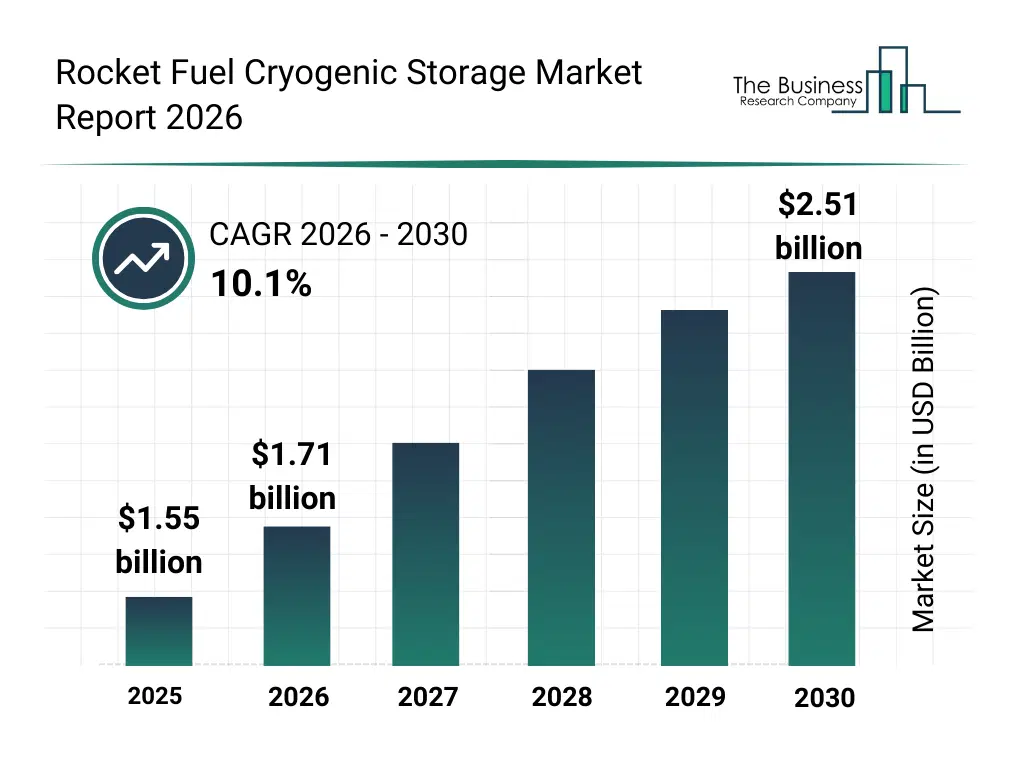
What Is The Rocket Fuel Cryogenic Storage Market Size and Share 2026?
The rocket fuel cryogenic storage market size has grown rapidly in recent years. It will grow from $1.55 billion in 2025 to $1.71 billion in 2026 at a compound annual growth rate (CAGR) of 10.3%. The growth in the historic period can be attributed to increasing adoption of liquid hydrogen and liquid oxygen propulsion driving demand for advanced cryogenic tanks, development of high-performance insulation materials to reduce propellant boil-off losses, expansion of government launch programs requiring large-scale cryogenic storage infrastructure, early advancement of cryogenic pumps and compressors enabling reliable fueling operations, growth in cryogenic fluid handling services supporting more frequent test and launch activities.What Is The Rocket Fuel Cryogenic Storage Market Growth Forecast?
The rocket fuel cryogenic storage market size is expected to see rapid growth in the next few years. It will grow to $2.51 billion in 2030 at a compound annual growth rate (CAGR) of 10.1%. The growth in the forecast period can be attributed to rising commercial launch cadence increasing need for scalable cryogenic storage and fueling systems, advancements in monitoring and control technologies improving safety and operational efficiency, expansion of reusable rockets driving demand for rapid turnaround cryogenic fueling solutions, innovation in lightweight composite cryogenic tank materials reducing mass and improving performance, growing investment in deep-space missions requiring long-duration cryogenic storage capabilities. Major trends in the forecast period include advanced insulation material development, integrated cryogenic monitoring systems, boil-off reduction and pressure management innovation, modular cryogenic tank architecture, expansion of methalox storage infrastructure.
Global Rocket Fuel Cryogenic Storage Market Segmentation
1) By Storage Type: Liquid Hydrogen, Liquid Oxygen, Liquid Methane, Other Storage Types 2) By Application: Space Exploration, Military, Commercial Aviation, Other Applications 3) By End-User: Aerospace, Defense, Research Institutions, Other End-Users Subsegments: 1) By Liquid Hydrogen: Ground-Based Storage Tanks, In-Flight Cryogenic Tanks, Mobile Cryogenic Tankers, Insulated Composite Cylinders 2) By Liquid Oxygen: Stationary Vacuum-Insulated Tanks, Cryogenic Dewars, Transportable Oxygen Tankers, Composite Overwrapped Pressure Vessels (COPVs) 3) By Liquid Methane: Vacuum-Jacketed Storage Tanks, Onboard Reusable Tanks, Methane-Compatible ISO Containers, Mobile Refueling Systems 4) By Other Storage Types: Liquid Nitrogen Tanks, Liquid Argon Vessels, Multi-Fuel Cryogenic Tanks, Custom Cryo Modules For Hybrid Propulsion SystemsWhat Is Driver Of The Rocket Fuel Cryogenic Storage Market?
The growing space exploration programs are expected to propel the growth of the rocket fuel cryogenic storage market going forward. Space exploration programs refer to organized efforts by governments or private entities to investigate and explore outer space using spacecraft, satellites, telescopes, and other technologies. Space exploration programs are increasing due to growing interest in scientific discovery, as nations and private companies seek to understand the universe, search for life, and study celestial bodies. Space exploration programs use rocket fuel cryogenic storage to safely store and supply supercooled propellants essential for launching and powering spacecraft. For instance, in May 2025, according to the Satellite Industry Association, a US-based organization, in 2024, the industry experienced remarkable growth, marked by a record 259 launches that placed 2,172 tons of payload and 2,695 satellites into Earth orbit. By the end of the year, a total of 11,539 satellites were actively operating in orbit around Earth. Therefore, the growing space exploration programs are driving the growth of the rocket fuel cryogenic storage industryKey Players In The Global Rocket Fuel Cryogenic Storage Market
Major companies operating in the rocket fuel cryogenic storage market are The Boeing Company, Lockheed Martin Corporation, Linde plc, Air Liquide S.A., Ball Aerospace & Technologies Corp., Air Products and Chemicals Inc., Cryofab Inc., Space Exploration Technologies Corp., Hanwha Corporation, Eta Space LLC, ONNES Technologies B.V., ArianeGroup SAS, Kawasaki Heavy Industries Ltd., Chart Industries Inc., MT Aerospace AG, FIBA Technologies Inc., VRV S.p.A., SpaceDreams Inc., Cryonorm B.V., INOX India Limited.
This chart is for illustrative purposes; the full report includes a detailed competitor analysis and comprehensive overview of the top 10 companies in the market.
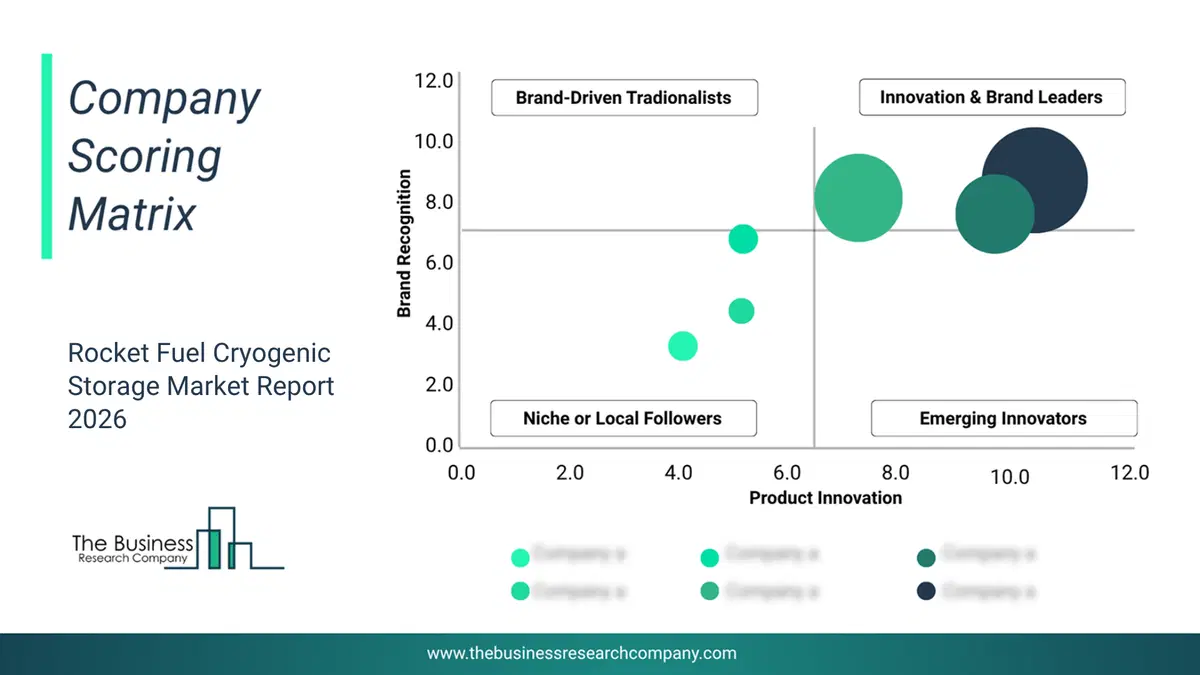
This chart maps companies by product innovation and brand strength, with bubble size indicating relative revenue, helping identify market leaders, challengers, and niche players. This is an illustrative chart; the full report provides a complete and accurate competitive analysis.
Global Rocket Fuel Cryogenic Storage Market Trends and Insights
Major companies operating in the rocket fuel cryogenic storage market are focusing on developing innovative solutions, such as single-piece 3D-printed engines, to enhance fuel efficiency and reduce system complexity. A single-piece 3D-printed engine refers to an engine manufactured as one integrated component using 3D printing technology, eliminating the need for separate parts and traditional assembly processes. For instance, in May 2024, Agnikul Cosmos Private Limited, an India-based aerospace manufacturer and commercial launch service provider, successfully launched a rocket powered by a semi-cryogenic engine. This type of engine combines liquid oxygen with a refined kerosene-based fuel, offering greater thrust, improved payload capacity, and more efficient fuel handling. It also provides a cost-effective solution suitable for future heavy-lift and potentially reusable space missions. The primary objective is to enable the efficient launch of heavier satellites while significantly reducing mission expenses for space agencies.What Are Latest Mergers And Acquisitions In The Rocket Fuel Cryogenic Storage Market? Rocket Lab Partners With Eta Space And NASA To Advance Cryogenic Fuel Management For In-Space Applications
In October 2025, Rocket Lab Corp., a US-based aerospace company, partnered with Eta Space and NASA to advance cryogenic fluid management technologies for in-space applications. This partnership aims to demonstrate and validate technologies for zero-loss storage and handling of cryogenic rocket fuel in space, enabling future orbital refueling depots and sustainable deep-space exploration. Eta Space is a US-based technology development company, while NASA, a US-based government agency, provides services and information related to aeronautics and space exploration.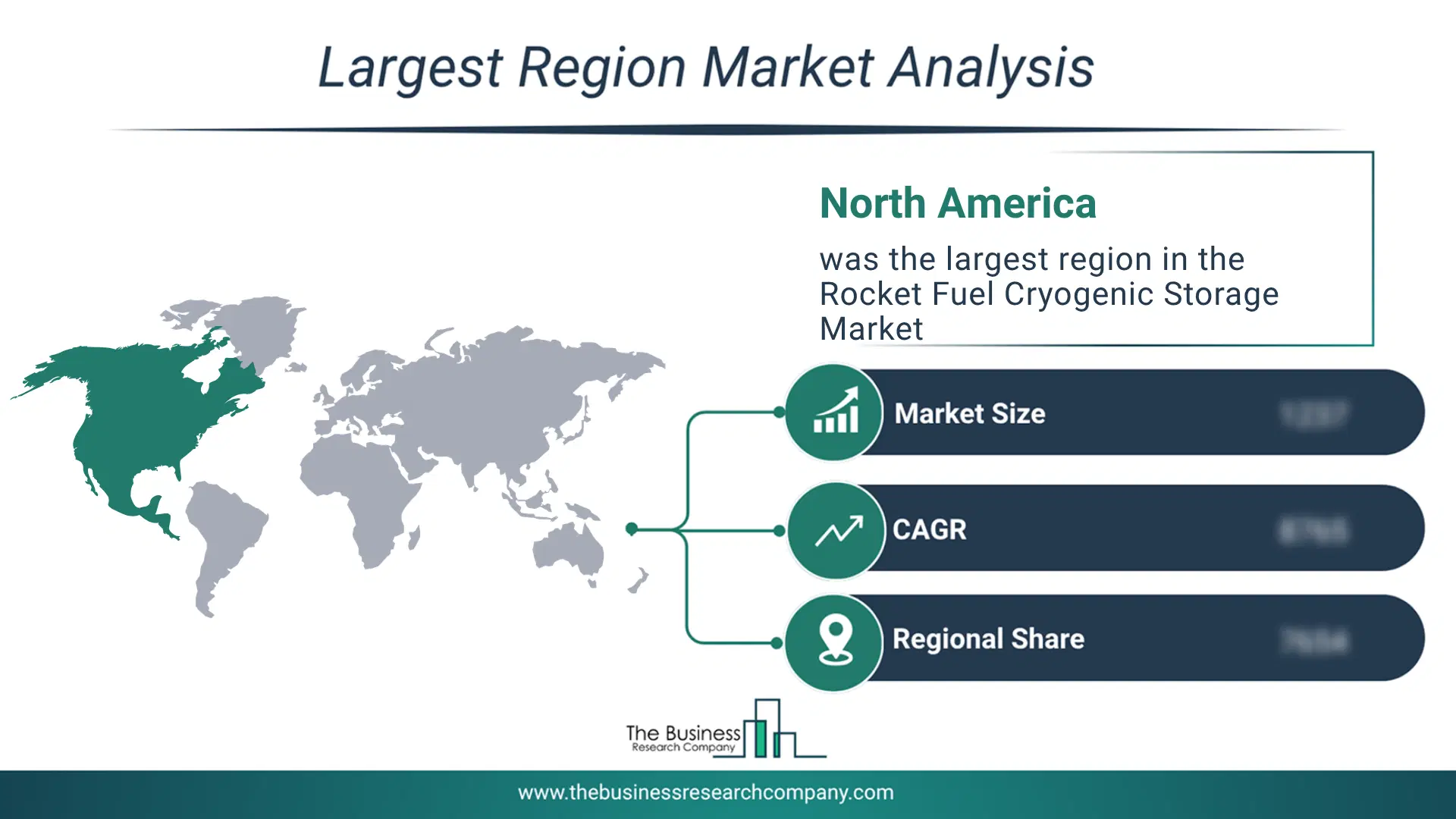
Regional Insights
North America was the largest region in the rocket fuel cryogenic storage market in 2025. The regions covered in this market report are Asia-Pacific, South East Asia, Western Europe, Eastern Europe, North America, South America, Middle East, Africa. The countries covered in this market report are Australia, Brazil, China, France, Germany, India, Indonesia, Japan, Taiwan, Russia, South Korea, UK, USA, Canada, Italy, SpainWhat Defines the Rocket Fuel Cryogenic Storage Market?
The rocket fuel cryogenic storage market consists of revenues earned by entities by providing services such as cryogenic tank design and engineering, tank fabrication and installation, fueling and defueling operations, cryogenic fluid handling and transfer systems, and monitoring and control systems. The market value includes the value of related goods sold by the service provider or included within the service offering. The rocket fuel cryogenic storage market also includes sales of products including cryogenic storage tanks, cryogenic valves and fittings, insulation materials, cryogenic pumps and compressors, and fuel transfer lines and piping. Values in this market are ‘factory gate’ values, that is, the value of goods sold by the manufacturers or creators of the goods, whether to other entities (including downstream manufacturers, wholesalers, distributors, and retailers) or directly to end customers. The value of goods in this market includes related services sold by the creators of the goods.How is Market Value Defined and Measured?
The market value is defined as the revenues that enterprises gain from the sale of goods and/or services within the specified market and geography through sales, grants, or donations in terms of the currency (in USD unless otherwise specified). The revenues for a specified geography are consumption values that are revenues generated by organizations in the specified geography within the market, irrespective of where they are produced. It does not include revenues from resales along the supply chain, either further along the supply chain or as part of other products.
This chart presents market attractiveness based on a quantitative evaluation of growth, competition, strategic alignment, and risk, offering a clear view of opportunity areas for decision-making. This chart is for illustrative purposes; the full report contains the complete analysis.

This chart highlights the Total Addressable Market (TAM) by estimating the maximum revenue opportunity using an assumption-driven approach, supporting strategic planning and opportunity sizing across markets. The chart is illustrative; the full report provides a more comprehensive analysis.
What Key Data and Analysis Are Included in the Rocket Fuel Cryogenic Storage Market Report 2026?
The rocket fuel cryogenic storage market research report is one of a series of new reports from The Business Research Company that provides market statistics, including industry global market size, regional shares, competitors with the market share, detailed market segments, market trends and opportunities, and any further data you may need to thrive in the rocket fuel cryogenic storage industry. The market research report delivers a complete perspective of everything you need, with an in-depth analysis of the current and future state of the industry.Rocket Fuel Cryogenic Storage Market Report Forecast Analysis
| Report Attribute | Details |
|---|---|
| Market Size Value In 2026 | $1.71 billion |
| Revenue Forecast In 2030 | $2.51 billion |
| Growth Rate | CAGR of 10.1% from 2026 to 2030 |
| Base Year For Estimation | 2025 |
| Actual Estimates/Historical Data | 2020-2025 |
| Forecast Period | 2026 - 2030 |
| Market Representation | Revenue in USD Billion and CAGR from 2026 to 2030 |
| Segments Covered | Storage Type, Application, End-User |
| Regional Scope | Asia-Pacific, Western Europe, Eastern Europe, North America, South America, Middle East, Africa |
| Country Scope | The countries covered in the rocket fuel cryogenic storage market report are Australia, Brazil, China, France, Germany, India, Indonesia, Japan, Taiwan, Russia, South Korea, UK, USA, Canada, Italy, Spain |
| Key Companies Profiled | The Boeing Company, Lockheed Martin Corporation, Linde plc, Air Liquide S.A., Ball Aerospace & Technologies Corp., Air Products and Chemicals Inc., Cryofab Inc., Space Exploration Technologies Corp., Hanwha Corporation, Eta Space LLC, ONNES Technologies B.V., ArianeGroup SAS, Kawasaki Heavy Industries Ltd., Chart Industries Inc., MT Aerospace AG, FIBA Technologies Inc., VRV S.p.A., SpaceDreams Inc., Cryonorm B.V., INOX India Limited. |
| Customization Scope | Request for Customization |
| Pricing And Purchase Options | Explore Purchase Options |