
Rocket Ground Support Systems Market Report 2026
Global Outlook – By Type (Mechanical Systems, Electrical Systems, Fluid Systems, Other Types), By Component (Launch Platforms, Ground Handling Equipment, Control Systems, Other Components), By Application (Commercial Space, Military, Government, Other Applications) – Market Size, Trends, Strategies, and Forecast to 2030
Rocket Ground Support Systems Market Overview
• Rocket Ground Support Systems market size has reached to $2.71 billion in 2025 • Expected to grow to $4.05 billion in 2030 at a compound annual growth rate (CAGR) of 8.2% • Growth Driver: The Rise In Space Missions And Satellite Launches Is Fueling The Growth Of The Market Due To Increasing Global Launch Activities And Government Investments • Market Trend: Advancement In Flame Trench And Diverter Systems Enhances Launch Pad Efficiency And Durability • North America was the largest region in 2025 and Asia-Pacific is the fastest growing region.What Is Covered Under Rocket Ground Support Systems Market?
Rocket ground support systems (GSS) comprise specialized infrastructure and equipment designed to support the preparation, maintenance, and launch of rockets from ground-based facilities. Their main purpose is to ensure the safe assembly, testing, and deployment of space vehicles. GSS is essential for mission success, providing critical coordination and operational support for both crewed and uncrewed launches. The main types of rocket ground support systems are mechanical systems, electrical systems, fluid systems, and others. Mechanical systems provide essential hardware for securely supporting, positioning, and transporting rockets during ground operations and launch preparations. The components include launch platforms, ground handling equipment, control systems, and others for various applications such as commercial space, military, government, and others.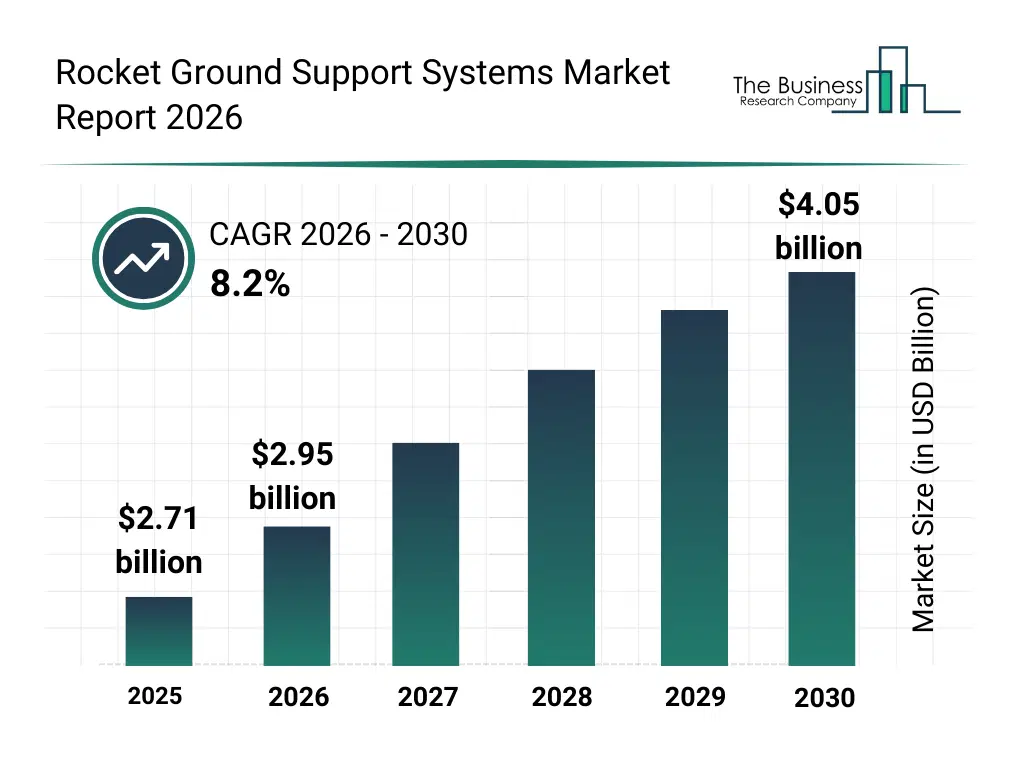
What Is The Rocket Ground Support Systems Market Size and Share 2026?
The rocket ground support systems market size has grown strongly in recent years. It will grow from $2.71 billion in 2025 to $2.95 billion in 2026 at a compound annual growth rate (CAGR) of 8.9%. The growth in the historic period can be attributed to growth of government space programs increasing demand for ground infrastructure and support equipment, development of cryogenic handling systems to support liquid propellant launches, rising use of thermal control systems to maintain vehicle and payload stability before liftoff, advancements in instrumentation systems enabling more accurate pre-launch diagnostics, expansion of environmental control systems to manage humidity, temperature, and air purity in launch preparation areas.What Is The Rocket Ground Support Systems Market Growth Forecast?
The rocket ground support systems market size is expected to see strong growth in the next few years. It will grow to $4.05 billion in 2030 at a compound annual growth rate (CAGR) of 8.2%. The growth in the forecast period can be attributed to expanding commercial launch operations requiring scalable and automated ground support equipment, advancements in power supply systems enabling more efficient and reliable launch site operations, increasing adoption of reusable rockets driving demand for rapid vehicle turnaround support systems, innovation in digital monitoring and control platforms enhancing ground operations efficiency, rising investments in global spaceports necessitating modernized and standardized ground support infrastructure. Major trends in the forecast period include expansion of advanced cryogenic ground systems, integration of modular launch platform architectures, increased use of high-precision environmental control systems, growth in automated propellant loading and pressurization technologies, development of enhanced ground safety and monitoring frameworks.
Global Rocket Ground Support Systems Market Segmentation
1) By Type: Mechanical Systems, Electrical Systems, Fluid Systems, Other Types 2) By Component: Launch Platforms, Ground Handling Equipment, Control Systems, Other Components 3) By Application: Commercial Space, Military, Government, Other Applications Subsegments: 1) By Mechanical Systems: Launch Mounts And Hold-Down Mechanisms, Flame Deflectors And Trenches, Transporter-Erector Systems, Mobile Service Towers, Access Platforms And Ladders 2) By Electrical Systems: Power Distribution Units, Ground Power Units (GPUs), Control Panels And Relay Systems, Monitoring And Safety Systems, Grounding and Lightning Protection Systems 3) By Fluid Systems: Propellant Loading Systems, Pressurization And Venting Systems, Water Deluge And Cooling Systems, Pneumatic Supply Systems, Leak Detection And Containment Units 4) By Other Types: Communication And Telemetry Systems, Environmental Control Systems (ECS), Fire Detection And Suppression Systems, Navigation And Alignment Systems, Instrumentation And Data Acquisition SystemsWhat Is Driver Of The Rocket Ground Support Systems Market?
The rise in space missions and satellite launches is expected to propel the growth of the rocket ground support systems market going forward. Space missions and satellite launches involve the deployment of spacecraft and satellites into space for communication, defense, research, and commercial purposes. The rise in space missions and satellite launches are primarily driven by increasing government investments in space programs to enhance national security and technological capabilities. Rocket ground support systems support space missions and satellite launches by supplying essential infrastructure for fueling, testing, monitoring, and environmental regulation. They help ensure rockets and payloads are launch-ready, minimizing risks and maximizing mission reliability. For instance, in January 2024, according to the Space Foundation, a US-based nonprofit organization, global launch activity hit record levels for the third consecutive year, with 223 attempts and 212 successful launches, reflecting a significant rise. Commercial launches surged by 50% compared to 2022, while the United States saw a 33% increase in launch attempts. Therefore, the rise in space missions and satellite launches is driving the growth of the rocket ground support systems industry.Key Players In The Global Rocket Ground Support Systems Market
Major companies operating in the rocket ground support systems market are Raytheon Technologies Corporation, The Boeing Company, Lockheed Martin Corporation, Airbus, General Dynamics, Northrop Grumman Corporation, Mitsubishi Heavy Industries Ltd., Thales Group, Moog Inc., ArianeGroup, United Launch Alliance (ULA), OHB SE, Kratos Defense & Security Solutions Inc., Firefly Aerospace, Redwire Corporation, Swedish Space Corporation, Unimech Aerospace Pvt. Ltd., Dedienne Aerospace SAS, ColumbusJACK/Regent, RST Rostock System-Technik GmbH
This chart is for illustrative purposes; the full report includes a detailed competitor analysis and comprehensive overview of the top 10 companies in the market.
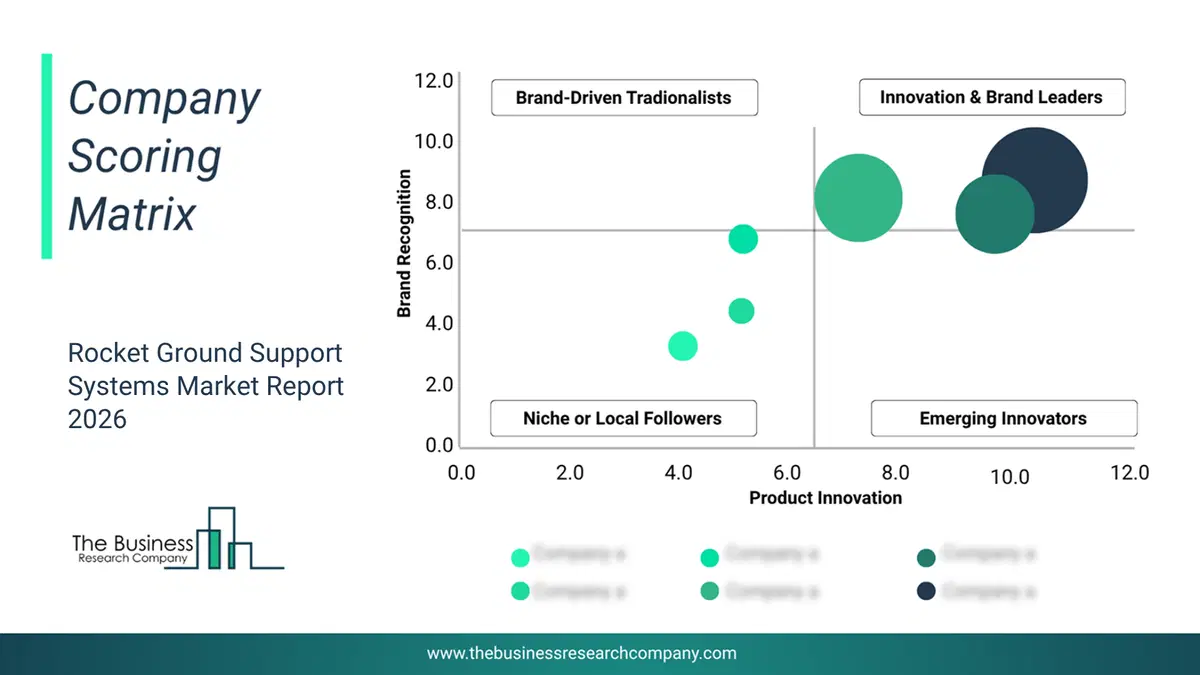
This chart maps companies by product innovation and brand strength, with bubble size indicating relative revenue, helping identify market leaders, challengers, and niche players. This is an illustrative chart; the full report provides a complete and accurate competitive analysis.
Global Rocket Ground Support Systems Market Trends and Insights
Major companies operating in the rocket ground support systems market are focusing on developing advanced products such as automated flame trench and diverter systems to enhance launch infrastructure durability and support rapid launch turnaround. An automated flame trench and diverter system is a launch pad component designed to redirect and cool rocket exhaust using water-cooled steel structures, ensuring safer and more efficient liftoffs. For instance, in May 2025, SpaceX, a US-based commercial space company, launched the Orbital Launch Mount (OLM) for Pad B at its Starbase facility. This system features an upgraded flame trench with diverter buckets, integrated water cooling, and a reinforced mount design. These innovations improve heat management, protect ground assets, and enable faster reusability for high-frequency launch operations. The launch mount is designed to support the Starship-Super Heavy system, aiming to improve pad durability and support rapid launch turnaround, marking a major upgrade for Starbase's second orbital launch pad.What Are Latest Mergers And Acquisitions In The Rocket Ground Support Systems Market? L3Harris Bolsters Defense & Space Capabilities with Aerojet Rocketdyne Acquisition
In July 2023, L3Harris Technologies, a US-based company that offers defense technology acquired Aerojet Rocketdyne for an undisclosedf amount. With this acquisition, L3Harris strengthens its position as a defense and space propulsion provider by integrating Aerojet Rocketdyne’s advanced rocket engines and hypersonic technologies into its missile and launch vehicle solutions. Aerojet Rocketdyne is a US-based company that manufactures rocket grounded systems.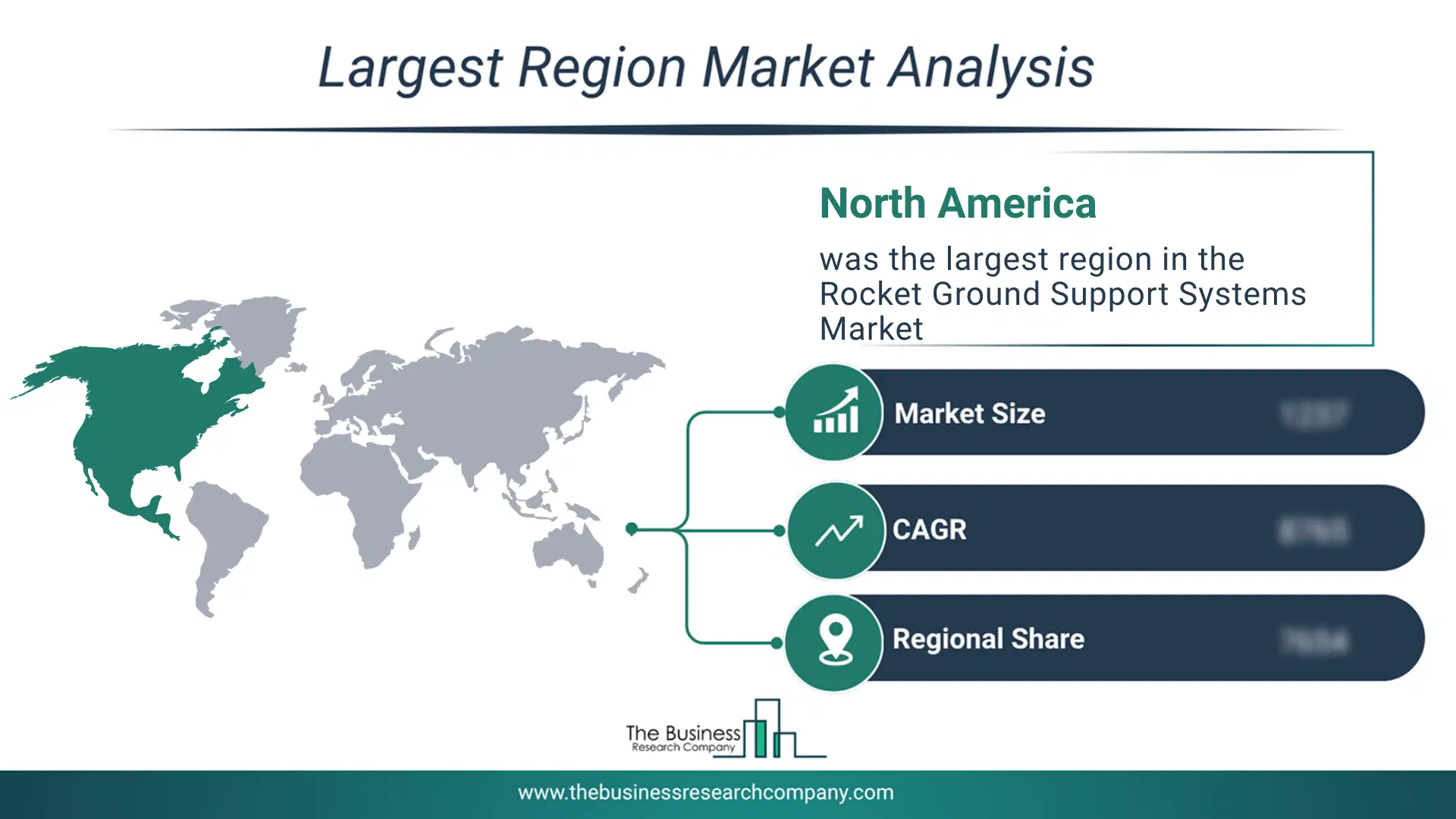
Regional Insights
North America was the largest region in the rocket ground support systems market in 2025. Asia-Pacific is expected to be the fastest-growing region in the forecast period. The regions covered in this market report are Asia-Pacific, South East Asia, Western Europe, Eastern Europe, North America, South America, Middle East, Africa. The countries covered in this market report are Australia, Brazil, China, France, Germany, India, Indonesia, Japan, Taiwan, Russia, South Korea, UK, USA, Canada, Italy, SpainWhat Defines the Rocket Ground Support Systems Market?
The rocket ground support systems market consists of sales of cryogenic systems, thermal control systems, instrumentation systems, environmental control systems, and power supply systems. Values in this market are ‘factory gate’ values, that is, the value of goods sold by the manufacturers or creators of the goods, whether to other entities (including downstream manufacturers, wholesalers, distributors, and retailers) or directly to end customers. The value of goods in this market includes related services sold by the creators of the goods.How is Market Value Defined and Measured?
The market value is defined as the revenues that enterprises gain from the sale of goods and/or services within the specified market and geography through sales, grants, or donations in terms of the currency (in USD unless otherwise specified). The revenues for a specified geography are consumption values that are revenues generated by organizations in the specified geography within the market, irrespective of where they are produced. It does not include revenues from resales along the supply chain, either further along the supply chain or as part of other products.
This chart presents market attractiveness based on a quantitative evaluation of growth, competition, strategic alignment, and risk, offering a clear view of opportunity areas for decision-making. This chart is for illustrative purposes; the full report contains the complete analysis.

This chart highlights the Total Addressable Market (TAM) by estimating the maximum revenue opportunity using an assumption-driven approach, supporting strategic planning and opportunity sizing across markets. The chart is illustrative; the full report provides a more comprehensive analysis.
What Key Data and Analysis Are Included in the Rocket Ground Support Systems Market Report 2026?
The rocket ground support systems market research report is one of a series of new reports from The Business Research Company that provides market statistics, including industry global market size, regional shares, competitors with the market share, detailed market segments, market trends and opportunities, and any further data you may need to thrive in the rocket ground support systems industry. The market research report delivers a complete perspective of everything you need, with an in-depth analysis of the current and future state of the industry.Rocket Ground Support Systems Market Report Forecast Analysis
| Report Attribute | Details |
|---|---|
| Market Size Value In 2026 | $2.95 billion |
| Revenue Forecast In 2030 | $4.05 billion |
| Growth Rate | CAGR of 8.2% from 2026 to 2030 |
| Base Year For Estimation | 2025 |
| Actual Estimates/Historical Data | 2020-2025 |
| Forecast Period | 2026 - 2030 |
| Market Representation | Revenue in USD Billion and CAGR from 2026 to 2030 |
| Segments Covered | Type, Component, Application |
| Regional Scope | Asia-Pacific, Western Europe, Eastern Europe, North America, South America, Middle East, Africa |
| Country Scope | The countries covered in the rocket ground support systems market report are Australia, Brazil, China, France, Germany, India, Indonesia, Japan, Taiwan, Russia, South Korea, UK, USA, Canada, Italy, Spain |
| Key Companies Profiled | Raytheon Technologies Corporation, The Boeing Company, Lockheed Martin Corporation, Airbus, General Dynamics, Northrop Grumman Corporation, Mitsubishi Heavy Industries Ltd., Thales Group, Moog Inc., ArianeGroup, United Launch Alliance (ULA), OHB SE, Kratos Defense & Security Solutions Inc., Firefly Aerospace, Redwire Corporation, Swedish Space Corporation, Unimech Aerospace Pvt. Ltd., Dedienne Aerospace SAS, ColumbusJACK/Regent, RST Rostock System-Technik GmbH |
| Customization Scope | Request for Customization |
| Pricing And Purchase Options | Explore Purchase Options |