
Rocket Mission Control Systems Market Report 2026
Global Outlook – By Component (Hardware, Software, Services), By Application (Launch Operations, Satellite Operations, Deep Space Missions, Other Applications), By End-User (Government, Commercial, Defense, Other End-Users) – Market Size, Trends, Strategies, and Forecast to 2030
Rocket Mission Control Systems Market Overview
• Rocket Mission Control Systems market size has reached to $4.6 billion in 2025 • Expected to grow to $6.83 billion in 2030 at a compound annual growth rate (CAGR) of 8.2% • Growth Driver: The Increasing Number Of Satellite Launches Is Fueling The Growth Of The Market Due To The Rising Demand For Precise Mission Management And Real-Time Tracking • Market Trend: Strategic Partnerships Driving Innovation In Rocket Mission Control Systems • North America was the largest region in 2025.What Is Covered Under Rocket Mission Control Systems Market?
Rocket mission control systems are advanced technological infrastructures designed to oversee and manage rocket launches and space missions. They facilitate real-time data exchange between spacecraft and ground control, supporting accurate navigation, telemetry analysis, and issue detection. Rocket mission control systems are essential for mission planning, launch coordination, and post-launch activities. The main component types of rocket mission control systems are hardware, software, and services. The hardware includes essential physical equipment that enables reliable communication and control between rockets and ground systems during missions. It is applicable for various applications, such as launch operations, satellite operations, deep space missions, and others, and is used by several end-users, including government, commercial, defense, and others.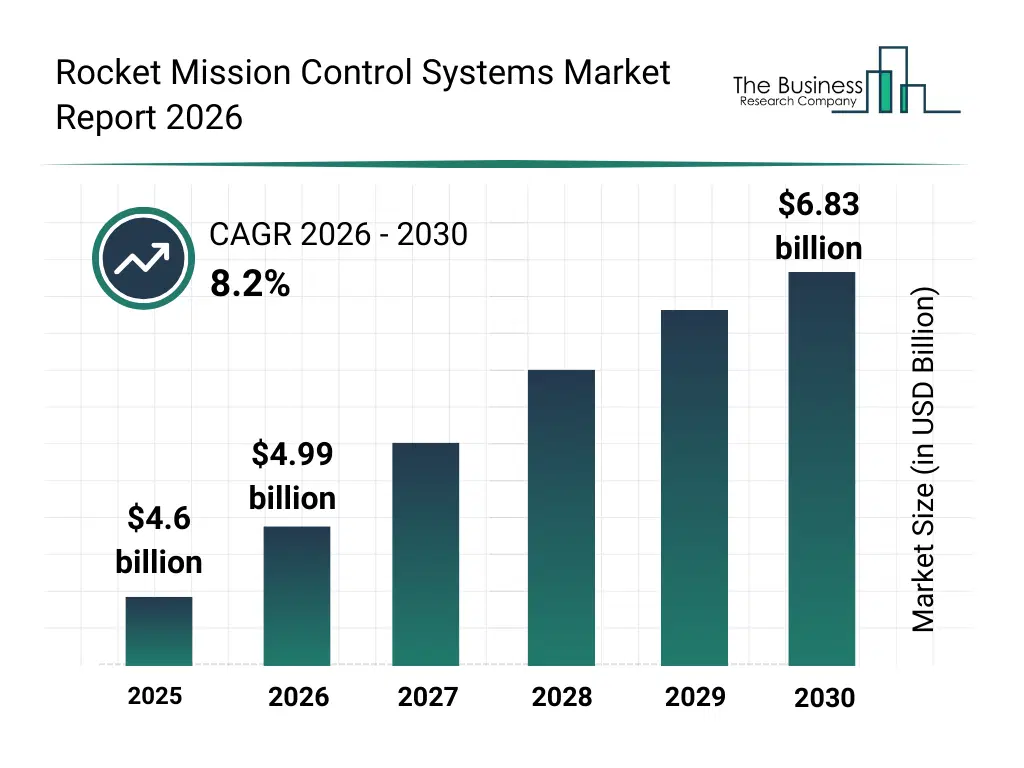
What Is The Rocket Mission Control Systems Market Size and Share 2026?
The rocket mission control systems market size has grown strongly in recent years. It will grow from $4.6 billion in 2025 to $4.99 billion in 2026 at a compound annual growth rate (CAGR) of 8.5%. The growth in the historic period can be attributed to increasing complexity of launch operations driving demand for robust mission control infrastructures, development of advanced telemetry receivers enabling more accurate real-time data monitoring, expansion of tracking antenna networks to support global mission coverage, adoption of command and control consoles to streamline launch coordination, growth of government space programs requiring sophisticated trajectory analysis and countdown management systems.What Is The Rocket Mission Control Systems Market Growth Forecast?
The rocket mission control systems market size is expected to see strong growth in the next few years. It will grow to $6.83 billion in 2030 at a compound annual growth rate (CAGR) of 8.2%. The growth in the forecast period can be attributed to rising commercial launch frequency increasing demand for scalable and automated mission control platforms, advancements in data processing and ai tools enhancing anomaly detection and decision support, expansion of reusable launch operations requiring continuous mission monitoring across multiple flight cycles, innovation in high-bandwidth communications systems improving spacecraft-to-ground connectivity, growing establishment of global spaceports driving adoption of modular and standardized mission control architectures. Major trends in the forecast period include growth in advanced telemetry processing capabilities, rising demand for high-precision flight dynamics modeling, expansion of integrated mission planning and post-launch analytics, enhanced redundancy systems for mission reliability, increased adoption of distributed ground network architectures.
Global Rocket Mission Control Systems Market Segmentation
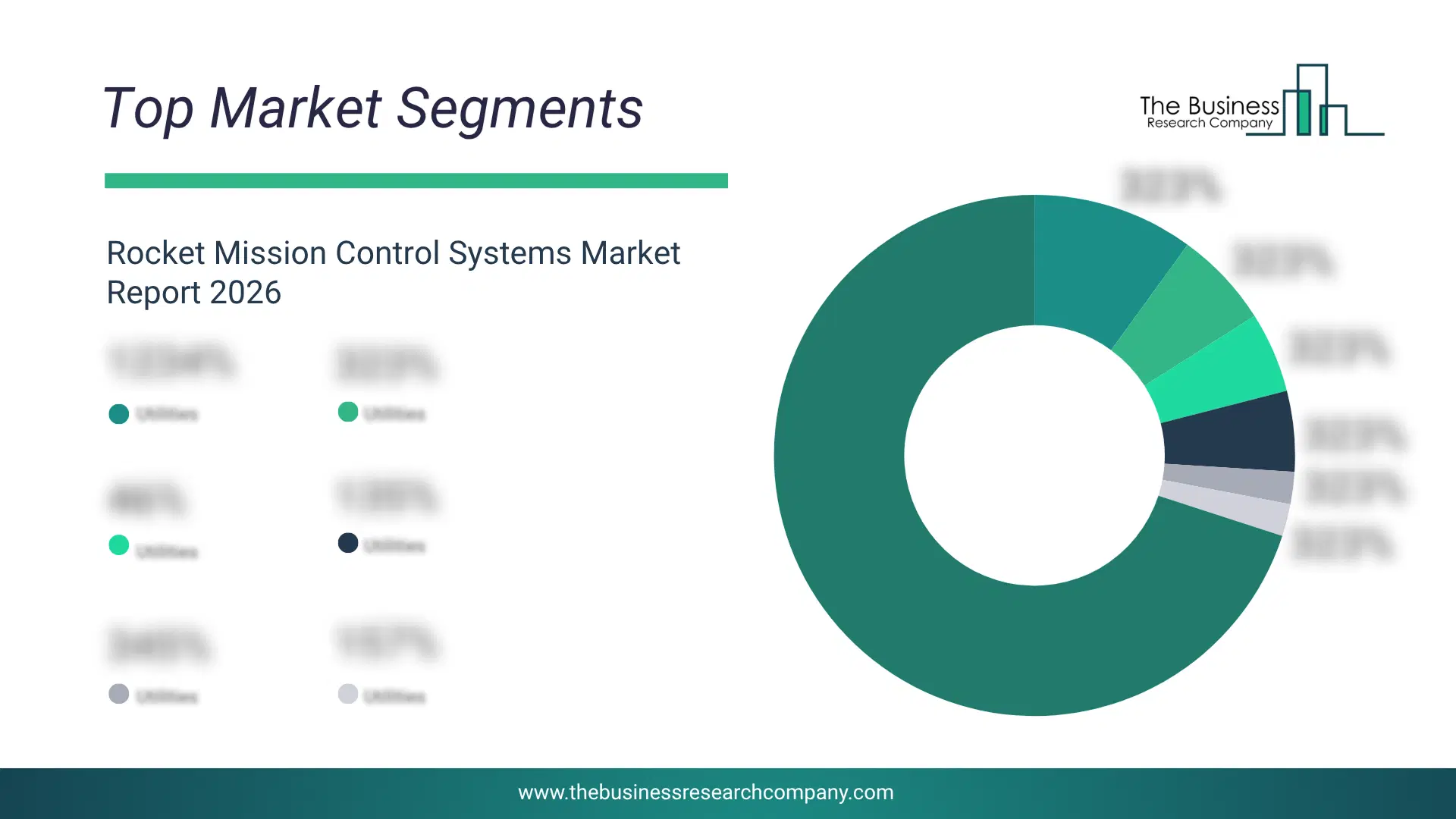
1) By Component: Hardware, Software, Services 2) By Application: Launch Operations, Satellite Operations, Deep Space Missions, Other Applications 3) By End-User: Government, Commercial, Defense, Other End-Users Subsegments: 1) By Hardware: Control Consoles, Data Acquisition Systems, Telemetry Antennas, Tracking Systems, Communication Equipment, Display Panels, Power Supply Units 2) By Software: Flight Management Software, Mission Planning Software, Telemetry And Data Processing Software, Real-Time Operating Systems (RTOS), Command And Control Software, Simulation And Training Software 3) By Services: Integration And Installation Services, Maintenance And Support Services, Software Upgrades And Patch Management, Training And Simulation Services, Mission Design And Analysis Services, Consulting ServicesWhat Is Driver Of The Rocket Mission Control Systems Market?
The increasing number of satellite launches is expected to propel the growth of the rocket mission control systems market going forward. Satellite launches refer to deploying artificial satellites into space using launch vehicles for various applications such as communication, navigation, or Earth observation. The increasing number of satellite launches is rising due to the growing global demand for satellite-based services, which has prompted government and private organizations to expand their launch schedules. Rising satellite launches boost the need for advanced rocket mission control systems to manage complex missions with accurate navigation and real-time tracking. These systems ensure mission safety and efficiency amid increasing launch frequency. For instance, in June 2024, as reported by the Satellite Industry Association, a US-based organization, the commercial satellite industry in 2023 witnessed record-breaking growth, launching 2,781 satellites a 20% rise from 2022. The space industry also achieved a new milestone with 190 total launches, the highest ever recorded. By the end of the year, the number of operational satellites reached 9,691, reflecting a 361% increase over the past five years. Therefore, the increasing number of satellite launches is driving the growth of the rocket mission control systems industry.Key Players In The Global Rocket Mission Control Systems Market
Major companies operating in the rocket mission control systems market are Lockheed Martin Corporation, Raytheon Technologies Corporation, Northrop Grumman Corporation, Thales Group, L3Harris Technologies, Kratos Defense & Security Solutions, Iridium Communications, Telespazio Spa, TERMA, Kongsberg Gruppen, Swedish Space Corporation, Atlas Space Operations, Elecnor Deimos, Integrasys, Infostellar, Leaf Space, Goonhilly Earth Station, Alén Space, Vega, GMV Innovating Solutions S.L.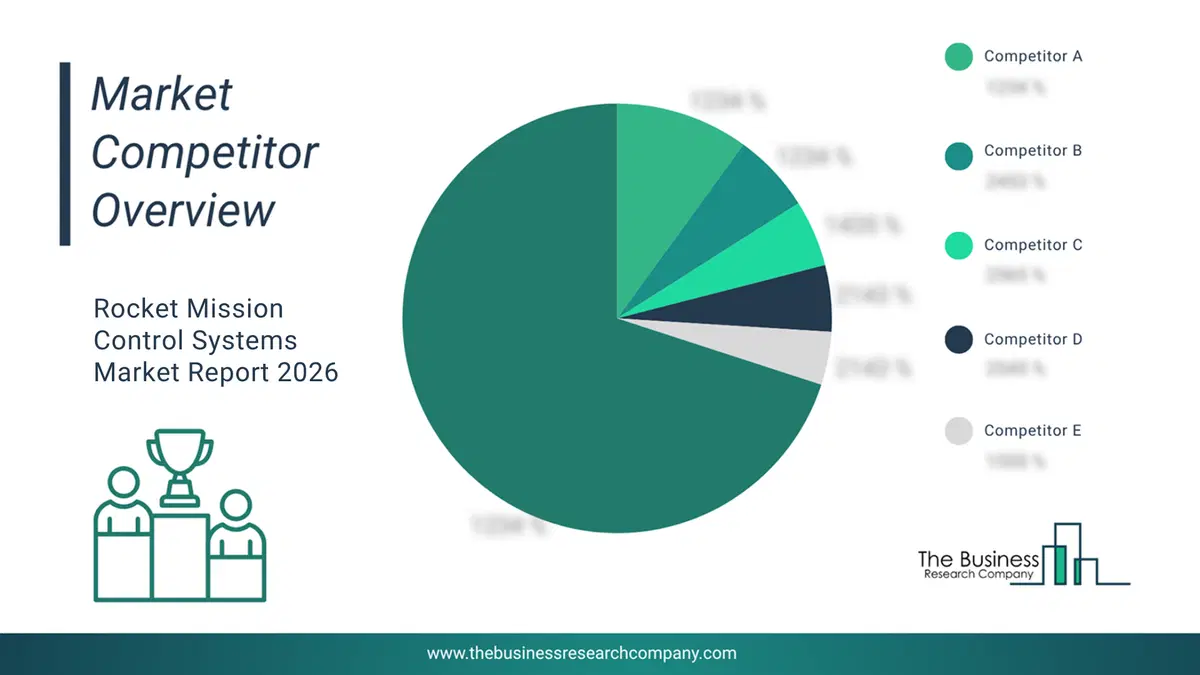
This chart is for illustrative purposes; the full report includes a detailed competitor analysis and comprehensive overview of the top 10 companies in the market.
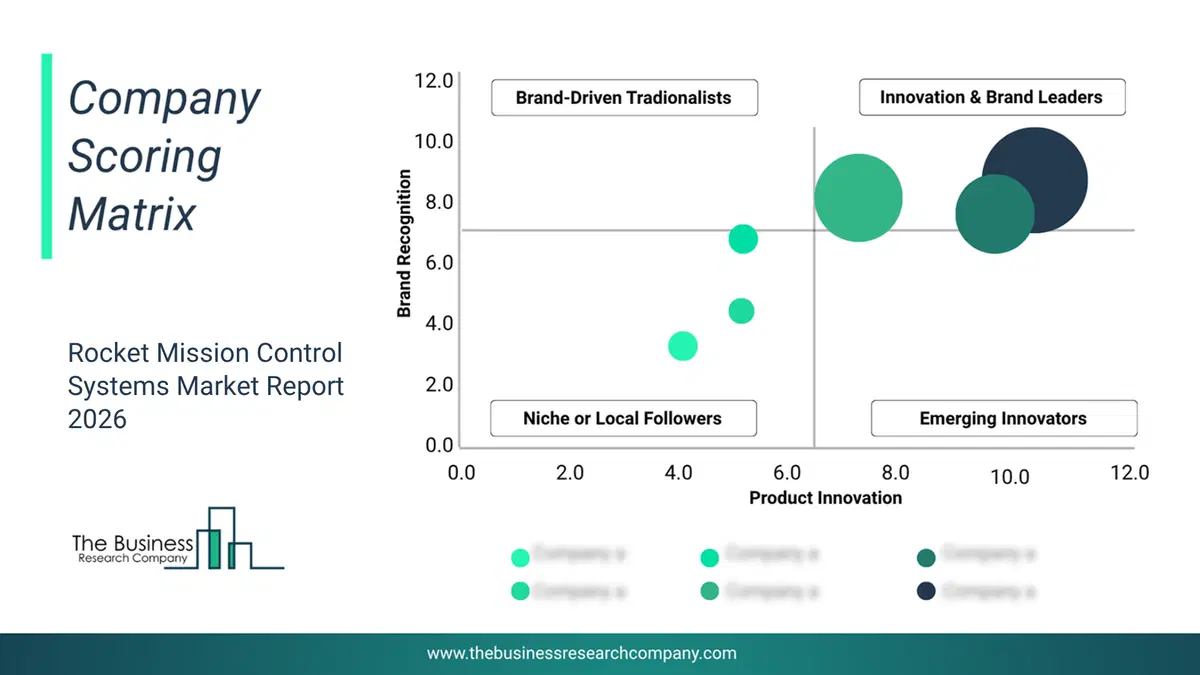
This chart maps companies by product innovation and brand strength, with bubble size indicating relative revenue, helping identify market leaders, challengers, and niche players. This is an illustrative chart; the full report provides a complete and accurate competitive analysis.
Global Rocket Mission Control Systems Market Trends and Insights
Major companies operating in the rocket mission control systems market are focusing on strategic partnerships to accelerate innovation in mission planning and execution. A strategic partnership is a collaboration between organizations to achieve common objectives by utilizing each other’s strengths. It fosters mutual growth through shared resources, innovation, and expanded market opportunities. For instance, in May 2025, Viasat, Inc., a US-based provider of satellite communications, partnered with Blue Origin, a US-based astronautics company, to demonstrate the InRange launch telemetry relay service on two future New Glenn rocket missions, supporting NASA’s Communications Services Project (CSP) as the agency transitions from its legacy Tracking and Data Relay Satellite (TDRS) system to commercial satellite communications solutions. The collaboration will involve integrating Viasat’s InRange user terminal onto Blue Origin’s New Glenn, enabling real-time, beyond-line-of-sight telemetry relay during launch and eliminating communication blackouts experienced with ground-based systems.What Are Latest Mergers And Acquisitions In The Rocket Mission Control Systems Market? Rocket Lab Partnered With Kongsberg Satellite Services (KSAT) To Enhance Global Satellite Communications And Mission Support
In August 2024, Rocket Lab, a US-based provider of mission control infrastructure, partnered with Kongsberg Satellite Services (KSAT) to streamline satellite communications through global connectivity. The partnership aims to deliver efficient, reliable, and scalable ground station services for Rocket Lab’s launch customers, enhancing real-time mission support and simplifying satellite operations. Kongsberg Satellite Services (KSAT) is a Norway-based provider of communication services for spacecraft and launch vehicles.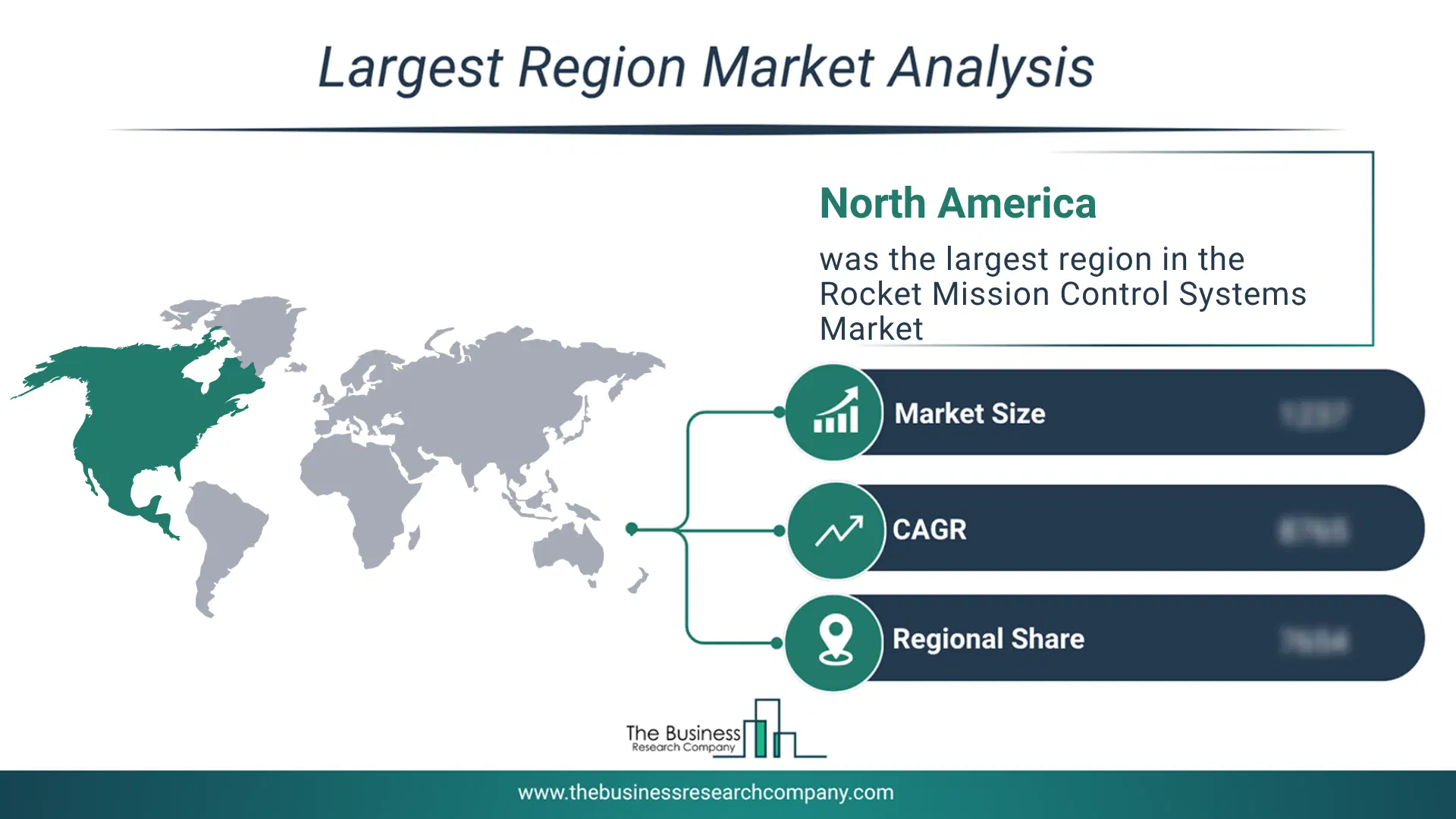
Regional Insights
North America was the largest region in the rocket mission control systems market in 2025. The regions covered in this market report are Asia-Pacific, South East Asia, Western Europe, Eastern Europe, North America, South America, Middle East, Africa. The countries covered in this market report are Australia, Brazil, China, France, Germany, India, Indonesia, Japan, Taiwan, Russia, South Korea, UK, USA, Canada, Italy, SpainWhat Defines the Rocket Mission Control Systems Market?
The rocket mission control systems market consists of revenues earned by entities providing services such as command and control, flight dynamics and trajectory analysis, launch and countdown management, and communications support. The market value includes the value of related goods sold by the service provider or included within the service offering. The rocket mission control systems market also includes sales of control consoles, telemetry receivers, tracking antennas, and data servers. Values in this market are ‘factory gate’ values, that is, the value of goods sold by the manufacturers or creators of the goods, whether to other entities (including downstream manufacturers, wholesalers, distributors, and retailers) or directly to end customers. The value of goods in this market includes related services sold by the creators of the goods.How is Market Value Defined and Measured?
The market value is defined as the revenues that enterprises gain from the sale of goods and/or services within the specified market and geography through sales, grants, or donations in terms of the currency (in USD unless otherwise specified). The revenues for a specified geography are consumption values that are revenues generated by organizations in the specified geography within the market, irrespective of where they are produced. It does not include revenues from resales along the supply chain, either further along the supply chain or as part of other products.
This chart presents market attractiveness based on a quantitative evaluation of growth, competition, strategic alignment, and risk, offering a clear view of opportunity areas for decision-making. This chart is for illustrative purposes; the full report contains the complete analysis.

This chart highlights the Total Addressable Market (TAM) by estimating the maximum revenue opportunity using an assumption-driven approach, supporting strategic planning and opportunity sizing across markets. The chart is illustrative; the full report provides a more comprehensive analysis.
What Key Data and Analysis Are Included in the Rocket Mission Control Systems Market Report 2026?
The rocket mission control systems market research report is one of a series of new reports from The Business Research Company that provides market statistics, including industry global market size, regional shares, competitors with the market share, detailed market segments, market trends and opportunities, and any further data you may need to thrive in the rocket mission control systems industry. The market research report delivers a complete perspective of everything you need, with an in-depth analysis of the current and future state of the industry.Rocket Mission Control Systems Market Report Forecast Analysis
| Report Attribute | Details |
|---|---|
| Market Size Value In 2026 | $4.99 billion |
| Revenue Forecast In 2030 | $6.83 billion |
| Growth Rate | CAGR of 8.2% from 2026 to 2030 |
| Base Year For Estimation | 2025 |
| Actual Estimates/Historical Data | 2020-2025 |
| Forecast Period | 2026 - 2030 |
| Market Representation | Revenue in USD Billion and CAGR from 2026 to 2030 |
| Segments Covered | Component, Application, End-User |
| Regional Scope | Asia-Pacific, Western Europe, Eastern Europe, North America, South America, Middle East, Africa |
| Country Scope | The countries covered in the rocket mission control systems market report are Australia, Brazil, China, France, Germany, India, Indonesia, Japan, Taiwan, Russia, South Korea, UK, USA, Canada, Italy, Spain |
| Key Companies Profiled | Lockheed Martin Corporation, Raytheon Technologies Corporation, Northrop Grumman Corporation, Thales Group, L3Harris Technologies, Kratos Defense & Security Solutions, Iridium Communications, Telespazio Spa, TERMA, Kongsberg Gruppen, Swedish Space Corporation, Atlas Space Operations, Elecnor Deimos, Integrasys, Infostellar, Leaf Space, Goonhilly Earth Station, Alén Space, Vega, GMV Innovating Solutions S.L. |
| Customization Scope | Request for Customization |
| Pricing And Purchase Options | Explore Purchase Options |