

Rocket Payload Heat Control Market Report 2026
Global Outlook – By Component (Thermal Protection Systems, Heat Shields, Insulation Materials, Radiators, Other Components), By Payload Type (Satellites, Space Probes, Manned Spacecraft, Other Payload Types), By Material Type (Ceramics, Metals, Polymers, Composites), By Application (Commercial Space, Military And Defense, Scientific Research, Other Applications) – Market Size, Trends, Strategies, and Forecast to 2030
Rocket Payload Heat Control Market Overview
• Rocket Payload Heat Control market size has reached to $2.57 billion in 2025 • Expected to grow to $3.61 billion in 2030 at a compound annual growth rate (CAGR) of 6.9% • Growth Driver: The Increasing Number Of Space Missions Is Fueling The Growth Of The Market Due To Rising Demand For Reliable Thermal Management Systems • Market Trend: Advancements In Thermal Management Systems For Spacecraft Payloads • North America was the largest region in 2025.What Is Covered Under Rocket Payload Heat Control Market?
Rocket payload heat control refers to the systems and methods used to manage the temperature of a rocket's payload during all phases of flight, including launch, space travel, and re-entry (if applicable). These systems protect sensitive instruments, satellites, or scientific experiments from extreme temperatures caused by atmospheric friction, solar radiation, or internal heat generation. The main components of rocket payload heat control are thermal protection systems, heat shields, insulation materials, radiators, and others. Thermal protection systems (TPS) safeguard rockets and payloads from extreme temperatures during launch, spaceflight, and re-entry by absorbing, deflecting, or dissipating heat. The various payloads involved are satellites, space probes, manned spacecraft, and others with various material types, including ceramics, metals, polymers, and composites. The various applications involved are commercial space, military and defense, scientific research, and others.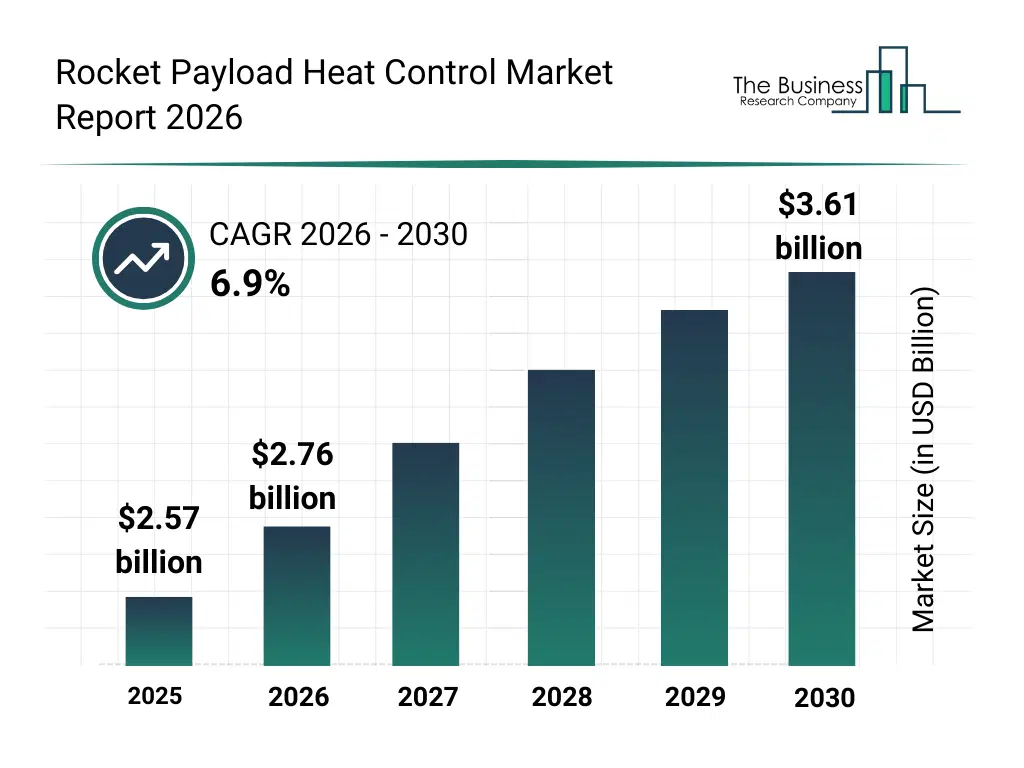
What Is The Rocket Payload Heat Control Market Size and Share 2026?
The rocket payload heat control market size has grown strongly in recent years. It will grow from $2.57 billion in 2025 to $2.76 billion in 2026 at a compound annual growth rate (CAGR) of 7.4%. The growth in the historic period can be attributed to increasing thermal sensitivity of scientific and commercial payloads driving adoption of heat control solutions, development of heat pipes and thermal straps to manage internal payload temperature gradients, growth of satellite deployment missions requiring advanced payload thermal protection, early integration of mechanical louvers to regulate heat rejection in varying thermal environments, expansion of cryogenic cooling technologies to support highly sensitive instrumentation.What Is The Rocket Payload Heat Control Market Growth Forecast?
The rocket payload heat control market size is expected to see strong growth in the next few years. It will grow to $3.61 billion in 2030 at a compound annual growth rate (CAGR) of 6.9%. The growth in the forecast period can be attributed to rising commercial satellite launches increasing demand for scalable payload thermal management systems, advancements in lightweight and high-conductivity materials improving heat control device performance, expansion of deep-space and high-energy missions requiring more sophisticated thermal protection architectures, innovation in adaptive and autonomous thermal regulation systems enhancing payload reliability, growing use of reusable rockets necessitating payload heat control systems compatible with rapid turnaround cycles. Major trends in the forecast period include increasing adoption of advanced cryogenic cooling solutions, rising use of lightweight composite thermal protection materials, growing demand for modular and reconfigurable payload thermal systems, expansion of passive thermal control technologies for small satellites, integration of high-performance thermal interfaces such as heat pipes and thermal straps.
Global Rocket Payload Heat Control Market Segmentation
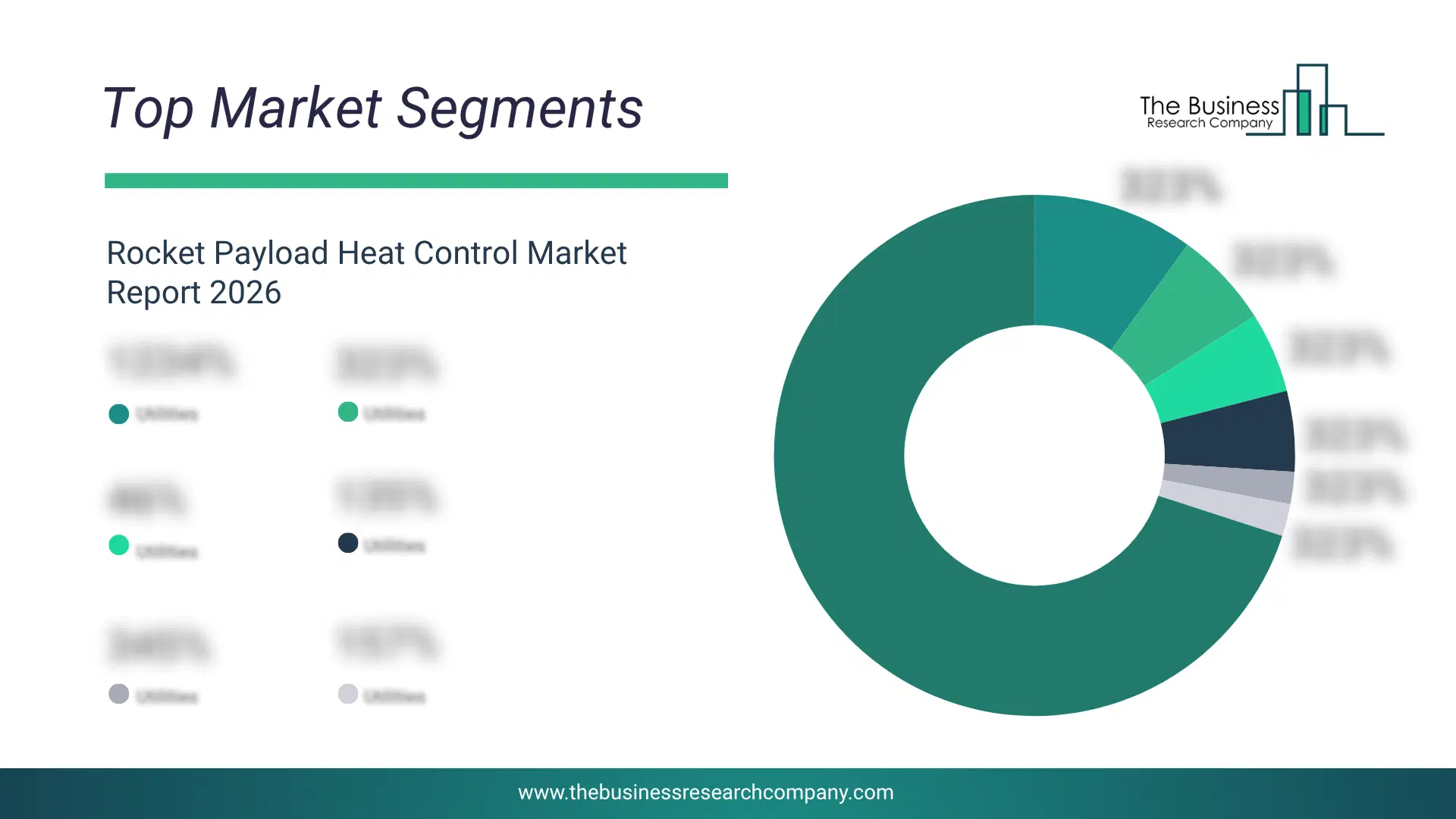
1) By Component: Thermal Protection Systems, Heat Shields, Insulation Materials, Radiators, Other Components 2) By Payload Type: Satellites, Space Probes, Manned Spacecraft, Other Payload Types 3) By Material Type: Ceramics, Metals, Polymers, Composites 4) By Application: Commercial Space, Military And Defense, Scientific Research, Other Applications Subsegments: 1) By Thermal Protection Systems: Ablative Thermal Protection, Reusable Thermal Protection, Passive Thermal Protection, Active Thermal Protection 2) By Heat Shields: Metallic Heat Shields, Ceramic Heat Shields, Composite Heat Shields, Flexible Heat Shields 3) By Insulation Materials: Multilayer Insulation (MLI), Foam Insulation, Aerogel Insulation, Fiberglass Insulation 4) By Radiators: Loop Heat Pipe Radiators, Deployable Radiators, Fixed Panel Radiators, Heat Pipe Embedded Radiators 5) By Other Components: Thermal Straps, Phase Change Materials (PCMs), Heaters, Coatings And Surface TreatmentsWhat Is Driver Of The Rocket Payload Heat Control Market?
The increasing number of space missions is expected to propel the growth of the rocket payload heat control market going forward. Space missions are strategically planned activities carried out in outer space to fulfill objectives related to science, exploration, technology, or commercial purposes. The increasing number of space missions is due to increasing participation from private space companies investing heavily in launch vehicles and space infrastructure. Rocket payload heat control safeguards critical instruments from harsh temperature variations during launch and spaceflight. This thermal management is essential for maintaining the mission's payload performance, precision, and durability. For instance, in November 2024, according to the Federal Aviation Administration, a US-based federal agency, commercial space operations increased by over 30% in 2023, reaching 148 missions, and is expected to double by 2028. Therefore, the increasing number of space missions is driving the growth of the rocket payload heat control industry.Key Players In The Global Rocket Payload Heat Control Market
Major companies operating in the rocket payload heat control market are Lockheed Martin Corporation, The Boeing Company, Saint-Gobain, Northrop Grumman Corporation, SpaceX, Blue Origin LLC, Ball Aerospace & Technologies Corp., Evonik Industries AG, Sierra Space, Meyer Tool & Mfg., Sheldahl, Aerospace Fabrication & Materials LLC, DHV Technology, Advanced Cooling Technologies, A&R Tarpaulins Inc., Admatis, Beyond Gravity, Technology Applications Inc., Dunmore Aerospace, Versiv Composites Limited, RAL Space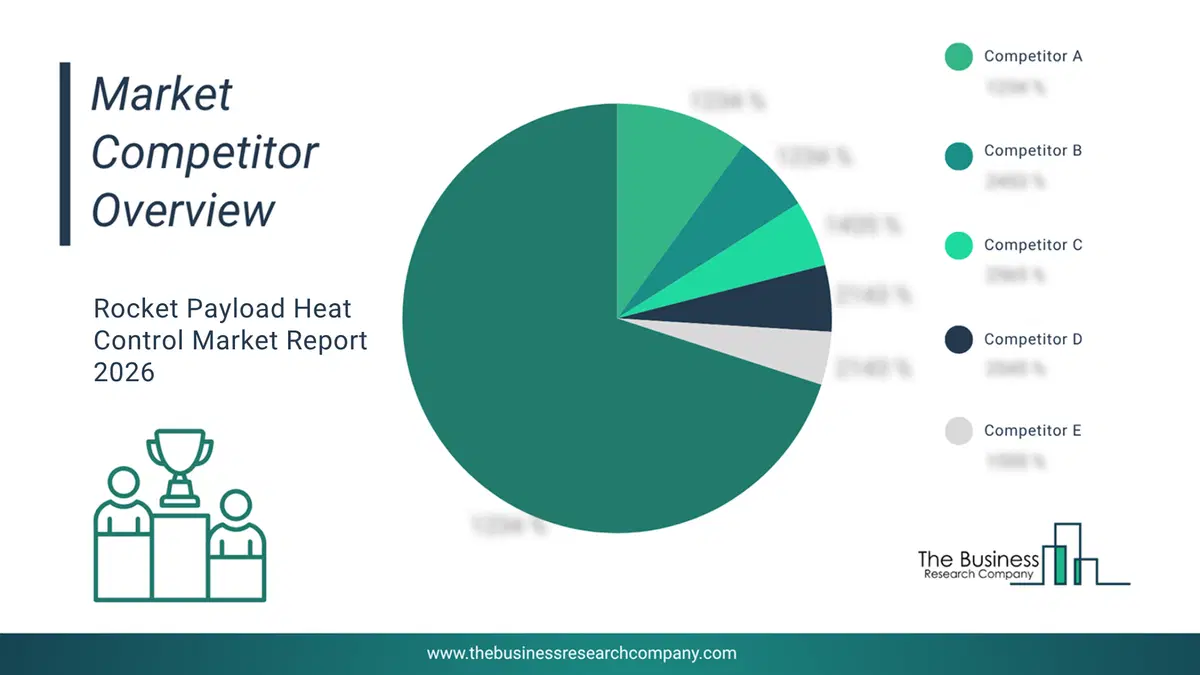
This chart is for illustrative purposes; the full report includes a detailed competitor analysis and comprehensive overview of the top 10 companies in the market.
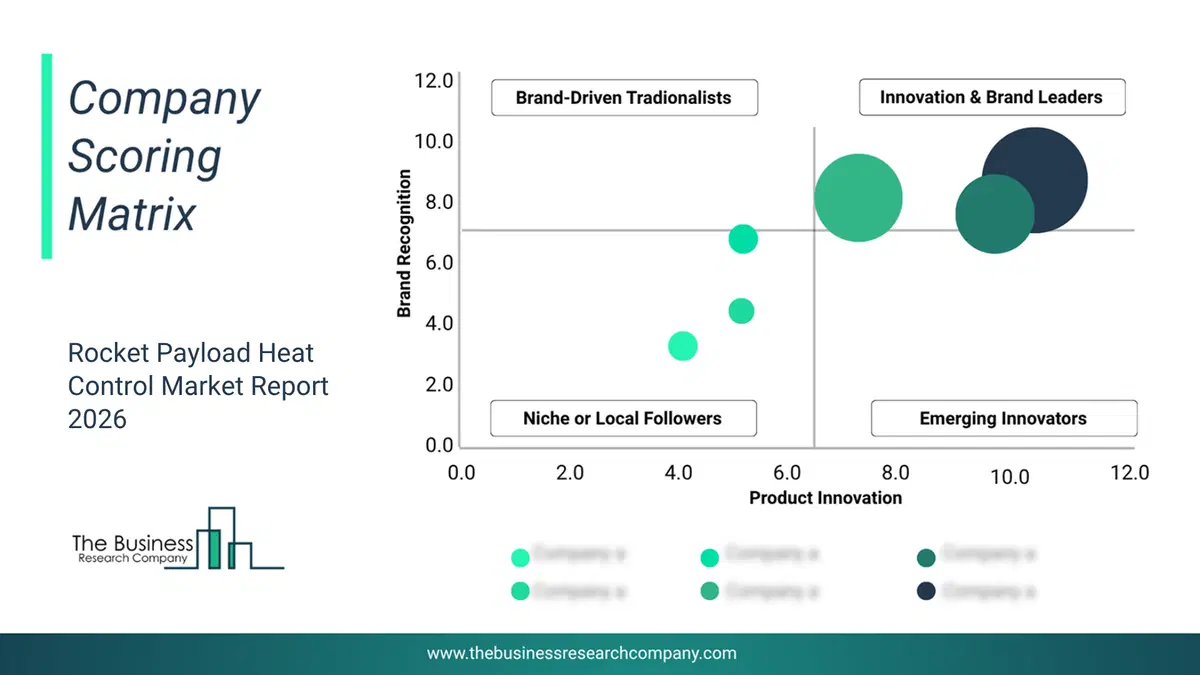
This chart maps companies by product innovation and brand strength, with bubble size indicating relative revenue, helping identify market leaders, challengers, and niche players. This is an illustrative chart; the full report provides a complete and accurate competitive analysis.
Global Rocket Payload Heat Control Market Trends and Insights
Major companies operating in the rocket payload heat control market are focusing on developing technological advancements such as thermal management systems to enhance payload temperature regulation, ensure component reliability, and maintain optimal performance during launch and space operations. A thermal management system refers to a set of technologies and mechanisms designed to monitor, control, and dissipate heat within a spacecraft or rocket to maintain optimal operating temperatures for payloads and critical components. For instance, in November 2024, the Air Force Research Laboratory, a US-based research and development center, launched its SPIRRAL (Space Power InfraRed Regulation and Analysis of Lifetime) experiment on SpaceX's CRS-31 (SPX-31) mission to study thermal control and power regulation technologies in space. This tests Variable Emissivity Materials (VEMs) for space-based thermal management. These materials passively regulate heat by changing their infrared emissivity to reduce extreme temperature swings, protecting spacecraft electronics without heavy, power-consuming systems. SPIRRAL’s success could revolutionize spacecraft thermal control, enabling longer life, greater resilience, and supporting space solar power systems for continuous energy supply.What Are Latest Mergers And Acquisitions In The Rocket Payload Heat Control Market? Sierra Space Partnered With Oak Ridge National Laboratory To Develop Reusable Silicon-Carbide Thermal Protection System
In November 2024, Sierra Space, a US-based manufacturer of passive thermal control heat switches for controlling the temperature of satellites and spacecraft, partnered with Oak Ridge National Laboratory to advance reusability through next-generation thermal protection. The partnership aims to develop a durable, lightweight, low-maintenance silicon-carbide thermal protection system that ensures spacecraft safety and enables rapid, repeated space missions. Oak Ridge National Laboratory is a US-based science and energy national laboratory in the Department of Energy system.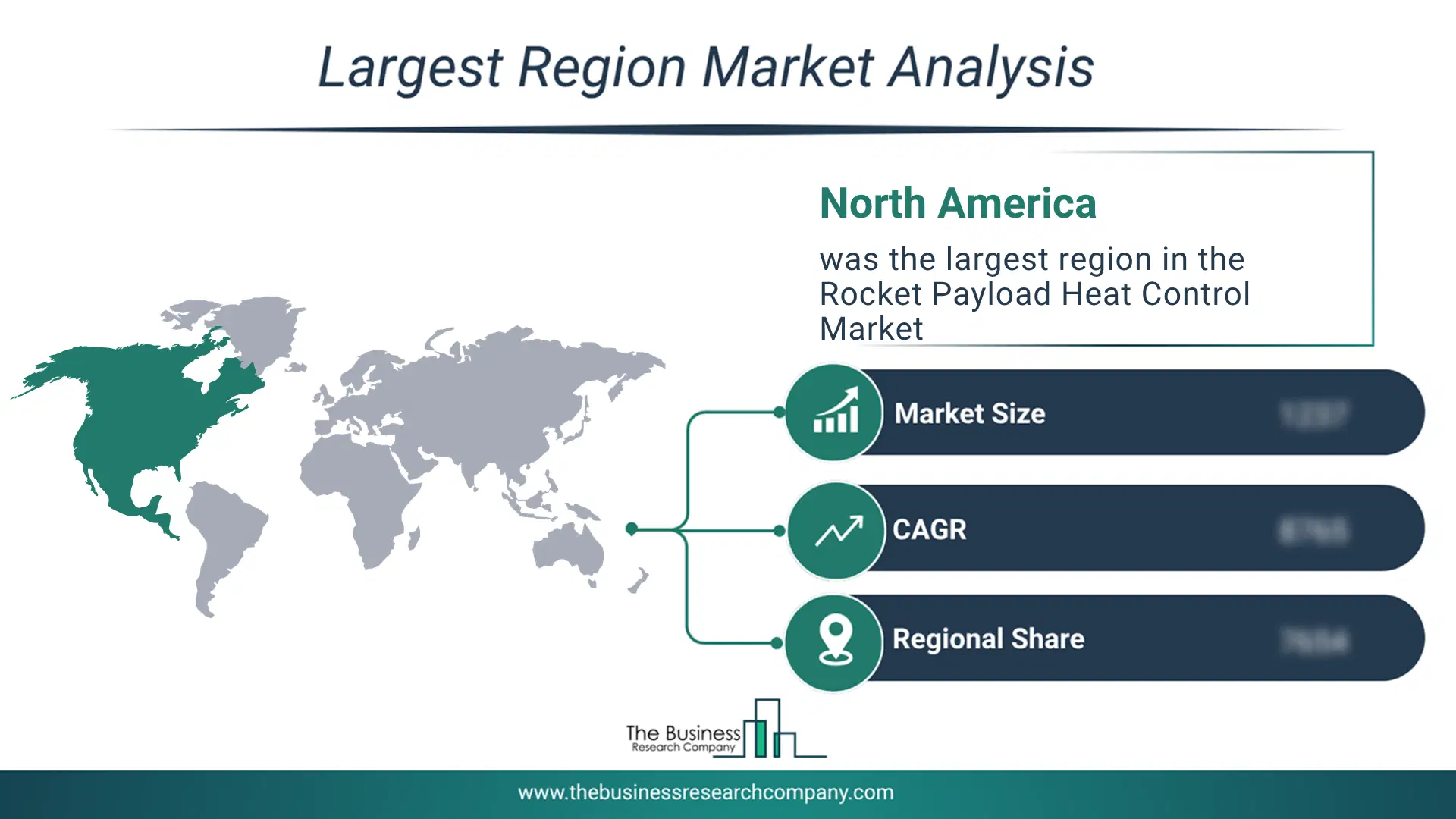
Regional Insights
North America was the largest region in the rocket payload heat control market in 2025. The regions covered in this market report are Asia-Pacific, South East Asia, Western Europe, Eastern Europe, North America, South America, Middle East, Africa. The countries covered in this market report are Australia, Brazil, China, France, Germany, India, Indonesia, Japan, Taiwan, Russia, South Korea, UK, USA, Canada, Italy, SpainWhat Defines the Rocket Payload Heat Control Market?
The rocket payload heat control market consists of sales of heat pipes, thermal straps, louvers, and cryogenic cooling systems. Values in this market are ‘factory gate’ values, that is, the value of goods sold by the manufacturers or creators of the goods, whether to other entities (including downstream manufacturers, wholesalers, distributors, and retailers) or directly to end customers. The value of goods in this market includes related services sold by the creators of the goods.How is Market Value Defined and Measured?
The market value is defined as the revenues that enterprises gain from the sale of goods and/or services within the specified market and geography through sales, grants, or donations in terms of the currency (in USD unless otherwise specified). The revenues for a specified geography are consumption values that are revenues generated by organizations in the specified geography within the market, irrespective of where they are produced. It does not include revenues from resales along the supply chain, either further along the supply chain or as part of other products.
This chart presents market attractiveness based on a quantitative evaluation of growth, competition, strategic alignment, and risk, offering a clear view of opportunity areas for decision-making. This chart is for illustrative purposes; the full report contains the complete analysis.

This chart highlights the Total Addressable Market (TAM) by estimating the maximum revenue opportunity using an assumption-driven approach, supporting strategic planning and opportunity sizing across markets. The chart is illustrative; the full report provides a more comprehensive analysis.
What Key Data and Analysis Are Included in the Rocket Payload Heat Control Market Report 2026?
The rocket payload heat control market research report is one of a series of new reports from The Business Research Company that provides market statistics, including industry global market size, regional shares, competitors with the market share, detailed market segments, market trends and opportunities, and any further data you may need to thrive in the rocket payload heat control industry. The market research report delivers a complete perspective of everything you need, with an in-depth analysis of the current and future state of the industry.Rocket Payload Heat Control Market Report Forecast Analysis
| Report Attribute | Details |
|---|---|
| Market Size Value In 2026 | $2.76 billion |
| Revenue Forecast In 2030 | $3.61 billion |
| Growth Rate | CAGR of 6.9% from 2026 to 2030 |
| Base Year For Estimation | 2025 |
| Actual Estimates/Historical Data | 2020-2025 |
| Forecast Period | 2026 - 2030 |
| Market Representation | Revenue in USD Billion and CAGR from 2026 to 2030 |
| Segments Covered | Component, Payload Type, Material Type, Application |
| Regional Scope | Asia-Pacific, Western Europe, Eastern Europe, North America, South America, Middle East, Africa |
| Country Scope | The countries covered in the rocket payload heat control market report are Australia, Brazil, China, France, Germany, India, Indonesia, Japan, Taiwan, Russia, South Korea, UK, USA, Canada, Italy, Spain |
| Key Companies Profiled | Lockheed Martin Corporation, The Boeing Company, Saint-Gobain, Northrop Grumman Corporation, SpaceX, Blue Origin LLC, Ball Aerospace & Technologies Corp., Evonik Industries AG, Sierra Space, Meyer Tool & Mfg., Sheldahl, Aerospace Fabrication & Materials LLC, DHV Technology, Advanced Cooling Technologies, A&R Tarpaulins Inc., Admatis, Beyond Gravity, Technology Applications Inc., Dunmore Aerospace, Versiv Composites Limited, RAL Space |
| Customization Scope | Request for Customization |
| Pricing And Purchase Options | Explore Purchase Options |