
Room Occupancy Sensor Market Report 2026
Global Outlook – By Sensor Type (Passive Infrared, Ultrasonic, Dual Technology, Other Sensor Types), By Mounting Type (Ceiling Mounted Sensors, Wall Mounted Sensors, Desk Or Surface Mounted Sensors, Heating, Ventilation, And Air Conditioning Integrated Sensors), By Connectivity (Wired, Wireless), By Distribution Channel (Direct Sales, Distributors And Wholesalers, Online Retail, System Integrators), By End User (Offices, Hotels, Hospitals, Educational Institutions, Retail, Other End Users) – Market Size, Trends, Strategies, and Forecast to 2035
Room Occupancy Sensor Market Overview
• Room Occupancy Sensor market size has reached to $2.74 billion in 2025 • Expected to grow to $5.07 billion in 2030 at a compound annual growth rate (CAGR) of 13% • Growth Driver: Growth In Commercial Construction Projects Is Fueling The Growth Of The Market Due To Increasing Investments In Smart Commercial Infrastructure • Market Trend: Innovations In Dual-Technology Occupancy Sensors Enhance Motion Detection And Energy-Efficient Lighting Control • North America was the largest region in 2025 and Asia-Pacific is the fastest growing region.What Is Covered Under Room Occupancy Sensor Market?
A room occupancy sensor is an electronic sensing device that detects the presence or absence of people within an enclosed or defined space and can provide occupancy information for automated or monitored functions. It may use technologies such as passive infrared, ultrasonic, microwave, or other sensing methods and can be integrated with building management systems for applications such as lighting, HVAC, security, and occupancy monitoring. The main sensor types of room occupancy sensor include passive infrared, ultrasonic, dual technology, and other sensor types. Passive infrared sensors detect changes in infrared radiation caused by human movement and are commonly used to determine whether a room is occupied. These sensors are available as ceiling mounted sensors, wall mounted sensors, desk or surface mounted sensors, and heating, ventilation, and air conditioning integrated sensors, with wired and wireless connectivity options. They are distributed through direct sales, distributors and wholesalers, online retail, and system integrators, and are used by several end users such as offices, hotels, hospitals, educational institutions, retail, and others.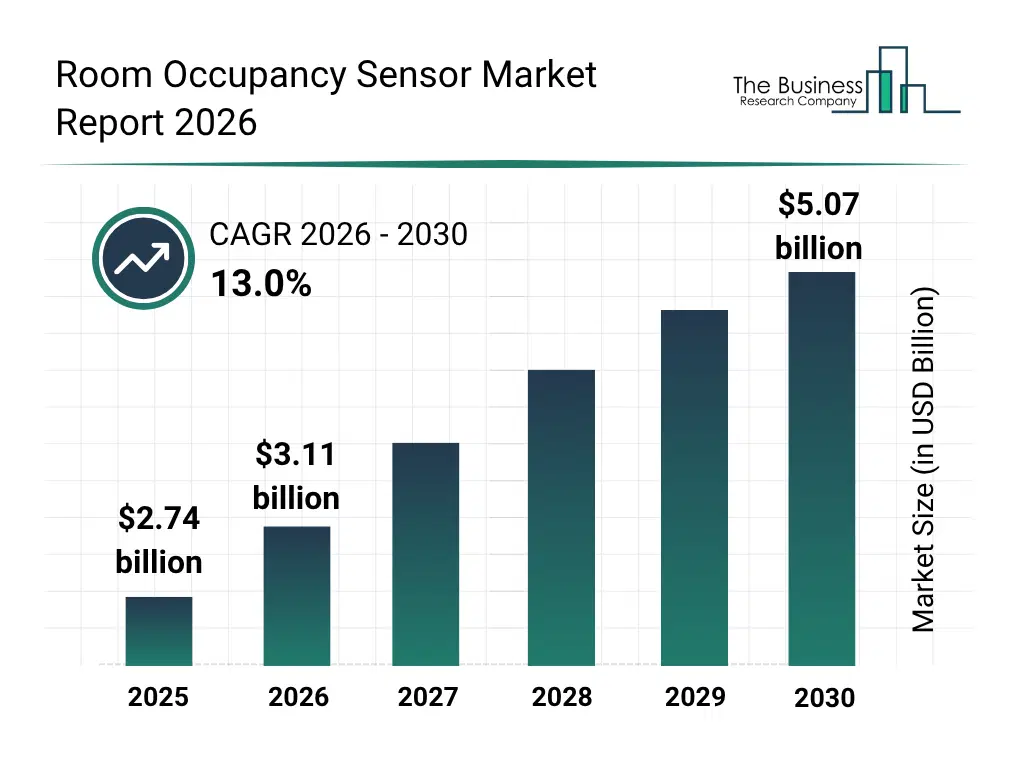
What Is The Room Occupancy Sensor Market Size and Share 2026?
The room occupancy sensor market size has grown rapidly in recent years. It will grow from $2.74 billion in 2025 to $3.11 billion in 2026 at a compound annual growth rate (CAGR) of 13.6%. The growth in the historic period can be attributed to increasing adoption of intelligent building management systems, rising demand for energy-efficient building operations, growing deployment of automated lighting controls, increasing commercial building modernization, rising awareness of occupancy-based energy management.What Is The Room Occupancy Sensor Market Growth Forecast?
The room occupancy sensor market size is expected to see rapid growth in the next few years. It will grow to $5.07 billion in 2030 at a compound annual growth rate (CAGR) of 13.0%. The growth in the forecast period can be attributed to increasing demand for real-time space utilization analytics, growing adoption of smart building technologies, rising demand for wireless occupancy sensors, expansion of energy efficiency regulations, increasing integration of occupancy sensors with HVAC and lighting systems. Major trends in the forecast period include advanced occupancy detection technologies, real-time occupancy monitoring, multi-sensor occupancy detection, energy-efficient occupancy-based building controls, privacy-preserving occupancy sensing.Tariff Impact On Room Occupancy Sensor Market
Tariffs are impacting the room occupancy sensor market by increasing the cost of imported sensors, semiconductor components, wireless modules, and electronic control equipment used in occupancy detection systems. Ceiling-mounted, wall-mounted, wireless, and integrated HVAC sensor segments may face greater cost pressures, particularly in North America, Europe, and Asia-Pacific due to interconnected electronics supply chains. However, tariffs can encourage manufacturers to diversify suppliers, localize component production, and develop cost-efficient sensor technologies, potentially strengthening regional manufacturing and supply-chain resilience.
Global Room Occupancy Sensor Market Segmentation
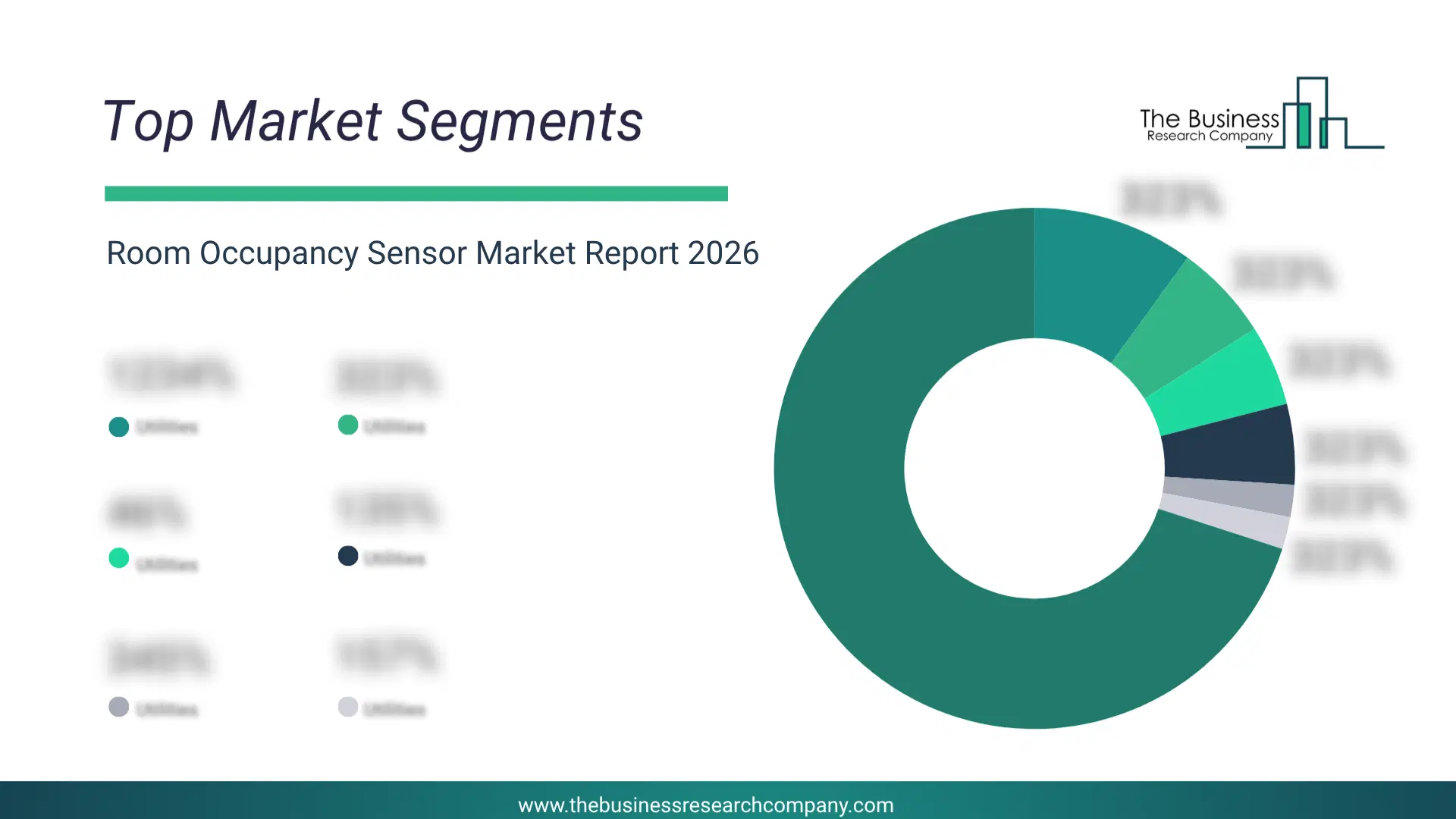
2) By Mounting Type: Ceiling Mounted Sensors, Wall Mounted Sensors, Desk Or Surface Mounted Sensors, Heating, Ventilation, And Air Conditioning Integrated Sensors 3) By Connectivity: Wired, Wireless 4) By Distribution Channel: Direct Sales, Distributors And Wholesalers, Online Retail, System Integrators 5) By End User: Offices, Hotels, Hospitals, Educational Institutions, Retail, Other End Users Subsegments: 1) By Passive Infrared: Standard Passive Infrared Sensors, Wide Angle Passive Infrared Sensors, Long Range Passive Infrared Sensors, Pet Immune Passive Infrared Sensors, High Sensitivity Passive Infrared Sensors 2) By Ultrasonic: Single Transducer Ultrasonic Sensors, Dual Transducer Ultrasonic Sensors, Wide Coverage Ultrasonic Sensors, Ceiling Mounted Ultrasonic Sensors, Wall Mounted Ultrasonic Sensors 3) By Dual Technology: Passive Infrared And Ultrasonic Sensors, Passive Infrared And Microwave Sensors, Ultrasonic And Microwave Sensors, Adaptive Dual Technology Sensors, Intelligent Dual Technology Sensors 4) By Other Sensor Types: Microwave Occupancy Sensors, Image Based Occupancy Sensors, Thermal Occupancy Sensors, Time Of Flight Sensors, Acoustic Occupancy Sensors, Radar Based Occupancy Sensors, Light Detection And Ranging Occupancy Sensors, Capacitive Occupancy Sensors, Carbon Dioxide Based Occupancy Sensors, Bluetooth Or Wi Fi Presence SensorsWhat Is The Driver Of The Room Occupancy Sensor Market?
The growth in commercial construction projects is expected to propel the growth of the room occupancy sensor market going forward. Commercial construction projects refer to the planning, development, and construction of buildings and facilities used for business, retail, hospitality, industrial, and commercial purposes. Commercial construction projects are increasing due to rapid urbanization, which is driving demand for new commercial buildings and business infrastructure. The growth in commercial construction projects is driving room occupancy sensors by increasing demand for smart building technologies that improve energy efficiency, automate lighting and HVAC systems, and optimize space utilization. For instance, in July 2025, according to the U.S. Census Bureau, a U.S.-based government agency, office construction spending was $42,249 million, marking a 1.7% increase from $41,537 million. Therefore, the growth in commercial construction projects is driving the growth of the room occupancy sensor industry.Key Players In The Global Room Occupancy Sensor Market
Major companies operating in the room occupancy sensor market are Siemens AG, Schneider Electric SE, Honeywell International Inc., Johnson Controls International plc, Eaton Corporation plc, Legrand SA, Signify N.V., Hubbell Incorporated, Acuity Brands Inc., Hager Group, Leviton Manufacturing Co. Inc., Lutron Electronics Co. Inc., Crestron Electronics Inc., EnOcean GmbH, B.E.G. Brück Electronic GmbH, Intermatic Incorporated, Enerlites Inc., Pressac Communications Limited, IR-TEC International Ltd., XY Sense, Robert Bosch GmbH, Panasonic Holdings Corporation, Steinel Vertrieb GmbH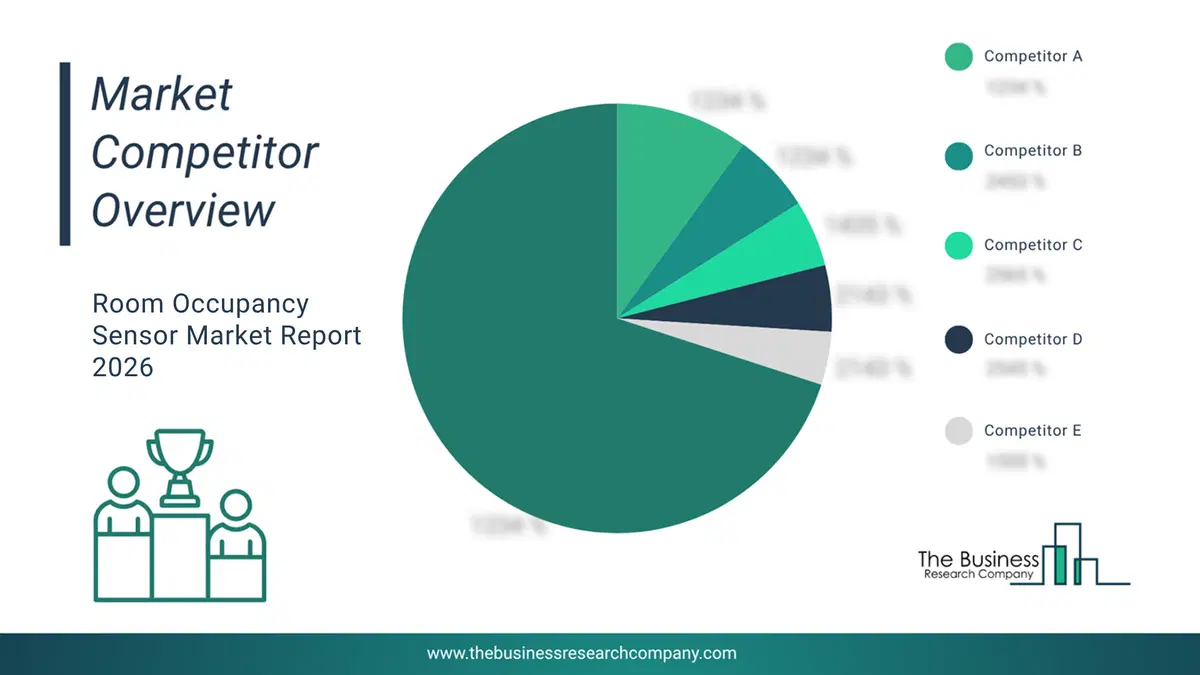
This chart is for illustrative purposes; the full report includes a detailed competitor analysis and comprehensive overview of the top 10 companies in the market.
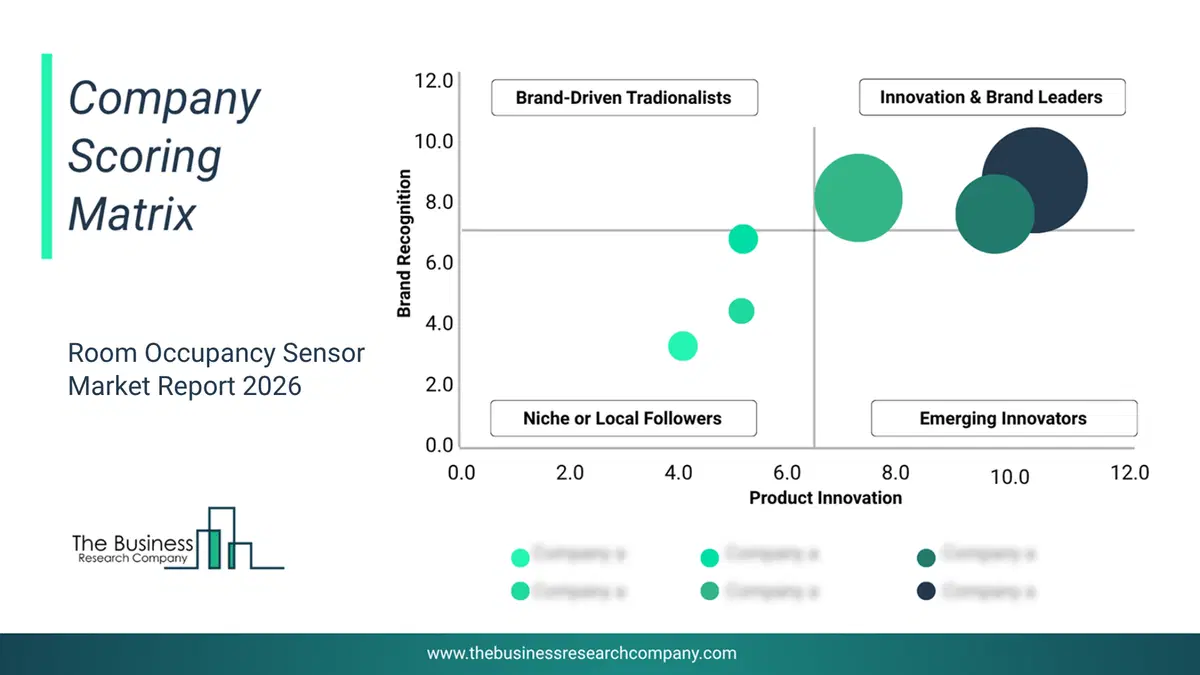
This chart maps companies by product innovation and brand strength, with bubble size indicating relative revenue, helping identify market leaders, challengers, and niche players. This is an illustrative chart; the full report provides a complete and accurate competitive analysis.
Global Room Occupancy Sensor Market Trends and Insights
Major companies operating in the room occupancy sensor market are focusing on developing advanced solutions, such as dual-technology occupancy sensors, to improve motion-detection accuracy, expand coverage, and optimize energy-efficient lighting control. Dual-technology occupancy sensors combine multiple sensing technologies, such as passive infrared (PIR) and ultrasonic detection, to identify room occupancy and reduce missed detections. For instance, in June 2025, EarthTronics, a US-based lighting products company, introduced the EarthConnect Dual-Technology Ceiling Sensor, a Bluetooth mesh network lighting control solution featuring a dual-tech occupancy sensor that combines PIR and ultrasonic technologies to provide high-accuracy motion detection across 600 square feet. The sensor supports daylight harvesting, on-off scheduling, dimming, scene setting, and wireless grouping, helping improve lighting efficiency, reduce energy waste, and enhance occupant comfort in commercial and institutional spaces.What Are Latest Mergers And Acquisitions In The Room Occupancy Sensor Market?
In March 2026, Calumino, an Australia-based thermal sensing technology company, partnered with Hytronik to advance smart-building intelligence through precise, privacy-preserving thermal occupancy detection. This partnership aims to integrate Calumino’s thermal sensing modules with Hytronik’s occupancy sensor portfolio to improve building automation, energy efficiency, and space utilization. Hytronik is a UK-based company designing and manufacturing sensors and intelligent building-control products, including occupancy sensing.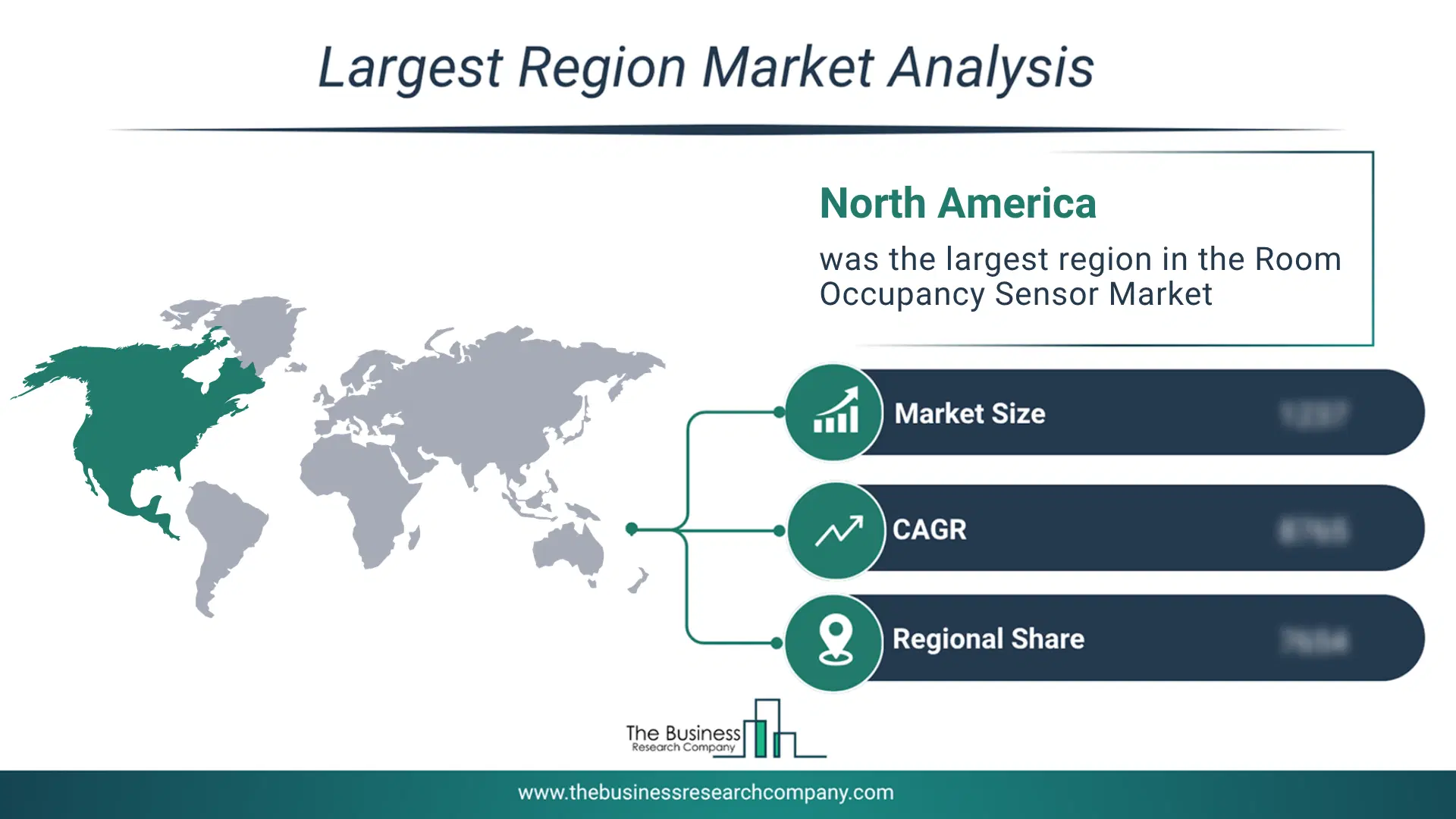
Regional Outlook/Insights
North America was the largest region in the room occupancy sensor market in 2025. Asia-Pacific is expected to be the fastest-growing region in the forecast period. The regions covered in this market report are Asia-Pacific, South East Asia, Western Europe, Eastern Europe, North America, South America, Middle East, Africa. The countries covered in this market report are Australia, Brazil, China, France, Germany, India, Indonesia, Japan, Taiwan, Russia, South Korea, UK, USA, Canada, Italy, Spain.What Defines the Room Occupancy Sensor Market?
The room occupancy sensor market consists of sales of passive infrared (PIR) occupancy sensors, ultrasonic occupancy sensors, microwave occupancy sensors, dual-technology occupancy sensors, and image-based occupancy sensors. Values in this market are ‘factory gate’ values, that is, the value of goods sold by the manufacturers or creators of the goods, whether to other entities (including downstream manufacturers, wholesalers, distributors, and retailers) or directly to end customers. The value of goods in this market includes related services sold by the creators of the goods.How is Market Value Defined and Measured?
The market value is defined as the revenues that enterprises gain from the sale of goods and/or services within the specified market and geography through sales, grants, or donations in terms of the currency (in USD unless otherwise specified). The revenues for a specified geography are consumption values that are revenues generated by organizations in the specified geography within the market, irrespective of where they are produced. It does not include revenues from resales along the supply chain, either further along the supply chain or as part of other products.
This chart presents market attractiveness based on a quantitative evaluation of growth, competition, strategic alignment, and risk, offering a clear view of opportunity areas for decision-making. This chart is for illustrative purposes; the full report contains the complete analysis.

This chart highlights the Total Addressable Market (TAM) by estimating the maximum revenue opportunity using an assumption-driven approach, supporting strategic planning and opportunity sizing across markets. The chart is illustrative; the full report provides a more comprehensive analysis.
What Key Data and Analysis Are Included in the Room Occupancy Sensor Market Report 2026?
The room occupancy sensor market research report is one of a series of new reports from The Business Research Company that provides market statistics, including industry global market size, regional shares, competitors with the market share, detailed market segments, market trends and opportunities, and any further data you may need to thrive in the room occupancy sensor industry. The market research report delivers a complete perspective of everything you need, with an in-depth analysis of the current and future state of the industry.Room Occupancy Sensor Market Report Forecast Analysis
| Report Attribute | Details |
|---|---|
| Market Size Value In 2026 | $3.11 billion |
| Revenue Forecast In 2030 | $5.07 billion |
| Growth Rate | CAGR of 13.0% from 2026 to 2035 |
| Base Year For Estimation | 2025 |
| Actual Estimates/Historical Data | 2020-2025 |
| Forecast Period | 2026 - 2030 |
| Market Representation | Revenue in USD Billion and CAGR from 2026 to 2030 |
| Segments Covered | Sensor Type, Mounting Type, Connectivity, Distribution Channel, End User |
| Regional Scope | Asia-Pacific, Western Europe, Eastern Europe, North America, South America, Middle East, Africa |
| Country Scope | The countries covered in the report are Australia, Brazil, China, France, Germany, India, Indonesia, Japan, Taiwan, Russia, South Korea, UK, USA, Canada, Italy, Spain. |
| Customization Scope | Request for Customization |
| Pricing And Purchase Options | Explore Purchase Options |