
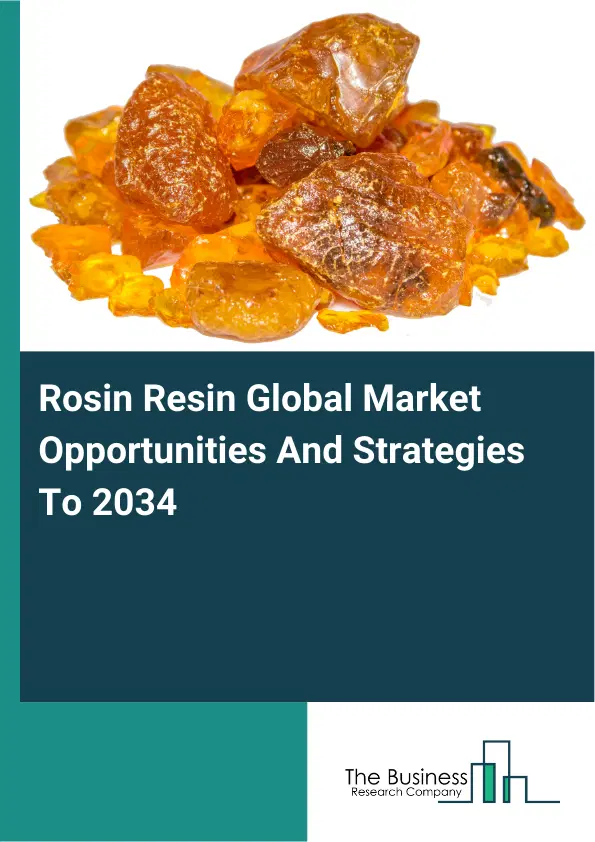
Rosin Resin Market 2026
By Type (Rosin Acids, Rosin Esters, Hydrogenated Rosin Resins, Dimerized Rosin Resins, Modified Rosin Resins), By Source (Gum Rosin, Wood Rosin, Tall Oil Rosin), By Application (Rubbers, Coatings, Inks, Adhesives, Food And Beverages, Cosmetics And Personal Care, Other Applications), And By Region, Opportunities And Strategies – Global Forecast To 2035
Rosin Resin Market Definition
Rosin resin refers to a group of solid natural or modified resins obtained from pine trees and other conifers, typically produced through distillation of the tree’s oleoresin or from by-products of the paper pulping process. Rosin resin is widely used as a tackifier, adhesive and flux agent across various industries. It enhances grip in sports, improves adhesion in rubber and paper products and serves as a key ingredient in varnishes, inks, soaps and soldering fluxes. The rosin resin market consists of sales by entities (organizations, sole traders and partnerships) of rosin resin that is used during the formulation and production stages where tack, adhesion, elasticity and compatibility with organic solvents are required.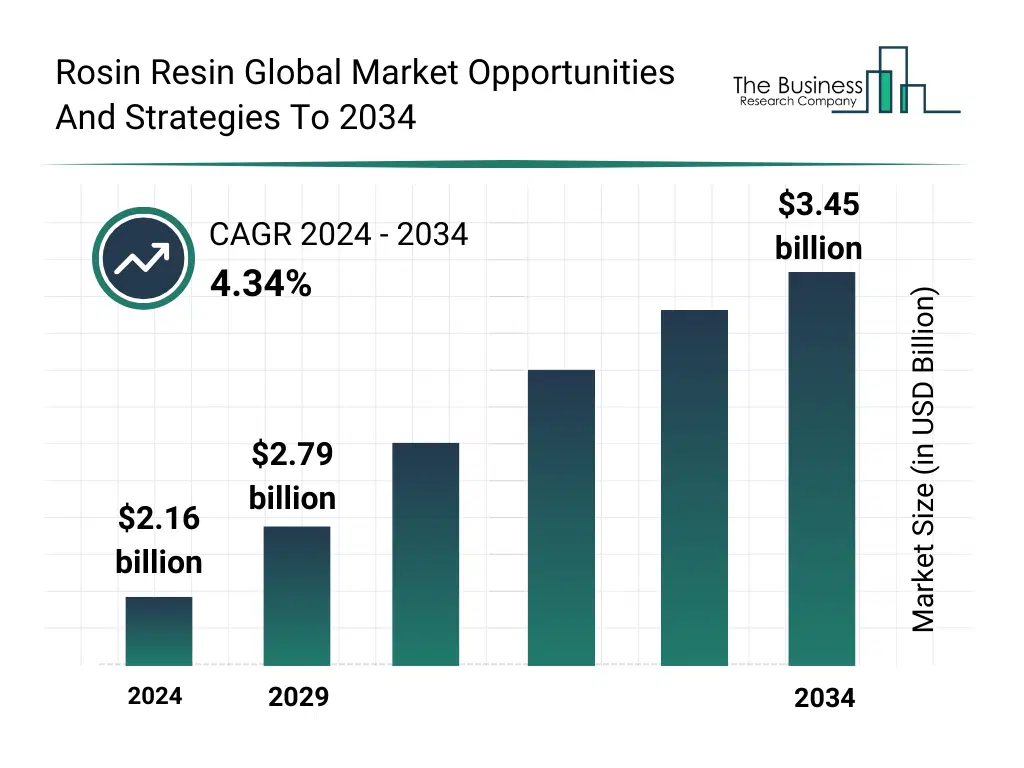
Rosin Resin Market Size
The global rosin resin market reached a value of nearly $2,162.22 million in 2024, having grown at a compound annual growth rate (CAGR) of 3.94% since 2019. The market is expected to grow from $2,162.22 million in 2024 to $2,792.82 million in 2029 at a rate of 5.25%. The market is then expected to grow at a CAGR of 4.34% from 2029 and reach $3,453.44 million in 2034. Growth in the historic period resulted from the growing use in paints and coatings, rise in the cosmetic industry, rising demand in the rubber industry and growth in tire manufacturing and rubber compounding. Factors that negatively affected growth in the historic period were limited adoption in high-end coatings and adhesives and raw material price volatility. Going forward, the growth of solvent-free and waterborne adhesive, expanding printing ink industry, increasing consumer awareness and demand for bio-based materials and growing uses in woodworking and furniture adhesive will drive the growth. Factors that could hinder the growth of the rosin resin market in the future include competition from synthetic and petroleum-based resins, quality inconsistency in natural rosin feedstocks and trade war and tariffs.Rosin Resin Market Drivers
The key drivers of the rosin resin market include: Growth Of Solvent-Free And Waterborne Adhesive During forecast period, the growth of solvent-free and waterborne adhesive is expected to propel the growth of the rosin resin market. These adhesive technologies are gaining traction as industries shift toward more sustainable and environmentally friendly formulations that reduce volatile organic compound (VOC) emissions. Rosin resins are a key component in these adhesives, offering excellent tack, adhesion and film-forming properties. The rising demand from packaging, construction and automotive sectors for safer and high-performance bonding solutions further supports market expansion. Additionally, regulatory pressures promoting green chemistry and eco-friendly materials are encouraging manufacturers to increase the use of rosin-based adhesive systems. The growth of solvent-free and waterborne adhesive growth contribution during the forecast period in 2024 is 1.50%.Rosin Resin Market Restraints
The key restraints on the rosin resin market include: Competition From Synthetic And Petroleum-Based Resins Competition from synthetic and petroleum-based resins is expected to hinder the growth of the rosin resin market in forecast period. These alternatives often offer consistent performance, lower production costs and easier scalability, making them attractive to manufacturers across adhesives, coatings, inks and other end-use industries. Despite the increasing demand for bio-based and sustainable solutions, the widespread availability and established supply chains of synthetic resins can limit the adoption of natural rosin resins. Additionally, fluctuations in raw material prices and production complexities associated with rosin resins may further constrain market growth, as industries weigh cost efficiency and performance when selecting resin materials. Growth affected by Competition from synthetic and petroleum-based resins across regions during the forecast period in 2024 is -2.00%.Rosin Resin Market Trends
Major trends shaping the rosin resin market include: Strategic Collaboration Accelerates Development of High-Performance, Low-Carbon Adhesive Solutions Major companies operating in the rosin resin market are focusing on developing biobased and sustainable product innovations through strategic partnerships and technology collaborations to reduce carbon emissions, enhance performance and meet the growing demand for eco-friendly adhesive and coating solutions. For instance, in March 2024, Henkel AG & Co. KGaA, a Germany-based chemical manufacturing company, partnered with Kraton Corporation, a US-based chemical manufacturing company to enhance sustainability in adhesive technologies. Under the agreement, Kraton will supply Henkel with biobased tackifiers and its patented REvolution rosin ester technology, enabling significant carbon emission reductions in Henkel’s Technomelt hot melt adhesive portfolio. The collaboration supports Henkel’s goal to expand eco-friendly packaging and consumer goods solutions without compromising performance. Kraton’s REvolution offers a renewable, high-performance alternative to fossil-based tackifiers, delivering lighter color, improved stability and reduced odor. This partnership reinforces both companies’ commitment to sustainable innovation and environmental stewardship within the global adhesives industry. Strategic Investments Strengthen Global Supply And Innovation In Specialty Resins Major companies operating in the rosin resin market are focusing on expanding production capacities and investing in advanced biobased resin technologies to strengthen their global supply capabilities, enhance product quality and meet the growing demand for sustainable and high-performance materials across specialized applications. For instance, in September 2023, dsm-firmenich Group (DRT division), a Switzerland-based chemical manufacturing company, has announced major investments in specialty resins to expand global supply capacity and strengthen its biobased materials portfolio. A new state-of-the-art facility is under construction in Vielle-Saint-Girons, France, dedicated to producing hydrogenated rosin and resin derivatives, with completion expected by mid-2024. The plant position DRT as a leading global supplier offering the highest hydrogenation levels available. Additionally, DRT plans to debottleneck polyterpene resin production and explore strategic alliances to meet rising market demand. These investments reinforce the Group’s long-term commitment to innovation, sustainability and supporting customers in specialized resin markets worldwide.Opportunities And Recommendations In The Rosin Resin Market
Opportunities – The top opportunities in the rosin resin market segmented by type will arise in the rosin resin segment, which will gain $630.60 million of global annual sales by 2029. The top opportunities in the rosin resin market segmented by source will arise in the gum rosin segment, which will gain $386.45 million of global annual sales by 2029. The top opportunities in the rosin resin market segmented by application will arise in the adhesives segment, which will gain $220.57 million of global annual sales by 2029. The rosin resin market size will gain the most in China at $163.53 million. Recommendations- To take advantage of the opportunities, The Business Research Company recommends the rosin resin companies to focus on hydrogenated rosin resins to strengthen high-performance growth, focus on tall oil rosin to capture sustainable growth momentum, expand in emerging markets, focus on biobased resin capacity expansion, focus on biobased sustainable product innovation, focus on balanced value-based pricing to protect margins and demand stability, focus on technical promotion to strengthen customer confidence and specification rates, focus on digital education and collaborative promotion to expand market reach and focus on coatings to strengthen high-growth application exposure.
Rosin Resin Market Segmentation
The rosin resin market is segmented by type, by source and by application.By Type –
The rosin resin market is segmented by type into:
- a) Rosin Acids
- b) Rosin Esters
- c) Hydrogenated Rosin Resins
- d) Dimerized Rosin Resin
- e) Modified Rosin Resins
By Source –
The rosin resin market is segmented by source into:
- a) Gum Rosin
- b) Wood Rosin
- c) Tall Oil Rosin
By Application –
The rosin resin market is segmented by application into:
- a) Rubbers
- b) Coatings
- c) Inks
- d) Adhesives
- e) Food And Beverages
- f) Cosmetics And Personal Care
- g) Other Applications
By Geography - The rosin resin market is segmented by geography into:
- • China
- • India
- • Japan
- • Australia
- • Indonesia
- • South Korea
- • USA
- • Canada
- • Brazil
- • France
- • Germany
- • UK
- • Italy
- • Spain
- • Russia
-
o Asia Pacific
o Africa