

Rotate Vector (RV) Reducer Market Report 2026
Global Outlook – By Type (Helical Rotate Vector (RV) Reducers, Worm Rotate Vector (RV) Reducers, Planetary Rotate Vector (RV) Reducers, Cycloidal Rotate Vector (RV) Reducers), By Distribution Channel (Direct Sales, Indirect Sales), By Application (Industrial Automation, Robotics, Aerospace, Marine, Automotive), By End-Use (Manufacturing, Healthcare, Construction, Energy, Transportation) – Market Size, Trends, Strategies, and Forecast to 2030
Rotate Vector (RV) Reducer Market Overview
• Rotate Vector (RV) Reducer market size has reached to $1.36 billion in 2025 • Expected to grow to $2.03 billion in 2030 at a compound annual growth rate (CAGR) of 8.3% • Growth Driver: Rising Adoption Of Industrial Automation Fueling The Growth Of The Market Due To Increasing Efficiency And Productivity Needs • North America was the largest region in 2025 and Asia-Pacific is the fastest growing region.What Is Covered Under Rotate Vector (RV) Reducer Market?
A rotate vector (RV) reducer is a type of precision gearbox designed to transmit high torque while maintaining compact size and high efficiency. It uses a cycloidal or planetary mechanism to achieve smooth, backlash-free rotation. Its primary purpose is to reduce the speed of a motor while proportionally increasing torque, enabling precise motion control applications. The main types of rotate vector (RV) reducer are helical rotate vector (RV) reducers, worm rotate vector (RV) reducers, planetary rotate vector (RV) reducers, and cycloidal rotate vector (RV) reducers. Helical RV reducers are precision mechanical devices that use helical gears to provide smooth, efficient, and high-torque rotational motion control in robotic and automation systems. It is distributed through direct and indirect sales channels and is applied in industrial automation, robotics, aerospace, marine, and automotive, serving end-users including manufacturing, healthcare, construction, energy, and transportation.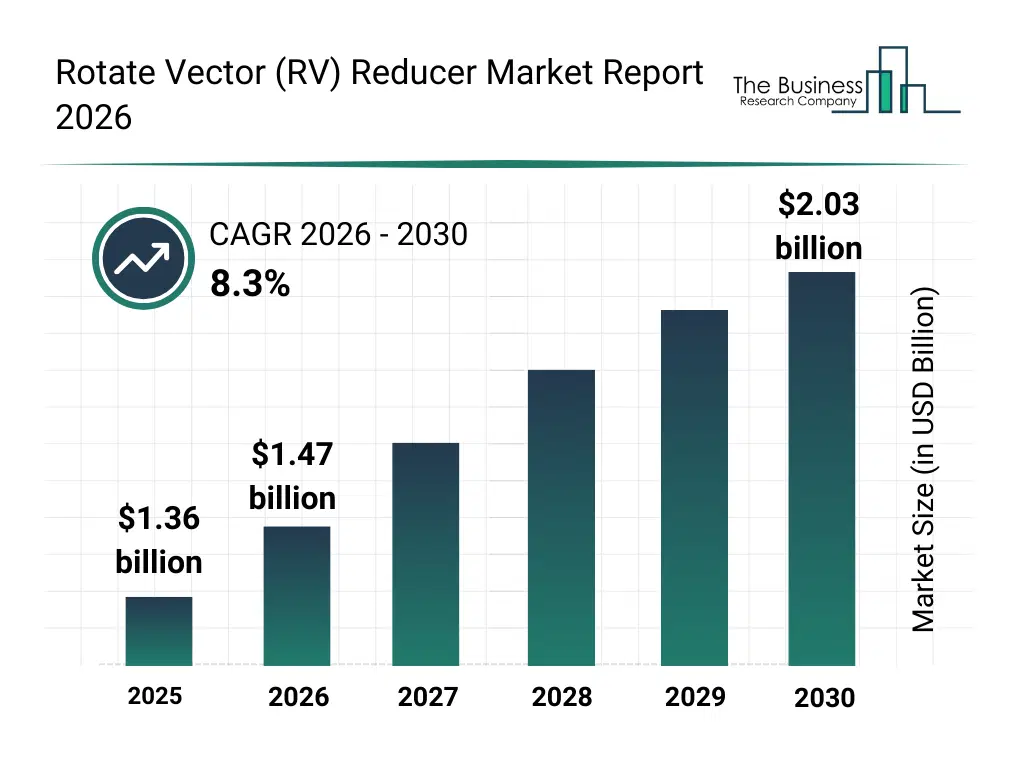
What Is The Rotate Vector (RV) Reducer Market Size and Share 2026?
The rotate vector (rv) reducer market size has grown strongly in recent years. It will grow from $1.36 billion in 2025 to $1.47 billion in 2026 at a compound annual growth rate (CAGR) of 8.6%. The growth in the historic period can be attributed to expansion of industrial automation systems, growth in robotics deployment, increasing demand for precision motion control, rising investments in manufacturing modernization, availability of advanced gearbox technologies.What Is The Rotate Vector (RV) Reducer Market Growth Forecast?
The rotate vector (rv) reducer market size is expected to see strong growth in the next few years. It will grow to $2.03 billion in 2030 at a compound annual growth rate (CAGR) of 8.3%. The growth in the forecast period can be attributed to increasing adoption of collaborative robots, rising demand for energy-efficient drive systems, expansion of electric vehicle manufacturing, growing use of automation in healthcare equipment, increasing focus on compact high-performance gear solutions. Major trends in the forecast period include increasing adoption of high-precision cycloidal rv reducers, rising integration of rv reducers in industrial robotics, growing demand for compact high-torque gear systems, expansion of rv reducer use in electric vehicles, enhanced focus on backlash-free motion control.Tariff Impact On Rotate Vector (RV) Reducer Market
Tariffs are significantly impacting the rotate vector (RV) reducer market by increasing the cost of imported precision gears, hardened steel components, bearings, and high-accuracy machining equipment used in RV reducer manufacturing. Robotics and industrial automation segments in Asia-Pacific, Europe, and North America are most affected due to their reliance on cross-border supply chains for precision drivetrain components. These tariffs are raising production costs and extending lead times for OEMs integrating RV reducers into automation systems. However, they are also encouraging localized manufacturing, supplier diversification, and investments in domestic precision engineering capabilities, strengthening long-term supply chain resilience.
Global Rotate Vector (RV) Reducer Market Segmentation
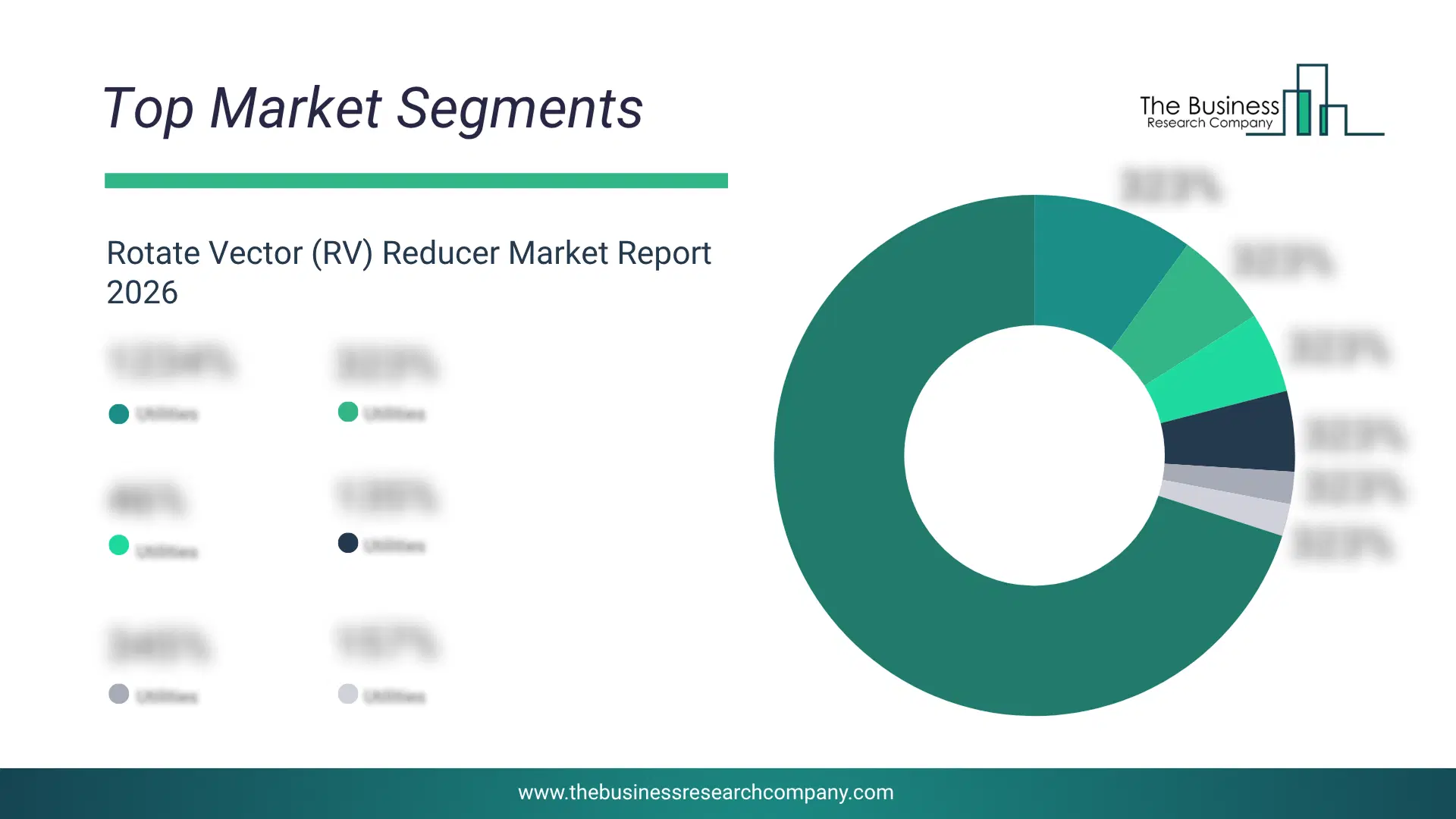
1) By Type: Helical Rotate Vector (RV) Reducers, Worm Rotate Vector (RV) Reducers, Planetary Rotate Vector (RV) Reducers, Cycloidal Rotate Vector (RV) Reducers 2) By Distribution Channel: Direct Sales, Indirect Sales 3) By Application: Industrial Automation, Robotics, Aerospace, Marine, Automotive 4) By End-Use: Manufacturing, Healthcare, Construction, Energy, Transportation Subsegments: 1) By Helical Rotate Vector (RV) Reducers: Single Stage Helical, Double Stage Helical, Coaxial Helical, Parallel Shaft Helical 2) By Worm Rotate Vector (RV) Reducers: Single Enveloping Worm, Double Enveloping Worm, Non-Enveloping Worm, Precision Worm 3) By Planetary Rotate Vector (RV) Reducers: Inline Planetary, Right Angle Planetary, High Torque Planetary, Compact Planetary 4) By Cycloidal Rotate Vector (RV) Reducers: Single Stage Cycloidal, Double Stage Cycloidal, High Precision Cycloidal, Compact CycloidalWhat Are The Drivers Of The Rotate Vector (RV) Reducer Market?
The rising adoption of industrial automation is expected to propel the growth of the rotate vector (RV) reducer market going forward. Industrial automation refers to the use of control systems, robotics, and information technologies to operate and monitor industrial processes with minimal human intervention, improving efficiency, productivity, and safety. The rise in industrial automation is due to the need for increased operational efficiency as businesses aim to reduce costs, minimize errors, and boost productivity. Rotate vector (RV) reducer enhances industrial automation by providing high-precision motion control and compact design, making them ideal for robotics and automated machinery. They improve operational efficiency by delivering smooth, accurate, and reliable torque transmission, reducing downtime and maintenance requirements. For instance, in September 2024, according to the International Federation of Robotics, a Germany-based non-profit organization, there were 4,281,585 robotic units operating in factories globally in 2023, marking a 10% increase from 3,904,000 units in 2022. Therefore, the rising adoption of industrial automation is driving the growth of the rotate vector (RV) reducer industry. The increasing adoption of electric vehicles is expected to propel the growth of the rotate vector (RV) reducer market going forward. Electric vehicles (EVs) are automobiles powered by electric motors using energy stored in rechargeable batteries, offering cleaner, quieter, and more efficient transportation than traditional fuel-based vehicles. The rising demand for electric vehicles is due to increasing fuel costs, as electric vehicles offer a more cost-efficient alternative to conventional gasoline-powered cars. Rotate Vector (RV) reducers enhance electric vehicle adoption by providing precise and efficient torque transmission, making them ideal for electric drivetrains and robotics-assisted manufacturing. They improve vehicle performance and energy efficiency by ensuring smooth and reliable motion control, reducing mechanical losses and maintenance requirements. For instance, in May 2025, according to the International Energy Agency, a France-based intergovernmental organization, the electric car sales exceeded 17 million units in 2024, representing a growth of over 25% and an increase of approximately 3.5 million vehicles compared to 2023. Therefore, the increasing adoption of electric vehicles is driving the growth of the rotate vector (RV) reducer industry. The surge in demand from the aerospace industry is expected to propel the growth of the rotate vector (RV) reducer market going forward. The aerospace industry refers to the sector that designs, develops, manufactures, and maintains aircraft, spacecraft, and related systems and equipment for commercial, military, and space applications. The surge in demand from the aerospace industry is due to the growing need for advanced aircraft that offer improved efficiency, safety, and performance. Rotate Vector (RV) reducers enhance the aerospace industry by providing high-precision motion control and compact design, making them ideal for use in aircraft systems and manufacturing processes. They improve operational efficiency and reliability by ensuring smooth, accurate, and reliable torque transmission, reducing maintenance requirements and enhancing the performance of aerospace technologies. For instance, in August 2025, according to the International Trade Administration, a US-based government agency, the revenue of the German aerospace industry reached EUR 52 billion ($56.3 billion) in 2024, an increase of 13% compared to 2023. Therefore, the surge in demand from the aerospace industry is driving the growth of the rotate vector (RV) reducer industry.Key Players In The Global Rotate Vector (RV) Reducer Market
Major companies operating in the rotate vector (rv) reducer market are Parker Hannifin Corporation, Nidec Corporation, Sumitomo Heavy Industries Ltd., FANUC Corporation, Nabtesco Corporation, Zhejiang Shuanghuan Driveline Co. Ltd., Qinchuan Machine Tool & Tool Group Co. Ltd., Rossi S.p.A., Ningbo Zhongda Leader Intelligent Transmission Co. Ltd., Greatoo Intelligent Equipment Inc., Shenzhen Homwing Technology Co. Ltd., Zhejiang Hengfengtai Reducer Co. Ltd., Wuhan Jinghua Precision Machinery Co. Ltd., Jiangsu Guomao Reducer Co. Ltd., DieQua Corporation, Chietom Precision Transmission Technology Co. Ltd., Genius Robotics, Shanghai Like Precision Machinery Co. Ltd., TallMan Robotics Limited, TechMan Automation Limited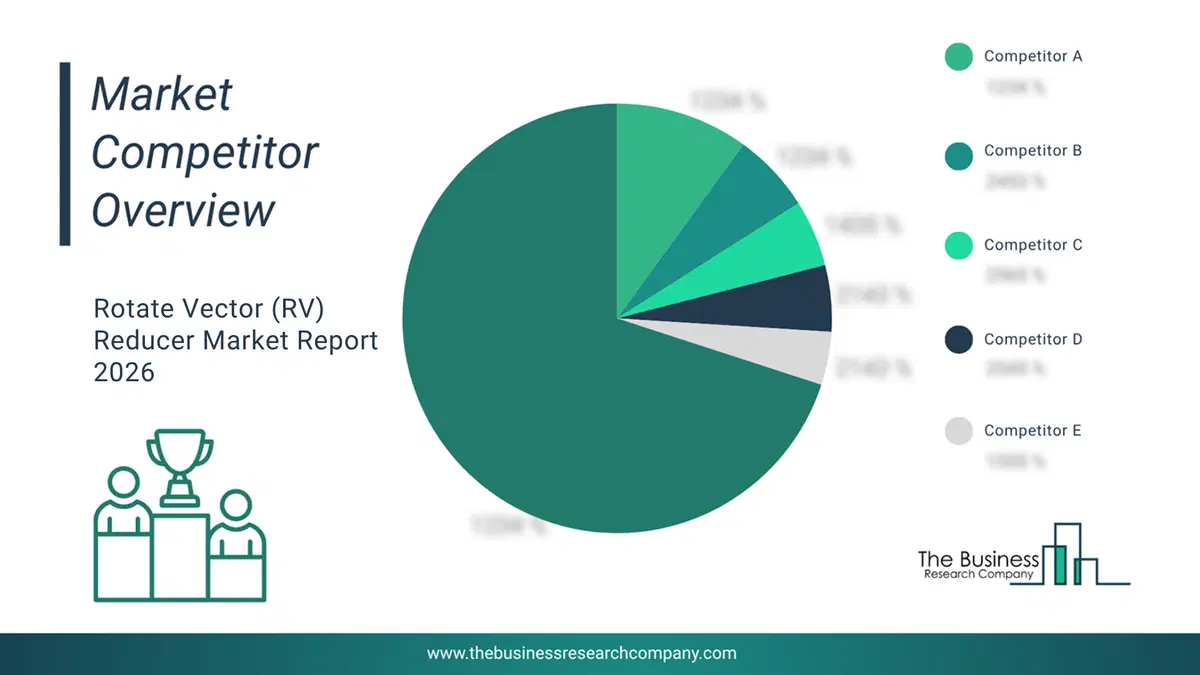
This chart is for illustrative purposes; the full report includes a detailed competitor analysis and comprehensive overview of the top 10 companies in the market.
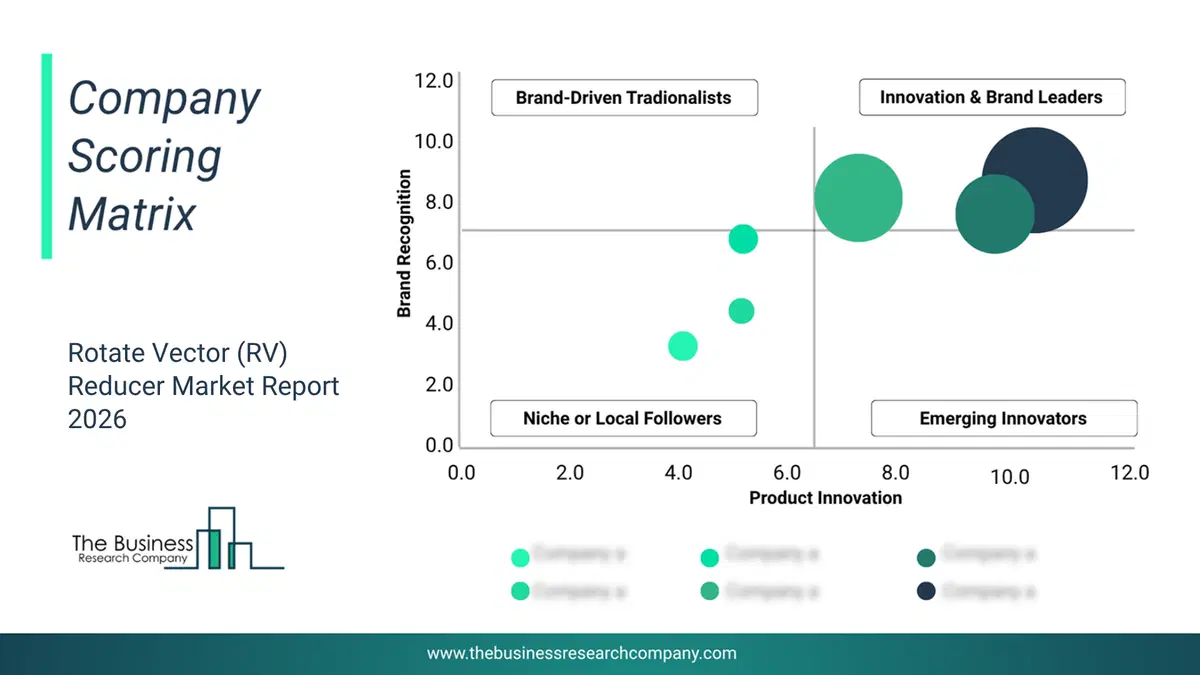
This chart maps companies by product innovation and brand strength, with bubble size indicating relative revenue, helping identify market leaders, challengers, and niche players. This is an illustrative chart; the full report provides a complete and accurate competitive analysis.
Regional Outlook
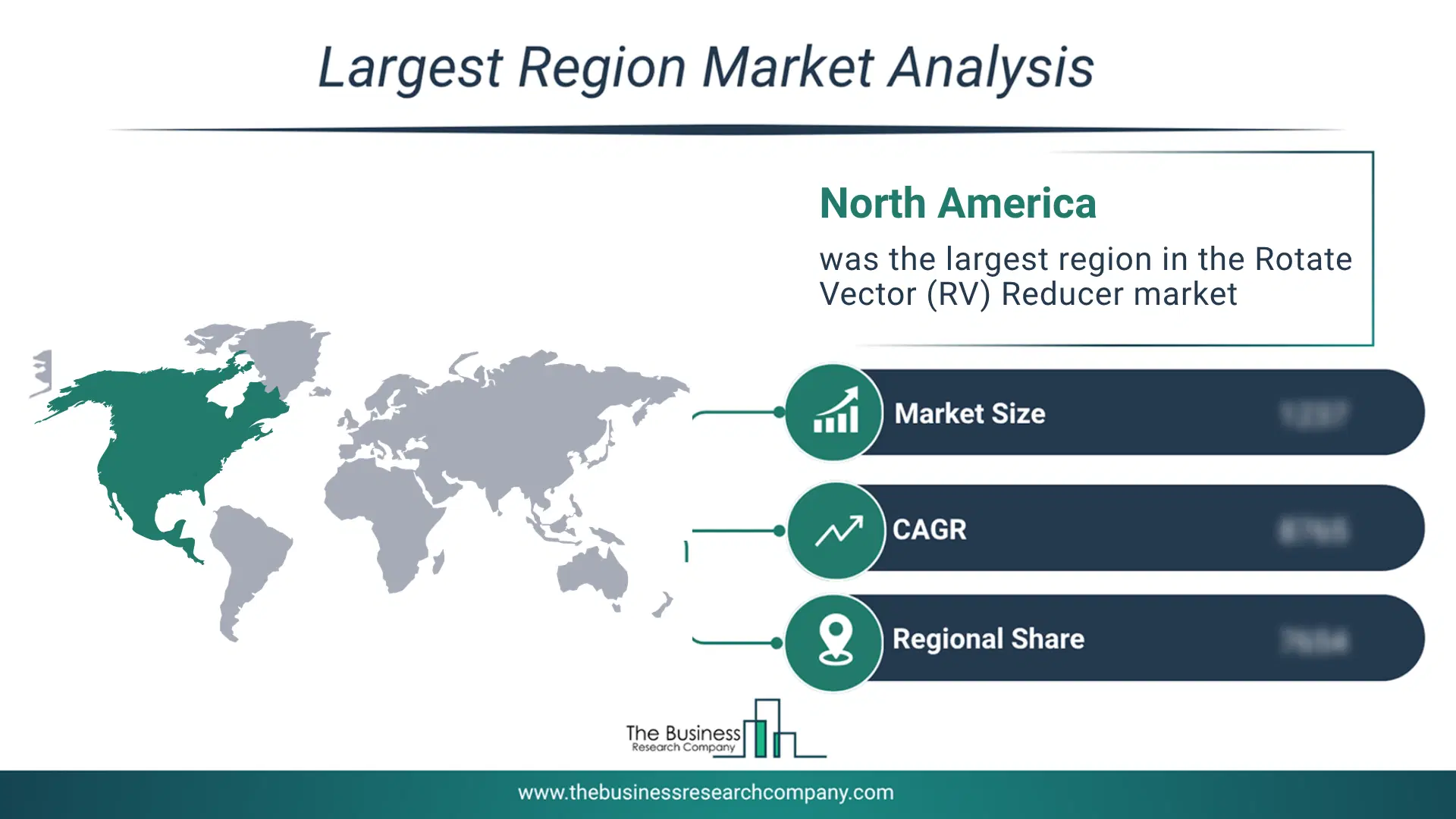
North America was the largest region in the rotate vector (RV) reducer market in 2025. Asia-Pacific is expected to be the fastest-growing region in the forecast period. The regions covered in this market report are Asia-Pacific, South East Asia, Western Europe, Eastern Europe, North America, South America, Middle East, Africa The countries covered in this market report are Australia, Brazil, China, France, Germany, India, Indonesia, Japan, Taiwan, Russia, South Korea, UK, USA, Canada, Italy, Spain.What Defines the Rotate Vector (RV) Reducer Market?
The rotate vector (RV) reducer consists of sales of products such as RV gears, cycloidal discs, input shafts, output shafts, bearings, housings, couplings, seals, lubrication systems, and motor adapters. Values in this market are ‘factory gate’ values, that is, the value of goods sold by the manufacturers or creators of the goods, whether to other entities (including downstream manufacturers, wholesalers, distributors, and retailers) or directly to end customers. The value of goods in this market includes related services sold by the creators of the goods.How is Market Value Defined and Measured?
The market value is defined as the revenues that enterprises gain from the sale of goods and/or services within the specified market and geography through sales, grants, or donations in terms of the currency (in USD unless otherwise specified). The revenues for a specified geography are consumption values that are revenues generated by organizations in the specified geography within the market, irrespective of where they are produced. It does not include revenues from resales along the supply chain, either further along the supply chain or as part of other products.
This chart presents market attractiveness based on a quantitative evaluation of growth, competition, strategic alignment, and risk, offering a clear view of opportunity areas for decision-making. This chart is for illustrative purposes; the full report contains the complete analysis.

This chart highlights the Total Addressable Market (TAM) by estimating the maximum revenue opportunity using an assumption-driven approach, supporting strategic planning and opportunity sizing across markets. The chart is illustrative; the full report provides a more comprehensive analysis.
What Key Data and Analysis Are Included in the Rotate Vector (RV) Reducer Market Report 2026?
The rotate vector (rv) reducer market research report is one of a series of new reports from The Business Research Company that provides market statistics, including industry global market size, regional shares, competitors with the market share, detailed market segments, market trends and opportunities, and any further data you may need to thrive in the rotate vector (rv) reducer industry. The market research report delivers a complete perspective of everything you need, with an in-depth analysis of the current and future state of the industry.Rotate Vector RV Reducer Market Report Forecast Analysis
| Report Attribute | Details |
|---|---|
| Market Size Value In 2026 | $1.47 billion |
| Revenue Forecast In 2030 | $2.03 billion |
| Base Year For Estimation | 2025 |
| Actual Estimates/Historical Data | 2020-2025 |
| Forecast Period | 2026 - 2030 |
| Market Representation | Revenue in USD Billion and CAGR from 2026 to 2030 |
| Segments Covered | Type, Distribution Channel, Application, End-Use |
| Regional Scope | Asia-Pacific, Western Europe, Eastern Europe, North America, South America, Middle East, Africa |
| Key Companies Profiled | Parker Hannifin Corporation, Nidec Corporation, Sumitomo Heavy Industries Ltd., FANUC Corporation, Nabtesco Corporation, Zhejiang Shuanghuan Driveline Co. Ltd., Qinchuan Machine Tool & Tool Group Co. Ltd., Rossi S.p.A., Ningbo Zhongda Leader Intelligent Transmission Co. Ltd., Greatoo Intelligent Equipment Inc., Shenzhen Homwing Technology Co. Ltd., Zhejiang Hengfengtai Reducer Co. Ltd., Wuhan Jinghua Precision Machinery Co. Ltd., Jiangsu Guomao Reducer Co. Ltd., DieQua Corporation, Chietom Precision Transmission Technology Co. Ltd., Genius Robotics, Shanghai Like Precision Machinery Co. Ltd., TallMan Robotics Limited, TechMan Automation Limited |
| Customization Scope | Request for Customization |
| Pricing And Purchase Options | Explore Purchase Options |