
Rubber Compound Market Report 2026
Global Outlook – By Product Type (Synthetic Rubber, Natural Rubber), By Product Form (Solid Rubber, Liquid Rubber, Powdered Rubber), By Rubber Type (Silicone Rubber, Fluoro Rubber, Butyronitrile Rubber, Ethylene Propylene Diene Monomer Rubber, Chloroprene Rubber), By Processing Method (Compression Molding, Injection Molding), By End Use Industry (Automotive, Industrial Manufacturing, Construction, Electrical And Electronics) – Market Size, Trends, Strategies, and Forecast to 2030
Rubber Compound Market Overview
• Rubber Compound market size has reached to $35.65 billion in 2025 • Expected to grow to $47.85 billion in 2030 at a compound annual growth rate (CAGR) of 6% • Growth Driver: The Increasing Automotive Production Is Fueling The Market Growth Due To Rising Demand For High-Performance Materials Used In Vehicle Components • Market Trend: Innovation In Low Carbon EPDM Materials Driving Sustainable Industrial Performance And Reduced Carbon Footprint Applications • Asia-Pacific was the largest region and fastest growing region.What Is Covered Under Rubber Compound Market?
Rubber compound refers to a formulated mixture of rubber and various additives such as fillers, curing agents, plasticizers, antioxidants, and processing aids that are blended to achieve specific physical, chemical, and mechanical properties. It is designed to enhance characteristics such as durability, elasticity, heat resistance, abrasion resistance, and chemical stability for use in a wide range of industrial applications. The main product types of rubber compound include synthetic rubber and natural rubber. Synthetic rubber refers to engineered elastomeric materials produced through chemical polymerization processes and formulated with additives to achieve specific mechanical, thermal, and chemical performance characteristics for industrial applications. These compounds are available in solid rubber, liquid rubber, and powdered rubber forms and include rubber types such as silicone rubber, fluoro rubber, butyronitrile rubber, ethylene propylene diene monomer rubber, and chloroprene rubber. They are processed using compression molding and injection molding and are utilized by end use industries including automotive, industrial manufacturing, construction, and electrical and electronics.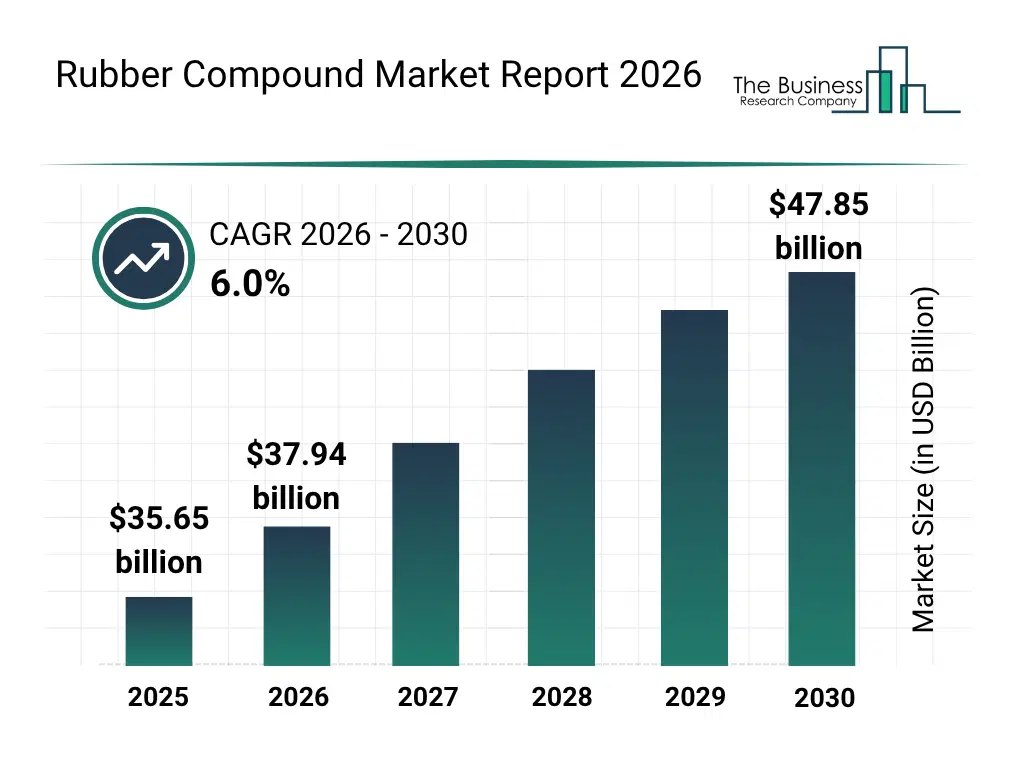
What Is The Rubber Compound Market Size and Share 2026?
The rubber compound market size has grown strongly in recent years. It will grow from $35.65 billion in 2025 to $37.94 billion in 2026 at a compound annual growth rate (CAGR) of 6.4%. The growth in the historic period can be attributed to increasing automotive production and demand for rubber components, growing industrial manufacturing activities, rising construction and infrastructure development, increasing demand for durable and high performance materials, growing expansion of electrical and electronics applications.What Is The Rubber Compound Market Growth Forecast?
The rubber compound market size is expected to see strong growth in the next few years. It will grow to $47.85 billion in 2030 at a compound annual growth rate (CAGR) of 6.0%. The growth in the forecast period can be attributed to increasing adoption of sustainable rubber formulations, rising demand for lightweight and efficient automotive materials, growing development of advanced specialty rubber compounds, increasing demand for electric vehicle rubber components, rising focus on improved material performance and lifecycle durability. Major trends in the forecast period include increasing adoption of high performance rubber compounds, growing demand for bio based and sustainable rubber formulations, rising development of advanced rubber additive technologies, increasing focus on enhanced durability and heat resistant rubber materials, growing demand for customized rubber compound solutions.
Global Rubber Compound Market Segmentation
1) By Product Type: Synthetic Rubber, Natural Rubber 2) By Product Form: Solid Rubber, Liquid Rubber, Powdered Rubber 3) By Rubber Type: Silicone Rubber, Fluoro Rubber, Butyronitrile Rubber, Ethylene Propylene Diene Monomer Rubber, Chloroprene Rubber 4) By Processing Method: Compression Molding, Injection Molding 5) By End Use Industry: Automotive, Industrial Manufacturing, Construction, Electrical And Electronics Subsegments: 1) By Synthetic Rubber: Styrene Butadiene Rubber, Polybutadiene Rubber, Nitrile Butadiene Rubber, Chloroprene Rubber 2) By Natural Rubber: Ribbed Smoked Sheet Rubber, Technically Specified Natural Rubber, Latex Concentrate Rubber, Crepe RubberWhat Is The Driver Of The Rubber Compound Market?
The increasing automotive production is expected to propel the growth of the rubber compound market going forward. Automotive production refers to the large-scale manufacturing of motor vehicles, including passenger cars, commercial vehicles, and electric vehicles. The growth in automotive production is rising due to increasing consumer demand for personal mobility, as more people prefer owning or using private vehicles for convenient, flexible, and time-saving transportation compared to public transit options. Rubber compound in automotive production provides essential materials used in tires, seals, hoses, gaskets, and vibration-dampening components that enhance vehicle durability, safety, comfort, and performance, enabling manufacturers to produce reliable and high-quality vehicles at scale. For instance, in April 2026, according to the International Organization of Motor Vehicle Manufacturers, a France-based trade association, global vehicle production increased from 92.7 million units in 2024 to 96.4 million units in 2025, marking a 3.9% rise, while global sales grew from 95.3 million to 99.8 million units, reflecting a 4.7% increase. Therefore, the increasing automotive production is driving the growth of the rubber compound industry.Key Players In The Global Rubber Compound Market
Major companies operating in the rubber compound market are Continental AG, Shin-Etsu Chemical Co. Ltd., Ravago Manufacturing Americas LLC, Wacker Chemie AG, Hutchinson SA, Cooper Standard Automotive Inc., HEXPOL Compounding, Teknor Apex Company, Mesnac Co. Ltd., RTP Company, Myers Industries Inc., KRAIBURG Holding GmbH & Co. KG, Kossan Rubber Industries Bhd, AirBoss of America Corp., Polymer-Technik Elbe GmbH, Rubberlite Inc., Zenith Industrial Rubber Products Pvt. Ltd., Condor Compounds GmbH, Chang Horing Rubber Co. Ltd., ENA Advanced Rubber Technologies, Polycomp B.V., CS Rubber Industry Co. Ltd., Trident Rubber Pvt. Ltd.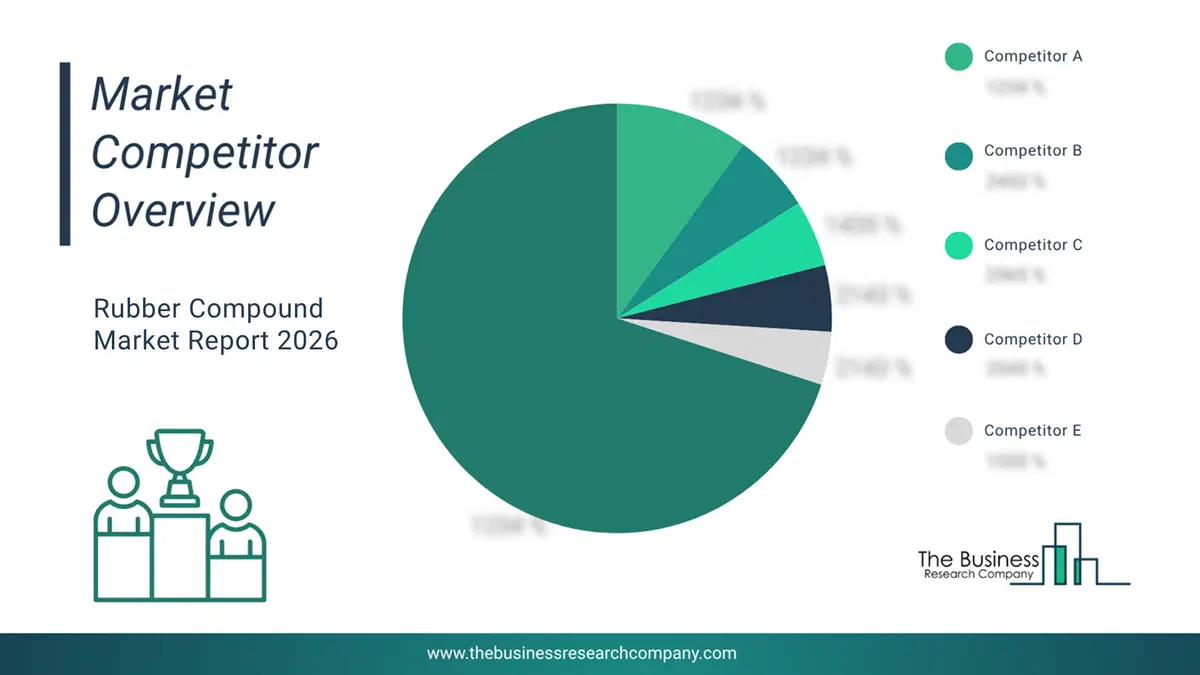
This chart is for illustrative purposes; the full report includes a detailed competitor analysis and comprehensive overview of the top 10 companies in the market.
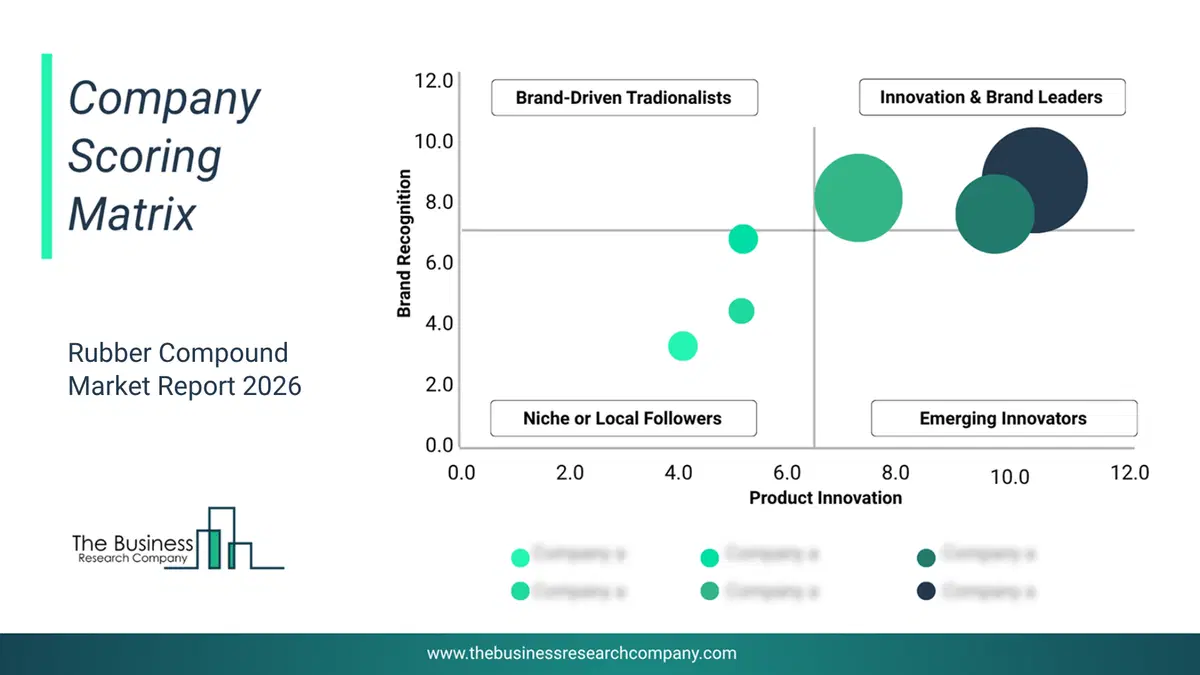
This chart maps companies by product innovation and brand strength, with bubble size indicating relative revenue, helping identify market leaders, challengers, and niche players. This is an illustrative chart; the full report provides a complete and accurate competitive analysis.
Global Rubber Compound Market Trends and Insights
Major companies operating in the rubber compound market are focusing on developing innovative products, such as low carbon footprint EPDM rubber compounds to enhance sustainability, performance consistency, and environmental compliance across industrial applications. Low carbon footprint EPDM rubber compounds are ethylene propylene diene monomer elastomers made using bio-based or recycled feedstocks instead of fossil materials, helping reduce emissions, support sustainability, and maintain performance in sealing and industrial applications. For instance, in April 2026, Trelleborg Sealing Solutions, a Sweden-based sealing and polymer solutions company, launched reduced carbon footprint EPDM rubber grades designed to significantly lower product carbon emissions while maintaining performance equivalent to conventional materials. These EPDM compounds are produced using non-fossil, bio-circular feedstocks derived from renewable sources such as used cooking oil, straw, forestry residue, and tall oil. The materials deliver up to 55 percent reduction in product carbon footprint and are suitable for applications including O-rings, gaskets, and engineered sealing components used across automotive, industrial, energy, and construction sectors. This innovation highlights the growing shift toward sustainable rubber compound development driven by circular economy principles and stricter environmental regulations.What Are Latest Mergers And Acquisitions In The Rubber Compound Market?
In April 2025, Trelleborg AB, a Sweden-based engineering and polymer solutions company, acquired National Gummi AB for an undisclosed amount. With this acquisition, Trelleborg AB aims to strengthen its position in niche sealing and extrusion markets by expanding its portfolio of rubber-based profiles and gaskets, enhancing its industrial solutions offering, and reinforcing its presence in construction, automotive, and industrial sealing applications across Europe. National Gummi AB is a Sweden-based sealing and rubber profile manufacturing company that specializes in providing rubber compounds.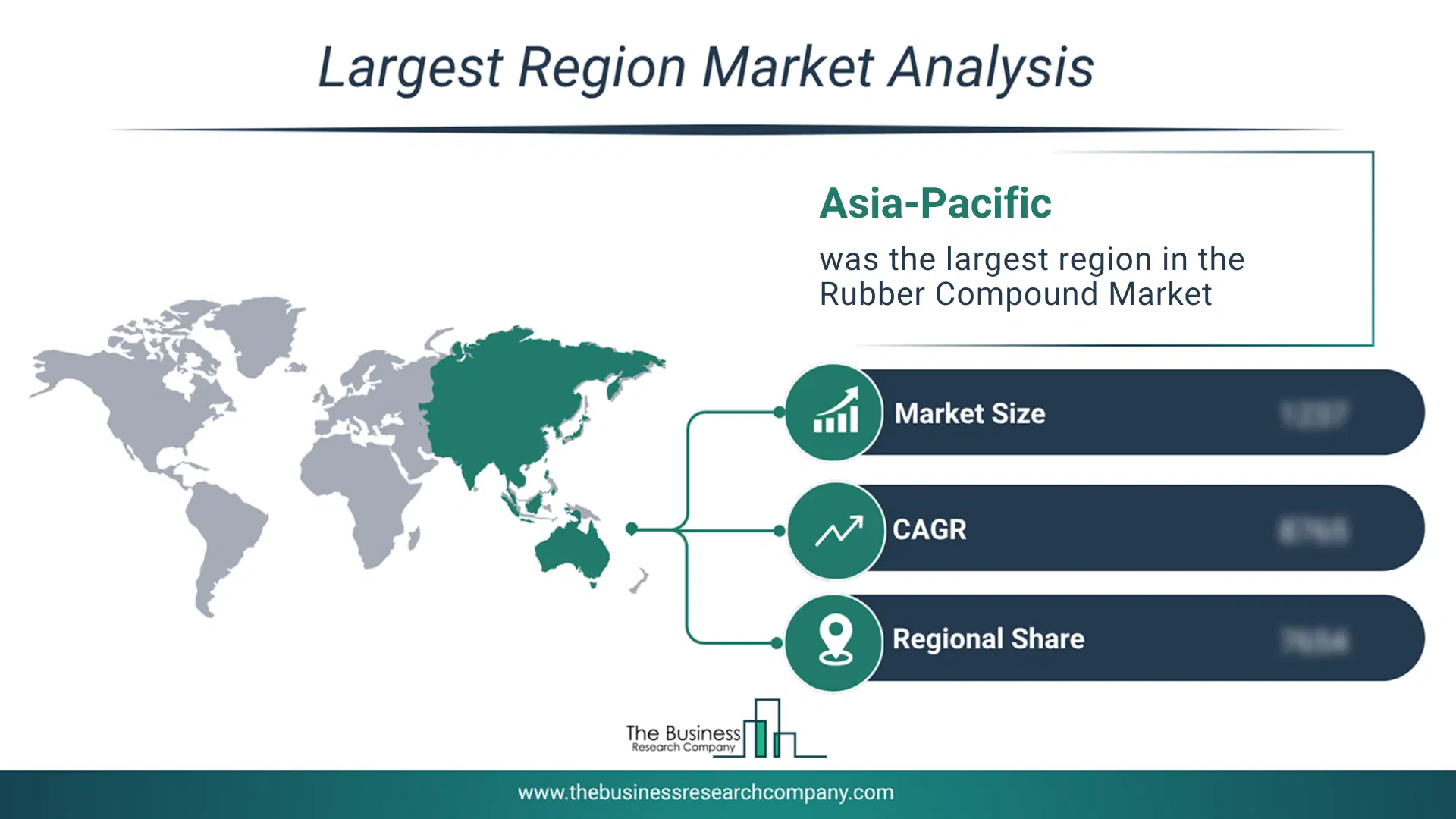
Regional Outlook
Asia-Pacific was the largest region in the rubber compound market in 2025. Asia-Pacific is expected to be the fastest-growing region in the forecast period. The regions covered in this market report are Asia-Pacific, South East Asia, Western Europe, Eastern Europe, North America, South America, Middle East, Africa. The countries covered in this market report are Australia, Brazil, China, France, Germany, India, Indonesia, Japan, Taiwan, Russia, South Korea, UK, USA, Canada, Italy, Spain.What Defines the Rubber Compound Market?
The rubber compound market consists of sales of styrene-butadiene rubber (SBR) compounds, butadiene rubber (BR) compounds, isoprene rubber (IR) compounds, ethylene vinyl acetate (EVA)-based rubber compounds, acrylic rubber compounds, polyurethane rubber compounds, halogenated rubber compounds, conductive rubber compounds, and flame-retardant rubber compounds. Values in this market are ‘factory gate’ values, that is, the value of goods sold by the manufacturers or creators of the goods, whether to other entities (including downstream manufacturers, wholesalers, distributors, and retailers) or directly to end customers. The value of goods in this market includes related services sold by the creators of the goods.How is Market Value Defined and Measured?
The market value is defined as the revenues that enterprises gain from the sale of goods and/or services within the specified market and geography through sales, grants, or donations in terms of the currency (in USD unless otherwise specified). The revenues for a specified geography are consumption values that are revenues generated by organizations in the specified geography within the market, irrespective of where they are produced. It does not include revenues from resales along the supply chain, either further along the supply chain or as part of other products.
This chart presents market attractiveness based on a quantitative evaluation of growth, competition, strategic alignment, and risk, offering a clear view of opportunity areas for decision-making. This chart is for illustrative purposes; the full report contains the complete analysis.

This chart highlights the Total Addressable Market (TAM) by estimating the maximum revenue opportunity using an assumption-driven approach, supporting strategic planning and opportunity sizing across markets. The chart is illustrative; the full report provides a more comprehensive analysis.
What Key Data and Analysis Are Included in the Rubber Compound Market Report 2026?
The rubber compound market research report is one of a series of new reports from The Business Research Company that provides market statistics, including industry global market size, regional shares, competitors with the market share, detailed market segments, market trends and opportunities, and any further data you may need to thrive in the rubber compound industry. The market research report delivers a complete perspective of everything you need, with an in-depth analysis of the current and future state of the industry.Rubber Compound Market Report Forecast Analysis
| Report Attribute | Details |
|---|---|
| Market Size Value In 2026 | $37.94 billion |
| Revenue Forecast In 2030 | $47.85 billion |
| Growth Rate | CAGR of 6.0% from 2026 to 2030 |
| Base Year For Estimation | 2025 |
| Actual Estimates/Historical Data | 2020-2025 |
| Forecast Period | 2026 - 2030 |
| Market Representation | Revenue in USD Billion and CAGR from 2026 to 2030 |
| Segments Covered | Product Type, Product Form, Rubber Type, Processing Method, End Use Industry |
| Regional Scope | Asia-Pacific, Western Europe, Eastern Europe, North America, South America, Middle East, Africa |
| Country Scope | The countries covered in the report are Australia, Brazil, China, France, Germany, India, Indonesia, Japan, Taiwan, Russia, South Korea, UK, USA, Canada, Italy, Spain. |
| Key Companies Profiled | Continental AG, Shin-Etsu Chemical Co. Ltd., Ravago Manufacturing Americas LLC, Wacker Chemie AG, Hutchinson SA, Cooper Standard Automotive Inc., HEXPOL Compounding, Teknor Apex Company, Mesnac Co. Ltd., RTP Company, Myers Industries Inc., KRAIBURG Holding GmbH & Co. KG, Kossan Rubber Industries Bhd, AirBoss of America Corp., Polymer-Technik Elbe GmbH, Rubberlite Inc., Zenith Industrial Rubber Products Pvt. Ltd., Condor Compounds GmbH, Chang Horing Rubber Co. Ltd., ENA Advanced Rubber Technologies, Polycomp B.V., CS Rubber Industry Co. Ltd., Trident Rubber Pvt. Ltd. |
| Customization Scope | Request for Customization |
| Pricing And Purchase Options | Explore Purchase Options |