
Saltwater Batteries Market Report 2026
Global Outlook – By Type ( 12 Volt, 24 Volt, 48 Volt), By Component ( Cathode, Anode, Electrolytes), By Capacity ( Low, Medium, High), By Battery Chemistry ( Sodium-ion, Magnesium-ion, Other Battery Chemistry), By Application ( Residential, Industrial, Commercial, Government, Enterprise) – Market Size, Trends, Strategies, and Forecast to 2030
Saltwater Batteries Market Overview
• Saltwater Batteries market size has reached to $16.68 billion in 2025 • Expected to grow to $38.43 billion in 2030 at a compound annual growth rate (CAGR) of 17.8% • Growth Driver: Rising Energy Storage Demand Fuels Growth In Saltwater Batteries Market • Market Trend: Technological Advancements In Eco-Friendly Saltwater Batteries • North America was the largest region in 2025 and Asia-Pacific is the fastest growing region.What Is Covered Under Saltwater Batteries Market?
Saltwater batteries, also known as saline batteries, are a type of rechargeable battery that uses saline solution (salt water) as the electrolyte. They typically consist of two electrodes immersed in a saltwater solution, which facilitates the flow of ions between the electrodes during charging and discharging cycles. These batteries are known for their safety and environmental friendliness due to the non-toxic nature of the electrolyte. The main types of saltwater batteries are 12 volts, 24 volts, and 48 volts. 12-volt saltwater batteries are rechargeable batteries that use a saltwater electrolyte to store electrical energy. The components are cathode, anode, and electrolytes, and the capacity is low, medium, and high. The battery chemistry includes sodium-ion, magnesium-ion, and others. It is used in various applications, such as residential, industrial, commercial, government, and enterprise.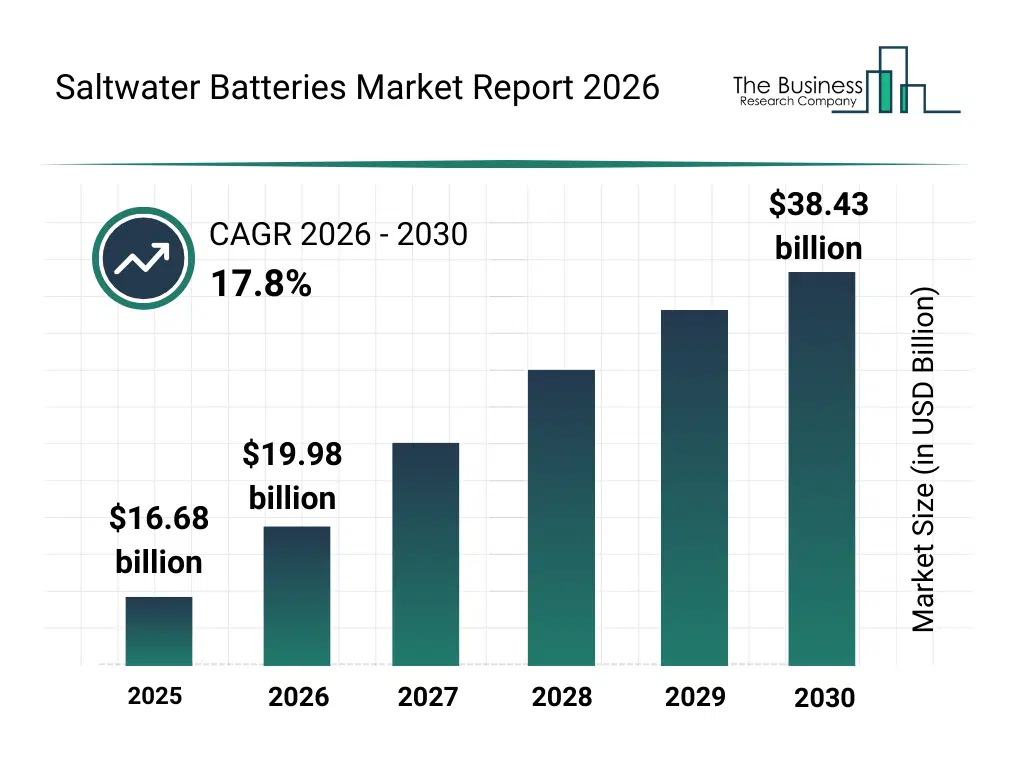
What Is The Saltwater Batteries Market Size 2026 And Growth Rate?
The saltwater batteries market size has grown rapidly in recent years. It will grow from $16.68 billion in 2025 to $19.98 billion in 2026 at a compound annual growth rate (CAGR) of 19.8%. The growth in the historic period can be attributed to concerns over lithium ion battery safety, increasing demand for renewable energy storage, early adoption of alternative battery chemistries, environmental regulations promoting non toxic materials, growth of off grid power systems.What Is The Saltwater Batteries Market Growth Forecast?
The saltwater batteries market size is expected to see rapid growth in the next few years. It will grow to $38.43 billion in 2030 at a compound annual growth rate (CAGR) of 17.8%. The growth in the forecast period can be attributed to rising deployment of residential energy storage systems, expansion of renewable energy installations, demand for sustainable battery recycling solutions, increasing government investments in green energy storage, growing need for long cycle life stationary batteries. Major trends in the forecast period include rising adoption of environment friendly and non toxic battery technologies, increasing use of saltwater batteries for stationary energy storage, growing preference for fire safe and non flammable energy storage systems, expansion of low cost battery solutions for off grid applications, advancements in sodium ion and magnesium ion based saltwater batteries.
Global Saltwater Batteries Market Segmentation
1) By Type: 12 Volt, 24 Volt, 48 Volt 2) By Component: Cathode, Anode, Electrolytes 3) By Capacity: Low, Medium, High 4) By Battery Chemistry: Sodium-ion, Magnesium-ion, Other Battery Chemistry 5) By Application: Residential, Industrial, Commercial, Government, Enterprise Subsegments: 1) By 12 Volt: Standard 12 Volt Saltwater Batteries, High-Capacity 12 Volt Saltwater Batteries 2) By 24 Volt: Standard 24 Volt Saltwater Batteries, High-Capacity 24 Volt Saltwater Batteries 3) By 48 Volt: Standard 48 Volt Saltwater Batteries, High-Capacity 48 Volt Saltwater BatteriesWhat Is The Driver Of The Saltwater Batteries Market?
The rising demand for energy storage is expected to propel the growth of the saltwater batteries market going forward. Energy storage is the process of capturing energy produced at one time for use at a later time to reduce imbalances between energy demand and energy production. The demand for energy storage is rising due to falling costs, increasing adoption of renewable energy, the need for grid reliability and resilience, and policy support such as tax credits. Saltwater batteries offer a safe, eco-friendly option for energy storage, utilizing abundant materials and posing a minimal environmental risk. For instance, in April 2024, according to the International Energy Agency, a France-based autonomous intergovernmental organization, battery storage was the fastest-growing commercially available energy technology in the power sector. Global deployment more than doubled year-on-year, with a total of 42 GW of new battery storage capacity added across utility-scale installations, behind-the-meter systems, mini-grids, and solar home systems for electricity access. Therefore, the rising demand for energy storage is driving the growth of the saltwater batteries industry.Key Players In The Global Saltwater Batteries Market
Major companies operating in the saltwater batteries market are General Electric Company, BYD Company Ltd., Panasonic Corporation, MANLY Battery, Contemporary Amperex Technology Co. Limited (CATL), Toshiba Corporation, LG Energy Solution Ltd., SAMSUNG SDI Co. Ltd., Fuji Electric Co. Ltd., EVE Energy, AMTE Power Plc, Exide Industries, Altris Group, Gotion High-Tech Co. Ltd., SVOLT Energy Technology, Sainik Industries, EnergySage, Su-Kam Power Systems, Altech Batteries Ltd, Aquion Energy, Faradion Limited, BlueSky Energy, BroadBit Batteries Oy, Greenrock Capital LLC, HiNa Battery Technology Co. Ltd, Tiamat Energy
This chart is for illustrative purposes; the full report includes a detailed competitor analysis and comprehensive overview of the top 10 companies in the market.
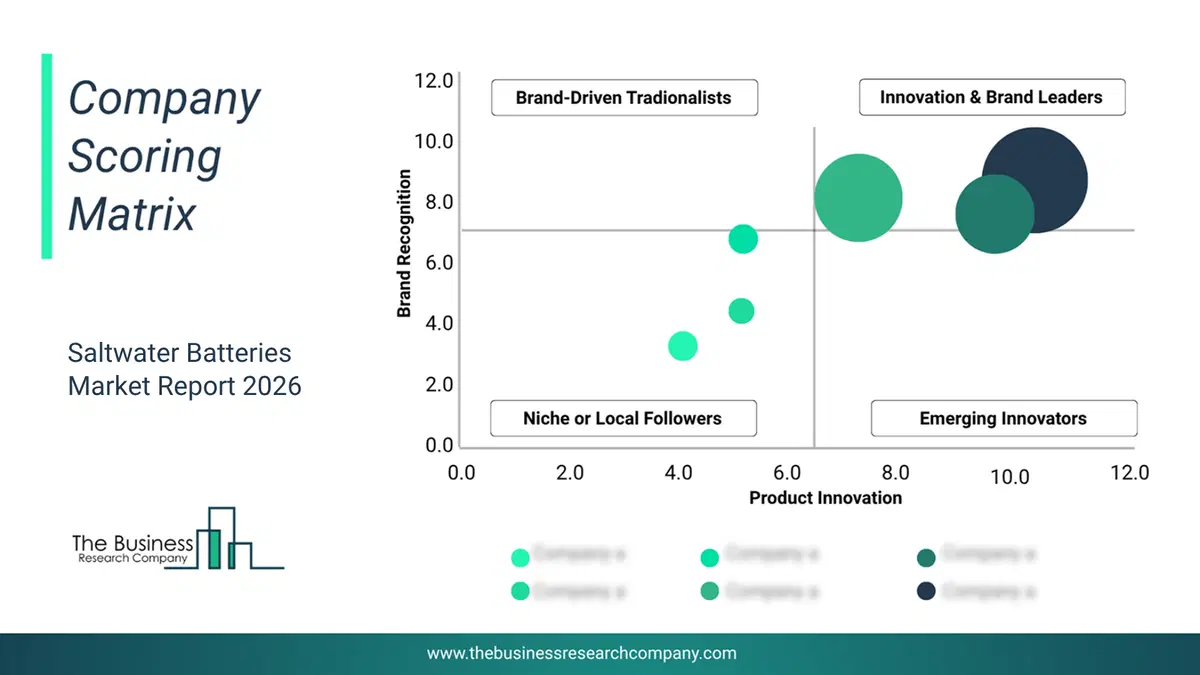
This chart maps companies by product innovation and brand strength, with bubble size indicating relative revenue, helping identify market leaders, challengers, and niche players. This is an illustrative chart; the full report provides a complete and accurate competitive analysis.
Global Saltwater Batteries Market Trends and Insights
Major companies operating in the saltwater batteries market are focusing on developing technologically advanced products, such as eco-friendly saltwater batteries, to gain a competitive edge. An eco-friendly saltwater battery is an energy storage device that uses a saline solution as the electrolyte instead of toxic chemicals, making it environmentally safe. For instance, in January 2024, Salgenx, a US-based provider of energy storage solutions, introduced an innovative saltwater battery for residential energy storage. This innovative battery utilizes sodium chloride (NaCl) for charging and recombination, providing a safe and environmentally friendly alternative to traditional batteries. Unlike conventional batteries, this redox flow energy storage system operates without a membrane and uses non-flammable saltwater, ensuring exceptional safety. Its modular design, constructed using shipping containers, allows for installation in a variety of settings, including garages, underground facilities, or integration into building foundations and walls. With a storage capacity of 126 kWh, the Salgenx battery can be expanded with additional electrolyte liquid and cathode materials, achieving an impressive 91% efficiency and a 20 kW power output.What Are Latest Mergers And Acquisitions In The Saltwater Batteries Market?
In December 2023, Statkraft AS, a Norway-based hydroelectric company and generator of renewable energy, partnered with Aquabattery to develop a promising technology to improve the long-term storage of electricity through a flow battery made with salt water. The primary goal of the partnership is to advance LDES technology, which utilizes saltwater for energy storage, and to test its scalability and commercial viability in Delft, the Netherlands. AquaBattery B.V. is a Netherlands-based company that provides sustainable and safe long-term energy storage.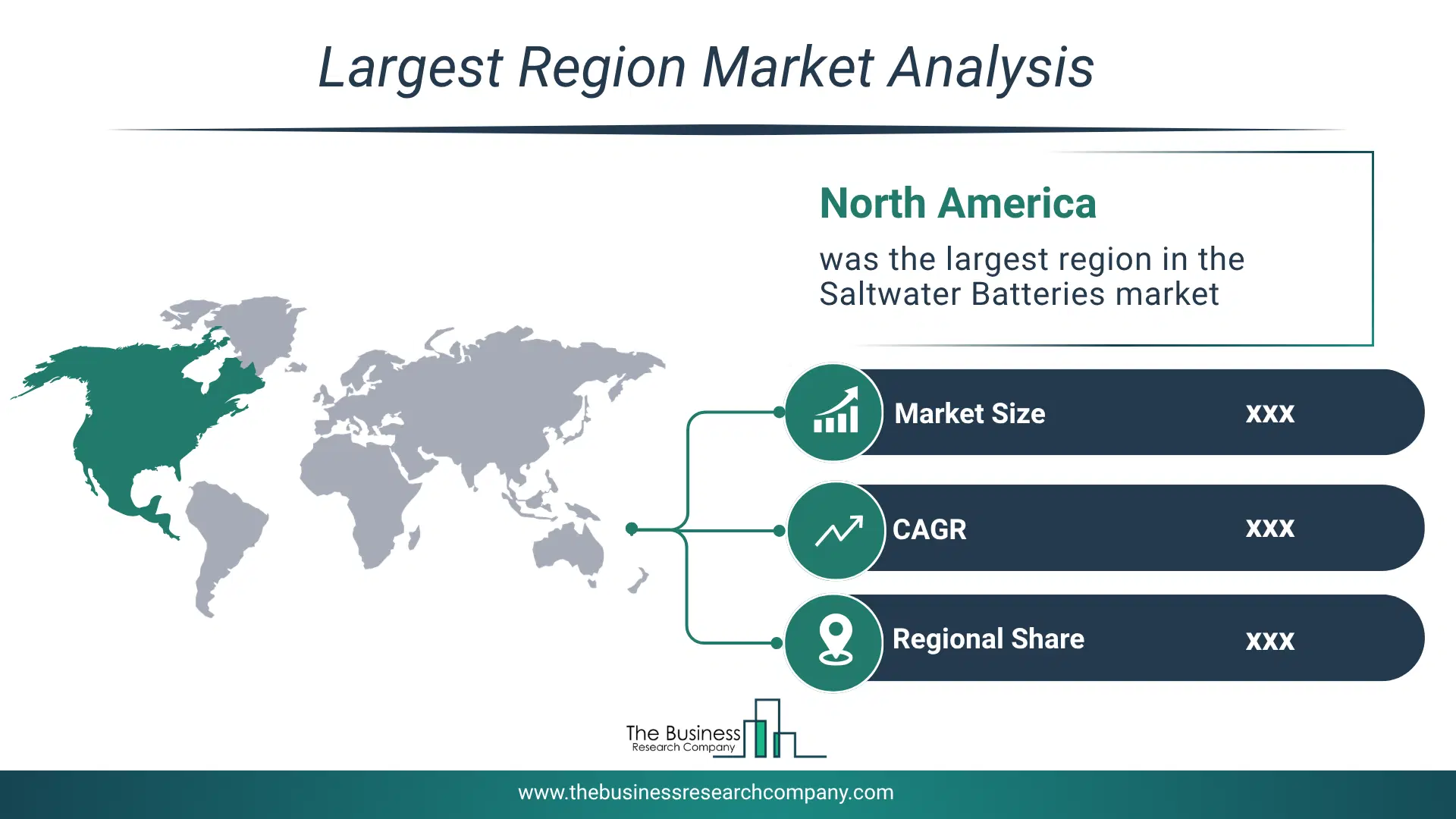
Regional Outlook
North America was the largest region in the saltwater batteries market in 2025. Asia-Pacific is expected to be the fastest-growing region in the forecast period. The regions covered in this market report are Asia-Pacific, South East Asia, Western Europe, Eastern Europe, North America, South America, Middle East, Africa. The countries covered in this market report are Australia, Brazil, China, France, Germany, India, Indonesia, Japan, Taiwan, Russia, South Korea, UK, USA, Canada, Italy, Spain.What Defines the Saltwater Batteries Market?
The saltwater batteries market consists of sales of sodium-nickel-chloride batteries, sodium-sulfur batteries, and sodium-ion batteries. Values in this market are ‘factory gate’ values, that is the value of goods sold by the manufacturers or creators of the goods, whether to other entities (including downstream manufacturers, wholesalers, distributors and retailers) or directly to end customers. The value of goods in this market includes related services sold by the creators of the goods.How is Market Value Defined and Measured?
The market value is defined as the revenues that enterprises gain from the sale of goods and/or services within the specified market and geography through sales, grants, or donations in terms of the currency (in USD unless otherwise specified). The revenues for a specified geography are consumption values that are revenues generated by organizations in the specified geography within the market, irrespective of where they are produced. It does not include revenues from resales along the supply chain, either further along the supply chain or as part of other products.
This chart presents market attractiveness based on a quantitative evaluation of growth, competition, strategic alignment, and risk, offering a clear view of opportunity areas for decision-making. This chart is for illustrative purposes; the full report contains the complete analysis.

This chart highlights the Total Addressable Market (TAM) by estimating the maximum revenue opportunity using an assumption-driven approach, supporting strategic planning and opportunity sizing across markets. The chart is illustrative; the full report provides a more comprehensive analysis.
What Key Data and Analysis Are Included in the Saltwater Batteries Market Report 2026?
The saltwater batteries market research report is one of a series of new reports from The Business Research Company that provides market statistics, including industry global market size, regional shares, competitors with the market share, detailed market segments, market trends and opportunities, and any further data you may need to thrive in the saltwater batteries industry. The market research report delivers a complete perspective of everything you need, with an in-depth analysis of the current and future state of the industry.Saltwater Batteries Market Report Forecast Analysis
| Report Attribute | Details |
|---|---|
| Market Size Value In 2026 | $19.98 billion |
| Revenue Forecast In 2030 | $38.43 billion |
| Growth Rate | CAGR of 17.8% from 2026 to 2030 |
| Base Year For Estimation | 2025 |
| Actual Estimates/Historical Data | 2020-2025 |
| Forecast Period | 2026 - 2030 |
| Market Representation | Revenue in USD Billion and CAGR from 2026 to 2030 |
| Segments Covered | Type, Component, Capacity, Battery Chemistry, Application |
| Regional Scope | Asia-Pacific, Western Europe, Eastern Europe, North America, South America, Middle East, Africa |
| Country Scope | The countries covered in the report are Australia, Brazil, China, France, Germany, India, Indonesia, Japan, Taiwan, Russia, South Korea, UK, USA, Canada, Italy, Spain. |
| Key Companies Profiled | General Electric Company, BYD Company Ltd., Panasonic Corporation, MANLY Battery, Contemporary Amperex Technology Co. Limited (CATL), Toshiba Corporation, LG Energy Solution Ltd., SAMSUNG SDI Co. Ltd., Fuji Electric Co. Ltd., EVE Energy, AMTE Power Plc, Exide Industries, Altris Group, Gotion High-Tech Co. Ltd., SVOLT Energy Technology, Sainik Industries, EnergySage, Su-Kam Power Systems, Altech Batteries Ltd, Aquion Energy, Faradion Limited, BlueSky Energy, BroadBit Batteries Oy, Greenrock Capital LLC, HiNa Battery Technology Co. Ltd, Tiamat Energy |
| Customization Scope | Request for Customization |
| Pricing And Purchase Options | Explore Purchase Options |