
Saponin-Based Adjuvants Market Report 2026
Global Outlook – By Product Type (Purified Quillaja Saponin Extracts, QS-21 Saponin Fractions, Crude Saponin Extracts, Semi-Purified Saponin Blends, Synthetic And Semi-Synthetic Saponin Analogues), By Source (Quillaja Saponaria, Soybean, Other Sources), By Formulation (Particulate, Emulsion, Liposomal, Other Formulations), By Application (Human Vaccines, Veterinary Vaccines, Research Applications, Other Applications), By End-User (Pharmaceutical Companies, Research Institutes, Contract Research Organizations, Other End-Users) – Market Size, Trends, Strategies, and Forecast to 2030
Saponin-Based Adjuvants Market Overview
• Saponin-Based Adjuvants market size has reached to $1.17 billion in 2025 • Expected to grow to $1.97 billion in 2030 at a compound annual growth rate (CAGR) of 10.9% • Growth Driver: Increasing Global Vaccine Development Activities Driving Market Expansion Through Expanded Immunization Programs And Pipeline Growth • Market Trend: Strategic Licensing And Co-Development Agreements Driving Innovation In Saponin-Based Adjuvants • North America was the largest region in 2025 and Asia-Pacific is the fastest growing region.What Is Covered Under Saponin-Based Adjuvants Market?
Saponin-based adjuvants are naturally derived compounds extracted primarily from plant sources that are used to enhance the immune response to an antigen. They function by stimulating both humoral and cellular immunity, improving the effectiveness and durability of immune activation. These adjuvants are widely valued for their ability to increase immunogenicity while enabling dose sparing and improved formulation performance. The main product types of saponin-based adjuvants include purified Quillaja saponin extracts, QS-21 saponin fractions, crude saponin extracts, semi-purified saponin blends, and synthetic and semi-synthetic saponin analogues. Purified Quillaja saponin extracts are compounds derived from the bark of Quillaja saponaria that enhance immune responses in vaccines and immunotherapies. They are sourced from Quillaja saponaria, soybean, and other sources, and are formulated as particulate, emulsion, liposomal, and other formulations. They find application in human vaccines, veterinary vaccines, research applications, and other applications, serving end users including pharmaceutical companies, research institutes, contract research organizations, and other end-users.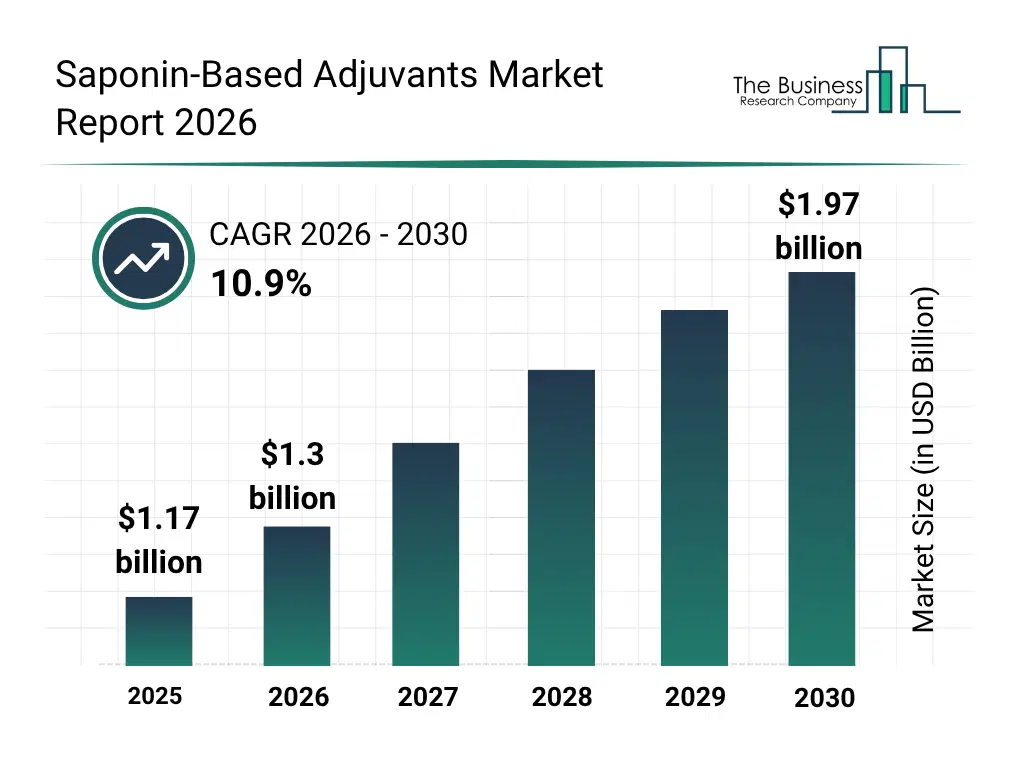
What Is The Saponin-Based Adjuvants Market Size and Share 2026?
The saponin-based adjuvants market size has grown rapidly in recent years. It will grow from $1.17 billion in 2025 to $1.3 billion in 2026 at a compound annual growth rate (CAGR) of 10.7%. The growth in the historic period can be attributed to increasing vaccine research activities, rising demand for effective adjuvants, growth of human and veterinary vaccines, advancements in plant-based extraction techniques, regulatory support for adjuvant development.What Is The Saponin-Based Adjuvants Market Growth Forecast?
The saponin-based adjuvants market size is expected to see rapid growth in the next few years. It will grow to $1.97 billion in 2030 at a compound annual growth rate (CAGR) of 10.9%. The growth in the forecast period can be attributed to adoption of synthetic and semi-synthetic saponin analogues, integration with next-generation vaccine platforms, expansion of veterinary vaccine applications, increasing r&d investments in immunology, focus on personalized and precision vaccine strategies. Major trends in the forecast period include development of novel saponin formulations, enhanced vaccine immunogenicity, adjuvant dose sparing strategies, integration with mrna and protein-based vaccines, standardization and quality control improvements.
Global Saponin-Based Adjuvants Market Segmentation
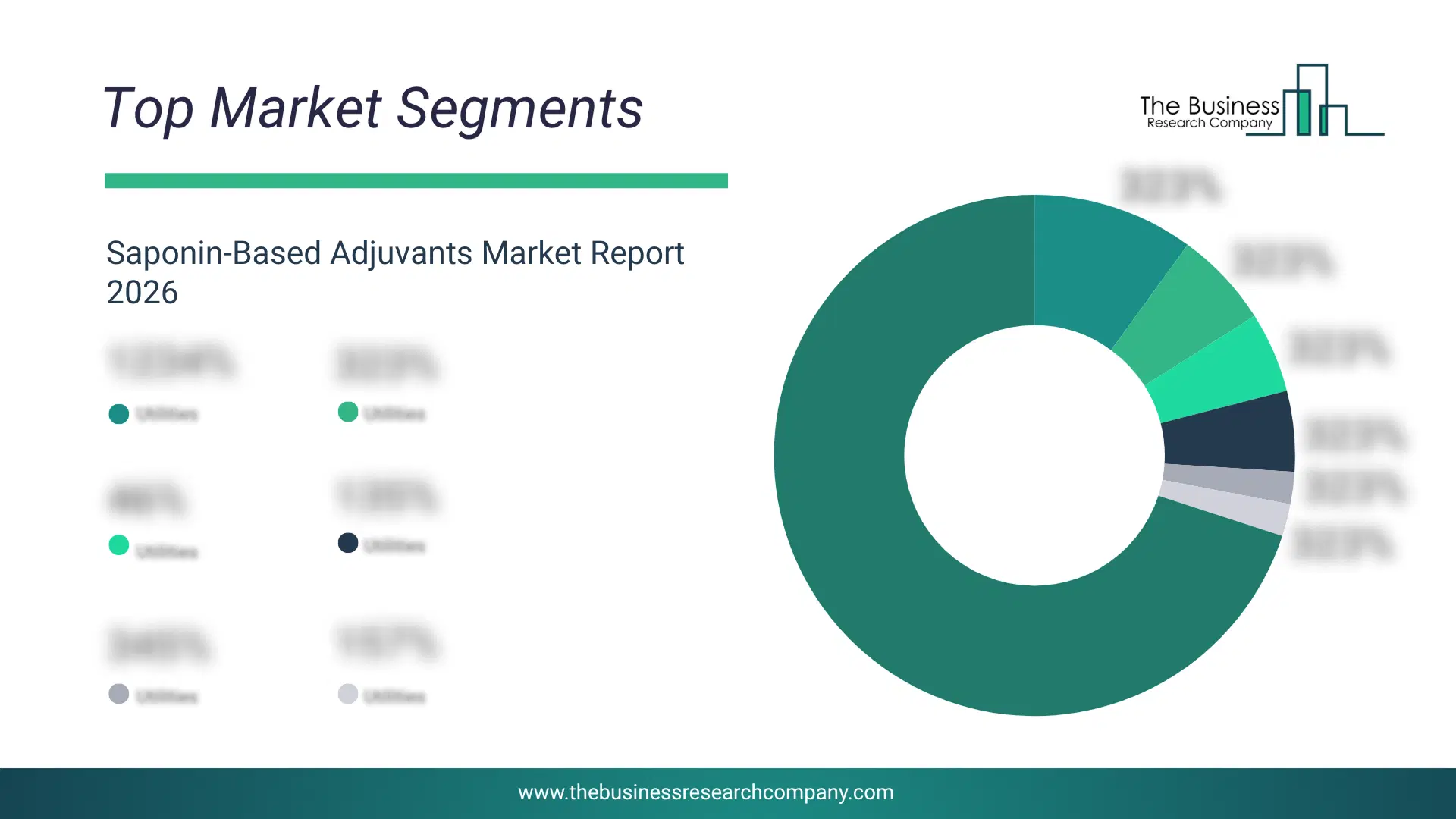
1) By Product Type: Purified Quillaja Saponin Extracts, QS-21 Saponin Fractions, Crude Saponin Extracts, Semi-Purified Saponin Blends, Synthetic And Semi-Synthetic Saponin Analogues 2) By Source: Quillaja Saponaria, Soybean, Other Sources 3) By Formulation: Particulate, Emulsion, Liposomal, Other Formulations 4) By Application: Human Vaccines, Veterinary Vaccines, Research Applications, Other Applications 5) By End-User: Pharmaceutical Companies, Research Institutes, Contract Research Organizations, Other End-Users Subsegments: 1) By Purified Quillaja Saponin Extracts: High Purity Quillaja Extracts, Standardized Quillaja Extracts, Pharmaceutical Grade Quillaja Extracts, Vaccine Grade Quillaja Extracts 2) By QS-21 Saponin Fractions: Clinical Grade QS-21 Fractions, Research Grade QS-21 Fractions, High Purity QS-21 Fractions, Stabilized QS-21 Formulations 3) By Crude Saponin Extracts: Raw Plant Derived Saponin Extracts, Aqueous Crude Saponin Extracts, Alcohol Extracted Crude Saponins, Unstandardized Botanical Saponin Extracts 4) By Semi-Purified Saponin Blends: Partially Refined Saponin Blends, Standardized Semi-Purified Blends, Blended Botanical Saponin Mixtures, Vaccine Grade Semi-Purified Blends 5) By Synthetic And Semi-Synthetic Saponin Analogues: Fully Synthetic Saponin Analogues, Chemically Modified Saponin Derivatives, Structure Optimized Saponin Analogues, Low Toxicity Saponin AnaloguesWhat Is The Driver Of The Saponin-Based Adjuvants Market?
The increasing demand for vaccine development activities is expected to propel the growth of the Saponin-Based Adjuvants market going forward. Vaccine development activities refer to the research, clinical evaluation, regulatory approval, and commercialization processes undertaken to develop new or improved vaccines for infectious and non-infectious diseases. Governments and global health agencies are increasing vaccine development activities due to sustained funding commitments for infectious disease prevention and pandemic preparedness. Saponin-Based Adjuvants support vaccine development activities by enhancing antigen immunogenicity, enabling dose sparing, and strengthening cellular immune responses in next-generation vaccine formulations. For instance, in April 2025, according to the World Health Organization, a Switzerland-based international public health organization, global measles cases reached an estimated 10.3 million in 2023, increasing by about 20% compared to 2022, highlighting the growing need for expanded vaccine development and immunization efforts. Therefore, the increasing demand for vaccine development activities is driving the growth of the Saponin-Based Adjuvants industry.Key Players In The Global Saponin-Based Adjuvants Market
Major companies operating in the saponin-based adjuvants market are GlaxoSmithKline plc, Croda International plc, HIPRA Human Health S.L, Novavax, Inc., Seppic S.A., Merck KGaA, Agenus Inc., PhytoLab GmbH & Co. KG, SPI Pharma Inc., InvivoGen, Desert King International, Adjuvatis S.A.S., Aphios Corporation, Vaxine Pty Ltd, Fatro S.p.A., Q-Vant Biosciences, AVT Pharmaceutical Inc., SaponiQx.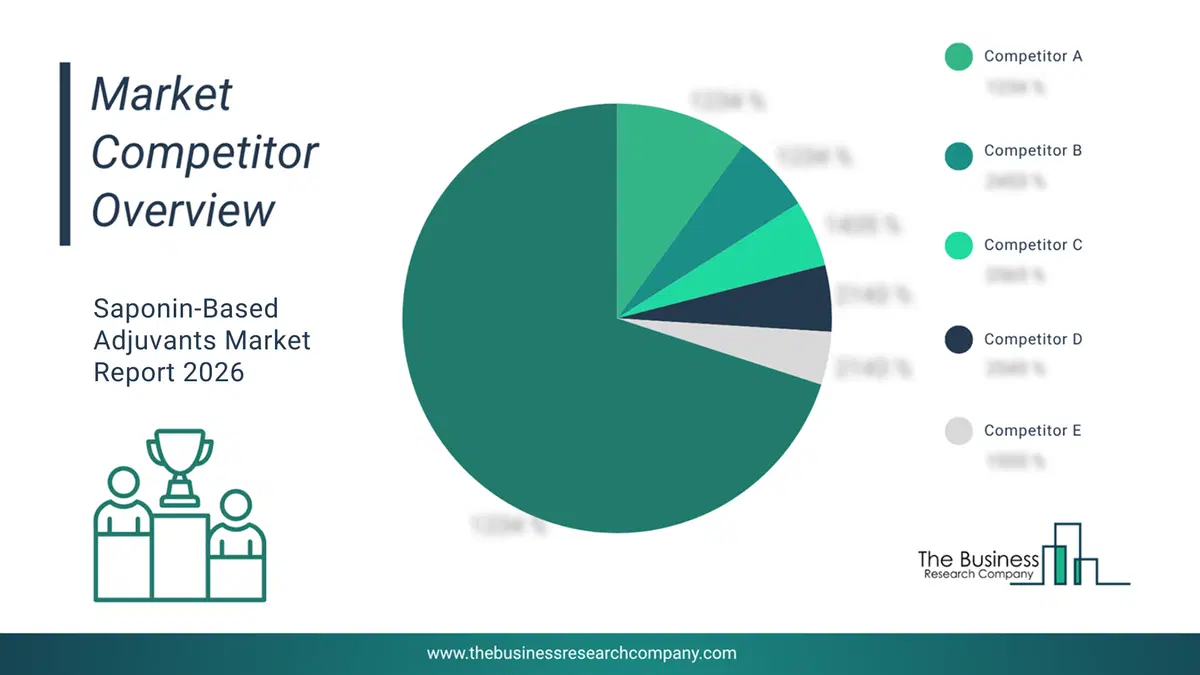
This chart is for illustrative purposes; the full report includes a detailed competitor analysis and comprehensive overview of the top 10 companies in the market.
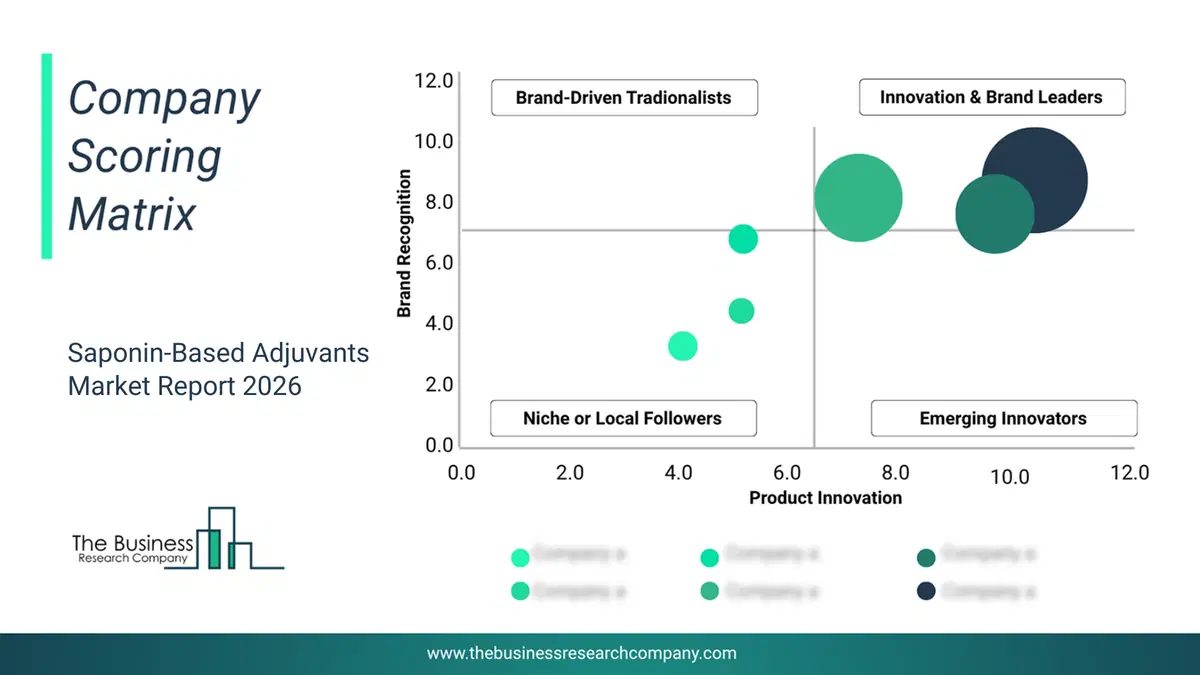
This chart maps companies by product innovation and brand strength, with bubble size indicating relative revenue, helping identify market leaders, challengers, and niche players. This is an illustrative chart; the full report provides a complete and accurate competitive analysis.
Global Saponin-Based Adjuvants Market Trends and Insights
Major companies operating in the saponin‑based adjuvants market are focusing on developing sustainable and scalable manufacturing alternatives, such as cultured plant cell-derived QS-21, to ensure supply chain stability, consistent quality, and reduced dependence on natural resources. Cultured plant cell-derived QS-21 refers to an advanced production method where the key vaccine adjuvant is grown from plant cells in a controlled laboratory setting, rather than being extracted from the bark of rare trees. For instance, in August 2024, SaponiQx, a US-based biomanufacturing company, launched STIMULON cultured plant cell QS-21, a cpcQS-21 adjuvant available for commercial purchase through InvivoGen. This product is produced via plant cell culture rather than tree bark, ensuring consistent and scalable supply; it offers high purity, lot-to-lot uniformity, and reduced environmental impact. Functionally, STIMULON cpcQS-21 retains the same immunostimulatory potency as tree-derived QS-21 in driving both humoral and cellular immune responses, making it suitable for use in vaccines for infectious diseases such as malaria, shingles, and RSV.What Are Latest Mergers And Acquisitions In The Saponin-Based Adjuvants Market?
In October 2023, SPI Pharma Inc., a US-based pharmaceutical company, partnered with Q Vant Biosciences Inc. for an undisclosed amount. Through this collaboration, SPI Pharma aims to expand the production and global availability of sustainable, scalable, pharmaceutical-grade saponin adjuvants, enhancing vaccine formulation capabilities. Q‑Vant Biosciences, Inc. is a US-based biotechnology company specializing in the sustainable production, purification, and supply of Quillaja saponin‑based adjuvants for human and veterinary vaccines.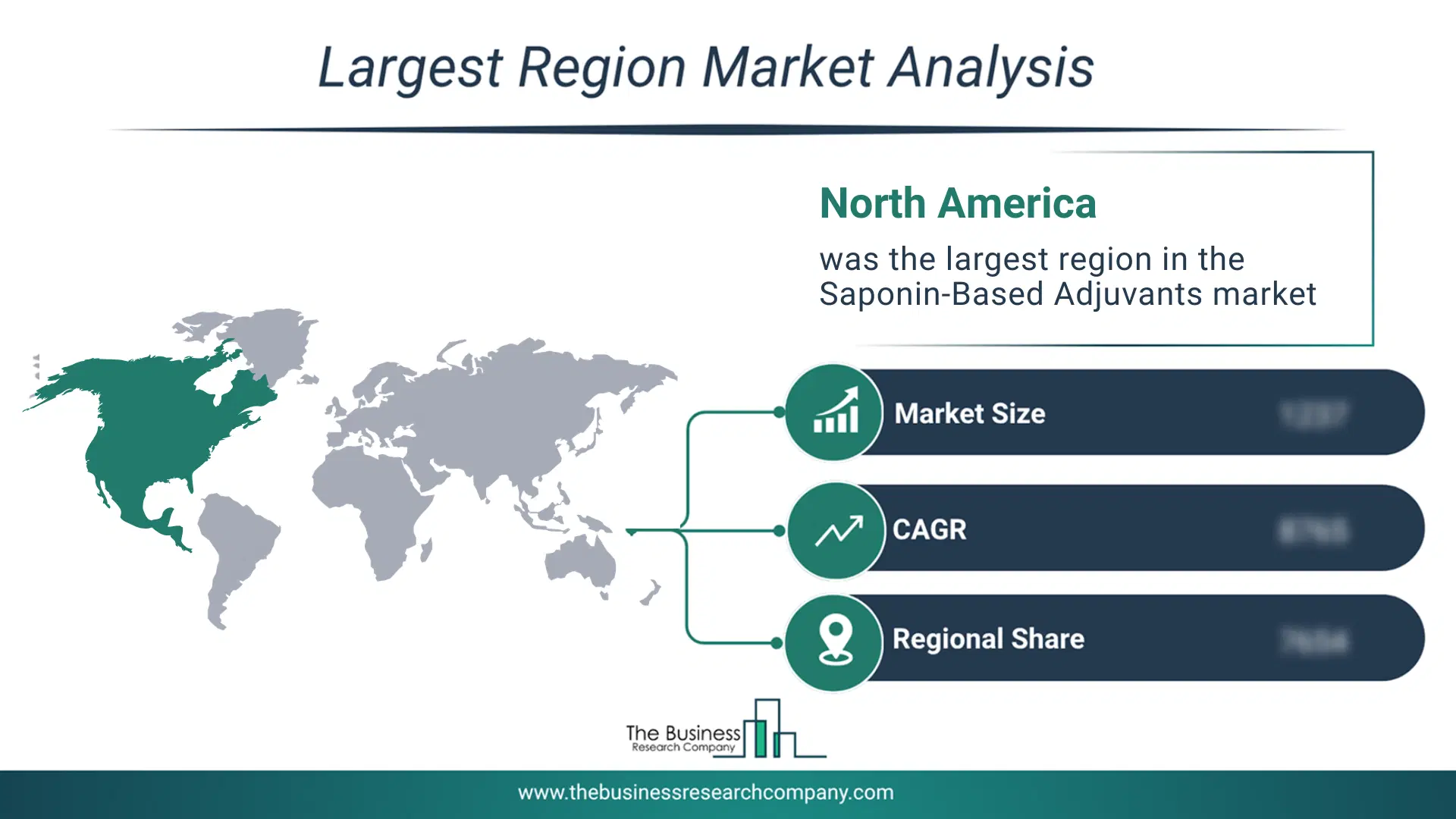
Regional Insights
North America was the largest region in the saponin-based adjuvants market in 2025. Asia-Pacific is expected to be the fastest-growing region in the forecast period. The regions covered in this market report are Asia-Pacific, South East Asia, Western Europe, Eastern Europe, North America, South America, Middle East, Africa. The countries covered in this market report are Australia, Brazil, China, France, Germany, India, Indonesia, Japan, Taiwan, Russia, South Korea, UK, USA, Canada, Italy, Spain.What Defines the Saponin-Based Adjuvants Market?
The saponin-based adjuvants market consists of sales of plant-derived saponins, combination adjuvant systems, VSA® adjuvants, saponin-liposome formulations, saponin-nanoparticle adjuvants, Fraction C saponins, and custom saponin blends. Values in this market are ‘factory gate’ values, that is, the value of goods sold by the manufacturers or creators of the goods, whether to other entities (including downstream manufacturers, wholesalers, distributors, and retailers) or directly to end customers. The value of goods in this market includes related services sold by the creators of the goods.How is Market Value Defined and Measured?
The market value is defined as the revenues that enterprises gain from the sale of goods and/or services within the specified market and geography through sales, grants, or donations in terms of the currency (in USD unless otherwise specified). The revenues for a specified geography are consumption values that are revenues generated by organizations in the specified geography within the market, irrespective of where they are produced. It does not include revenues from resales along the supply chain, either further along the supply chain or as part of other products.
This chart presents market attractiveness based on a quantitative evaluation of growth, competition, strategic alignment, and risk, offering a clear view of opportunity areas for decision-making. This chart is for illustrative purposes; the full report contains the complete analysis.

This chart highlights the Total Addressable Market (TAM) by estimating the maximum revenue opportunity using an assumption-driven approach, supporting strategic planning and opportunity sizing across markets. The chart is illustrative; the full report provides a more comprehensive analysis.
What Key Data And Analysis Are Included In The Saponin-Based Adjuvants Market Report 2026?
The saponin-based adjuvants market research report is one of a series of new reports from The Business Research Company that provides market statistics, including industry global market size, regional shares, competitors with the market share, detailed market segments, market trends and opportunities, and any further data you may need to thrive in the saponin-based adjuvants industry. The market research report delivers a complete perspective of everything you need, with an in-depth analysis of the current and future state of the industry.Saponin-Based Adjuvants Market Report Forecast Analysis
| Report Attribute | Details |
|---|---|
| Market Size Value In 2026 | $1.3 billion |
| Revenue Forecast In 2030 | $1.97 billion |
| Growth Rate | CAGR of 10.7% from 2026 to 2030 |
| Base Year For Estimation | 2025 |
| Actual Estimates/Historical Data | 2020-2025 |
| Forecast Period | 2026 - 2030 |
| Market Representation | Revenue in USD Billion and CAGR from 2026 to 2030 |
| Segments Covered | Product Type, Source, Formulation, Application, End-User |
| Regional Scope | Asia-Pacific, Western Europe, Eastern Europe, North America, South America, Middle East, Africa |
| Country Scope | The countries covered in the report are Australia, Brazil, China, France, Germany, India, Indonesia, Japan, Taiwan, Russia, South Korea, UK, USA, Canada, Italy, Spain. |
| Key Companies Profiled | GlaxoSmithKline plc, Croda International plc, HIPRA Human Health S.L, Novavax, Inc., Seppic S.A., Merck KGaA, Agenus Inc., PhytoLab GmbH & Co. KG, SPI Pharma Inc., InvivoGen, Desert King International, Adjuvatis S.A.S., Aphios Corporation, Vaxine Pty Ltd, Fatro S.p.A., Q-Vant Biosciences, AVT Pharmaceutical Inc., SaponiQx. |
| Customization Scope | Request for Customization |
| Pricing And Purchase Options | Explore Purchase Options |