
Satellite And Spacecraft Subsystem Market Report 2026
Global Outlook – By Component (Hardware, Software, Services), By Launch Vehicle Subsystem (Structure, Avionics, Propulsion System, Control System, Electrical System, Stage Separation, Thermal System), By Orbit (Low Earth Orbit, Medium Earth Orbit, Geostationary Earth Orbit, Beyond Earth Orbit), By Application (Communication, Earth Observation, Navigation, Space Exploration, Scientific Research, Surveillance And Reconnaissance), By End User (Commercial, Civil Government, Defense, Academic Or Research Organizations) – Market Size, Trends, Strategies, and Forecast to 2030
Satellite And Spacecraft Subsystem Market Overview
• Satellite And Spacecraft Subsystem market size has reached to $25.68 billion in 2025 • Expected to grow to $36.52 billion in 2030 at a compound annual growth rate (CAGR) of 7.2% • Growth Driver: Increasing Deployment Of Low Earth Orbit (LEO) Satellite Constellations Driving The Market Growth Due To Rising Demand For Broadband Connectivity, Earth Observation, And Defense Capabilities • Market Trend: Advanced Propulsion Systems Support Precise Spacecraft Positioning • North America was the largest region in 2025 and Asia-Pacific is the fastest growing region.What Is Covered Under Satellite And Spacecraft Subsystem Market?
Satellite and spacecraft subsystems are the integrated functional units that enable a spacecraft to perform its intended operations and maintain performance in the space environment. These subsystems include interconnected systems responsible for supporting spacecraft functionality, reliability, and mission operations throughout its life cycle. The main components of satellite and spacecraft subsystem include hardware, software, and services. Hardware refers to the physical equipment and components that enable satellites and spacecraft to perform their intended functions, including communication, navigation, observation, and mission operations. These subsystems support launch vehicle components including structure, avionics, propulsion system, control system, electrical system, stage separation, and thermal system, and operate across low earth orbit, medium earth orbit, geostationary earth orbit, and beyond earth orbit. The various applications involved are communication, earth observation, navigation, space exploration, scientific research, and surveillance and reconnaissance, and they are used by several end users such as commercial, civil government, defense, and academic or research organizations.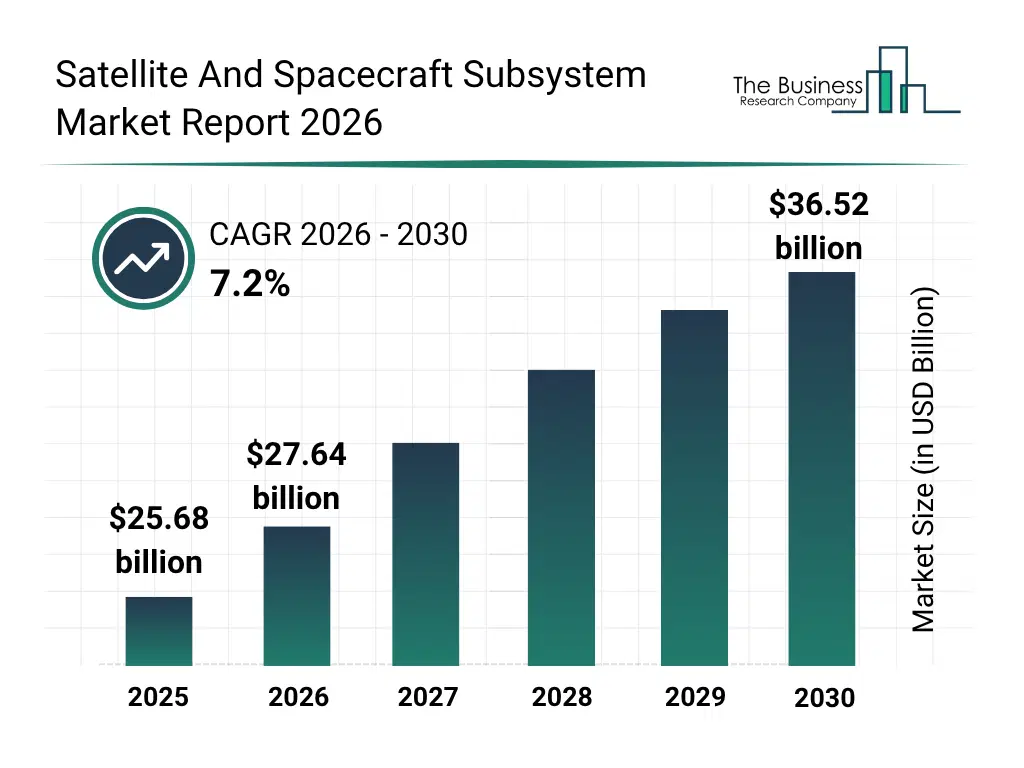
What Is The Satellite And Spacecraft Subsystem Market Size and Share 2026?
The satellite and spacecraft subsystem market size has grown strongly in recent years. It will grow from $25.68 billion in 2025 to $27.64 billion in 2026 at a compound annual growth rate (CAGR) of 7.6%. The growth in the historic period can be attributed to increasing satellite launches, expansion of commercial satellite communications, growth in earth observation missions, rising government space exploration programs, increasing demand for satellite-based navigation.What Is The Satellite And Spacecraft Subsystem Market Growth Forecast?
The satellite and spacecraft subsystem market size is expected to see strong growth in the next few years. It will grow to $36.52 billion in 2030 at a compound annual growth rate (CAGR) of 7.2%. The growth in the forecast period can be attributed to growing deployment of small satellites, increasing demand for space-based connectivity, expansion of satellite constellations, rising defense and surveillance space programs, increasing investment in deep-space exploration missions. Major trends in the forecast period include increasing integration of autonomous spacecraft operations, growing adoption of modular satellite subsystems, advancements in high-reliability spacecraft electronics, increasing miniaturization of spacecraft subsystems, growing demand for radiation-hardened subsystems.
Global Satellite And Spacecraft Subsystem Market Segmentation
1) By Component: Hardware, Software, Services 2) By Launch Vehicle Subsystem: Structure, Avionics, Propulsion System, Control System, Electrical System, Stage Separation, Thermal System 3) By Orbit: Low Earth Orbit, Medium Earth Orbit, Geostationary Earth Orbit, Beyond Earth Orbit 4) By Application: Communication, Earth Observation, Navigation, Space Exploration, Scientific Research, Surveillance And Reconnaissance 5) By End User: Commercial, Civil Government, Defense, Academic Or Research Organizations Subsegments: 1) By Hardware: Satellite Bus Systems, Power Systems, Communication Systems, Attitude And Orbit Control Systems, Thermal Control Systems 2) By Software: Flight Software, Ground Control Software, Mission Planning Software, Data Processing Software, Satellite Simulation Software 3) By Services: Satellite Integration Services, Testing And Validation Services, Launch Support Services, Maintenance And Repair Services, Ground Station ServicesWhat Is The Driver Of The Satellite And Spacecraft Subsystem Market?
The increasing deployment of low earth orbit (LEO) satellite constellations is expected to propel the growth of the satellite and spacecraft subsystem market going forward. Low earth orbit (LEO) satellite constellations are networks of multiple satellites positioned at altitudes between 160 km and 2,000 km above Earth that operate together to provide low-latency communication and continuous global coverage. Low earth orbit (LEO) satellite constellations are increasing due to the rising demand for high-speed internet connectivity, as these satellite networks provide faster data transmission and lower latency compared with traditional satellite systems, enabling reliable connectivity in remote and underserved regions. Low earth orbit (LEO) satellite constellations support the growth of satellite and spacecraft subsystems by increasing the demand for advanced components such as communication, power, propulsion, thermal control, and navigation systems required to operate large networks of satellites efficiently. For instance, in May 2023, according to the Union of Concerned Scientists (UCS), a US-based nonprofit organization, there were 7,560 operational satellites in orbit worldwide. Of these, 6,768 satellites operated in low earth orbit (LEO). Therefore, the increasing deployment of low earth orbit (LEO) satellite constellations is driving the growth of the satellite and spacecraft subsystem industry.Key Players In The Global Satellite And Spacecraft Subsystem Market
Major companies operating in the satellite and spacecraft subsystem market are The Boeing Company, RTX Corporation, Lockheed Martin Corporation, Airbus Defence and Space SAS, Northrop Grumman Corporation, China Aerospace Science and Technology Corporation, Honeywell International Inc., L3Harris Technologies Inc., Thales Alenia Space SAS, Mitsubishi Electric Corporation, NEC Corporation, Leonardo S.p.A., Space Exploration Technologies Corp., MDA Space Ltd., Kawasaki Heavy Industries Ltd., Teledyne Technologies Incorporated, Israel Aerospace Industries Ltd., Moog Inc., Hanwha Systems Co. Ltd., OHB SE, INVAP S.E., Arquimea Group S.L., EnduroSat AD, GomSpace A/S, AAC Clyde Space AB, ISISPACE Group B.V., Cosine Research B.V., Berlin Space Technologies GmbH, NewSpace Systems Pty Ltd
This chart is for illustrative purposes; the full report includes a detailed competitor analysis and comprehensive overview of the top 10 companies in the market.
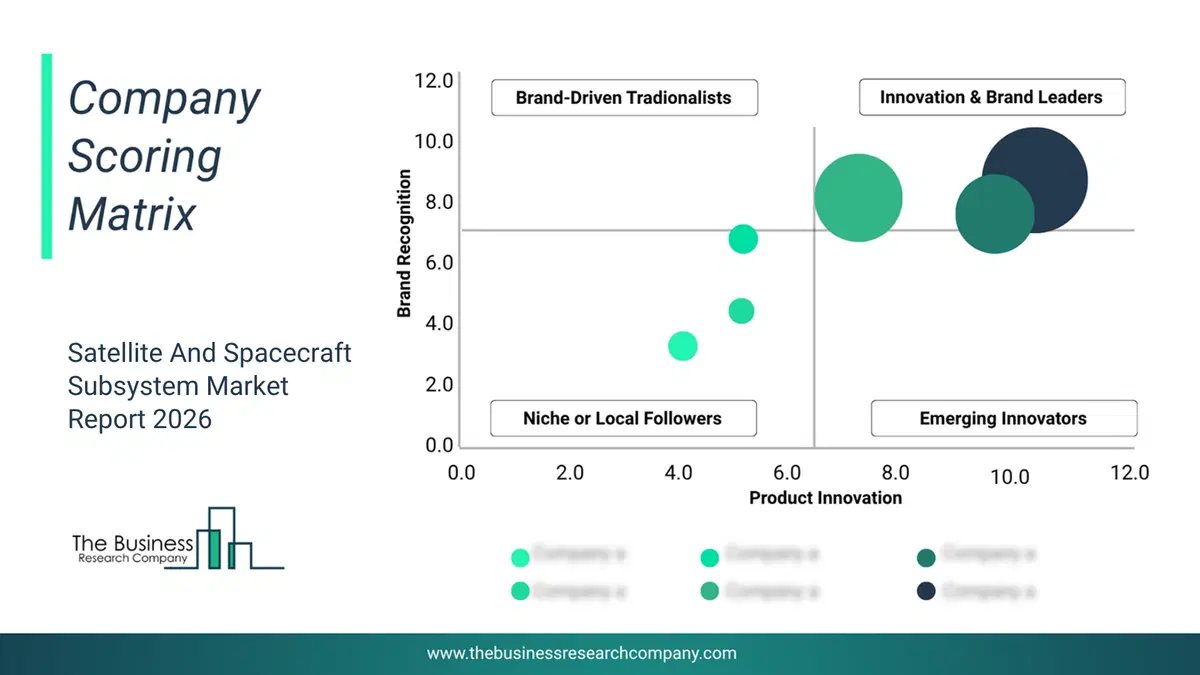
This chart maps companies by product innovation and brand strength, with bubble size indicating relative revenue, helping identify market leaders, challengers, and niche players. This is an illustrative chart; the full report provides a complete and accurate competitive analysis.
Global Satellite And Spacecraft Subsystem Market Trends and Insights
Major companies operating in the satellite and spacecraft subsystem market are focusing on developing and supplying advanced propulsion systems to support precise spacecraft positioning, maneuvering, and mission operations. These developments strengthen spacecraft performance and reliability while enabling complex scientific and exploration missions to meet demanding operational requirements. For instance, in January 2026, Thales Alenia Space, a France-based aerospace company specializing in satellite systems and space technologies, signed a $19.2 million (€16.5 million) contract with OHB System AG, a Germany-based company specializing in satellites for Earth observation, to provide the propulsion subsystem for the European Space Agency’s Laser Interferometer Space Antenna (LISA) mission. Under the contract, Thales Alenia Space will design, manufacture, assemble, integrate, and test the propulsion subsystem for LISA, which will comprise three spacecraft operating in formation to detect gravitational waves. The propulsion subsystem will support the precise positioning and control required for the mission's three-spacecraft configuration. The contract strengthens Thales Alenia Space's role in supplying critical spacecraft subsystems and demonstrates continued development of propulsion technologies for advanced space missions.What Are Latest Mergers And Acquisitions In The Satellite And Spacecraft Subsystem Market?
In May 2026, Schaeffler AG, a Germany-based motion technology company, partnered with Spire Global Inc. to develop space hardware subsystems, satellite platforms, and advanced radiofrequency (RF) and environmental sensing capabilities aimed at strengthening European space infrastructure. Through this partnership, the companies aim to establish a sovereign European space hardware and mission business by combining Schaeffler’s precision manufacturing capabilities with Spire Global’s satellite platform expertise and flight heritage. Spire Global Inc. is a US-based space technology company that provides satellite-based data, analytics, intelligence, and space services.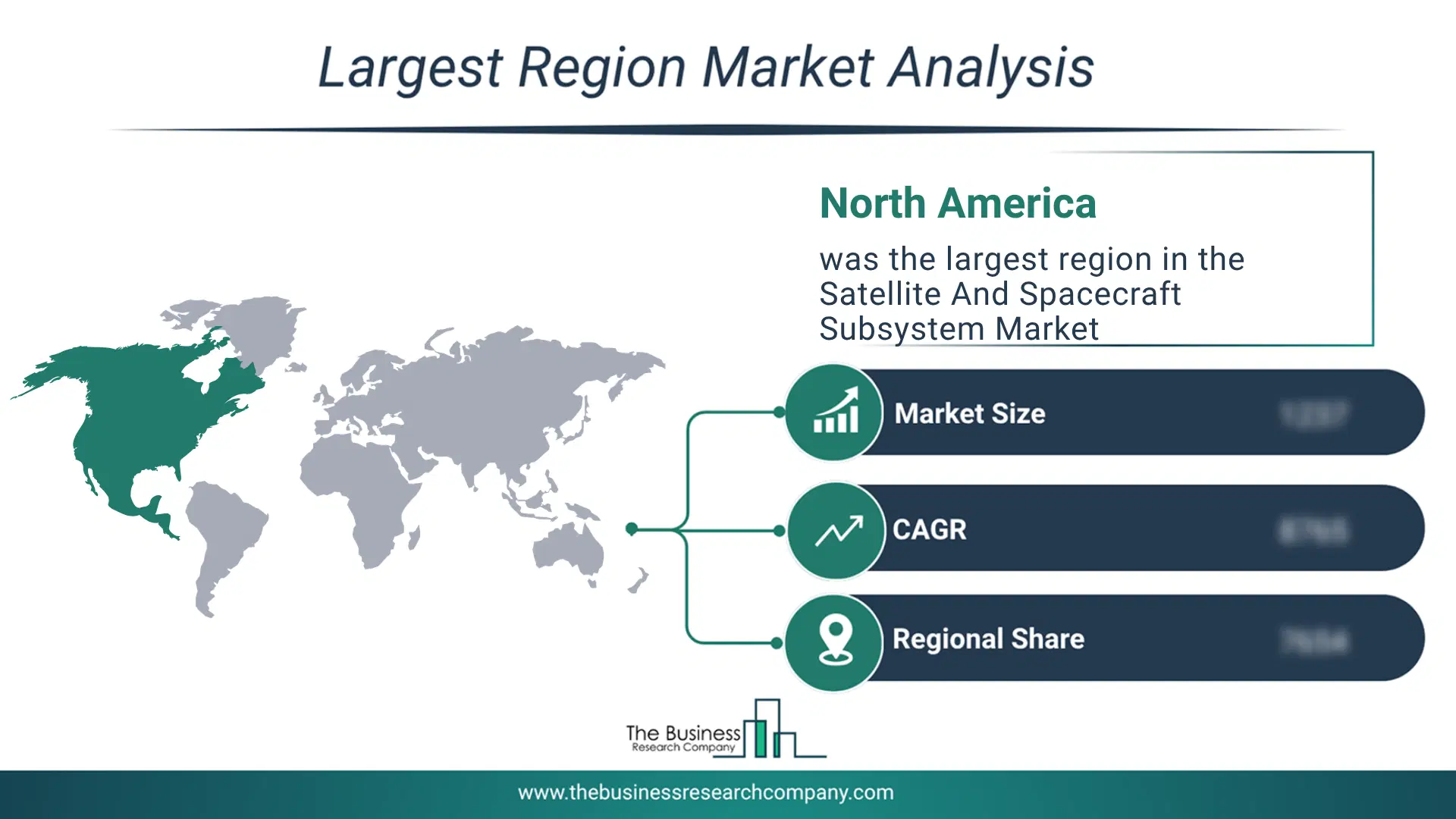
Regional Outlook
North America was the largest region in the satellite and spacecraft subsystem market in 2025. Asia-Pacific is expected to be the fastest-growing region in the forecast period. The regions covered in this market report are Asia-Pacific, South East Asia, Western Europe, Eastern Europe, North America, South America, Middle East, Africa. The countries covered in this market report are Australia, Brazil, China, France, Germany, India, Indonesia, Japan, Taiwan, Russia, South Korea, UK, USA, Canada, Italy, Spain.What Defines the Satellite And Spacecraft Subsystem Market?
The satellite and spacecraft subsystems market consists of revenues earned by entities by providing services such as spacecraft control and management, orbit maintenance and maneuvering, space situational awareness, and data processing and handling. The market value includes the value of related goods sold by the service provider or included within the service offering. The satellite and spacecraft subsystems market also includes sales of power management units, solar array systems, battery systems, and electrical power distribution units. Values in this market are ‘factory gate’ values, that is, the value of goods sold by the manufacturers or creators of the goods, whether to other entities (including downstream manufacturers, wholesalers, distributors, and retailers) or directly to end customers. The value of goods in this market includes related services sold by the creators of the goods.How is Market Value Defined and Measured?
The market value is defined as the revenues that enterprises gain from the sale of goods and/or services within the specified market and geography through sales, grants, or donations in terms of the currency (in USD unless otherwise specified). The revenues for a specified geography are consumption values that are revenues generated by organizations in the specified geography within the market, irrespective of where they are produced. It does not include revenues from resales along the supply chain, either further along the supply chain or as part of other products.
This chart presents market attractiveness based on a quantitative evaluation of growth, competition, strategic alignment, and risk, offering a clear view of opportunity areas for decision-making. This chart is for illustrative purposes; the full report contains the complete analysis.

This chart highlights the Total Addressable Market (TAM) by estimating the maximum revenue opportunity using an assumption-driven approach, supporting strategic planning and opportunity sizing across markets. The chart is illustrative; the full report provides a more comprehensive analysis.
What Key Data and Analysis Are Included in the Satellite And Spacecraft Subsystem Market Report 2026?
The satellite and spacecraft subsystem market research report is one of a series of new reports from The Business Research Company that provides market statistics, including industry global market size, regional shares, competitors with the market share, detailed market segments, market trends and opportunities, and any further data you may need to thrive in the satellite and spacecraft subsystem industry. The market research report delivers a complete perspective of everything you need, with an in-depth analysis of the current and future state of the industry.Satellite And Spacecraft Subsystem Market Report Forecast Analysis
| Report Attribute | Details |
|---|---|
| Market Size Value In 2026 | $27.64 billion |
| Revenue Forecast In 2030 | $36.52 billion |
| Growth Rate | CAGR of 7.2% from 2026 to 2030 |
| Base Year For Estimation | 2025 |
| Actual Estimates/Historical Data | 2020-2025 |
| Forecast Period | 2026 - 2030 |
| Market Representation | Revenue in USD Billion and CAGR from 2026 to 2030 |
| Segments Covered | Component, Launch Vehicle Subsystem, Orbit, Application, End User |
| Regional Scope | Asia-Pacific, Western Europe, Eastern Europe, North America, South America, Middle East, Africa |
| Country Scope | The countries covered in the report are Australia, Brazil, China, France, Germany, India, Indonesia, Japan, Taiwan, Russia, South Korea, UK, USA, Canada, Italy, Spain. |
| Key Companies Profiled | The Boeing Company, RTX Corporation, Lockheed Martin Corporation, Airbus Defence and Space SAS, Northrop Grumman Corporation, China Aerospace Science and Technology Corporation, Honeywell International Inc., L3Harris Technologies Inc., Thales Alenia Space SAS, Mitsubishi Electric Corporation, NEC Corporation, Leonardo S.p.A., Space Exploration Technologies Corp., MDA Space Ltd., Kawasaki Heavy Industries Ltd., Teledyne Technologies Incorporated, Israel Aerospace Industries Ltd., Moog Inc., Hanwha Systems Co. Ltd., OHB SE, INVAP S.E., Arquimea Group S.L., EnduroSat AD, GomSpace A/S, AAC Clyde Space AB, ISISPACE Group B.V., Cosine Research B.V., Berlin Space Technologies GmbH, NewSpace Systems Pty Ltd |
| Customization Scope | Request for Customization |
| Pricing And Purchase Options | Explore Purchase Options |