
Contact Us
  Search
The Business Research Company Logo
Satellite-Based Earth Observation Global Market Opportunities And Strategies To 2035
Published :July 2026
Pages :383
Format :PDF
Delivery Time :2-3 Business Days
Why 2-3 days? We update the report with the latest data and news before delivery. Let us know if you need us to expedite.
Report Price :$4,490.00

Satellite-Based Earth Observation Global Market Opportunities And Strategies To 2035

By Product Type (Earth Observation (EO) Data, Value Added Services), By Satellite Orbit (Low Earth Orbit, Geostationary Orbit, Medium Earth Orbit), By Technology (Optical, Synthetic Aperture Radar, Other Technologies), By Payload Type (Electro-Optical Or Infra-Red (EO Or IR), Imaging, Navigation), By End-User (Defense And Intelligence, Infrastructure And Engineering, Agriculture, Energy And Power, Other End-Users), And By Region, Opportunities And Strategies – Global Forecast To 2035

Satellite-Based Earth Observation Market Definition

Satellite-based Earth Observation (EO) refers to the use of equipped sensors and imaging technologies to collect information about the Earth’s surface, atmosphere, oceans and environmental conditions from space. These satellites capture data through optical imaging, radar, thermal sensing, hyperspectral imaging and other remote sensing techniques to monitor natural and human activities across the globe in real time or over periodic intervals. The primary purpose of satellite-based Earth observation is to support accurate monitoring, analysis and decision-making related to environmental management, weather forecasting, disaster response, agriculture, urban planning, climate change assessment, defense and security, natural resource management and infrastructure development. The satellite-based earth observation market consists of revenues generated by entities (organizations, sole traders and partnerships) that provide satellite imagery, geospatial data products and related analytical services. These offerings enable users to derive actionable insights for decision-making across various sectors.
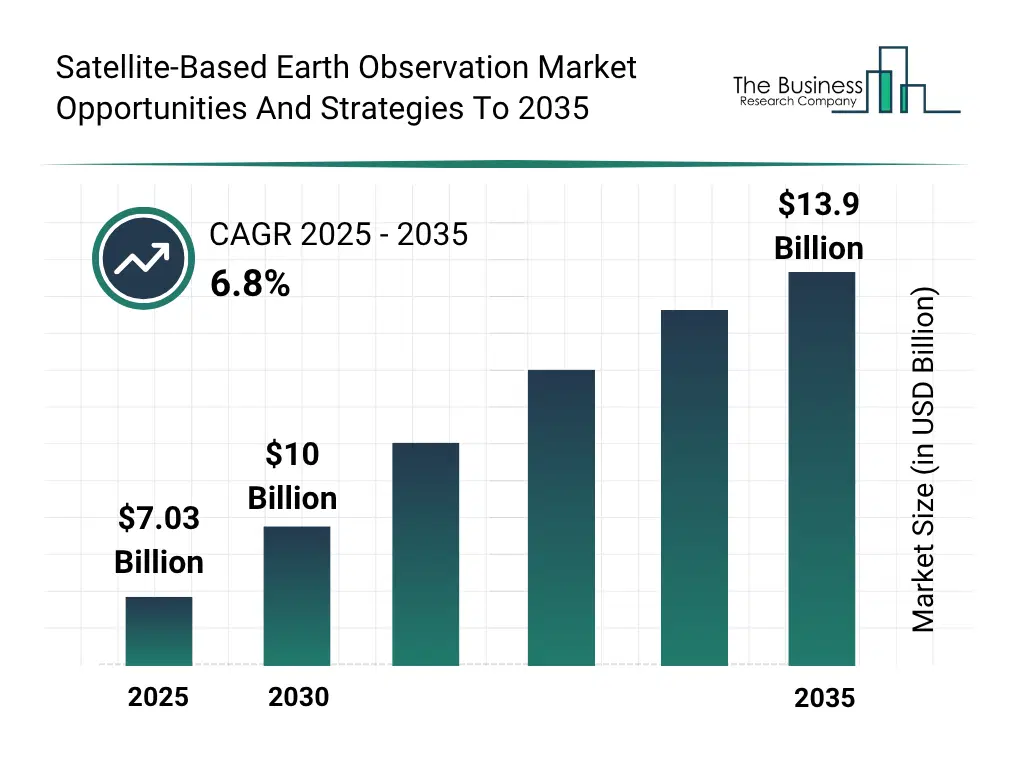
Satellite-Based Earth Observation Global Market Opportunities And Strategies To 2035 Market Size and growth rate 2026 to 2030: Graph

Satellite-Based Earth Observation Market Size

The global satellite-based earth observation market reached a value of nearly $7,034.3 million in 2025, having grown at a compound annual growth rate (CAGR) of 7.8% since 2020. The market is expected to grow from $7,034.3 million in 2025 to $9,999.2 million in 2030 at a rate of 7.3%. The market is then expected to grow at a CAGR of 6.8% from 2030 and reach $13,898.8 million in 2035. Growth in the historic period resulted from rising defense and surveillance spending, disaster risk management and emergency response demands, rising government space program investments and public funding and growth in publicly funded EO programs. Factors that negatively affected growth in the historic period were data privacy and sovereignty concerns across countries and high cost of satellite imagery for end-users. Going forward, increased commercialization of satellite data services, expansion of commercial satellite constellations and private space companies, growth in weather forecasting and meteorological services and rising use in land and land cover mapping will drive the growth. Factors that could hinder the growth of the satellite-based earth observation market in the future include high capital requirements for satellite deployment and operations, limited awareness and adoption among traditional industries and impact of trade war and tariffs.
Research Expert

Book your 30 minutes free consultation with our research experts

Satellite-Based Earth Observation Market Segmentation

The satellite-based earth observation market is segmented by product type, by satellite orbit, by technology, by payload type and by end-user.

By Product Type –
The solar electricity market is segmented by product type into:
    • a) Earth Observation (EO) Data
    • b) Value Added Services
The earth observation (EO) data market was the largest segment of the satellite-based earth observation market segmented by product type, accounting for 61.9% or $4,353.5 million of the total in 2025. Going forward, the value added services segment is expected to be the fastest-growing segment in the satellite-based earth observation market segmented by product type, at a CAGR of 9.8% during 2025-2030.

By Satellite Orbit –
The satellite-based earth observation market is segmented by satellite orbit into:
    • a) Low Earth Orbit
    • b) Medium Earth Orbit
    • c) Geostationary Orbit
The low earth orbit was the largest segment of the satellite-based earth observation market segmented by satellite orbit, accounting for 67.2% or $4,726.1 million of the total in 2025. Going forward, the geostationary orbit segment is expected to be the fastest-growing segment in the satellite-based earth observation market segmented by satellite orbit, at a CAGR of 8.6% during 2025-2030.

By Technology –
The satellite-based earth observation market is segmented by technology into:
    • a) Optical
    • b) Synthetic Aperture Radar
    • c) Other Technologies
The optical market was the largest segment of the satellite-based earth observation market segmented by technology, accounting for 50.7% or $3,564.4 million of the total in 2025. Going forward, the synthetic aperture radar segment is expected to be the fastest-growing segment in the satellite-based earth observation market segmented by technology, at a CAGR of 10.5% during 2025-2030.

By Payload Type –
The satellite-based earth observation market is segmented by payload type into:
    • a) Electro-Optical Or Infra-Red (EO or IR)
    • b) Imaging
    • c) Navigation
The electro-optical or infra-red (EO Or IR) market was the largest segment of the satellite-based earth observation market segmented by payload type, accounting for 57.9% or $4,072.9 million of the total in 2025. Going forward, the imaging segment is expected to be the fastest-growing segment in the satellite-based earth observation market segmented by payload type, at a CAGR of 8.6% during 2025-2030.

By End-User –
The satellite-based earth observation market is segmented by end-user into:
    • a) Defense And Intelligence
    • b) Infrastructure And Engineering
    • c) Agriculture
    • d) Energy And Power
    • e) Other End-Users
The defense and intelligence market was the largest segment of the satellite-based earth observation market segmented by end-user, accounting for 38.1% or $2,679.2 million of the total in 2025. Going forward, the agriculture segment is expected to be the fastest-growing segment in the satellite-based earth observation market segmented by end-user, at a CAGR of 8.3% during 2025-2030.

By Geography - The satellite-based earth observation market is segmented by geography into:
      o Asia Pacific
      • China
      • India
      • Japan
      • Australia
      • Indonesia
      • South Korea
      o North America
      • USA
      • Canada
      o South America
      • Brazil
      o Western Europe
      • France
      • Germany
      • UK
      • Italy
      • Spain
      o Eastern Europe
      • Russia
      o Middle East
      o Africa
North America was the largest region in the satellite-based earth observation market, accounting for 36.6% or $2,574.2 million of the total in 2025. It was followed by Asia Pacific, Western Europe and then the other regions. Going forward, the fastest-growing regions in the satellite-based earth observation market will be Asia Pacific and North America where growth will be at CAGRs of 7.7% and 7.2% respectively. These will be followed by Western Europe and Eastern Europe where the markets are expected to grow at CAGRs of 7.2% and 7.1% respectively.

Satellite-Based Earth Observation Market Drivers

The key drivers of the satellite-based earth observation market include: Increased Commercialization Of Satellite Data Services During the forecast period, increased commercialization of satellite data services is expected to drive growth in the satellite-based earth observation market. The shift from government-centric usage toward commercial adoption across sectors such as agriculture, logistics, insurance and energy is significantly expanding the addressable market. Companies are increasingly offering subscription-based data access, analytics platforms and application-specific insights, making EO data more accessible to enterprises. This commercialization trend is also enabling integration with digital technologies such as artificial intelligence and cloud computing, further enhancing usability and scalability. As more industries embed EO data into operational decision-making, demand for high-frequency and high-resolution data services is expected to rise steadily. The increased commercialization of satellite data services growth contribution during the forecast period in 2026 is 1.8%.

Satellite-Based Earth Observation Market Restraints

The key restraints on the satellite-based earth observation market include: High Capital Requirements For Satellite Deployment And Operations The high capital requirements for satellite deployment and operations is expected to hamper the growth of the satellite-based Earth observation (EO) market. The development, manufacturing, launch and maintenance of satellites involve substantial upfront investments along with continuous operational costs for ground infrastructure, data processing and system upgrades. These high financial barriers limit entry for startups and smaller players, while also increasing dependency on government funding and long-term contracts. Additionally, cost overruns and launch risks further increase financial uncertainty, slowing project execution and expansion. As a result, high capital requirements pose a significant challenge to scalability and market participation, thereby hindering market growth. Growth affected by high capital requirements for satellite deployment and operations during the forecast period in 2026 is -2.0%.

Satellite-Based Earth Observation Market Competitive Landscape

Major Competitors are:

  • Maxar Technologies
  • Airbus SE
  • Planet Labs Inc.
  • Spire Global Inc.
  • Thales Alenia Space
  • Other Competitors Include:

  • BlackSky Technology Inc.
  • L3Harris Technologies Inc.
  • Iceye
  • MDA Space Corporation
  • BAE Systems Plc
  • PixxelSpace India Pvt. Ltd.
  • GalaxEye Space
  • Institute for Q-shu Pioneers of Space, Inc. (iQPS)
  • Hanwha Systems
  • Thales Group
  • Northrop Grumman Corporation
  • Lockheed Martin Corporation
  • Leonardo India
  • Elena Geo Systems Private Limited
  • MinoSpace
  • ArkEdge Space Inc.
  • Topcon Corporation
  • Korea Aerospace Industries (KAI)
  • Chang Guang Satellite Technology Co Ltd
  • China Siwei Surveying and Mapping Technology Co Ltd
  • Twenty First Century Aerospace Technology
  • Zhuhai Orbita Aerospace Science & Technology Co Ltd
  • Space Star Technology Co Ltd
  • Beijing Space Eye Innovation Technology Co., Ltd.
  • Remote Sensing Technology Center of Japan (RESTEC)
  • Axelspace Corporation
  • Kokusai Kogyo Co., Ltd.
  • Dabeeo Inc.
  • Geofocus Co., Ltd.
  • Nara Space
  • Synspective
  • SKY Perfect JSAT Group
  • PASCO Corporation
  • Satrec Initiative Co., Ltd.
  • Satellogic
  • EarthEye Space Technologies Pte. Ltd.
  • Sarawak Information Systems Sdn. Bhd.
  • MEASAT Global Berhad
  • Capella Space
  • SkyMap Global
  • OMEO Space
  • Surrey Satellite Technology Limited
  • Albedo
  • European Space Imaging (EUSI)
  • LiveEO
  • Loft Orbital
  • Airbus Defense and Space
  • OHB SE
  • Telespazio
  • GomSpace Group AB
  • Swedish Space Corporation
  • Elecnor Deimos
  • Creotech Instruments
  • VZLU AEROSPACE
  • OHB System AG
  • SatRev S.A.
  • SENER Polska Sp. z o.o.
  • Deimos Imaging S.L.U
  • EarthDaily Analytics
  • Safran Federal Systems
  • NovAtel
  • RTX Corporation
  • SkyWatch
  • GeoOptics, Inc.
  • Planet Labs PBC
  • Teledyne Technologies Inc.
  • GHGSat
  • Wyvern
  • Vantor Holdings, Inc.
  • Lemu
  • Telespazio Brasil
  • Visiona Tecnologia Espacial S.A.
  • INVAP S.E.
  • SARsatX
  • Neo Space Group
  • Space42 PLC
  • Israel Aerospace Industries Ltd.
  • Elbit Systems Ltd
  • Aselsan A.S.
  • SCS Space (Pty) Ltd.
  • NewSpace Systems (Pty) Ltd.
  • Need data on a specific region in this market?

    Opportunities And Recommendations In The Satellite-Based Earth Observation Market

    Opportunities – The top opportunities in the satellite-based earth observation market segmented by product type will arise in the value added services segment, which will gain $1,590.4 million of global annual sales by 2030. The top opportunities in the satellite-based earth observation market segmented by satellite orbit will arise in the low earth orbit segment, which will gain $1,923.2 million of global annual sales by 2030. The top opportunities in the satellite-based earth observation market segmented by technology will arise in the synthetic aperture radar segment, which will gain $1,670.0 million of global annual sales by 2030. The top opportunities in the satellite-based earth observation market segmented by payload type will arise in the electro-optical or infra-red (EO Or IR) segment, which will gain $1,568.0 million of global annual sales by 2030. The top opportunities in the satellite-based earth observation market segmented by end-user will arise in the defense and intelligence segment, which will gain $1,119.5 million of global annual sales by 2030. The satellite-based earth observation market size will gain the most in the USA at $1,050.7 million. Recommendations- To take advantage of the opportunities, The Business Research Company recommends the satellite-based earth observation companies to focus on on-orbit data processing and space based computing for real-time earth observation growth, focus on multi sensor satellite intelligence for maritime and industrial operational efficiency, focus on in orbit satellite commercialization for rapid geospatial capability expansion, focus on vertical integration of satellite constellations for end to end earth observation analytics, focus on value added services for high growth geospatial intelligence expansion, expand in emerging markets, continue to focus on developed markets, focus on value based and tiered pricing strategy for satellite earth observation companies, focus on technical thought leadership and specification driven promotion for satellite earth observation companies, focus on channel partnerships and digital ecosystem promotion for market expansion in earth observation, focus on agriculture driven growth for high value satellite earth observation applications.
    Chat with us