
Satellite Communication Market Report 2026
Global Outlook – By Component (Transponder, Transceiver, Antenna, Receiver, Other Components), By Technology (SATCOM Automatic Identification System, SATCOM VSAT, SATCOM On-The-Move (SOTM), SATCOM On-The-Pause (SOTP), SATCOM Telemetry), By Application (Asset Tracking or Monitoring, Airtime, Data Backup and Recovery, Navigation and Monitoring, Broadcasting, Drones’ Connectivity, Tele-Medicine, Other Applications), By Vertical (Government and Military Applications, Civil Satellite Communications, Commercial Application, Other Verticals) – Market Size, Trends, Strategies, and Forecast to 2030
Satellite Communication Market Overview
• Satellite Communication market size has reached to $66.19 billion in 2025 • Expected to grow to $113.04 billion in 2030 at a compound annual growth rate (CAGR) of 11.4% • Growth Driver: The Rise In Adoption Of Low Earth Orbit (LEO) satellites The Growth Of The Satellite Communication Market Due To Reduced Launch Costs • Market Trend: New Record-Breaking Satellite Enhances Secure Multi-Band Naval Connectivity • North America was the largest region in 2025 and Asia-Pacific is the fastest growing region.Market Gains By 2030 – Top Opportunities By Segment
Market Gain identifies the most promising market opportunities by highlighting the segments or products expected to generate the highest incremental revenue growth over the next five years.
What Is Covered Under Satellite Communication Market?
Satellite communications refer to a system that uses satellite technology to transport information from one place to another through a communication satellite placed in the Earth’s orbit. The signal is transmitted through a transponder between the transmitter and the receiver. The main components of satellite communication are the transponder, transceiver, antenna, receiver, and other components. The transponder transmits the signal between the transmitter and the receiver. Satellite communication uses various technologies such as SATCOM automatic identification system, SATCOM VSAT, SATCOM on-the-move (SOTM), SATCOM on the pause (SOTP), and SATCOM telemetry that are used for asset tracking and monitoring, airtime, data backup and recovery, navigation and monitoring, broadcasting, and other applications. It is employed in government and military applications, civil satellite communications, commercial applications, and others.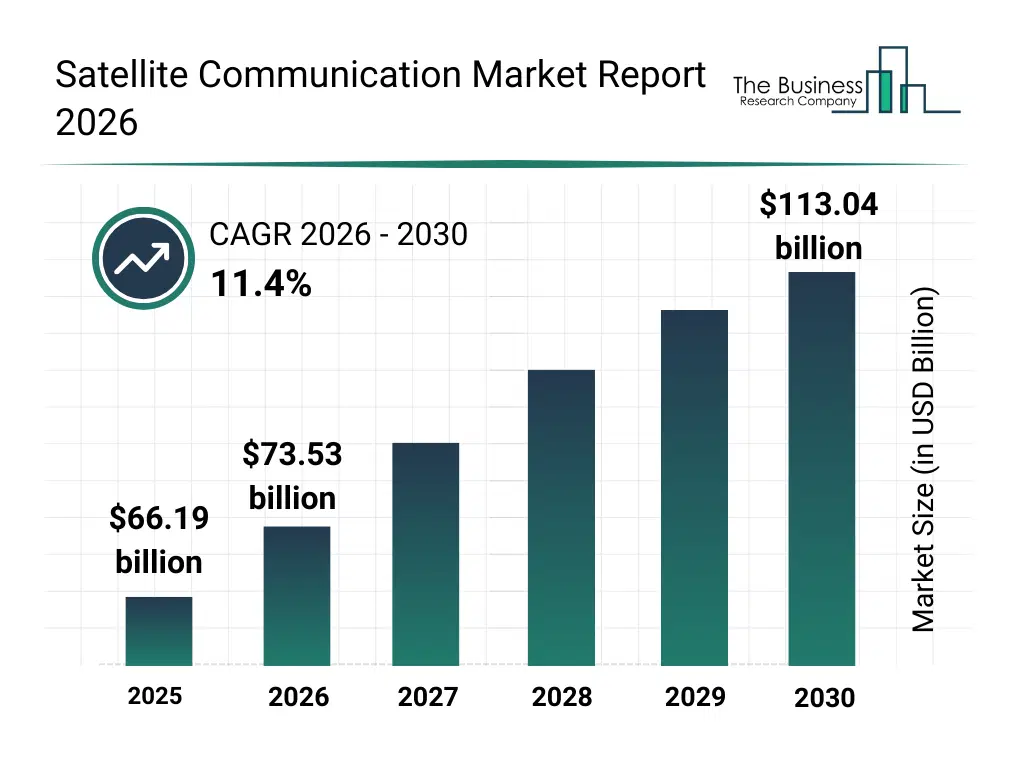
What Is The Satellite Communication Market Size and Share 2026?
The satellite communication market size has grown rapidly in recent years. It will grow from $66.19 billion in 2025 to $73.53 billion in 2026 at a compound annual growth rate (CAGR) of 11.1%. The growth in the historic period can be attributed to expansion of satellite infrastructure, rising government and defense satellite initiatives, increasing broadcasting and media requirements, growth in civil satellite communications, adoption of satellite navigation systems.What Is The Satellite Communication Market Growth Forecast?
The satellite communication market size is expected to see rapid growth in the next few years. It will grow to $113.04 billion in 2030 at a compound annual growth rate (CAGR) of 11.4%. The growth in the forecast period can be attributed to integration of ka/ku/c-band transponders, adoption of ai-enabled signal optimization, growth in commercial satcom applications, expansion of drone and iot connectivity via satellite, development of ip-based receivers and ground stations. Major trends in the forecast period include high-throughput satellite (hts) deployment, satcom on-the-move (sotm) integration, advanced vsat networks, tele-medicine and remote connectivity solutions, satellite-based asset tracking and monitoring.
Global Satellite Communication Market Segmentation
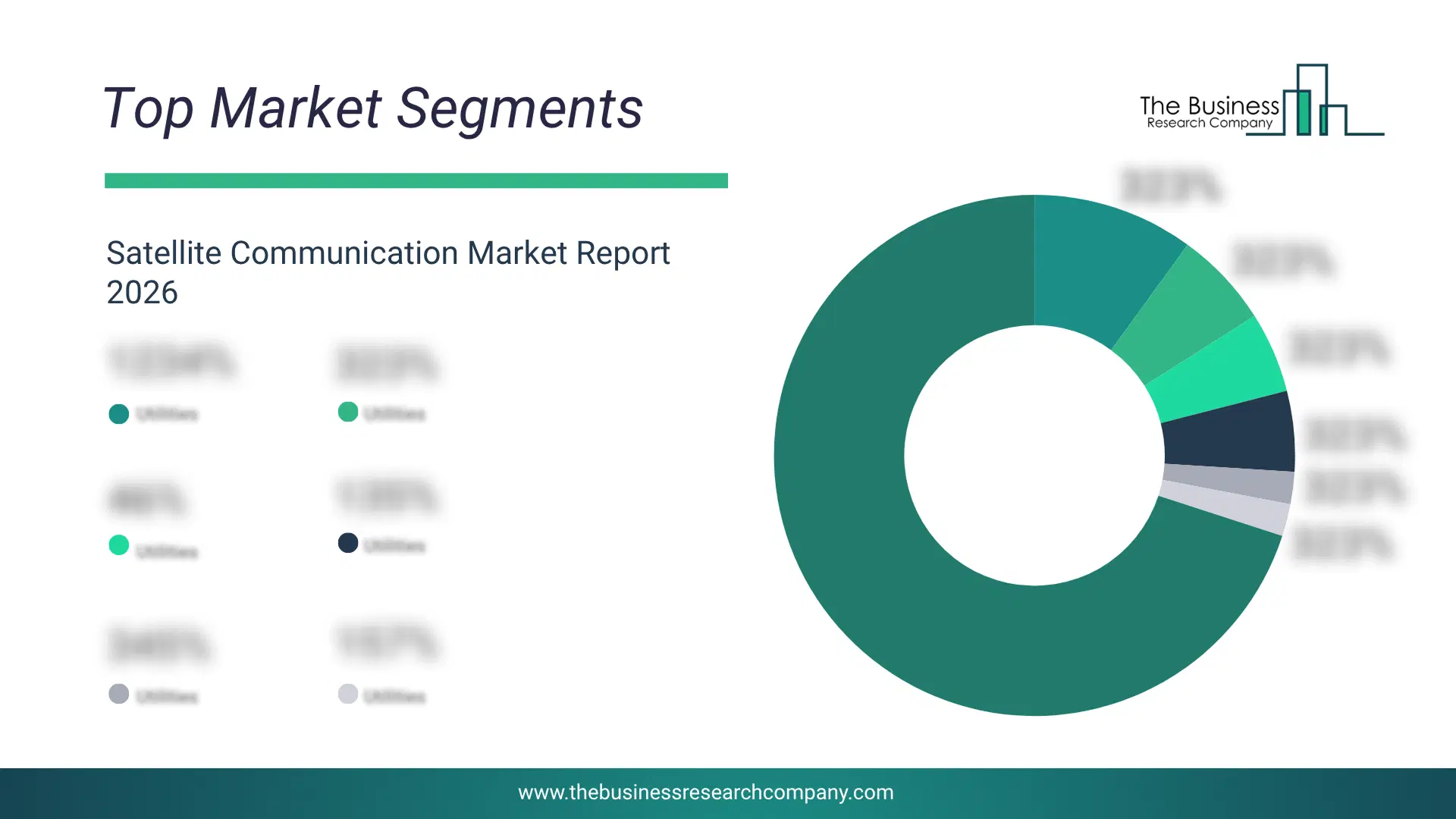
1) By Component: Transponder, Transceiver, Antenna, Receiver, Other Components 2) By Technology: SATCOM Automatic Identification System, SATCOM VSAT, SATCOM On-The-Move (SOTM), SATCOM On-The-Pause (SOTP), SATCOM Telemetry 3) By Application: Asset Tracking or Monitoring, Airtime, Data Backup and Recovery, Navigation and Monitoring, Broadcasting, Drones’ Connectivity, Tele-Medicine, Other Applications 4) By Vertical: Government and Military Applications, Civil Satellite Communications, Commercial Application, Other Verticals Subsegments: 1) By Transponder: C-band Transponders, Ku-band Transponders, Ka-band Transponders, Other Frequency Bands 2) By Transceiver: RF Transceivers, Optical Transceivers, Integrated Transceivers 3) By Antenna: Parabolic Antennas, Phased Array Antennas, Flat Panel Antennas, Other Antenna Types 4) By Receiver: Satellite Receivers, DVB-S Or S2 Receivers, IP-based Receivers 5) By Other Components: Modulators, Demodulators, Signal Processors, Ground Stations The top segments in the satellite communication market will be: • Transponder will reach $37.11 Billion by 2030. • Antenna will reach $30.41 Billion by 2030. • Transceiver will reach $23.46 Billion by 2030. • Receiver will reach $13.59 Billion by 2030. • Other Components will reach $8.02 Billion by 2030.What Is The Driver Of The Satellite Communication Market?
The increasing adoption of low Earth orbit satellites is expected to propel the growth of the satellite communication market going forward. Low Earth orbit (LEO) satellites are artificial satellites that orbit the Earth at altitudes between approximately 160 km and 2,000 km, enabling low-latency communication and imaging. The increasing adoption of low earth orbit (LEO) satellites is primarily driven by reduced launch costs, which make deploying large constellations of satellites more economically feasible. Satellite communication supports low Earth orbit satellites by enabling reliable, high-speed data transmission between ground stations, satellites, and end-users, ensuring seamless connectivity for applications such as broadband internet, remote sensing, and IoT networks. For instance, in October 2025, according to New America (organization), a US-based liberal think tank, In 2024, over 10,000 functioning satellites were in orbit, with Starlink accounting for about 60% of them. Therefore, the increasing adoption of low earth orbit satellites drives the growth of the satellite communication industry.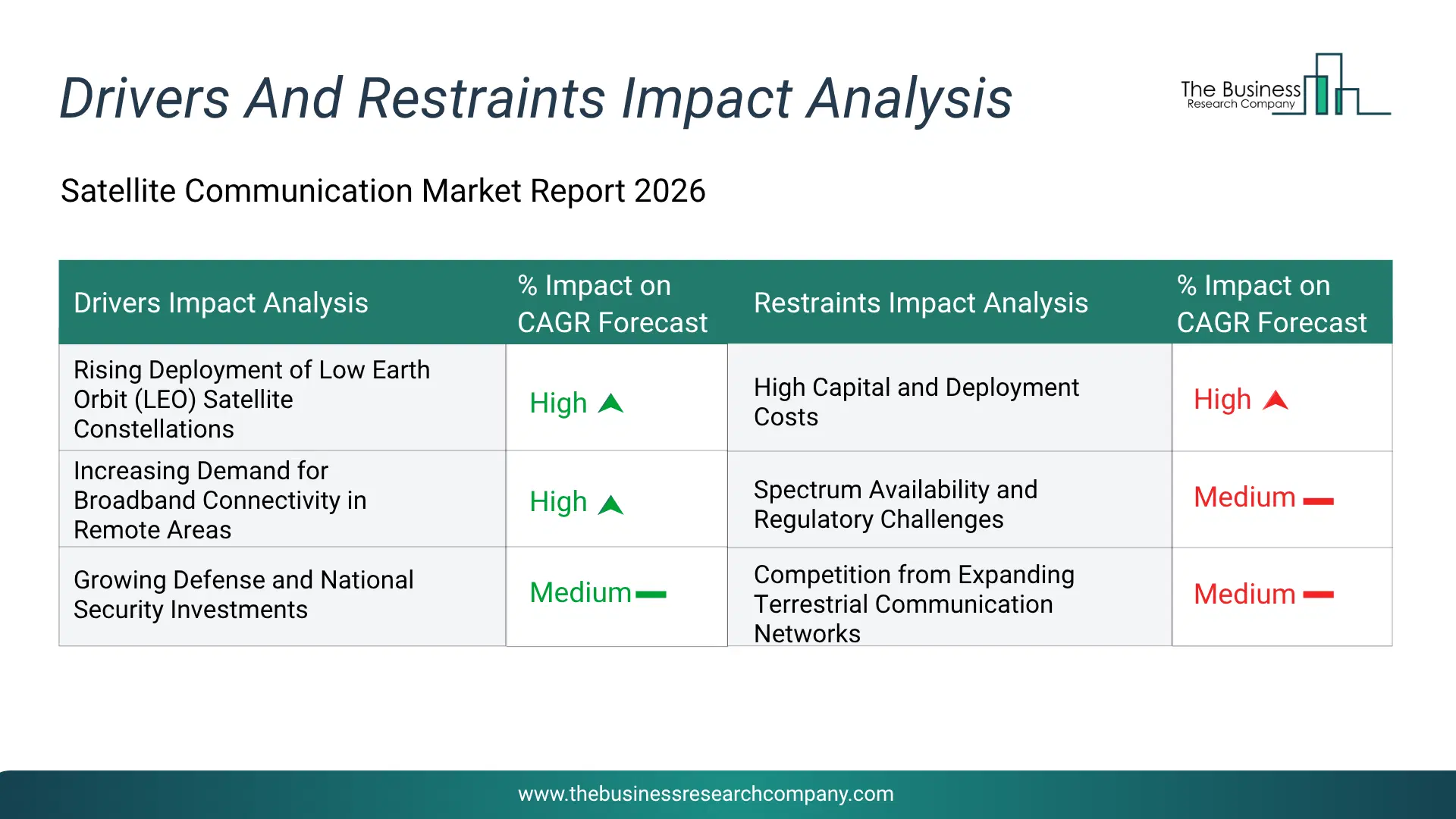
Infographic Chart Showing Key Market Drivers Analysis And Restraints For Satellite Communication Market
The chart presents an impact analysis of key drivers and restraints, quantifying their relative influence on the market's growth rate and helping assess the balance between growth enablers and limiting factors. This chart offers a high-level perspective; the full report contains more detailed insights.
How Will The Drivers Impact Growth In The Global Satellite Communication Market?
• Rising Deployment of Low Earth Orbit (LEO) Satellite Constellations (High) – During the forecast period, the rising deployment of low earth orbit (LEO) satellite constellations is expected to become a key growth driver for the satellite communication market by 2030. The rapid deployment of LEO satellite constellations by commercial operators is significantly increasing demand for satellite communication equipment and services. These constellations provide high-speed, low-latency connectivity for broadband, enterprise, and mobility applications. Growing investments in next-generation satellite networks are driving the adoption of advanced transponders, antennas, and ground infrastructure. The expansion of global internet coverage into underserved regions further accelerates market growth. Continuous satellite launches are expected to sustain long-term demand for communication systems. • Increasing Demand for Broadband Connectivity in Remote Areas (High) – During the forecast period, the increasing demand for broadband connectivity in remote areas is expected to emerge as a major factor driving the expansion of the satellite communication market by 2030. Governments and telecom operators are expanding satellite-based broadband services to connect rural and underserved populations where terrestrial networks remain economically unfeasible. Satellite communications enable reliable internet access for education, healthcare, emergency response, and digital government services. The growing need for universal connectivity is driving investments in satellite terminals and gateway infrastructure. Enterprises operating in remote mining, oil and gas, and energy locations also rely heavily on satellite networks. This broadens the commercial adoption of satellite communication technologies worldwide. • Growing Defense and National Security Investments (Medium) – During the forecast period, the growing defense and national security investments is expected to act as a key growth catalyst for the satellite communication market by 2030. Military organizations are increasingly investing in secure satellite communication systems to support command and control, intelligence gathering, surveillance, and tactical operations. Modern defense missions require resilient, encrypted, and uninterrupted communication across land, sea, air, and space domains. Governments are modernizing military satellite fleets and upgrading ground communication infrastructure. Rising geopolitical tensions are encouraging higher defense budgets dedicated to space-based communication capabilities. These investments continue to generate strong demand for advanced satellite communication components.How Will The Restraints Impact Growth In The Global Satellite Communication Market?
• High Capital and Deployment Costs (High) – During the forecast period, the satellite communication systems require substantial investments in satellite manufacturing, launch services, ground stations, user terminals, and ongoing maintenance. Developing and deploying communication satellites involves long project timelines and significant financial risk. Smaller operators often face barriers to market entry because of these high upfront costs. Infrastructure upgrades and satellite replacement cycles further increase operational expenditure. These factors can slow adoption, particularly in price-sensitive markets. • Spectrum Availability and Regulatory Challenges (High) – During the forecast period, the satellite communication depends on access to limited radio frequency spectrum that must be coordinated internationally. Obtaining regulatory approvals for satellite launches, orbital slots, and frequency allocations can be complex and time-consuming. Increasing competition among satellite operators and terrestrial wireless networks intensifies spectrum congestion. Regulatory differences across countries may delay network deployment and commercial expansion. Compliance costs also add to the operational burden for service providers. • Competition from Expanding Terrestrial Communication Networks (Medium) – During the forecast period, the continued expansion of fiber-optic infrastructure and advanced 5G mobile networks provides high-speed connectivity at competitive costs in densely populated regions. These terrestrial technologies often offer greater bandwidth and lower operating costs than satellite communications for urban applications. As fiber and wireless coverage expands, reliance on satellite connectivity decreases in accessible areas. Satellite services remain essential for remote and mobility applications but face increasing competition in mainstream broadband markets. This limits market growth opportunities in well-connected regions.Key Players In The Global Satellite Communication Market
Major companies operating in the satellite communication market are Thales Group; Honeywell International Inc; L3Harris Technologies Inc; Viasat Inc; Cobham Limited; Gilat Satellite Networks Ltd; Al Yah Satellite Communication Company PJSC; KVH Industries Inc; Iridium Communications Inc; Jio Satellite Communications Ltd; Hughes Communications India Ltd; China Satellite Communications Co Ltd; Telespazio SpA; Lockheed Martin Corporation; Raytheon; JSC Information Satellite Systems Reshetnev; Russian Satellite Communications Company; Telesat; Intelsat; General Dynamics; EchoStar; Spire; TerreStar Solutions Inc; Ciel Satellite Group; Andesat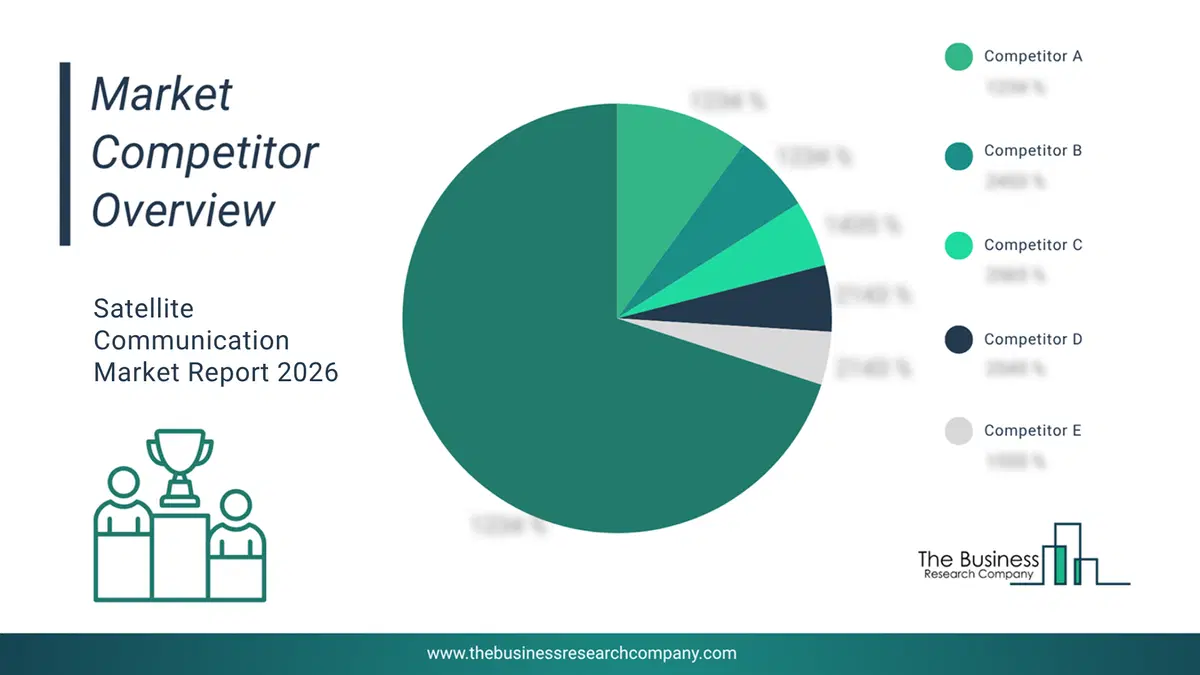
This chart is for illustrative purposes; the full report includes a detailed competitor analysis and comprehensive overview of the top 10 companies in the market.
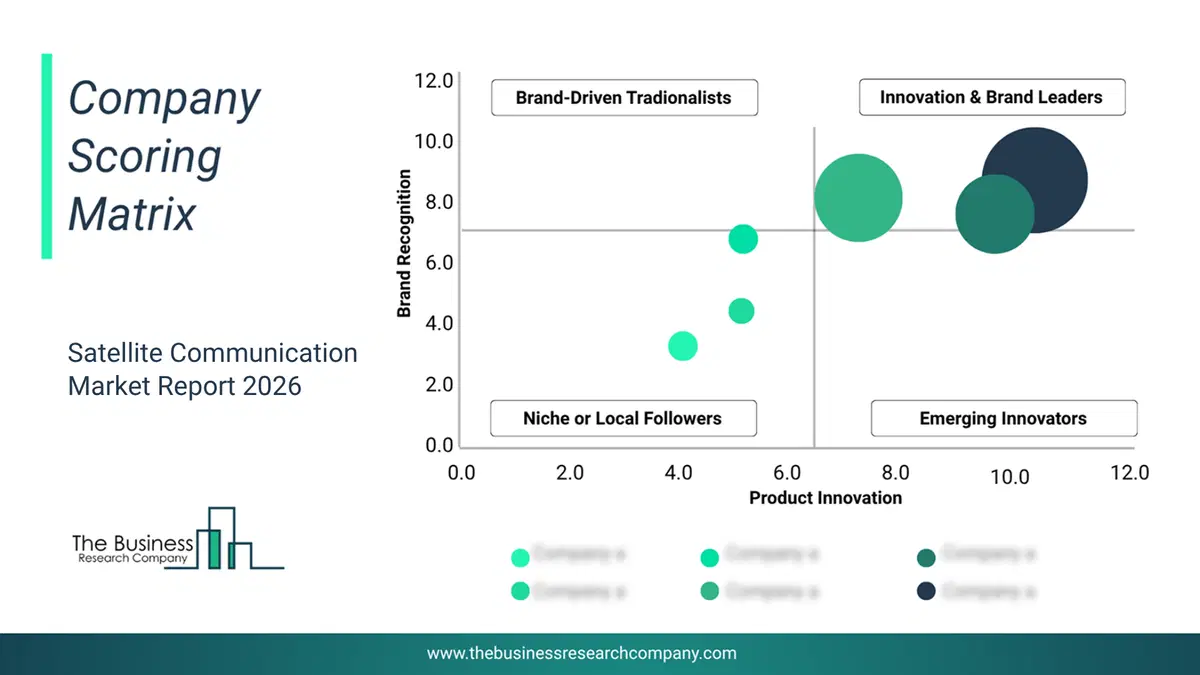
This chart maps companies by product innovation and brand strength, with bubble size indicating relative revenue, helping identify market leaders, challengers, and niche players. This is an illustrative chart; the full report provides a complete and accurate competitive analysis.
Global Satellite Communication Market Trends and Insights
Major companies in the satellite communication market are focusing on developing innovative solutions, such as the heaviest operational rocket, to enhance payload capacity and enable advanced satellite deployment. The heaviest operational rocket is a launch vehicle capable of carrying the largest payloads into orbit, supporting the deployment of heavy satellites and space infrastructure. For instance, in November 2025, the Indian Space Research Organisation, an India-based national space agency, launched CMS-03, also known as GSAT-7R, marking India’s heaviest indigenously built communication satellite to date, with a mass of approximately 4,400 kg. Designed and developed domestically, the satellite provides secure, multi-band communication including voice, data, and video across the Indian Ocean Region for the Indian Navy. Operating on UHF, S, C, and Ku frequency bands, it ensures continuous, encrypted connectivity among naval ships, submarines, aircraft, and maritime command centers, thereby strengthening maritime domain awareness and enabling real-time, network-centric operations. With an anticipated mission life of around 15 years, CMS-03 represents a major enhancement of India’s strategic defense autonomy, facilitating seamless command, control, and coordination across extensive naval operations.What Are Latest Mergers And Acquisitions In The Satellite Communication Market?
In August 2023, MDA Ltd., a Canada-based space technology company provider of advanced technology and services, acquired SatixFy Space Systems UK Ltd. for a US$40 million amount. With this acquisition, MDA Ltd. aims to enhance its technological capabilities, expand its market presence, and strengthen its competitive advantage in the aerospace and defense sectors. SatixFy Space Systems Ltd. is a UK-based manufacturer of advanced digital satellite payload systems and associated technologies.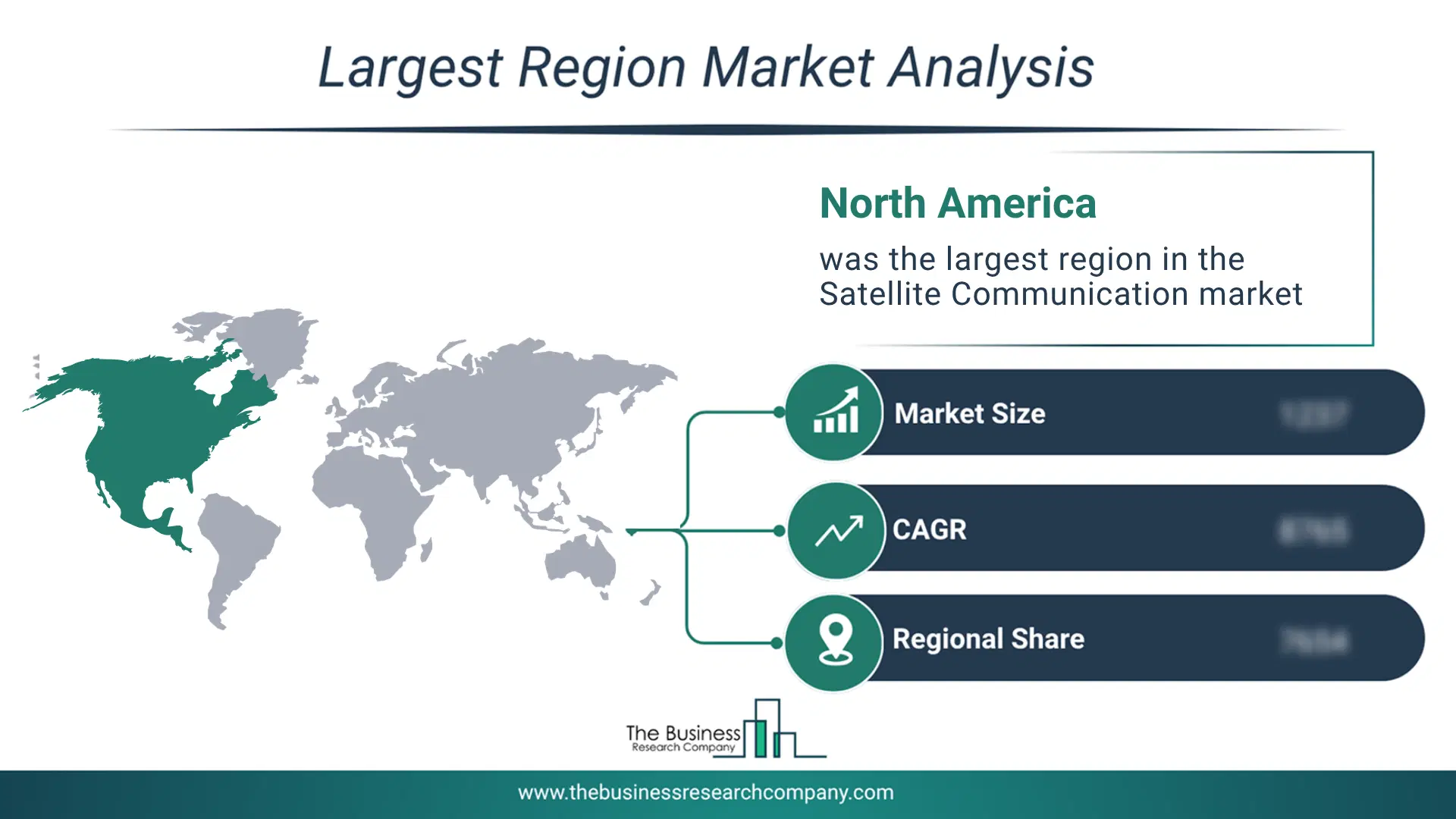
Regional Insights
North America was the largest region in the satellite communication market in 2025. Asia-Pacific is expected to be the fastest-growing region in the forecast period. The regions covered in this market report are Asia-Pacific, South East Asia, Western Europe, Eastern Europe, North America, South America, Middle East, Africa. The countries covered in this market report are Australia, Brazil, China, France, Germany, India, Indonesia, Japan, Taiwan, Russia, South Korea, UK, USA, Canada, Italy, SpainWhat Defines the Satellite Communication Market?
The satellite communications market includes revenues earned by entities by providing systems for transferring data between locations by employing a communication satellite circling the Earth. The market value includes the value of related goods sold by the service provider or included within the service offering. Only goods and services traded between entities or sold to end consumers are included.How is Market Value Defined and Measured?
The market value is defined as the revenues that enterprises gain from the sale of goods and/or services within the specified market and geography through sales, grants, or donations in terms of the currency (in USD unless otherwise specified). The revenues for a specified geography are consumption values that are revenues generated by organizations in the specified geography within the market, irrespective of where they are produced. It does not include revenues from resales along the supply chain, either further along the supply chain or as part of other products.
This chart presents market attractiveness based on a quantitative evaluation of growth, competition, strategic alignment, and risk, offering a clear view of opportunity areas for decision-making. This chart is for illustrative purposes; the full report contains the complete analysis.

This chart highlights the Total Addressable Market (TAM) by estimating the maximum revenue opportunity using an assumption-driven approach, supporting strategic planning and opportunity sizing across markets. The chart is illustrative; the full report provides a more comprehensive analysis.
What Key Data and Analysis Are Included in the Satellite Communication Market Report 2026?
The satellite communication market research report is one of a series of new reports from The Business Research Company that provides market statistics, including industry global market size, regional shares, competitors with the market share, detailed market segments, market trends and opportunities, and any further data you may need to thrive in the satellite communication industry. The market research report delivers a complete perspective of everything you need, with an in-depth analysis of the current and future state of the industry.Satellite Communication Market Report Forecast Analysis
| Report Attribute | Details |
|---|---|
| Market Size Value In 2026 | $73.53 billion |
| Revenue Forecast In 2030 | $113.04 billion |
| Growth Rate | CAGR of 11.1% from 2026 to 2030 |
| Base Year For Estimation | 2025 |
| Actual Estimates/Historical Data | 2020-2025 |
| Forecast Period | 2026 - 2030 |
| Market Representation | Revenue in USD Billion and CAGR from 2026 to 2030 |
| Segments Covered | Component, Technology, Application, Vertical |
| Regional Scope | Asia-Pacific, Western Europe, Eastern Europe, North America, South America, Middle East, Africa |
| Country Scope | The countries covered in the report are Australia, Brazil, China, France, Germany, India, ... |
| Key Companies Profiled | Thales Group; Honeywell International Inc; L3Harris Technologies Inc; Viasat Inc; Cobham Limited; Gilat Satellite Networks Ltd; Al Yah Satellite Communication Company PJSC; KVH Industries Inc; Iridium Communications Inc; Jio Satellite Communications Ltd; Hughes Communications India Ltd; China Satellite Communications Co Ltd; Telespazio SpA; Lockheed Martin Corporation; Raytheon; JSC Information Satellite Systems Reshetnev; Russian Satellite Communications Company; Telesat; Intelsat; General Dynamics; EchoStar; Spire; TerreStar Solutions Inc; Ciel Satellite Group; Andesat |
| Customization Scope | Request for Customization |
| Pricing And Purchase Options | Explore Purchase Options |