
Satellite Communication (SATCOM) Network Policy Control Market Report 2026
Global Outlook – By Component (Software, Hardware, Services), By Network Type (Geostationary Earth Orbit (GEO), Medium Earth Orbit (MEO), Low Earth Orbit (LEO), Hybrid), By Deployment Mode (On-Premises, Cloud), By Application (Commercial, Defence, Government, Maritime, Aviation, Other Applications), By End-Users (Telecommunications, Media And Entertainment, Transportation, Energy And Utilities, Other End Users) – Market Size, Trends, Strategies, and Forecast to 2035
Satellite Communication (SATCOM) Network Policy Control Market Overview
• Satellite Communication (SATCOM) Network Policy Control market size has reached to $2.73 billion in 2025 • Expected to grow to $5.15 billion in 2030 at a compound annual growth rate (CAGR) of 13.5% • Growth Driver: Surge In Reliance On Satellite Communications Fueling The Growth Of The Market Due To The Need For Reliable, Ubiquitous, And Efficient Management Of Expanding Satellite Connectivity • Market Trend: Automated Network Management Enables Efficient Traffic Routing and Data Prioritization • North America was the largest region in 2025 and Asia-Pacific is the fastest growing region.What Is Covered Under Satellite Communication (SATCOM) Network Policy Control Market?
Satellite communication (SATCOM) network policy control refers to a centralized system that manages and enforces operational, security, and quality-of-service rules across satellite communication networks. It defines how satellite bandwidth, traffic prioritization, access rights, and network resources are allocated and monitored. The system enables real-time policy enforcement across satellites, gateways, and user terminals. It helps to ensure efficient, secure, and reliable use of satellite network resources while meeting service-level and regulatory requirements. The main components of satellite communication network policy control include software, hardware, and services. Software refers to programs that manage, monitor, and enforce policies across satellite networks, while hardware and services support connectivity, operations, and maintenance. These solutions operate over various network types, including geostationary earth orbit, medium earth orbit, low earth orbit, and hybrid networks, and can be deployed on-premises or via cloud platforms. The multiple applications involved are commercial, defence, government, maritime, aviation, and other use cases. These solutions are used by several end users such as telecommunications companies, media and entertainment organizations, transportation providers, energy and utilities companies, and other end users.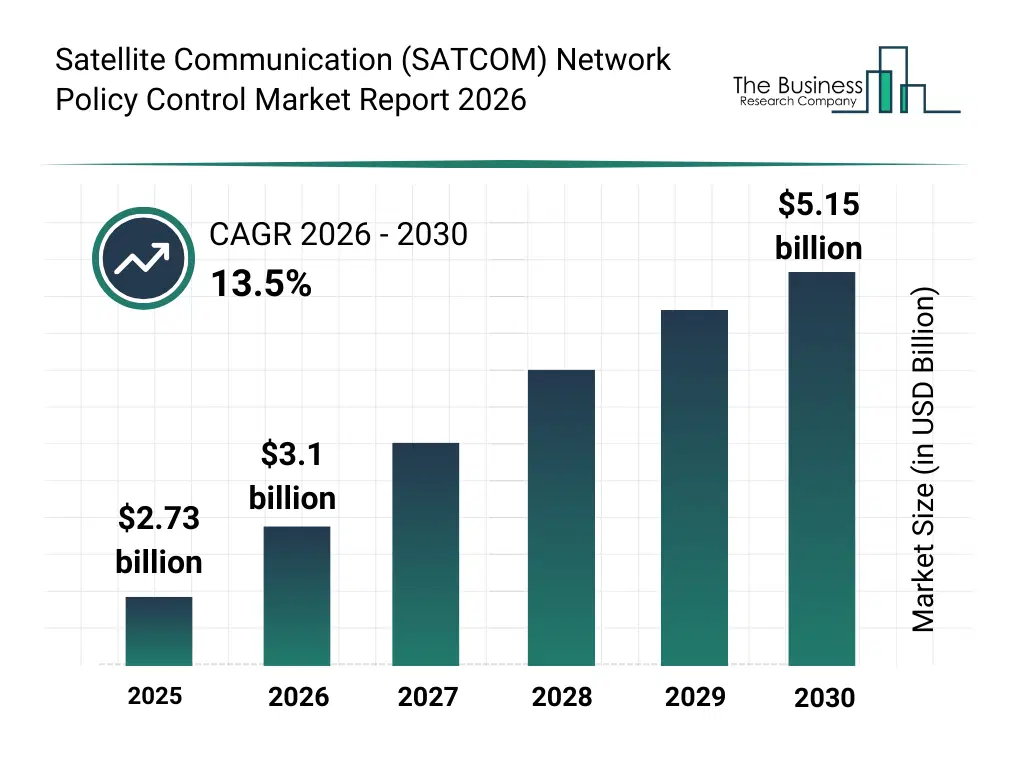
What Is The Satellite Communication (SATCOM) Network Policy Control Market Size and Share 2026?
The satellite communication (satcom) network policy control market size has grown rapidly in recent years. It will grow from $2.73 billion in 2025 to $3.1 billion in 2026 at a compound annual growth rate (CAGR) of 13.3%. The growth in the historic period can be attributed to expansion of satellite broadband services, rise in defense and government satellite communication projects, increasing maritime and aviation connectivity demand, growth in satellite ground infrastructure deployment, early adoption of geostationary satellite networks.What Is The Satellite Communication (SATCOM) Network Policy Control Market Growth Forecast?
The satellite communication (satcom) network policy control market size is expected to see rapid growth in the next few years. It will grow to $5.15 billion in 2030 at a compound annual growth rate (CAGR) of 13.5%. The growth in the forecast period can be attributed to growing low earth orbit satellite constellations, rising demand for secure satellite communications, expansion of global broadband coverage initiatives, increasing integration of artificial intelligence based network management, growth in cross border satellite service regulations. Major trends in the forecast period include rising adoption of real time satellite traffic management platforms, growing integration of advanced network security and access control modules, expansion of multi orbit and hybrid satellite network policies, increasing deployment of automated bandwidth allocation systems, enhancement of predictive network analytics and monitoring capabilities.
Global Satellite Communication (SATCOM) Network Policy Control Market Segmentation
1) By Component: Software, Hardware, Services 2) By Network Type: Geostationary Earth Orbit (GEO), Medium Earth Orbit (MEO), Low Earth Orbit (LEO), Hybrid 3) By Deployment Mode: On-Premises, Cloud 4) By Application: Commercial, Defence, Government, Maritime, Aviation, Other Applications 5) By End-Users: Telecommunications, Media And Entertainment, Transportation, Energy And Utilities, Other End Users Subsegments: 1) By Software: Policy Management Software, Network Orchestration Software, Analytics And Monitoring Software, Security And Access Control Software 2) By Hardware: Network Controller Device, Signal Amplifier Device, Switching Module Device, Transceiver Unit Device 3) By Services: Integration Services, Consulting Services, Managed Services, Maintenance ServicesWhat Is The Driver Of The Satellite Communication (SATCOM) Network Policy Control Market?
The increasing reliance on satellite communications is expected to propel the growth of the Satcom network policy control market going forward. Satellite communications refers to the transmission of voice, data, and video signals between Earth-based stations and satellites to enable long-distance and global connectivity. The increasing reliance on satellite communications is driven by the need for ubiquitous and reliable connectivity, as satellites enable seamless communication across remote, rural, maritime, and airborne environments where terrestrial networks are limited or unavailable. Satcom network policy control helps satellite communications by dynamically managing bandwidth, prioritizing traffic, and enforcing service policies to ensure reliable, secure, and optimized connectivity across diverse satellite networks and user applications. For instance, in May 2025, according to the Satellite Industry Association, a US-based trade association, a record 259 launches placed 2,172 tons and 2,695 satellites into orbit, as the global space economy grew by 4%, with commercial satellites representing 71% of total activity. Therefore, the increasing reliance on satellite communications is driving the growth of the Satcom network policy control market.Key Players In The Global Satellite Communication (SATCOM) Network Policy Control Market
Major companies operating in the satellite communication (satcom) network policy control market are Airbus SE, EchoStar Corporation, Thales Group, L3Harris Technologies Inc., Viasat Inc., SES S.A., Eutelsat Communications S.A., Comtech Telecommunications Corp., ST Engineering iDirect Inc., Telesat Inc., Hughes Network Systems LLC, Speedcast International Ltd., Astranis Space Technologies Corp., Saankhya Labs Private Limited, ReOrbit Oy, Comsat Systems Private Limited, Skylo Technologies Inc., AST SpaceMobile Inc., Cobham SATCOM Ltd., Kratos Defense & Security Solutions Inc., Gilat Satellite Networks Ltd., and Kacific Broadband Satellites Group Ltd.Global Satellite Communication (SATCOM) Network Policy Control Market Trends and Insights
Major companies operating in the Satcom network policy control market are focusing on enhancing network policy control capabilities to help vessel operators manage connectivity costs, optimize bandwidth allocation, and maintain service continuity amid evolving satellite pricing structures. Network policy control refers to software-driven mechanisms that allow operators to prioritize traffic, enforce usage policies, and dynamically route data across multiple satellite networks based on cost, performance, or application requirements. For instance, in March 2025, IEC Telecom, a France-based satellite communications company, unveiled an advanced network management capability designed to support maritime operators ahead of upcoming pricing changes from Starlink. The solution enables intelligent traffic steering, real-time usage monitoring, and policy-based control across hybrid satellite networks, allowing vessel operators to balance performance and cost efficiency while ensuring uninterrupted connectivity for critical onboard applications.What Are Latest Mergers And Acquisitions In The Satellite Communication (SATCOM) Network Policy Control Market?
In July 2025, SES S.A., a Luxembourg-based satellite communications company, acquired Intelsat S.A. for $3.1 billion (€2.8 billion). Through this acquisition, SES aims to enhance its satellite communications network capabilities, including integrated multi-orbit (GEO, MEO, and strategic access to LEO) and multi-band connectivity solutions that improve how network resources are controlled, allocated, and delivered across its expanded infrastructure to commercial and government customers worldwide. Intelsat S.A. is a US-based communications satellite services provider whose network assets contribute to satcom connectivity platform.Regional Outlook
North America was the largest region in the satcom network policy control market in 2025. Asia-Pacific is expected to be the fastest-growing region in the forecast period. The regions covered in this market report are Asia-Pacific, South East Asia, Western Europe, Eastern Europe, North America, South America, Middle East, Africa. The countries covered in this market report are Australia, Brazil, China, France, Germany, India, Indonesia, Japan, Taiwan, Russia, South Korea, UK, USA, Canada, Italy, Spain.What Defines the Satellite Communication (SATCOM) Network Policy Control Market?
The satellite communication (SATCOM) network policy control market consists of revenues earned by entities by providing services such as network policy management, traffic prioritization and quality-of-service enforcement, bandwidth allocation and optimization, network monitoring and analytics, and security and access control management. The market value includes the value of related goods sold by the service provider or included within the service offering. The satellite communication (SATCOM) network policy control market also includes sales of policy control software platforms, network orchestration tools, traffic management systems, analytics and monitoring solutions, and security enforcement modules. Values in this market are ‘factory gate’ values, that is, the value of goods sold by the manufacturers or creators of the goods, whether to other entities (including downstream manufacturers, wholesalers, distributors, and retailers) or directly to end customers. The value of goods in this market includes related services sold by the creators of the goods.How is Market Value Defined and Measured?
The market value is defined as the revenues that enterprises gain from the sale of goods and/or services within the specified market and geography through sales, grants, or donations in terms of the currency (in USD unless otherwise specified). The revenues for a specified geography are consumption values that are revenues generated by organizations in the specified geography within the market, irrespective of where they are produced. It does not include revenues from resales along the supply chain, either further along the supply chain or as part of other products.What Key Data and Analysis Are Included in the Satellite Communication (SATCOM) Network Policy Control Market Report 2026?
The satellite communication (satcom) network policy control market research report is one of a series of new reports from The Business Research Company that provides market statistics, including industry global market size, regional shares, competitors with the market share, detailed market segments, market trends and opportunities, and any further data you may need to thrive in the satellite communication (satcom) network policy control industry. The market research report delivers a complete perspective of everything you need, with an in-depth analysis of the current and future state of the industry.Satellite Communication (SATCOM) Network Policy Control Market Report Forecast Analysis
| Report Attribute | Details |
|---|---|
| Market Size Value In 2026 | $3.1 billion |
| Revenue Forecast In 2035 | $5.15 billion |
| Growth Rate | CAGR of 13.3% from 2026 to 2035 |
| Base Year For Estimation | 2025 |
| Actual Estimates/Historical Data | 2020-2025 |
| Forecast Period | 2026 - 2030 - 2035 |
| Market Representation | Revenue in USD Billion and CAGR from 2026 to 2035 |
| Segments Covered | Component, Network Type, Deployment Mode, Application, End-Users |
| Regional Scope | Asia-Pacific, Western Europe, Eastern Europe, North America, South America, Middle East, Africa |
| Country Scope | The countries covered in the report are Australia, Brazil, China, France, Germany, India, ... |
| Key Companies Profiled | Airbus SE, EchoStar Corporation, Thales Group, L3Harris Technologies Inc., Viasat Inc., SES S.A., Eutelsat Communications S.A., Comtech Telecommunications Corp., ST Engineering iDirect Inc., Telesat Inc., Hughes Network Systems LLC, Speedcast International Ltd., Astranis Space Technologies Corp., Saankhya Labs Private Limited, ReOrbit Oy, Comsat Systems Private Limited, Skylo Technologies Inc., AST SpaceMobile Inc., Cobham SATCOM Ltd., Kratos Defense & Security Solutions Inc., Gilat Satellite Networks Ltd., and Kacific Broadband Satellites Group Ltd. |
| Customization Scope | Request for Customization |
| Pricing And Purchase Options | Explore Purchase Options |