
Satellite Component Market Report 2026
Global Outlook – By Component (Antennas, Power Systems, Propulsion Systems, Transponders, Other Components), By Satellite Type (Small Satellite, Medium Satellite, Large Satellite), By Orbits (Geostationary Orbit, Low Earth Orbit, Medium Earth Orbit, Polar Orbit), By Application (Communication, Earth Observation, Technology Development, Navigation, Space Science, Other Applications), By End Use (Commercial, Government And Military, Scientific And Research Institutions) – Market Size, Trends, Strategies, and Forecast to 2030
Satellite Component Market Overview
• Satellite Component market size has reached to $2.97 billion in 2025 • Expected to grow to $4.19 billion in 2030 at a compound annual growth rate (CAGR) of 7.1% • Growth Driver: Rising Demand For 5G And IoT Connectivity Driving Market Growth Due To Expanding Need For High-Speed, Low-Latency Networks • Market Trend: Advancing Flexible And Scalable Solutions For Space Missions • North America was the largest region in 2025 and Asia-Pacific is the fastest growing region.What Is Covered Under Satellite Component Market?
A satellite component refers to any part or subsystem used in a satellite's construction, operation, or functioning. These components are designed to withstand the harsh conditions of space and operate for a long time, which plays a specific role in ensuring the satellite operates effectively in space, such as power generation, communication, data collection, or navigation. Satellite components work together to provide the satellite with the ability to perform tasks such as sending signals, taking pictures, or monitoring the weather. The main components of a satellite component are antennas, power systems, propulsion systems, transponders, and others. The antennas are devices that transmit and receive signals for communication, navigation, and data transmission in satellite systems. The various satellites involved are small, medium, and large, and they revolve around geostationary, low earth, medium earth, and polar orbit. The various applications involved are communication, earth observation, technology development, navigation, space science, and others by commercial, government and military, scientific, and research institutions.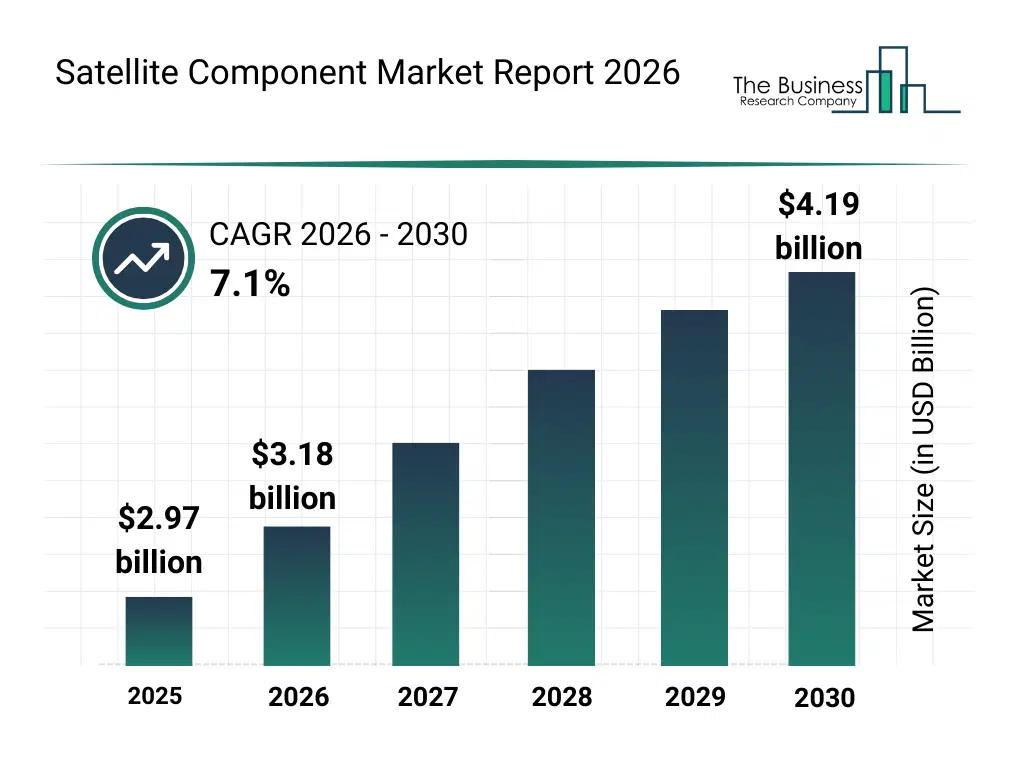
What Is The Satellite Component Market Size and Share 2026?
The satellite component market size has grown strongly in recent years. It will grow from $2.97 billion in 2025 to $3.18 billion in 2026 at a compound annual growth rate (CAGR) of 7.1%. The growth in the historic period can be attributed to increasing global demand for communication and earth observation satellites, advancements in solar panel and battery technologies for space applications, growing adoption of high-precision sensors and onboard computers, rising investments in satellite manufacturing and deployment, expansion of satellite constellations for navigation and data services.What Is The Satellite Component Market Growth Forecast?
The satellite component market size is expected to see strong growth in the next few years. It will grow to $4.19 billion in 2030 at a compound annual growth rate (CAGR) of 7.1%. The growth in the forecast period can be attributed to development of miniaturized and high-efficiency satellite components, increasing adoption of AI-enabled onboard systems for autonomous operations, growth in reusable satellite platforms and modular components, rising demand from emerging markets for space-based communication and monitoring, integration of advanced materials for durability and extended satellite lifespan. Major trends in the forecast period include increasing demand for lightweight and compact satellite components, rising adoption of modular satellite architectures for faster assembly, growing use of radiation-hardened materials to improve component durability, higher production of small satellites driving component standardization, expansion of satellite-based communication, imaging, and navigation missions.
Global Satellite Component Market Segmentation
1) By Component: Antennas, Power Systems, Propulsion Systems, Transponders, Other Components 2) By Satellite Type: Small Satellite, Medium Satellite, Large Satellite 3) By Orbits: Geostationary Orbit, Low Earth Orbit, Medium Earth Orbit, Polar Orbit 4) By Application: Communication, Earth Observation, Technology Development, Navigation, Space Science, Other Applications 5) By End Use: Commercial, Government And Military, Scientific And Research Institutions Subsegments: 1) By Antennas: Parabolic Antennas, Phased Array Antennas, Reflector Antennas, Flat Panel Antennas 2) By Power Systems: Solar Panels, Battery Systems, Power Distribution Units, Power Conversion Units 3) By Propulsion Systems: Chemical Propulsion Systems, Electric Propulsion Systems, Hybrid Propulsion Systems, Ions and Hall Effect Thrusters 4) By Transponders: C-band Transponders, Ku-band Transponders, Ka-band Transponders, L-band Transponders 5) By Other Components: Thermal Systems, Structural Systems, Communication Systems, On-board Data Handling SystemsWhat Is Driver Of The Satellite Component Market?
The rising demand for 5G and internet of things connectivity is expected to drive the growth of the satellite component market going forward. 5G and the internet of things refer to the fast wireless network that connects smart devices, allowing them to share data instantly. They help everyday gadgets, machines, and systems work together more efficiently and smoothly. The demand for 5G and internet of things connectivity is due to increasing data consumption and the need for faster internet speeds to support high-bandwidth applications such as streaming, gaming, and cloud computing are pushing the demand for 5G. Further, the growing adoption of smart devices in homes, cities, and industries is fueling the need for IoT, as these devices rely on seamless, low-latency communication for efficient operation. As demand for global 5G and IoT coverage grows, satellites will play a critical role in extending connectivity beyond traditional terrestrial infrastructure, boosting the need for satellite components. For instance, in September 2024, according to the IoT Business News, a France-based independent online media platform, the total number of connected IoT devices is expected to grow by 13%, from 18.8 billion in 2024 to 40 billion by 2030. Therefore, the rising demand for 5G and Internet of Things connectivity is driving the growth of the satellite component industry.Key Players In The Global Satellite Component Market
Major companies operating in the satellite component market are RTX Corporation, Lockheed Martin Corporation, General Dynamics Corporation, Mitsubishi Electric Corporation, Northrop Grumman Corporation, Honeywell International Inc., BAE Systems plc, Boeing Defense Space & Security, Thales Group, L3Harris Technologies Inc., IHI Corporation, Teledyne Technologies Incorporated, Space Exploration Technologies Corp. (SpaceX), Leonardo S.p.A., QinetiQ Group plc, Maxar Technologies Inc., Airbus Defence and Space, Sierra Nevada Corporation, OHB SE, Cobham Limited, JONSA TECHNOLOGIES CO. LTD., Sat-Lite Technologies LLC, Challenger Communications LLC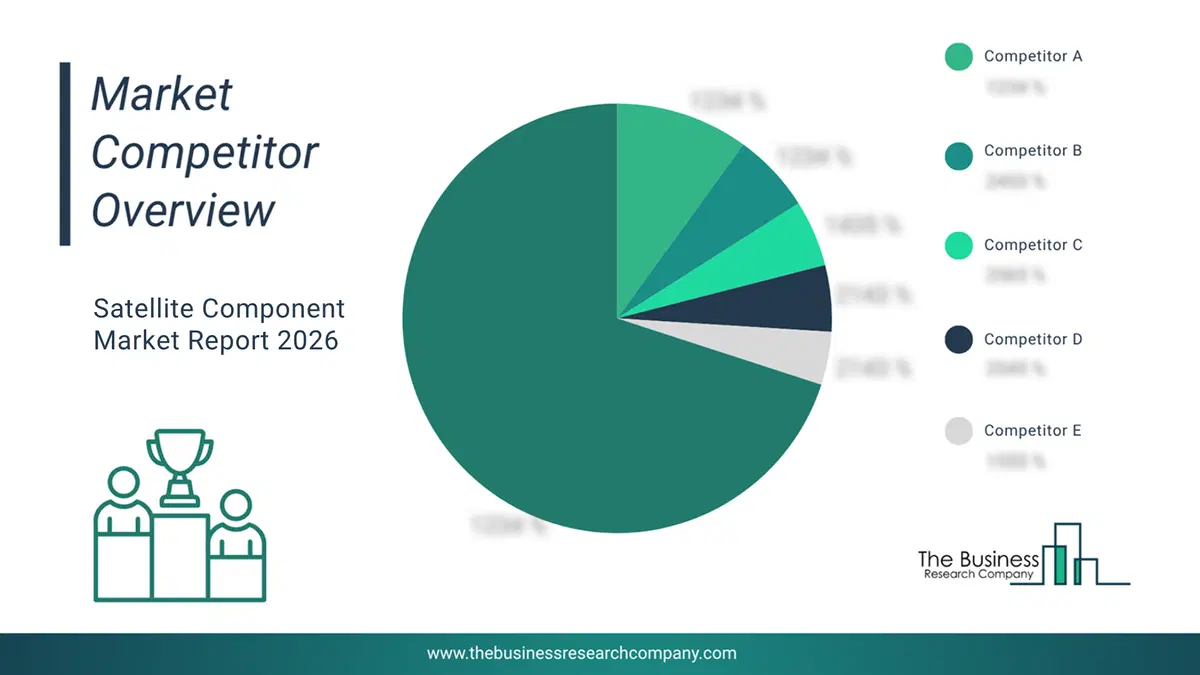
This chart is for illustrative purposes; the full report includes a detailed competitor analysis and comprehensive overview of the top 10 companies in the market.
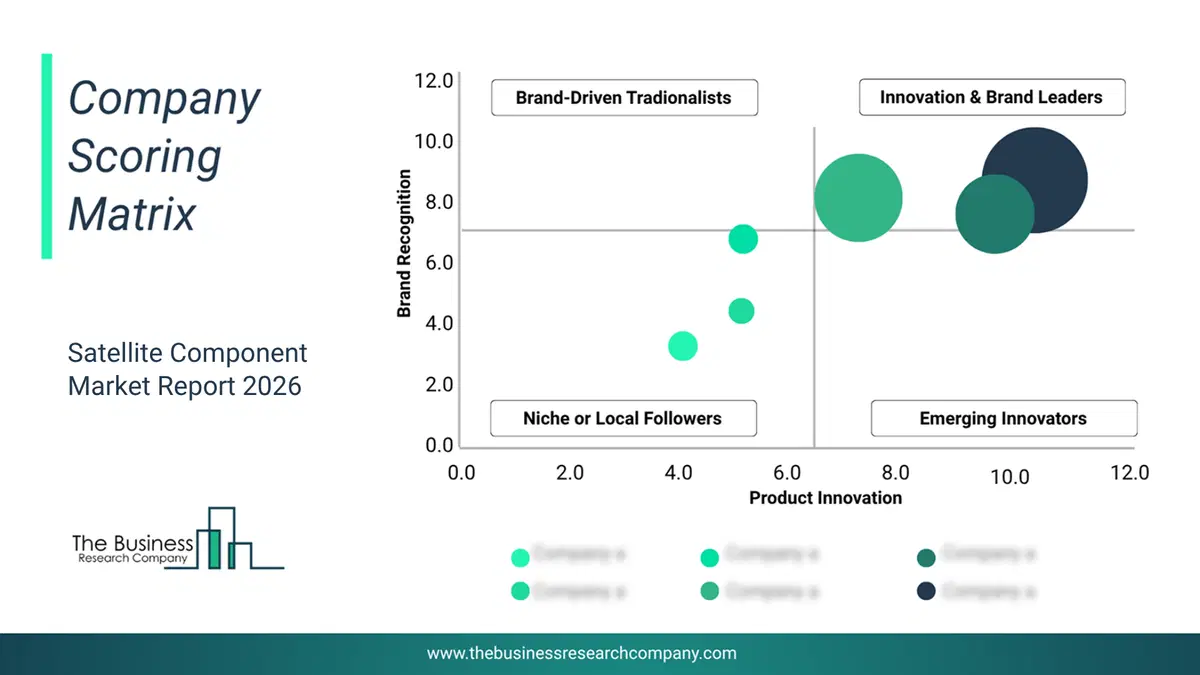
This chart maps companies by product innovation and brand strength, with bubble size indicating relative revenue, helping identify market leaders, challengers, and niche players. This is an illustrative chart; the full report provides a complete and accurate competitive analysis.
Global Satellite Component Market Trends and Insights
Major companies operating in the satellite component market are focusing on developing innovative products, such as satellite buses, to enhance satellite performance, reduce costs, improve payload capacity, and enable faster deployment. A satellite bus is the core structure of a satellite that houses and supports the various subsidiary components (such as power systems, propulsion, thermal control, and communication systems). It provides the framework and infrastructure necessary for the satellite's operations and ensures the payload (such as sensors or communication equipment) can function effectively. For instance, in September 2024, Apex Space Systems, a US-based private aerospace and satellite manufacturing company, launched the Nova satellite bus to offer a flexible and scalable platform for various space missions. The base version of Nova weighs 250 kilograms. It is built to carry up to 300 kilograms of payloads, making it suitable for various applications, including Earth observation, scientific research, and technology demonstrations. For missions requiring greater capacity, Apex has developed a heavy version of Nova, which weighs 400 kilograms and can support up to 500 kilograms of payloads.What Are Latest Mergers And Acquisitions In The Satellite Component Market? ETL Systems Limited Acquires IRT Technologies Inc. To Strengthen Satellite Communication Capabilities
In February 2025, ETL Systems Limited, a UK-based manufacturing company specializing in radio frequency distribution and satellite communication equipment, acquired IRT Technologies Inc. for an undisclosed amount. This acquisition aims to expand ETL Systems Limited's satellite communication portfolio, enhance its RF and microwave product offerings, and strengthen ETL Systems Limited's presence in North America. IRT Technologies Inc. is a Canada-based manufacturing company that provides advanced satellite communication equipment.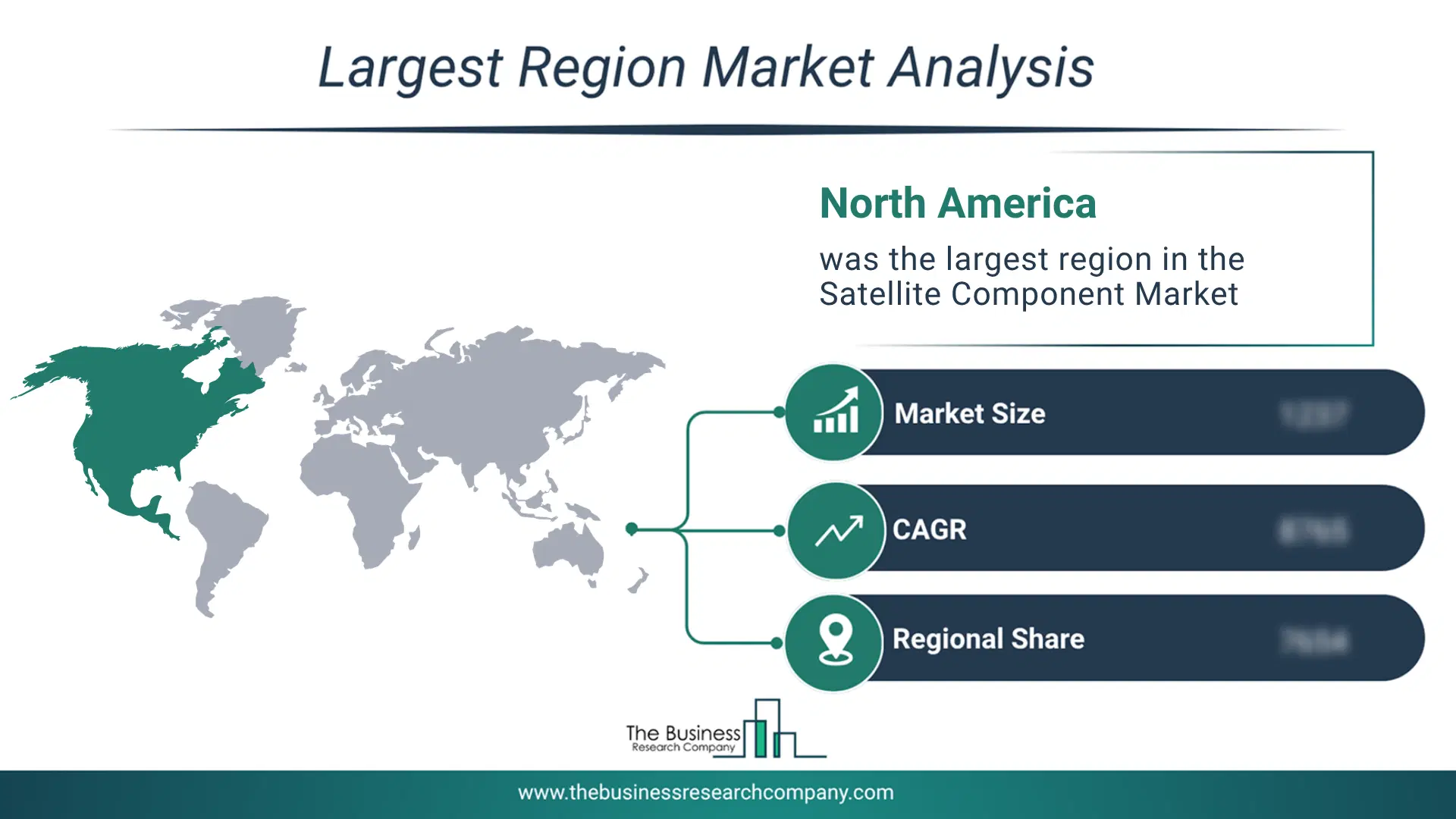
Regional Insights
North America was the largest region in the satellite component market in 2025. Asia-Pacific is expected to be the fastest-growing region in the forecast period. The regions covered in this market report are Asia-Pacific, South East Asia, Western Europe, Eastern Europe, North America, South America, Middle East, Africa. The countries covered in this market report are Australia, Brazil, China, France, Germany, India, Indonesia, Japan, Taiwan, Russia, South Korea, UK, USA, Canada, Italy, SpainWhat Defines the Satellite Component Market?
The satellite component market consists of sales of solar panels, sensors, structural frames, batteries, and onboard computers. Values in this market are ‘factory gate’ values, that is the value of goods sold by the manufacturers or creators of the goods, whether to other entities (including downstream manufacturers, wholesalers, distributors and retailers) or directly to end customers. The value of goods in this market includes related services sold by the creators of the goods.How is Market Value Defined and Measured?
The market value is defined as the revenues that enterprises gain from the sale of goods and/or services within the specified market and geography through sales, grants, or donations in terms of the currency (in USD unless otherwise specified). The revenues for a specified geography are consumption values that are revenues generated by organizations in the specified geography within the market, irrespective of where they are produced. It does not include revenues from resales along the supply chain, either further along the supply chain or as part of other products.
This chart presents market attractiveness based on a quantitative evaluation of growth, competition, strategic alignment, and risk, offering a clear view of opportunity areas for decision-making. This chart is for illustrative purposes; the full report contains the complete analysis.

This chart highlights the Total Addressable Market (TAM) by estimating the maximum revenue opportunity using an assumption-driven approach, supporting strategic planning and opportunity sizing across markets. The chart is illustrative; the full report provides a more comprehensive analysis.
What Key Data and Analysis Are Included in the Satellite Component Market Report 2026?
The satellite component market research report is one of a series of new reports from The Business Research Company that provides market statistics, including industry global market size, regional shares, competitors with the market share, detailed market segments, market trends and opportunities, and any further data you may need to thrive in the satellite component industry. The market research report delivers a complete perspective of everything you need, with an in-depth analysis of the current and future state of the industry.Satellite Component Market Report Forecast Analysis
| Report Attribute | Details |
|---|---|
| Market Size Value In 2026 | $3.18 billion |
| Revenue Forecast In 2030 | $4.19 billion |
| Growth Rate | CAGR of 7.1% from 2026 to 2030 |
| Base Year For Estimation | 2025 |
| Actual Estimates/Historical Data | 2020-2025 |
| Forecast Period | 2026 - 2030 |
| Market Representation | Revenue in USD Billion and CAGR from 2026 to 2030 |
| Segments Covered | Component, Satellite Type, Orbits, Application, End Use |
| Regional Scope | Asia-Pacific, Western Europe, Eastern Europe, North America, South America, Middle East, Africa |
| Country Scope | The countries covered in the satellite component market report are Australia, Brazil, China, France, Germany, India, Indonesia, Japan, Taiwan, Russia, South Korea, UK, USA, Canada, Italy, Spain |
| Key Companies Profiled | RTX Corporation, Lockheed Martin Corporation, General Dynamics Corporation, Mitsubishi Electric Corporation, Northrop Grumman Corporation, Honeywell International Inc., BAE Systems plc, Boeing Defense Space & Security, Thales Group, L3Harris Technologies Inc., IHI Corporation, Teledyne Technologies Incorporated, Space Exploration Technologies Corp. (SpaceX), Leonardo S.p.A., QinetiQ Group plc, Maxar Technologies Inc., Airbus Defence and Space, Sierra Nevada Corporation, OHB SE, Cobham Limited, JONSA TECHNOLOGIES CO. LTD., Sat-Lite Technologies LLC, Challenger Communications LLC |
| Customization Scope | Request for Customization |
| Pricing And Purchase Options | Explore Purchase Options |