
Satellite Data Service For Agriculture Market Report 2026
Global Outlook – By Type Of Satellite Service (Optical Satellite Imagery, Radar Satellite Imagery, Multispectral And Hyperspectral Imagery, Infrared Imaging, Gridded Weather Data), By Deployment Model (Cloud-Based Services, On-Premise Solutions, Hybrid Solutions), By Satellite Data Processing Features (Data Compression And Storage, Real-Time Data Processing, Analytical Tools And Software, Data Visualization Solutions, Machine Learning And Artificial Intelligence Integration), By Application (Mapping, Vegetation And Crop Health Monitoring, Crop Yield Management, Other Applications), By End User (Farmers And Agricultural Producers, Agricultural Consultants, Government And Regulatory Bodies, Research And Educational Institutions) – Market Size, Trends, Strategies, and Forecast to 2030
Satellite Data Service For Agriculture Market Overview
• Satellite Data Service For Agriculture market size has reached to $5.95 billion in 2025 • Expected to grow to $11.53 billion in 2030 at a compound annual growth rate (CAGR) of 14.2% • Growth Driver: Rising Adoption Of Precision Agriculture Driving The Growth Of The Market Due To Increasing Input Costs And Data-Driven Farming Practices • Market Trend: Advancements In Remote Sensing For Enhanced Agricultural Monitoring • North America was the largest region in 2025 and Asia-Pacific is the fastest growing region.What Is Covered Under Satellite Data Service For Agriculture Market?
Satellite data service for agriculture refers to the use of satellite-based remote sensing and geospatial technologies to collect, process, and provide data that supports agricultural activities. Its purpose is to enhance farm productivity, optimize resource use, reduce risks, and support sustainable agricultural practices. The main types of satellite services in satellite data service for agriculture market are optical satellite imagery, radar satellite imagery, multispectral and hyperspectral imagery, infrared imaging, and gridded weather data. Optical satellite imagery refers to images of the Earth or other objects captured by satellites using visible and near-visible light sensors, similar to how a regular camera works but from space. The deployment models include cloud-based services, on-premise solutions, and hybrid solutions, and different satellite data processing features including data compression and storage, real-time data processing, analytical tools and software, data visualization solutions, and machine learning and artificial intelligence integration. The different applications encompass mapping, vegetation and crop health monitoring, crop yield management, and others. The various end users including farmers and agricultural producers, agricultural consultants, government and regulatory bodies, research and educational institutions, agri-tech companies.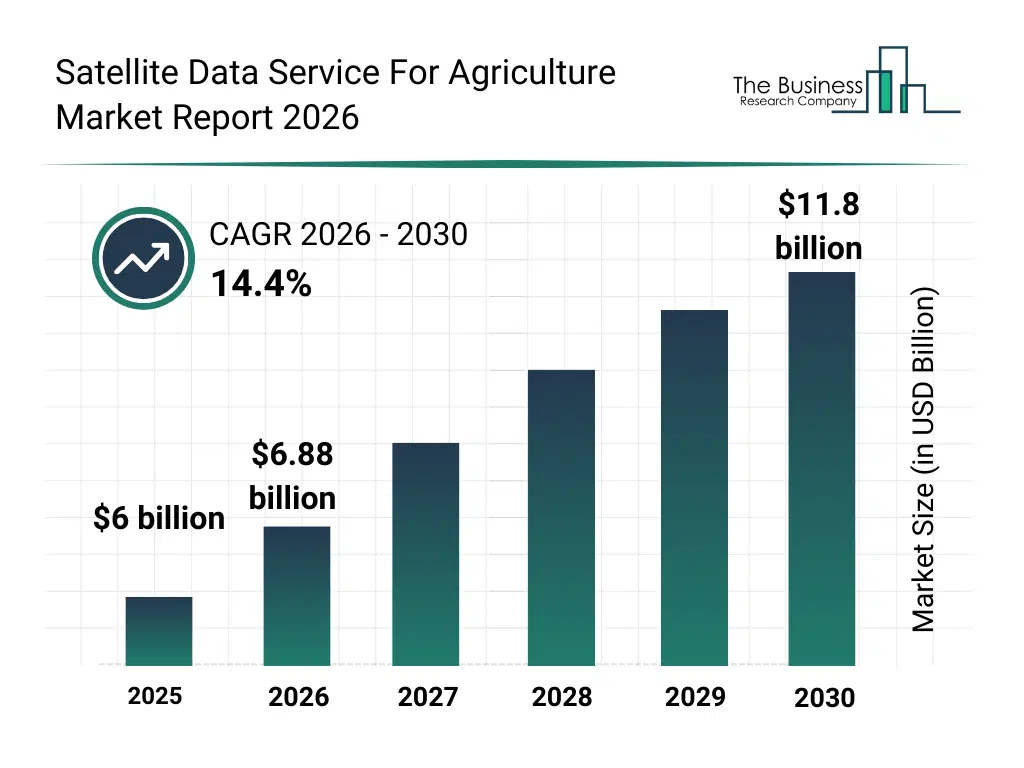
What Is The Satellite Data Service For Agriculture Market Size and Share 2026?
The satellite data service for agriculture market size has grown rapidly in recent years. It will grow from $5.95 billion in 2025 to $6.79 billion in 2026 at a compound annual growth rate (CAGR) of 14.2%. The growth in the historic period can be attributed to early adoption of remote sensing in large farms, initial government investment in agricultural satellite programs, growing awareness of crop monitoring benefits, limited access to ground-based analytics, traditional reliance on manual field scouting.What Is The Satellite Data Service For Agriculture Market Growth Forecast?
The satellite data service for agriculture market size is expected to see rapid growth in the next few years. It will grow to $11.53 billion in 2030 at a compound annual growth rate (CAGR) of 14.2%. The growth in the forecast period can be attributed to increasing need for climate-resilient farming insights, rising demand for automated geospatial analytics, expansion of satellite coverage in rural areas, growing integration of AI with satellite datasets, shift toward data-driven precision agriculture. Major trends in the forecast period include rising demand for weather-integrated satellite advisory services, expansion of satellite-enabled risk assessment for crop insurance, increased adoption of farm-level geospatial decision-support solutions, growth in precision input planning based on satellite vegetation analytics, development of satellite-based early pest and disease warning systems.
Global Satellite Data Service For Agriculture Market Segmentation
2) By Deployment Model: Cloud-Based Services, On-Premise Solutions, Hybrid Solutions 3) By Satellite Data Processing Features: Data Compression And Storage, Real-Time Data Processing, Analytical Tools And Software, Data Visualization Solutions, Machine Learning And Artificial Intelligence Integration 4) By Application: Mapping, Vegetation And Crop Health Monitoring, Crop Yield Management, Other Applications 5) By End User: Farmers And Agricultural Producers, Agricultural Consultants, Government And Regulatory Bodies, Research And Educational Institutions, Agri-Tech Companies Subsegments: 1) By Optical Satellite Imagery Services: High Resolution Optical Imagery, Medium Resolution Optical Imagery, Low Resolution Optical Imagery 2) By Radar Satellite Imagery Services: Synthetic Aperture Radar Imagery, Interferometric Radar Imagery, Polarimetric Radar Imagery 3) By Multispectral and Hyperspectral Imagery Services: Shortwave Infrared Imagery, Near Infrared Imagery, Visible Spectrum Imagery 4) By Infrared Imaging Services: Thermal Infrared Imaging, Near Infrared Imaging, Mid Infrared Imaging 5) By Gridded Weather Data Services: Precipitation Data, Temperature Data, Soil Moisture Data, Evapotranspiration DataWhat Is The Driver Of The Satellite Data Service For Agriculture Market?
The growing awareness of precision agriculture is expected to propel the growth of the satellite data service for the agriculture market going forward. Precision agriculture refers to the use of data-driven tools and practices to manage variability in fields and optimize inputs such as seeds, fertilizers, and water. The growing awareness of precision agriculture is due to its ability to optimize crop yields and reduce resource wastage. Satellite data service supports precision agriculture by providing timely, field-level insights such as crop health monitoring, soil moisture assessment, yield prediction, and vegetation mapping that enable farmers to make data-driven and site-specific decisions. For instance, in July 2024, according to the Mississippi Soybean Promotion Board, a US-based state-level agricultural organization, the proportion of farms using variable rate technology (VRT) for any input rose from 2.8% in to 4.9% over three years. Therefore, growing awareness of the benefits of precision agriculture is driving the growth of the satellite data service for the agriculture market.Key Players In The Global Satellite Data Service For Agriculture Market
Major companies operating in the satellite data service for agriculture market are Airbus SE, Planet Labs PBC, EOS Data Analytics Inc., Pixxel Space Technologies, CropX Inc., Ceres Imaging Inc., SatSure Analytics Pvt. Ltd., OneSoil AG, Kermap, AgroScout, Earth-i Ltd, SI Imaging Services (SIIS), DataFarming, Farmonaut, FarmQA, Agricolus Srl, Avant Global LLC, Esper Satellite Imagery, Agremo, FarmiSpace
This chart is for illustrative purposes; the full report includes a detailed competitor analysis and comprehensive overview of the top 10 companies in the market.
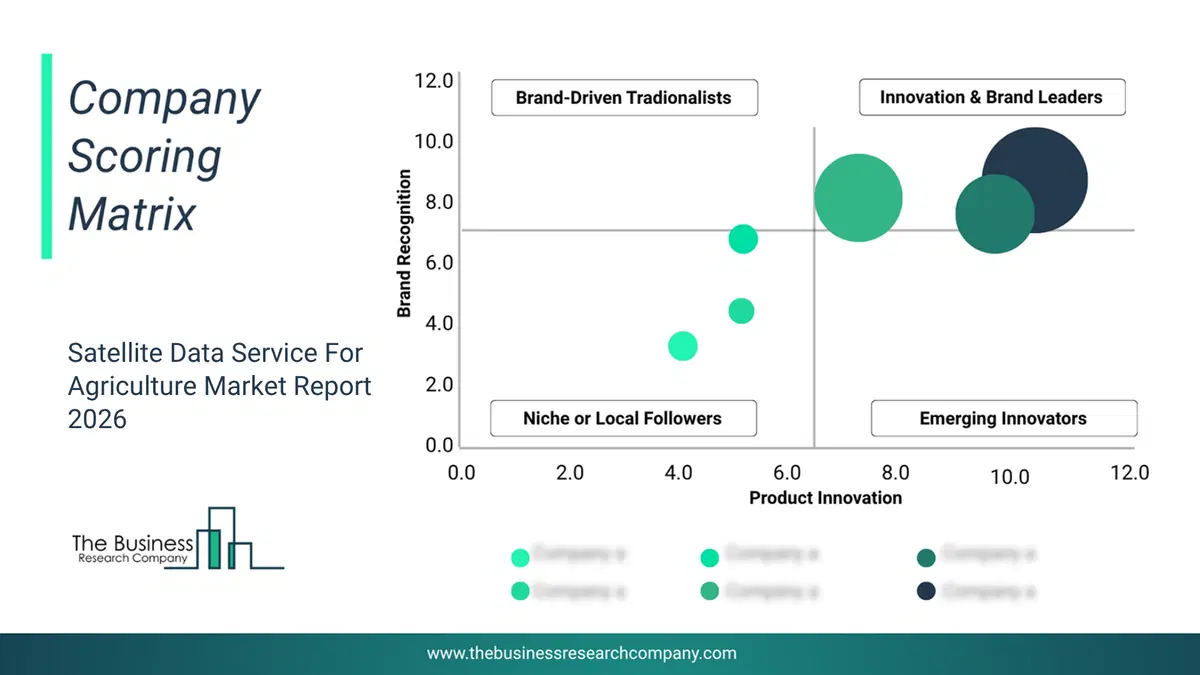
This chart maps companies by product innovation and brand strength, with bubble size indicating relative revenue, helping identify market leaders, challengers, and niche players. This is an illustrative chart; the full report provides a complete and accurate competitive analysis.
Global Satellite Data Service For Agriculture Market Trends and Insights
Major companies operating in the satellite data service for the agriculture market are focusing on developing innovative technology, such as remote sensing technology, to capture and analyze crop conditions, soil characteristics, and environmental variables without direct physical contact. Remote sensing technology refers to the process of collecting information about the Earth’s surface and atmosphere from a distance, typically using satellites, drones, or aircraft, without making direct physical contact. For instance, in Mar 2023, InnerPlant, a US-based technology company, in collaboration with Satellogic Inc., a US-based earth observation company, launched Detecting Human-Made Crop Signals from Space. Detecting human-made crop signals from space provides a new level of accuracy in watching farming activities by spotting small signs like when fertilizers are used, how water is applied, and changes to the soil that regular images can't see. This capability enhances decision-making by enabling real-time tracking of input efficiency, crop stress levels, and sustainability compliance across large areas. It supports farmers in optimizing resources, reducing environmental impact, and improving yields while providing governments and agribusinesses with verifiable data for policy enforcement and supply chain transparency.What Are Latest Mergers And Acquisitions In The Satellite Data Service For Agriculture Market?
In June 2023, Hydrosat, a US-based geospatial-analytics software company, acquired IrriWatch for an undisclosed amount. With this acquisition, Hydrosat merges IrriWatch’s satellite-based irrigation analytics platform with its own thermal imagery and crop-forecasting capabilities to deliver a unified, end-to-end solution that empowers farmers worldwide to boost yields and reduce water usage amid climate and sustainability challenges. IrriWatch is a Netherlands-based farming software company, engaged in the development of tools to manage soil and crop irrigation water usage to increase crop yields and reduce water waste.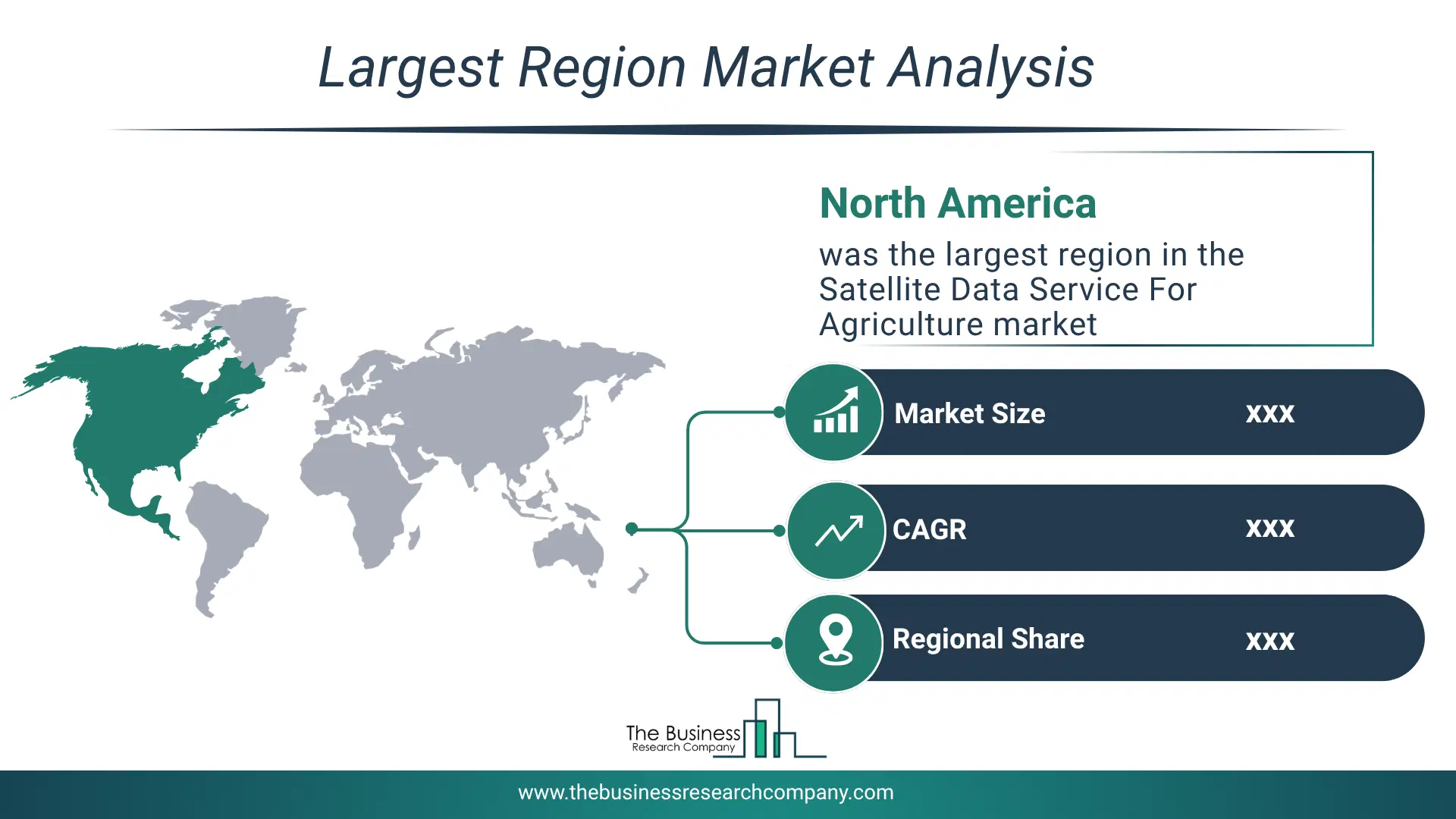
Regional Outlook
North America was the largest region in the satellite data service for agriculture market in 2025. Asia-Pacific is expected to be the fastest-growing region in the forecast period. The regions covered in this market report are Asia-Pacific, South East Asia, Western Europe, Eastern Europe, North America, South America, Middle East, Africa. The countries covered in this market report are Australia, Brazil, China, France, Germany, India, Indonesia, Japan, Taiwan, Russia, South Korea, UK, USA, Canada, Italy, Spain.What Defines the Satellite Data Service For Agriculture Market?
The satellite data service for agriculture market includes revenues earned by entities by providing services such as crop monitoring and yield forecasting, soil moisture mapping, precision irrigation advisory, vegetation health analysis, and satellite-based pest and disease detection. The market value includes the value of related goods sold by the service provider or included within the service offering. Only goods and services traded between entities or sold to end consumers are included.How is Market Value Defined and Measured?
The market value is defined as the revenues that enterprises gain from the sale of goods and/or services within the specified market and geography through sales, grants, or donations in terms of the currency (in USD unless otherwise specified). The revenues for a specified geography are consumption values that are revenues generated by organizations in the specified geography within the market, irrespective of where they are produced. It does not include revenues from resales along the supply chain, either further along the supply chain or as part of other products.
This chart presents market attractiveness based on a quantitative evaluation of growth, competition, strategic alignment, and risk, offering a clear view of opportunity areas for decision-making. This chart is for illustrative purposes; the full report contains the complete analysis.

This chart highlights the Total Addressable Market (TAM) by estimating the maximum revenue opportunity using an assumption-driven approach, supporting strategic planning and opportunity sizing across markets. The chart is illustrative; the full report provides a more comprehensive analysis.
What Key Data and Analysis Are Included in the Satellite Data Service For Agriculture Market Report 2026?
The satellite data service for agriculture market research report is one of a series of new reports from The Business Research Company that provides market statistics, including industry global market size, regional shares, competitors with the market share, detailed market segments, market trends and opportunities, and any further data you may need to thrive in the satellite data service for agriculture industry. The market research report delivers a complete perspective of everything you need, with an in-depth analysis of the current and future state of the industry.Satellite Data Service For Agriculture Market Report Forecast Analysis
| Report Attribute | Details |
|---|---|
| Market Size Value In 2026 | $6.79 billion |
| Revenue Forecast In 2030 | $11.53 billion |
| Growth Rate | CAGR of 14.2% from 2026 to 2030 |
| Base Year For Estimation | 2025 |
| Actual Estimates/Historical Data | 2020-2025 |
| Forecast Period | 2026 - 2030 |
| Market Representation | Revenue in USD Billion and CAGR from 2026 to 2030 |
| Segments Covered | Type Of Satellite Service, Deployment Model, Satellite Data Processing Features, Application, End User |
| Regional Scope | Asia-Pacific, Western Europe, Eastern Europe, North America, South America, Middle East, Africa |
| Country Scope | The countries covered in the report are Australia, Brazil, China, France, Germany, India, Indonesia, Japan, Taiwan, Russia, South Korea, UK, USA, Canada, Italy, Spain. |
| Key Companies Profiled | Airbus SE, Planet Labs PBC, EOS Data Analytics Inc., Pixxel Space Technologies, CropX Inc., Ceres Imaging Inc., SatSure Analytics Pvt. Ltd., OneSoil AG, Kermap, AgroScout, Earth-i Ltd, SI Imaging Services (SIIS), DataFarming, Farmonaut, FarmQA, Agricolus Srl, Avant Global LLC, Esper Satellite Imagery, Agremo, FarmiSpace |
| Customization Scope | Request for Customization |
| Pricing And Purchase Options | Explore Purchase Options |