
Satellite Internet Market Report 2026
Global Outlook – By Product (Two-Way Satellite-Only Communication, One-Way Receive, One-Way Broadcast), By Band Type (C-Band, X-Band, L-Band, K-Band , Other Band Types), By End User (Commercial, Residential, Military, Industrial, Other End Users) – Market Size, Trends, Strategies, and Forecast to 2030
Satellite Internet Market Overview
• Satellite Internet market size has reached to $6.48 billion in 2025 • Expected to grow to $12.69 billion in 2030 at a compound annual growth rate (CAGR) of 14.4% • Growth Driver: Residential Sector Surge Is A Catalyst For The Satellite Internet Market's Growth • Market Trend: Next-Generation Meo satellites Enable Faster, Low-Latency Global Connectivity • North America was the largest region in 2025.Market Gains By 2030 – Top Opportunities By Segment
Market Gain identifies the most promising market opportunities by highlighting the segments or products expected to generate the highest incremental revenue growth over the next five years.
What Is Covered Under Satellite Internet Market?
Satellite internet refers to the wireless connection that is spread across the multiple satellite dishes that are located both on earth and in space. The satellite internet operates by communicating with satellites orbiting the Earth via radio waves. Two-way satellite-only communication, one-way receiving, and one-way broadcast are the three main types of satellite internet products. Two-way satellite-only communication can send data from a remote contact site via a satellite, then to a hub. The different band types include C-band, X-band, L-band, K-band, and others and involve various sectors such as commercial, residential, military, industrial, and others.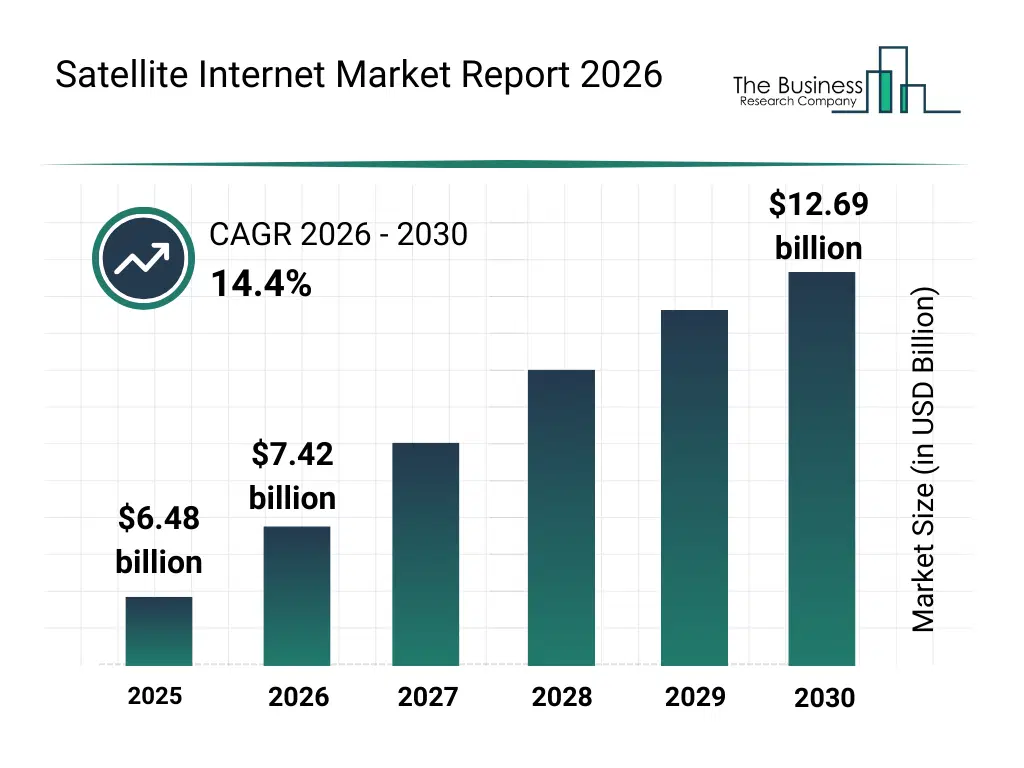
What Is The Satellite Internet Market Size and Share 2026?
The satellite internet market size has grown rapidly in recent years. It will grow from $6.48 billion in 2025 to $7.42 billion in 2026 at a compound annual growth rate (CAGR) of 14.6%. The growth in the historic period can be attributed to limited terrestrial connectivity in rural areas, rising demand for satellite television and radio, growing commercial internet needs, military communication requirements, increasing adoption of industrial satellite solutions.What Is The Satellite Internet Market Growth Forecast?
The satellite internet market size is expected to see rapid growth in the next few years. It will grow to $12.69 billion in 2030 at a compound annual growth rate (CAGR) of 14.4%. The growth in the forecast period can be attributed to deployment of high-throughput satellites (hts), integration of low-earth orbit (leo) satellite constellations, advancements in satellite-based broadband technology, increasing adoption in smart homes and iot networks, expansion of satellite internet for industrial and commercial sectors. Major trends in the forecast period include expansion of two-way satellite-only communication, growth of direct-to-home (dth) satellite services, satellite voip service adoption, high-speed residential satellite internet deployment, one-way broadcast satellite services enhancement.
Global Satellite Internet Market Segmentation
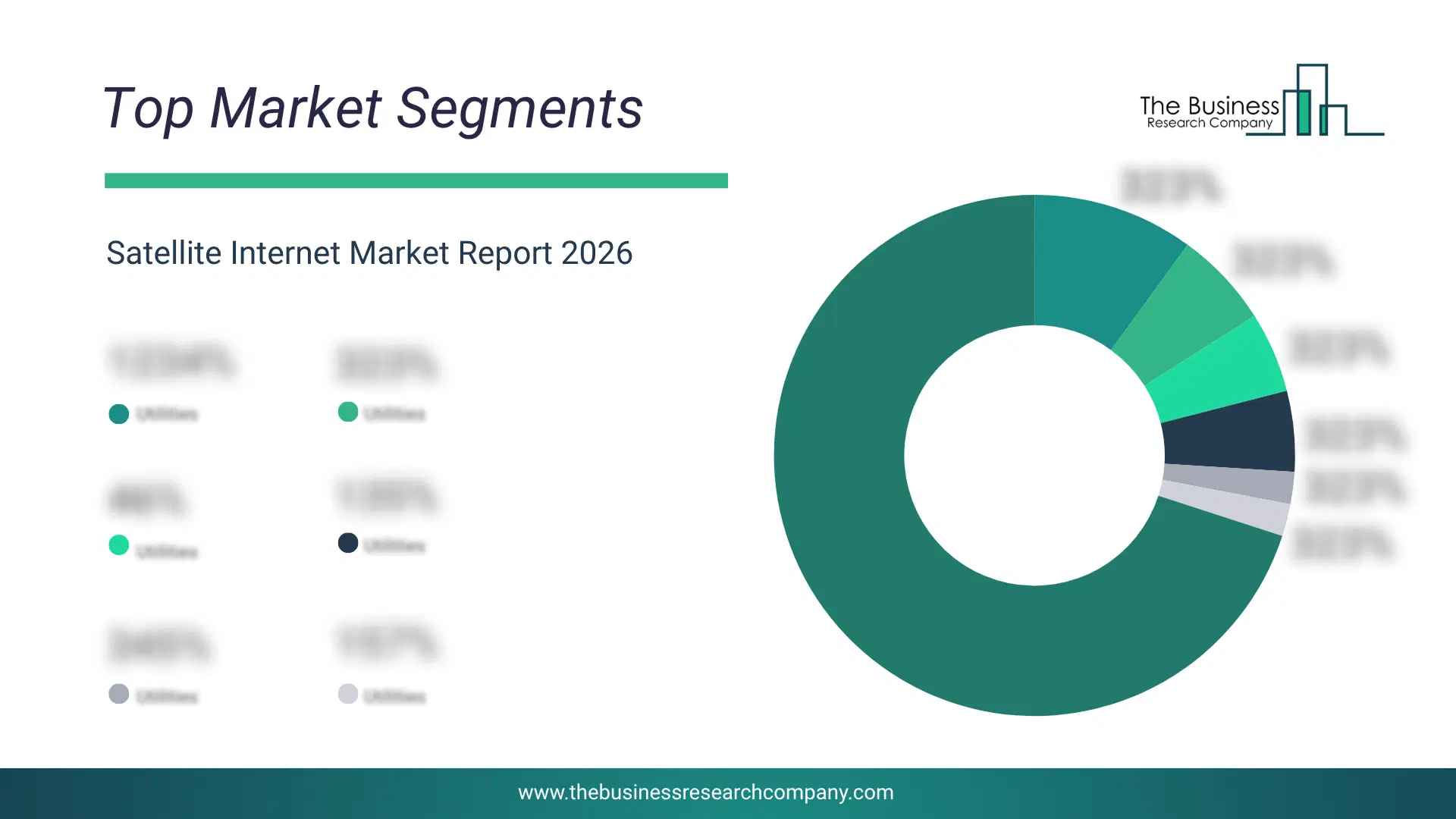
1) By Product: Two-Way Satellite-Only Communication, One-Way Receive, One-Way Broadcast 2) By Band Type: C-Band, X-Band, L-Band, K-Band , Other Band Types 3) By End User: Commercial, Residential, Military, Industrial, Other End Users Subsegments: 1) By Two-Way Satellite-Only Communication: Satellite Internet Service, Satellite VoIP Service 2) By One-Way Receive: Satellite Television Services, Satellite Radio Services 3) By One-Way Broadcast: Broadcast Satellite Services, Direct-To-Home (DTH) Services The top segments in the satellite internet market will be: • Two-Way Satellite-Only Communication will reach $12.85 Billion by 2030. • One-Way Receive will reach $6.04 Billion by 2030. • One-Way Broadcast will reach $3.47 Billion by 2030.What Is The Driver Of The Satellite Internet Market?
The increasing demand in residential sector is expected to propel the growth of the satellite internet market going forward. Residential refers to areas or buildings that are primarily designed and used for housing or dwelling purposes. Satellite internet in residential areas offer wide coverage, quick deployment, global accessibility, high-speed internet, ubiquitous access, reliability, and offer a variety of plans with different data allowances and speeds. For instance, in October 2023, according to the United States Census Bureau, a US-based principal agency of the federal statistical system, the number of privately owned housing units approved by building permits in February was 1,524,000 on a seasonally adjusted yearly basis. This is 13.8% more than the January rate, which was corrected to 1,339,000. Therefore, the increasing demand in the residential sector is driving the growth of the satellite internet industry.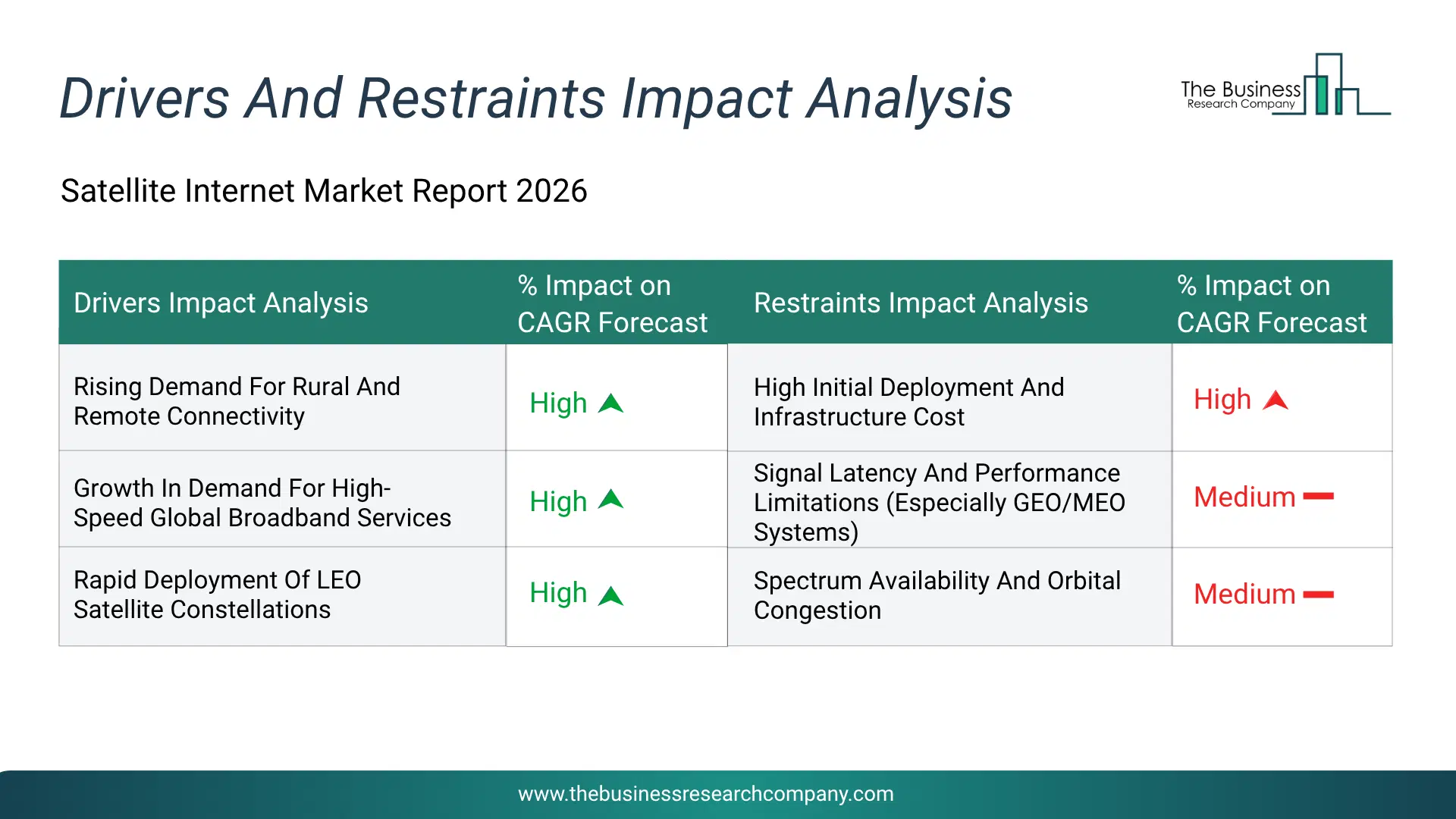
Infographic Chart Showing Key Market Drivers Analysis And Restraints For Satellite Internet Market
The chart presents an impact analysis of key drivers and restraints, quantifying their relative influence on the market's growth rate and helping assess the balance between growth enablers and limiting factors. This chart offers a high-level perspective; the full report contains more detailed insights.
How Will The Drivers Impact Growth In The Global Satellite Internet Market?
• Rising Demand For Rural And Remote Connectivity (High) – During the forecast period, the rising demand for rural and remote connectivity is expected to become a key growth driver for the satellite internet market by 2030. Millions of households, businesses, and public institutions located in underserved regions continue to face limited access to reliable broadband due to the high cost of deploying terrestrial infrastructure. Satellite internet enables seamless connectivity across geographically isolated areas by delivering broadband services without dependence on fiber or cellular networks. This expanding access supports digital inclusion initiatives while improving communication capabilities for education, healthcare, emergency response, and agricultural operations. As governments and service providers continue to prioritize universal internet access, demand for satellite-based broadband solutions is expected to strengthen. • Growth In Demand For High-Speed Global Broadband Services (High) – During the forecast period, the growth in demand for high-speed global broadband services is expected to emerge as a major factor driving the expansion of the satellite internet market by 2030. Increasing reliance on digital platforms, enterprise applications, and bandwidth-intensive workloads is creating the need for uninterrupted internet connectivity across international and hard-to-reach locations. Satellite networks provide consistent broadband access for maritime, aviation, energy, logistics, and multinational business operations where terrestrial coverage remains limited. The ability to deliver reliable connectivity across diverse operating environments is strengthening the role of satellite internet in global communications infrastructure. • Rapid Deployment Of LEO Satellite Constellations (High) – During the forecast period, the rapid deployment of low Earth orbit (LEO) satellite constellations is expected to act as a key growth catalyst for the satellite internet market by 2030. The expansion of next-generation satellite networks is improving service quality through lower latency, higher network capacity, and broader geographic coverage. Continuous satellite launches and advances in constellation architecture are enabling providers to deliver more reliable broadband services while supporting growing user demand for data-intensive applications. The commercialization of leo infrastructure is also encouraging new service offerings for consumers, enterprises, and government organizations worldwide.How Will The Restraints Impact Growth In The Global Satellite Internet Market?
• High Initial Deployment And Infrastructure Cost (High) – During the forecast period, high initial deployment and infrastructure cost acts as a major restraint for the satellite internet market due to the substantial investment required for satellite manufacturing, launch services, and ground station development. Building and deploying satellite constellations involves advanced technology and specialized expertise, which significantly increases overall project expenses. Additionally, frequent satellite replacements and maintenance further add to long-term operational costs. These high capital requirements limit entry for new players and slow down market expansion in cost-sensitive regions. As a result, affordability remains a key challenge for widespread adoption of satellite internet services. • Signal Latency And Performance Limitations (Especially GEO/MEO Systems) (High) – During the forecast period, signal latency and performance limitations, especially in geostationary orbit (geo) and medium earth orbit (meo) systems, act as a key restraint for the satellite internet market. These satellites operate at much higher altitudes, which increases the time required for signals to travel between the user and the satellite. This results in higher latency compared to fiber or low earth orbit systems, affecting real-time applications such as video conferencing, online gaming, and financial trading. Performance can also be impacted by weather conditions and network congestion. As a result, these limitations reduce user experience and restrict adoption in latency-sensitive applications. • Spectrum Availability And Orbital Congestion (High) – During the forecast period, spectrum availability and orbital congestion can act as a significant restraint on the satellite internet market by limiting the efficient deployment and operation of satellite constellations. Satellite internet providers rely on access to limited radio frequency spectrum and orbital slots, both of which are subject to international coordination and regulatory approvals. The rapid increase in the number of satellites launched into low Earth orbit (LEO) has intensified competition for these resources and raised concerns about orbital congestion and space debris. Delays in obtaining spectrum licenses and orbital approvals can postpone network expansion and increase deployment complexity. Additionally, the growing risk of satellite interference and collision necessitates continuous monitoring and investment in collision avoidance technologies. Consequently, spectrum constraints and orbital congestion can hinder service expansion, increase operational costs, and restrain the growth of the satellite internet market.Key Players In The Global Satellite Internet Market
Major companies operating in the satellite internet market are AT&T Inc.; Dish Network Corporation; Singapore Telecommunications Limited; Avonline Satellite Broadband; Kacific Broadband Satellites Group; Thaicom Public Company Limited; ViaSat Inc.; Telesat Canada; SES S.A.; Space Exploration Technologies Corp; EchoStar Corporation; Intelsat S.A.; Inmarsat Global Limited; Eutelsat S.A.; Eutelsat OneWeb; Iridium Communications Inc.; Al Yah Satellite Communications Company P.J.S.C.; Speedcast International Limited; NordNet AB; Globalstar Inc.; Konnect Africa; Avanti Communications Group plc; Gilat Satellite Networks Ltd.; Bigblu Broadband plc; Bentley Walker Ltd.; SkyDSL Europe B.V.; Skycasters Co; Freedomsat Group Limited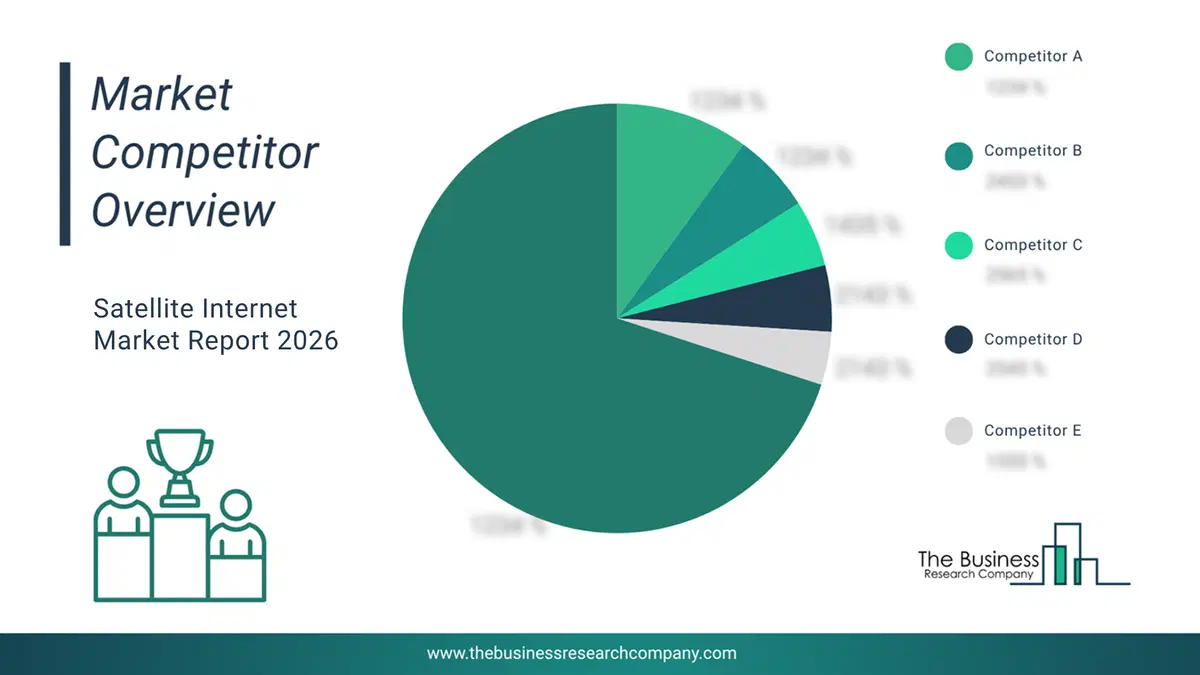
This chart is for illustrative purposes; the full report includes a detailed competitor analysis and comprehensive overview of the top 10 companies in the market.
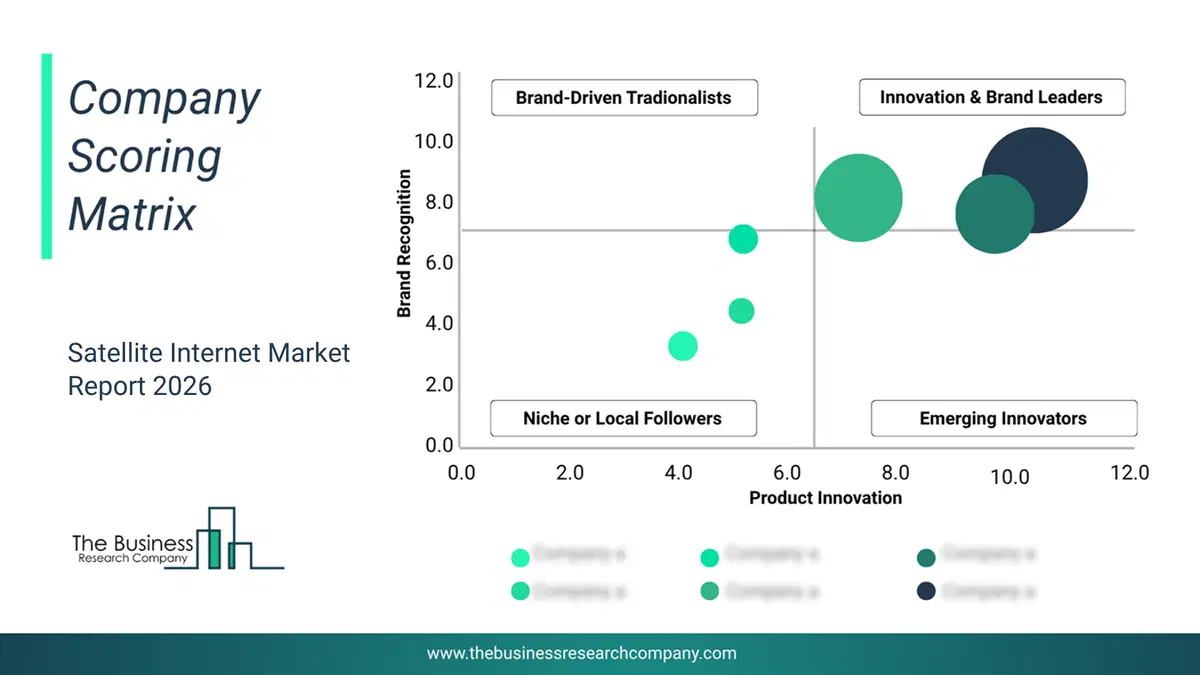
This chart maps companies by product innovation and brand strength, with bubble size indicating relative revenue, helping identify market leaders, challengers, and niche players. This is an illustrative chart; the full report provides a complete and accurate competitive analysis.
Global Satellite Internet Market Trends and Insights
Major companies operating in the satellite internet market are focusing on developing innovative solutions, such as second generation Medium Earth Orbit (MEO) satellite systems, to provide faster, more reliable global internet connectivity. Second-generation Medium Earth Orbit (MEO) satellite systems are advanced satellites operating between roughly 2,000 km and 35,786 km above Earth, designed to deliver higher-speed, lower-latency, and more reliable global communications compared to first-generation MEO satellites. For instance, in April 2024, SES S.A., a Luxembourg-based space solutions company, launched the second-generation O3b mPOWER satellite system, which is now operational and providing high-performance connectivity worldwide. The system features fully shapeable and steerable spot beams, enabling real-time, flexible allocation of bandwidth and power to users anywhere. With predictable low latency of approximately 150 milliseconds, it supports latency-sensitive cloud applications reliably. Additionally, it offers exceptional flexibility through multi-gigabit throughput per terminal and adaptive resource control software that dynamically optimizes network resources for efficiency and cost reduction.What Are Latest Mergers And Acquisitions In The Satellite Internet Market?
In January 2024, EchoStar Corporation, a US-based telecommunications company, merged with DISH Network Corporation for an undisclosed amount. This acquisition aims to enhance global connectivity solutions by integrating satellite and 5G technologies, allowing EchoStar to provide comprehensive services and bridge the digital divide. DISH Network Corporation os a US-based provider of satellite television services, also offers satellite internet solutions that cater to areas with limited connectivity options.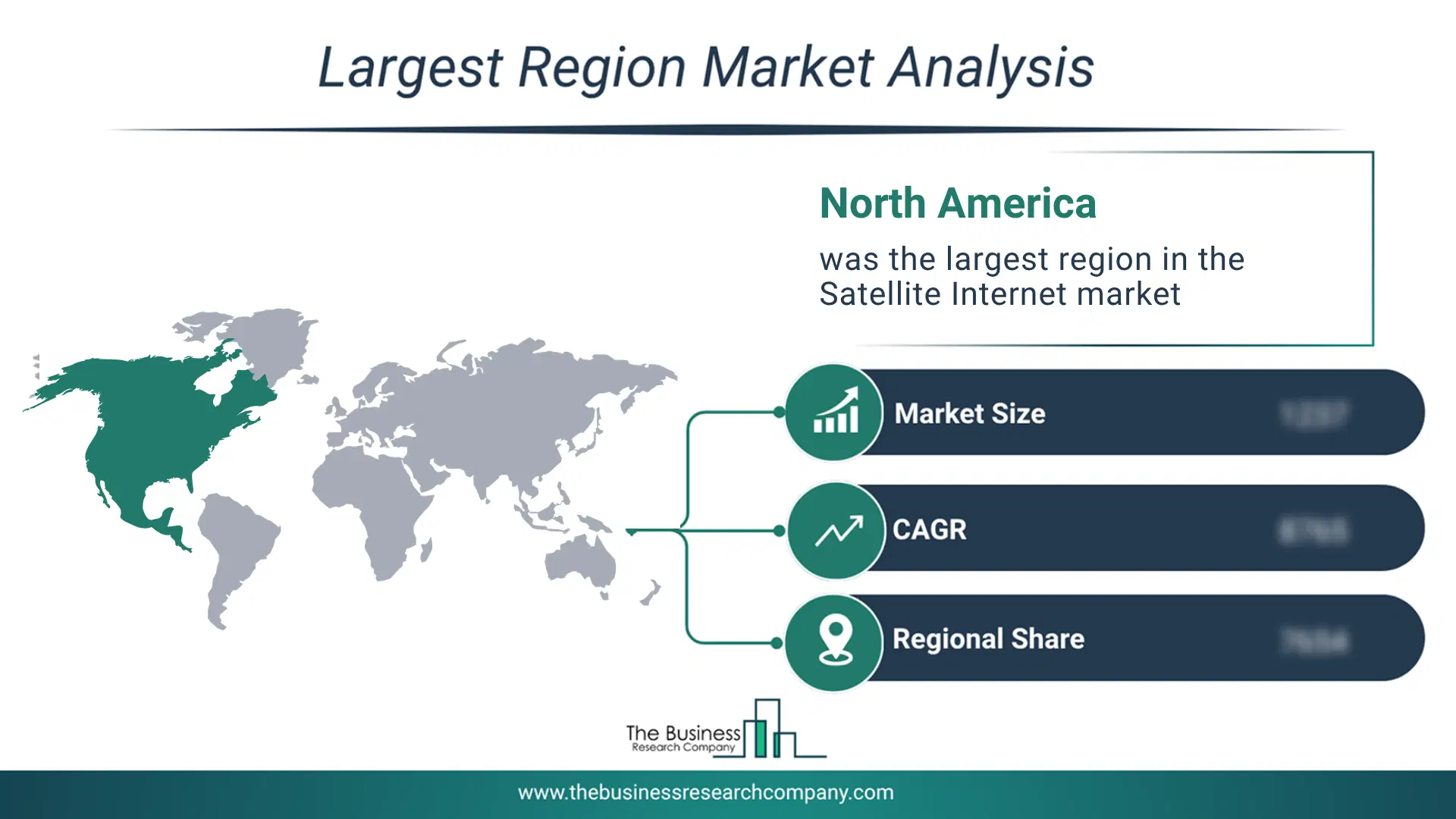
Regional Insights
North America was the largest region in the satellite internet market in 2025. The regions covered in this market report are Asia-Pacific, South East Asia, Western Europe, Eastern Europe, North America, South America, Middle East, Africa. The countries covered in this market report are Australia, Brazil, China, France, Germany, India, Indonesia, Japan, Taiwan, Russia, South Korea, UK, USA, Canada, Italy, SpainWhat Defines the Satellite Internet Market?
The satellite internet market includes revenues earned by entities by providing internet services that can be used to offer internet access services for remote areas or hard-to-reach areas since these areas lack physical infrastructures such as wireless radio connections, telephones, or fiber cables. The market value includes the value of related goods sold by the service provider or included within the service offering. Only goods and services traded between entities or sold to end consumers are included.How is Market Value Defined and Measured?
The market value is defined as the revenues that enterprises gain from the sale of goods and/or services within the specified market and geography through sales, grants, or donations in terms of the currency (in USD unless otherwise specified). The revenues for a specified geography are consumption values that are revenues generated by organizations in the specified geography within the market, irrespective of where they are produced. It does not include revenues from resales along the supply chain, either further along the supply chain or as part of other products.
This chart presents market attractiveness based on a quantitative evaluation of growth, competition, strategic alignment, and risk, offering a clear view of opportunity areas for decision-making. This chart is for illustrative purposes; the full report contains the complete analysis.

This chart highlights the Total Addressable Market (TAM) by estimating the maximum revenue opportunity using an assumption-driven approach, supporting strategic planning and opportunity sizing across markets. The chart is illustrative; the full report provides a more comprehensive analysis.
What Key Data and Analysis Are Included in the Satellite Internet Market Report 2026?
The satellite internet market research report is one of a series of new reports from The Business Research Company that provides market statistics, including industry global market size, regional shares, competitors with the market share, detailed market segments, market trends and opportunities, and any further data you may need to thrive in the satellite internet industry. The market research report delivers a complete perspective of everything you need, with an in-depth analysis of the current and future state of the industry.Satellite Internet Market Report Forecast Analysis
| Report Attribute | Details |
|---|---|
| Market Size Value In 2026 | $7.42 billion |
| Revenue Forecast In 2030 | $12.69 billion |
| Growth Rate | CAGR of 14.6% from 2026 to 2030 |
| Base Year For Estimation | 2025 |
| Actual Estimates/Historical Data | 2020-2025 |
| Forecast Period | 2026 - 2030 |
| Market Representation | Revenue in USD Billion and CAGR from 2026 to 2030 |
| Segments Covered | Product, Band Type, End User |
| Regional Scope | Asia-Pacific, Western Europe, Eastern Europe, North America, South America, Middle East, Africa |
| Country Scope | The countries covered in the report are Australia, Brazil, China, France, Germany, India, ... |
| Key Companies Profiled | AT&T Inc.; Dish Network Corporation; Singapore Telecommunications Limited; Avonline Satellite Broadband; Kacific Broadband Satellites Group; Thaicom Public Company Limited; ViaSat Inc.; Telesat Canada; SES S.A.; Space Exploration Technologies Corp; EchoStar Corporation; Intelsat S.A.; Inmarsat Global Limited; Eutelsat S.A.; Eutelsat OneWeb; Iridium Communications Inc.; Al Yah Satellite Communications Company P.J.S.C.; Speedcast International Limited; NordNet AB; Globalstar Inc.; Konnect Africa; Avanti Communications Group plc; Gilat Satellite Networks Ltd.; Bigblu Broadband plc; Bentley Walker Ltd.; SkyDSL Europe B.V.; Skycasters Co; Freedomsat Group Limited |
| Customization Scope | Request for Customization |
| Pricing And Purchase Options | Explore Purchase Options |