
Satellite Manufacturing And Launch Systems Market Report 2026
Global Outlook – By Technology Type (Satellite Manufacturing, Satellite Launch System), By Satellite Type (Lower Earth Orbit (LEO) Satellites, Medium Earth Orbit (MEO) Satellites, Geosynchronous Equatorial Orbit (GEO) Satellites, Beyond GEO Satellites), By Application (Commercial Communications, Government Communications, Earth Observation Services, Research and Development, Navigation, Military Surveillance, Scientific Applications, Other Applications), By End-User (Military and Government, Commercial, Other End-Users) – Market Size, Trends, Strategies, and Forecast to 2030
Satellite Manufacturing And Launch Systems Market Overview
• Satellite Manufacturing And Launch Systems market size has reached to $29.6 billion in 2025 • Expected to grow to $43.81 billion in 2030 at a compound annual growth rate (CAGR) of 8% • Growth Driver: Rising Satellite Demand Fuels Growth In Satellite Manufacturing And Launch Systems Market • Market Trend: Rise Of Miniaturization And Small Satellites • North America was the largest region in 2025 and Asia-Pacific is the fastest growing region.Market Gains By 2030 – Top Opportunities By Segment
Market Gain identifies the most promising market opportunities by highlighting the segments or products expected to generate the highest incremental revenue growth over the next five years.
What Is Covered Under Satellite Manufacturing And Launch Systems Market?
The satellite manufacturing and launch system refer to systems that are used for remote transmission, detection, inspection, communication, traffic control, and telemetry. A satellite is an artificially designed machine, placed in an earth’s orbit to perform various applications such as navigation, weather monitoring, and space telescopes. A launch vehicle is used to place a satellite into earth’s orbit. The main technology types in the satellite manufacturing and launch systems market are satellite manufacturing and satellite launch system. The prime contractor and manufacturer of the satellite that is a party to the satellite purchase agreement are referred to as the satellite manufacturer. Satellite manufacturing and launch systems are lower earth orbit (LEO) satellites, medium earth orbit (MEO) satellites, geosynchronous equatorial orbit (GEO) satellites, and beyond GEO satellites types that have applications in commercial communications, government communications, earth observation services, research and development, navigation, military surveillance, scientific applications, other applications and can be used by military and government, commercial and other end-users.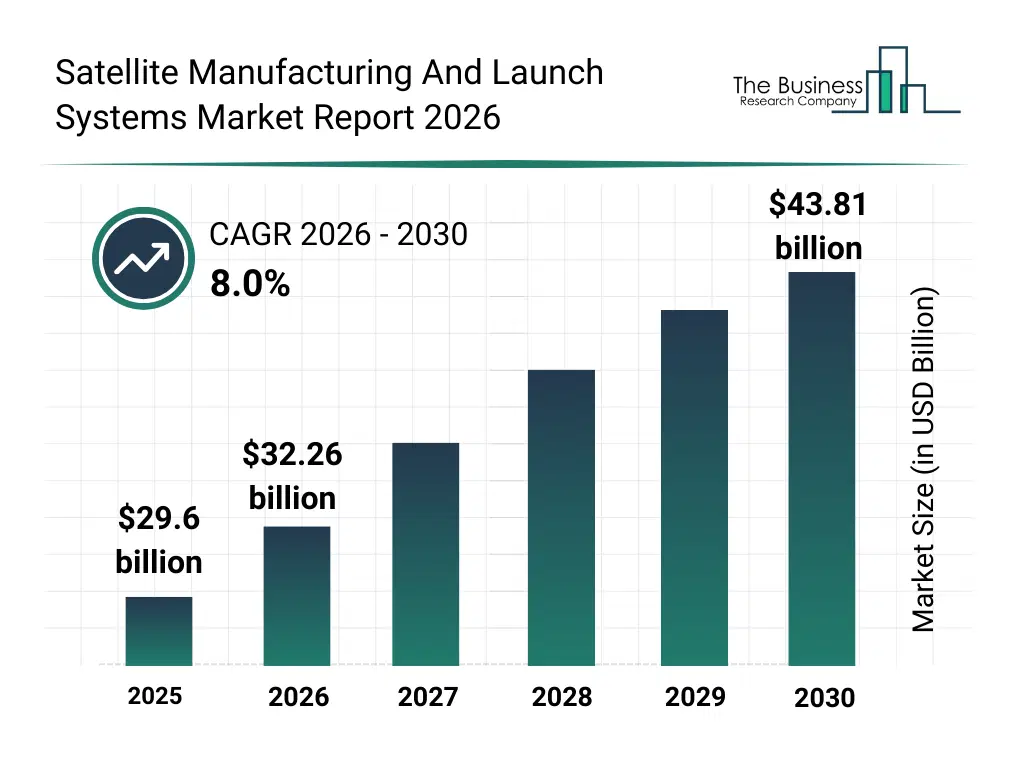
What Is The Satellite Manufacturing And Launch Systems Market Size and Share 2026?
The satellite manufacturing and launch systems market size has grown strongly in recent years. It will grow from $29.6 billion in 2025 to $32.26 billion in 2026 at a compound annual growth rate (CAGR) of 9.0%. The growth in the historic period can be attributed to expansion of global satellite communication and earth-observation programs, increasing deployment of satellites across LEO MEO and GEO orbits, advancements in lightweight satellite materials and subsystem integration, growth in government-funded space missions driving demand for launch systems, development of standardized launch capabilities for highly elliptical and sun-synchronous orbits.What Is The Satellite Manufacturing And Launch Systems Market Growth Forecast?
The satellite manufacturing and launch systems market size is expected to see strong growth in the next few years. It will grow to $43.81 billion in 2030 at a compound annual growth rate (CAGR) of 8.0%. The growth in the forecast period can be attributed to rising demand for small satellite constellations requiring high-frequency launches, increasing commercialization of launch services across diverse orbital classes, advancements in modular satellite manufacturing to reduce cost and production cycles, growth in multi-orbit mission planning enabled by improved transfer-orbit technologies, expanding public-private partnerships to scale global launch infrastructure. Major trends in the forecast period include miniaturization of satellite components, development of high-performance reusable launch vehicles, modular satellite design for rapid deployment, expansion of multi-orbit satellite constellations, enhanced telemetry and remote monitoring systems.
Global Satellite Manufacturing And Launch Systems Market Segmentation
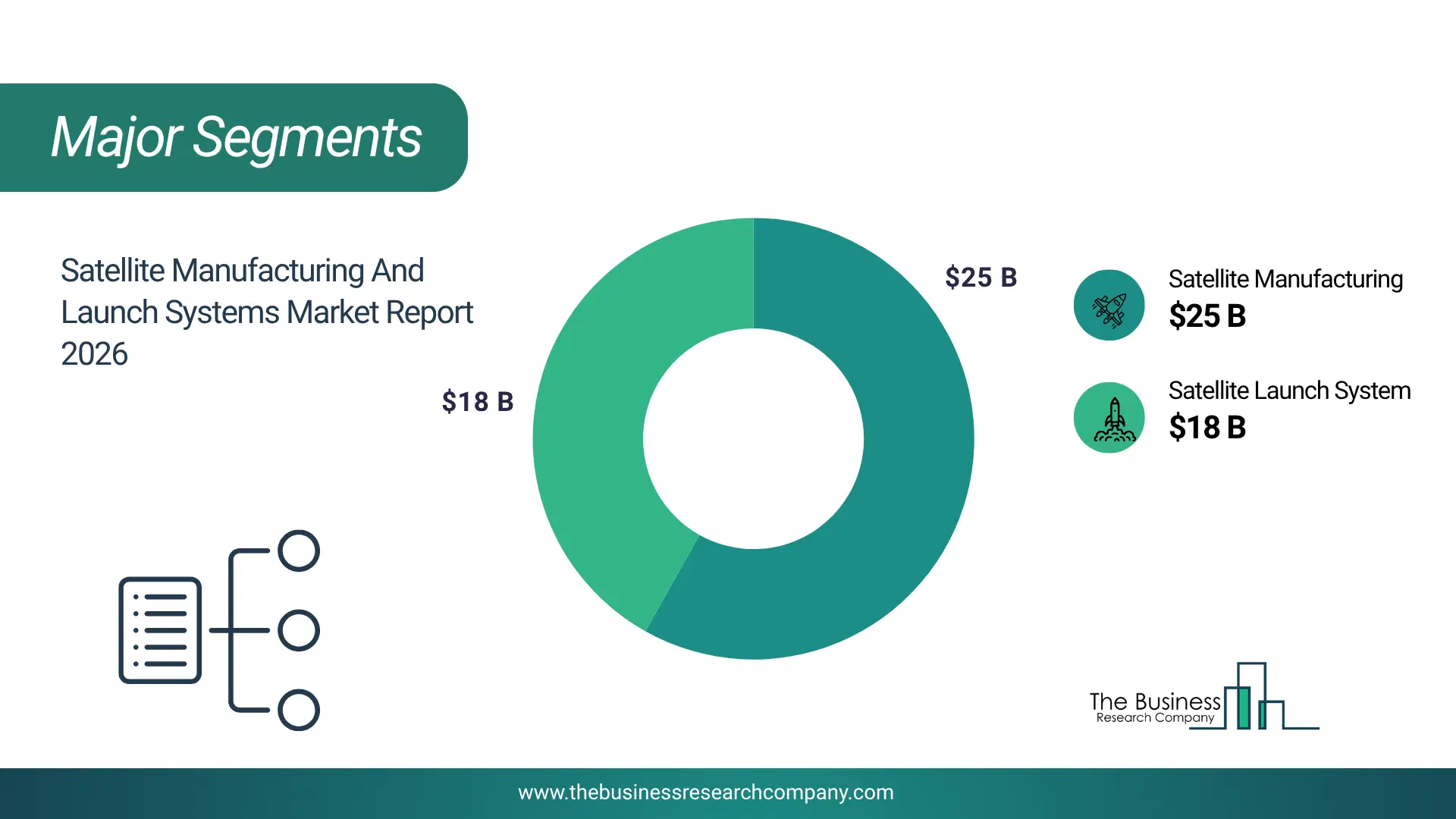
1) By Technology Type: Satellite Manufacturing, Satellite Launch System 2) By Satellite Type: Lower Earth Orbit (LEO) Satellites, Medium Earth Orbit (MEO) Satellites, Geosynchronous Equatorial Orbit (GEO) Satellites, Beyond GEO Satellites 3) By Application: Commercial Communications, Government Communications, Earth Observation Services, Research and Development, Navigation, Military Surveillance, Scientific Applications, Other Applications 4) By End-User: Military and Government, Commercial, Other End-Users Subsegments: 1) By Satellite Manufacturing: Small Satellites, Medium Satellites, Large Satellites, Satellite Components 2) By Satellite Launch System: Expendable Launch Vehicles (ELVs), Reusable Launch Vehicles (RLVs), Hybrid Launch Vehicles The top segments in the satellite manufacturing and launch systems market will be: • Satellite Manufacturing will reach $25.39 Billion by 2030. • Satellite Launch System will reach $18.18 Billion by 2030.What Is Driver Of The Satellite Manufacturing And Launch Systems Market?
The increased demand for satellites from the civil/government, commercial, and military sectors is significantly contributing to the growth of the satellite manufacturing and launch market. Satellite technologies are rapidly used by military forces around the world to enhance their defense resources. Various tests and experiments are being carried out by government organizations and defense forces across the world to launch space-attacking facilities. Ground-to-space war, like attacking satellites from the earth, space-to-space war, such as satellites attacking satellites, and space-to-earth war, such as satellites targeting earth-based objects, are all several types of space warfare. For instance, in June 2024, according to the SpaceNews, a US-based non-governmental organization, in 2023 U.S. manufacturers accounted for approximately 85% of commercially procured satellites, with satellite manufacturing revenue rising by 9% to $17.2 billion, fueled by flexible software-defined payloads and advanced small satellites. A record 190 commercially procured launches took place, marking an 18% increase from 2022. These launches deployed 2,781 commercial satellites, up 20% year-over-year, largely driven by SpaceX. Therefore, increased demand for satellites from the civil/government, commercial, and military sectors is expected to drive the growth of the satellite manufacturing and launch market.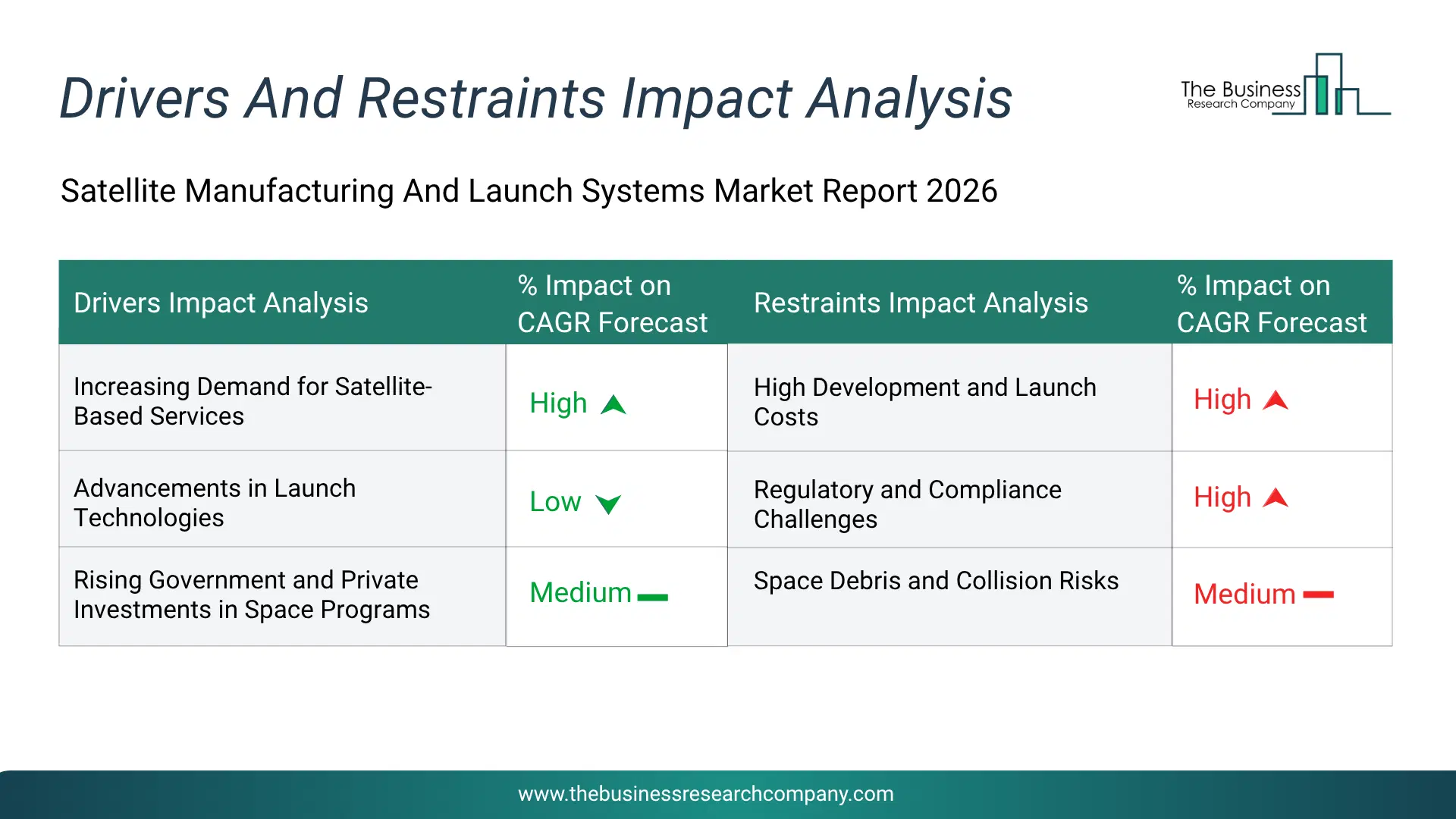
Infographic Chart Showing Key Market Drivers Analysis And Restraints For Satellite Manufacturing And Launch Systems Market
The chart presents an impact analysis of key drivers and restraints, quantifying their relative influence on the market's growth rate and helping assess the balance between growth enablers and limiting factors. This chart offers a high-level perspective; the full report contains more detailed insights.
How Will The Drivers Impact Growth In The Global Satellite Manufacturing And Launch Systems Market?
• Increasing Demand for Satellite-Based Services (High) – During the forecast period, the increasing demand for satellite-based services is expected to become a key growth driver for the satellite manufacturing and launch systems market by 2030. The rising reliance on satellite-enabled applications such as broadband connectivity, earth observation, navigation, and remote sensing is significantly expanding the need for advanced satellite infrastructure. Growing digitalization across industries and underserved connectivity regions is accelerating the deployment of satellite constellations. Service providers are focusing on enhancing coverage, capacity, and latency through next-generation satellite systems. This growing dependence on space-based services is strengthening demand for both manufacturing and launch capabilities. • Advancements in Launch Technologies (Low) – During the forecast period, the advancements in launch technologies are expected to emerge as a major factor driving the expansion of the satellite manufacturing and launch systems market by 2030. Continuous innovation in propulsion systems, reusable launch vehicles, and small satellite launch platforms is improving launch efficiency and reducing overall mission costs. These advancements are enabling higher launch frequency and supporting the rapid deployment of large satellite constellations. Market participants are also focusing on flexible launch solutions to cater to diverse payload requirements. Enhanced reliability and turnaround time of launch systems are further strengthening market growth. • Rising Government and Private Investments in Space Programs (Medium) – During the forecast period, the rising government and private investments in space programs are expected to act as a key growth catalyst for the satellite manufacturing and launch systems market by 2030. Increasing budget allocations for national space missions, defense-related satellite programs, and scientific exploration are driving demand for satellite production and launch services. At the same time, private sector participation is accelerating innovation, commercialization, and competitive dynamics within the space ecosystem. Strategic collaborations between public agencies and commercial players are expanding project pipelines and enhancing technological capabilities. As investment momentum continues to grow globally, infrastructure development and launch activities are expected to increase significantly.How Will The Restraints Impact Growth In The Global Satellite Manufacturing And Launch Systems Market?
• High Development and Launch Costs (High) – During the forecast period, high development and launch costs are significantly restricting the growth of the satellite manufacturing and launch systems market. Substantial capital requirements for satellite design, testing, manufacturing, and launch operations, along with insurance and mission risks, are limiting participation, especially for emerging players and smaller organizations. • Regulatory and Compliance Challenges (Low) – During the forecast period, regulatory and compliance challenges are restricting the growth of the satellite manufacturing and launch systems market. Complex licensing procedures, export control regulations, and international space governance frameworks are increasing operational complexity and slowing down project approvals and cross-border collaborations. • Space Debris and Collision Risks (Medium) – During the forecast period, space debris and collision risks are restricting the growth of the satellite manufacturing and launch systems market. Increasing congestion in low Earth orbit and the growing risk of orbital collisions are necessitating enhanced tracking, mitigation measures, and insurance costs, thereby increasing operational uncertainty for satellite operators and manufacturers.Key Players In The Global Satellite Manufacturing And Launch Systems Market
Major companies operating in the satellite manufacturing and launch systems market are Northrop Grumman Corporation, ArianeGroup, Space Exploration Technologies Corp., Blue Origin LLC, Lockheed Martin Corporation, The Boeing Company, Sierra Nevada Corporation, Thales Group, Maxar Technologies Inc., Dynetics Inc., NanoAvionics UAB, Israel Aerospace Industries Ltd., OHB SE, Airbus SE, China Aerospace Science and Technology Corporation, Mitsubishi Heavy Industries Ltd., SpaceQuest Ltd, GomSpace Group AB, Planet Labs Inc., United Launch Alliance LLC, Rocket Lab USA Inc., GeoOptics Inc., Honeywell International Inc., BAE Systems plc, Safran S.A., Parker Hannifin Corporation, Cobham plc., Kratos Defense & Security Solutions Inc.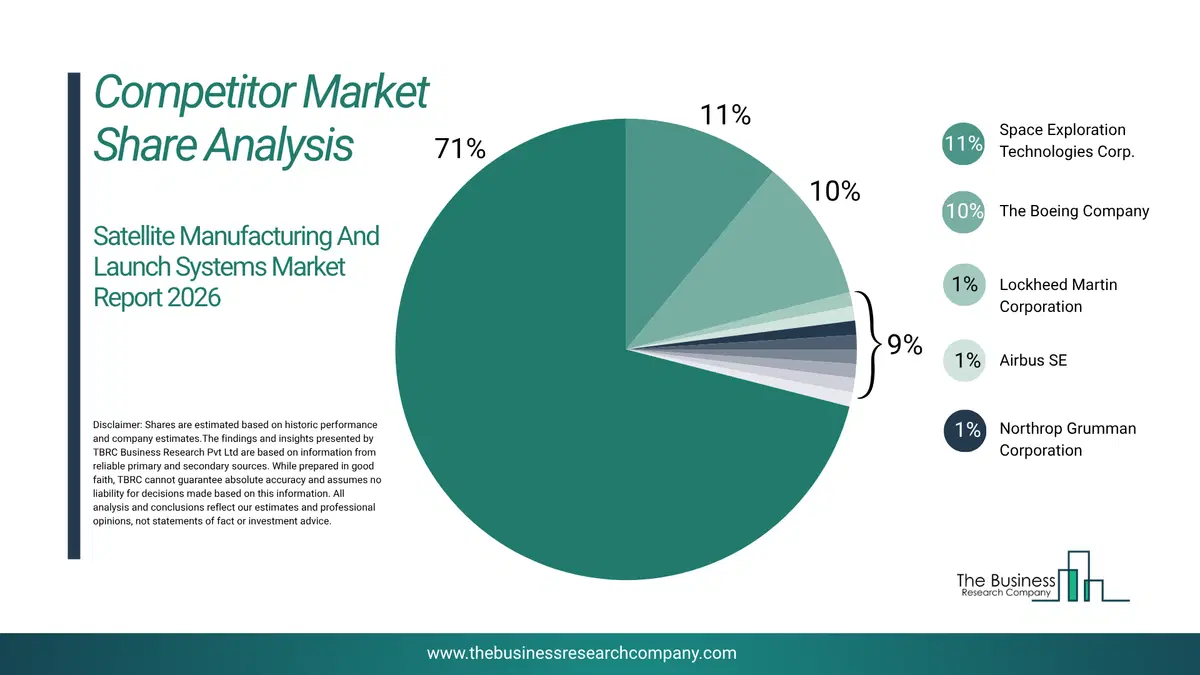
This chart is for illustrative purposes; the full report includes a detailed competitor analysis and comprehensive overview of the top 10 companies in the market.
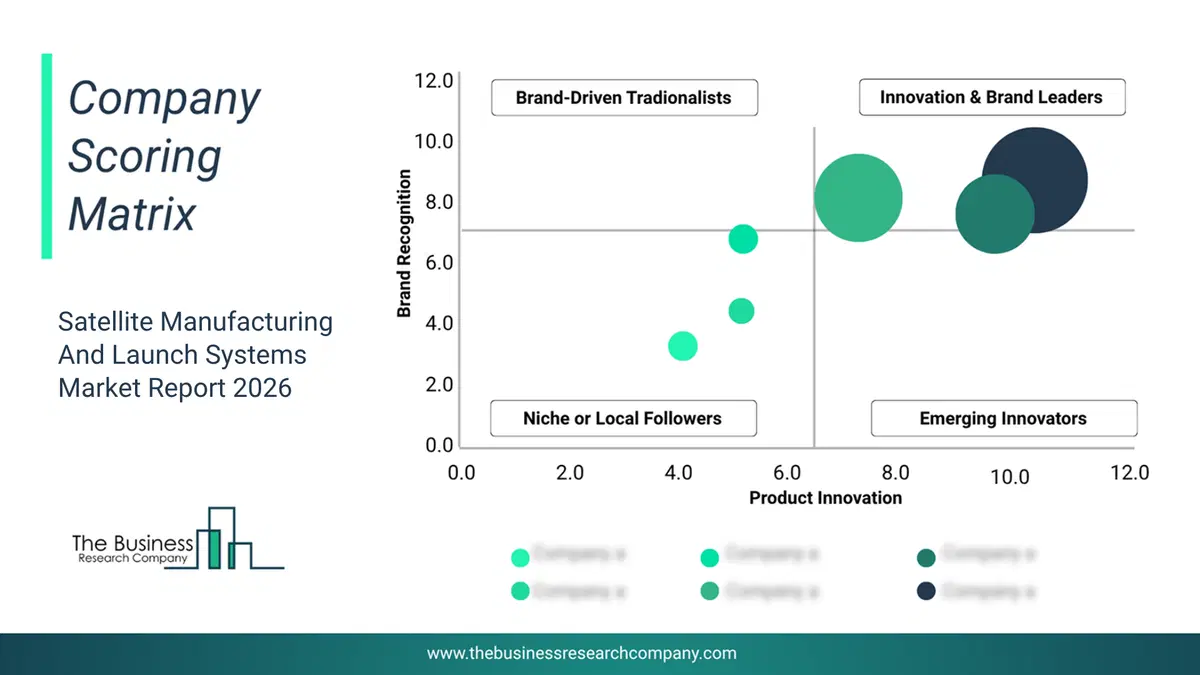
This chart maps companies by product innovation and brand strength, with bubble size indicating relative revenue, helping identify market leaders, challengers, and niche players. This is an illustrative chart; the full report provides a complete and accurate competitive analysis.
Global Satellite Manufacturing And Launch Systems Market Trends and Insights
Major companies operating in the satellite manufacturing and launch systems market are developing miniature and small satellites to gain a competitive edge in the market. Miniaturized satellites, such as CubeSats and SmallSats, offer cost-effective options for various applications, including Earth observation, communication, and scientific research. For instance, in May 2023, Rocket Lab, Inc., a US-based aerospace manufacturing company, launched a pair of NASA cubesats designed for monitoring tropical storms. The Time-Resolved Observations of Precipitation structure and storm Intensity with a Constellation of Smallsats (TROPICS) cubesats were deployed into a 550-kilometer orbit, providing crucial data for tracking the development of tropical storms. A second Electron (launch vehicle) launch will carry two more TROPICS cubesats, completing the four-satellite system. This constellation will enable hourly updates on temperature and water vapor profiles, significantly improving the understanding of storm formation and intensification and enhancing hurricane and tropical weather system forecasting capabilities.What Are Latest Mergers And Acquisitions In The Satellite Manufacturing And Launch Systems Market? Lockheed Martin Acquires Terran Orbital To Expand Small Satellite Capabilities
In October 2024, Lockheed Martin Corporation, a US-based defense and aerospace manufacturing company, acquired Terran Orbital Corporation for approximately $450 million. With this acquisition, Lockheed Martin Corporation aims to strengthen its position in the rapidly growing small satellite sector by integrating Terran Orbital Corporation’s end-to-end satellite solutions, including design, production, launch planning, and mission operations. Terran Orbital Corporation is a US-based manufacturing company that specializes in providing satellite manufacturing and launch systems.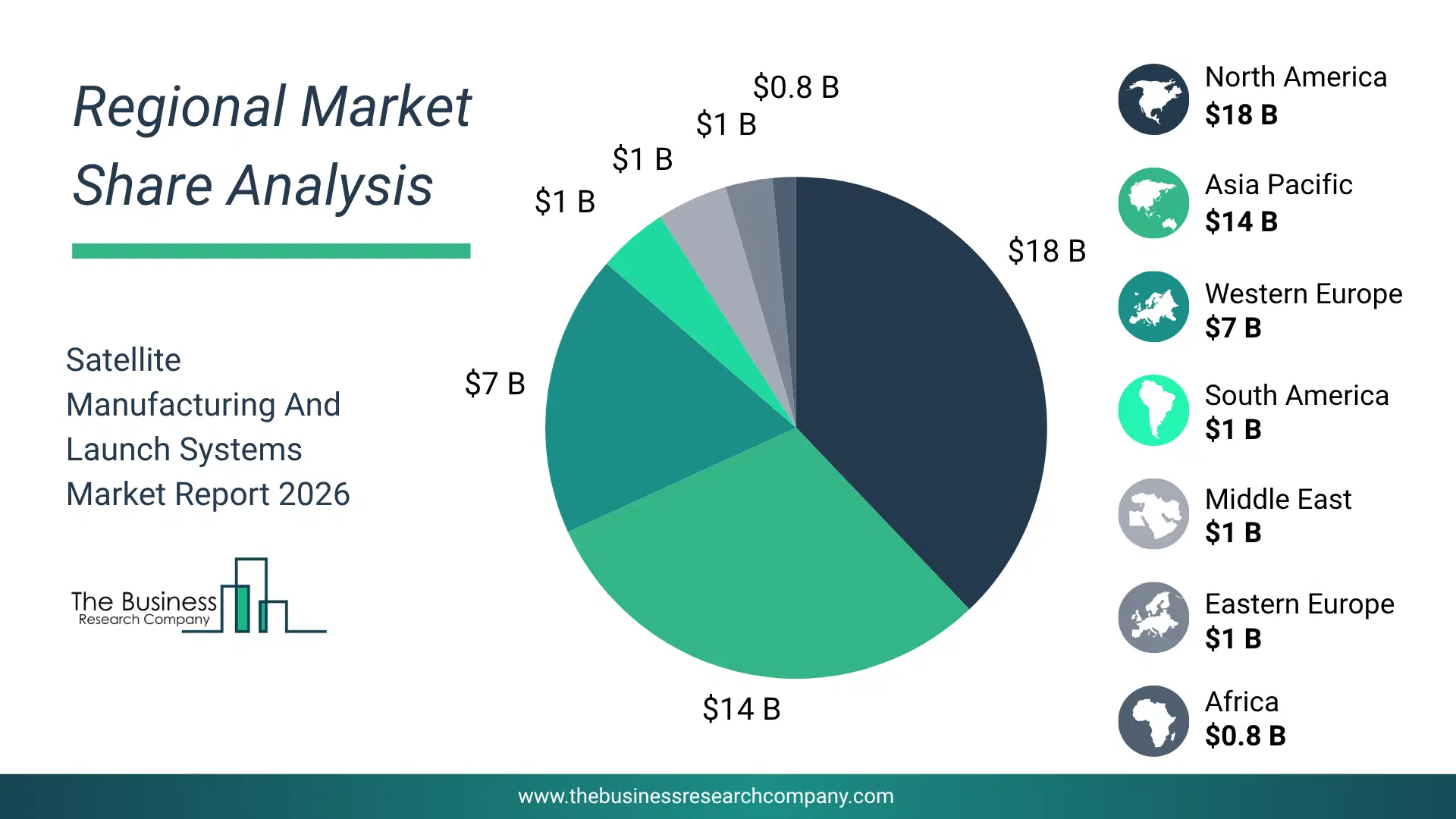
Regional Insights
North America was the largest region in the satellite manufacturing and launch systems market in 2025. The Asia-Pacific is expected to be the fastest-growing region in the forecast period. The regions covered in this market report are Asia-Pacific, South East Asia, Western Europe, Eastern Europe, North America, South America, Middle East, Africa. The countries covered in this market report are Australia, Brazil, China, France, Germany, India, Indonesia, Japan, Taiwan, Russia, South Korea, UK, USA, Canada, Italy, SpainWhat Defines the Satellite Manufacturing And Launch Systems Market?
The satellite manufacturing and launch system market consists of sales of satellite and launch systems such as highly elliptical orbit, near-polar sun-synchronous orbit, polar orbit, and geostationary transfer orbit. Values in this market are ‘factory gate’ values, that is the value of goods sold by the manufacturers or creators of the goods, whether to other entities (including downstream manufacturers, wholesalers, distributors, and retailers) or directly to end customers. The value of goods in this market includes related services sold by the creators of the goods.How is Market Value Defined and Measured?
The market value is defined as the revenues that enterprises gain from the sale of goods and/or services within the specified market and geography through sales, grants, or donations in terms of the currency (in USD unless otherwise specified). The revenues for a specified geography are consumption values that are revenues generated by organizations in the specified geography within the market, irrespective of where they are produced. It does not include revenues from resales along the supply chain, either further along the supply chain or as part of other products.
This chart presents market attractiveness based on a quantitative evaluation of growth, competition, strategic alignment, and risk, offering a clear view of opportunity areas for decision-making. This chart is for illustrative purposes; the full report contains the complete analysis.

This chart highlights the Total Addressable Market (TAM) by estimating the maximum revenue opportunity using an assumption-driven approach, supporting strategic planning and opportunity sizing across markets. The chart is illustrative; the full report provides a more comprehensive analysis.
What Key Data and Analysis Are Included in the Satellite Manufacturing And Launch Systems Market Report 2026?
The satellite manufacturing and launch systems market research report is one of a series of new reports from The Business Research Company that provides market statistics, including industry global market size, regional shares, competitors with the market share, detailed market segments, market trends and opportunities, and any further data you may need to thrive in the satellite manufacturing and launch systems industry. The market research report delivers a complete perspective of everything you need, with an in-depth analysis of the current and future state of the industry.Satellite Manufacturing And Launch Systems Market Report Forecast Analysis
| Report Attribute | Details |
|---|---|
| Market Size Value In 2026 | $32.26 billion |
| Revenue Forecast In 2030 | $43.81 billion |
| Growth Rate | CAGR of 9.0% from 2026 to 2030 |
| Base Year For Estimation | 2025 |
| Actual Estimates/Historical Data | 2020-2025 |
| Forecast Period | 2026 - 2030 |
| Market Representation | Revenue in USD Billion and CAGR from 2026 to 2030 |
| Segments Covered | Technology Type, Satellite Type, Application, End-User |
| Regional Scope | Asia-Pacific, Western Europe, Eastern Europe, North America, South America, Middle East, Africa |
| Country Scope | The countries covered in the report are Australia, Brazil, China, France, Germany, India, Indonesia, Japan, Taiwan, Russia, South Korea, UK, USA, Canada, Italy, Spain. |
| Key Companies Profiled | Northrop Grumman Corporation, ArianeGroup, Space Exploration Technologies Corp., Blue Origin LLC, Lockheed Martin Corporation, The Boeing Company, Sierra Nevada Corporation, Thales Group, Maxar Technologies Inc., Dynetics Inc., NanoAvionics UAB, Israel Aerospace Industries Ltd., OHB SE, Airbus SE, China Aerospace Science and Technology Corporation, Mitsubishi Heavy Industries Ltd., SpaceQuest Ltd, GomSpace Group AB, Planet Labs Inc., United Launch Alliance LLC, Rocket Lab USA Inc., GeoOptics Inc., Honeywell International Inc., BAE Systems plc, Safran S.A., Parker Hannifin Corporation, Cobham plc., Kratos Defense & Security Solutions Inc. |
| Customization Scope | Request for Customization |
| Pricing And Purchase Options | Explore Purchase Options |