

Satellite Reconnaissance Market Report 2026
Global Outlook – By Type (Optical Reconnaissance Satellites, Radar Reconnaissance Satellites, Electronic Reconnaissance Satellites, Signals Intelligence (SIGINT) Satellites, Other Satellite), By Platform (Earth Observation Satellites, Reconnaissance Drones), By Orbit (Low Earth Orbit (LEO), Geosynchronous Earth Orbit (GEO), Medium Earth Orbit (MEO), Other Orbits), By Application (Intelligence, Surveillance, And Reconnaissance (ISR), Earth Observation and Mapping, Signal Intelligence (SIGINT), Electronic Intelligence (ELINT), Communications Intelligence (COMINT), Other Applications), By End User (Défense And Intelligence Agencies, Government And Civil Agencies, Commercial Enterprises) – Market Size, Trends, Strategies, and Forecast to 2035
Satellite Reconnaissance Market Overview
• Satellite Reconnaissance market size has reached to $16.53 billion in 2025 • Expected to grow to $28.74 billion in 2030 at a compound annual growth rate (CAGR) of 11.6% • Growth Driver: Surge In Demand For National Security And Defense Intelligence Fueling The Growth Of The Market Due To Rising Global Military Expenditure • Market Trend: Advancing Next-Generation Satellite Reconnaissance Capabilities • North America was the largest region in 2025 and Asia-Pacific is the fastest growing region.What Is Covered Under Satellite Reconnaissance Market?
Satellite reconnaissance is the use of orbiting satellites equipped with imaging or sensing payloads to observe, monitor, and collect data about the Earth’s surface and activities. Its purpose is to provide high-resolution intelligence for defense, security, environmental monitoring, disaster response, and strategic decision-making. The main types of satellite reconnaissance include optical reconnaissance satellites, radar reconnaissance satellites, electronic reconnaissance satellites, signals intelligence (SIGINT) satellites, and others. Optical reconnaissance satellites use high-resolution imaging sensors to capture detailed visual data of the Earth’s surface for monitoring and intelligence purposes. Different platforms include earth observation satellites and reconnaissance drones. Multiple orbits are low earth orbit (LEO), geosynchronous earth orbit (GEO), medium earth orbit (MEO), and others. Various applications involved are intelligence, surveillance, and reconnaissance (ISR), earth observation and mapping, signal intelligence (SIGINT), electronic intelligence (ELINT), communications intelligence (COMINT), and others, and they are utilized by several end users such as defense and intelligence agencies, government and civil agencies, and commercial enterprises.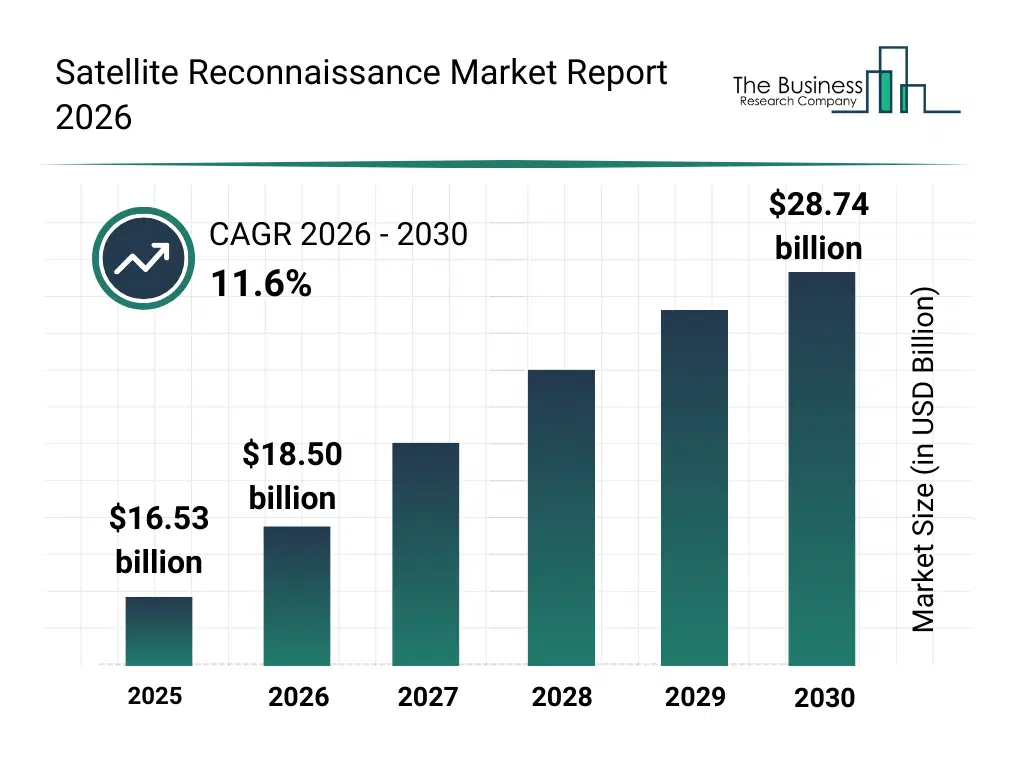
What Is The Satellite Reconnaissance Market Size and Share 2026?
The satellite reconnaissance market size has grown rapidly in recent years. It will grow from $16.53 billion in 2025 to $18.50 billion in 2026 at a compound annual growth rate (CAGR) of 11.9%. The growth in the historic period can be attributed to increasing defense spending, growing demand for earth observation, rising need for border surveillance, expansion of military modernization programs, and increasing use of satellite imaging for disaster management.What Is The Satellite Reconnaissance Market Growth Forecast?
The satellite reconnaissance market size is expected to see rapid growth in the next few years. It will grow to $28.74 billion in 2030 at a compound annual growth rate (CAGR) of 11.6%. The growth in the forecast period can be attributed to growing investment in intelligence capabilities, rising adoption of small satellites, increasing demand for real-time imaging, expansion of commercial satellite operators, and growing use of satellite data in environmental monitoring. Major trends in the forecast period include technology advancements in remote sensing, innovations in satellite imaging systems, developments in artificial intelligence (AI)-based image analytics, research and development in small-satellite constellations, and advancements in hyperspectral and SAR imaging.
Global Satellite Reconnaissance Market Segmentation
1) By Type: Optical Reconnaissance Satellites, Radar Reconnaissance Satellites, Electronic Reconnaissance Satellites, Signals Intelligence (SIGINT) Satellites, Other Satellite 2) By Platform: Earth Observation Satellites, Reconnaissance Drones 3) By Orbit: Low Earth Orbit (LEO), Geosynchronous Earth Orbit (GEO), Medium Earth Orbit (MEO), Other Orbits 4) By Application: Intelligence, Surveillance, And Reconnaissance (ISR), Earth Observation and Mapping, Signal Intelligence (SIGINT), Electronic Intelligence (ELINT), Communications Intelligence (COMINT), Other Applications 5) By End User: Défense And Intelligence Agencies, Government And Civil Agencies, Commercial Enterprises Subsegments: 1) By Optical Reconnaissance Satellites: High Resolution Imaging Satellites, Multispectral Imaging Satellites, Hyperspectral Imaging Satellites, Infrared Imaging Satellites, Panchromatic Imaging Satellites 2) By Radar Reconnaissance Satellites: Synthetic Aperture Radar Satellites, Side Looking Airborne Radar Satellites, Interferometric Radar Satellites, Moving Target Indicator Radar Satellites 3) By Electronic Reconnaissance Satellites: Electronic Signal Interception Satellites, Radar Signal Monitoring Satellites, Electronic Emission Mapping Satellites, Electronic Threat Detection Satellites 4) By Signals Intelligence Satellites: Communication Signal Interception Satellites, Signal Monitoring Satellites, Command And Control Signal Analysis Satellites, Frequency Analysis Satellites 5) By Other Satellites: Early Warning Satellites, Measurement And Signature Intelligence Satellites, Multisensor Fusion Satellites, Special Purpose Reconnaissance SatellitesWhat Is The Driver Of The Satellite Reconnaissance Market?
The increasing demand for national security and defense intelligence is expected to propel the growth of the satellite reconnaissance market going forward. National security and defense intelligence refer to the requirements of countries to collect strategic information, including imagery and signals from orbit to monitor threats, conflicts, and security developments. The rise in demand for national security and defense intelligence is due to geopolitical tensions and conflicts around the world have escalated, prompting governments to allocate more resources for defence and surveillance. The satellite reconnaissance supports national security and defense intelligence by providing the necessary space-based observation capabilities to satisfy those enhanced surveillance needs. For instance, in April 2025, according to the Stockholm International Peace Research Institute (SIPRI), a Sweden-based research institute, world military expenditure rose by 9.4% in real terms from 2023 to reach a record total of $2.7 trillion in 2024, with average military spending reached 7.1 percent of total government expenditure in 2024. Therefore, the increasing demand for national security and defense intelligence is driving the growth of the satellite reconnaissance industry.Key Players In The Global Satellite Reconnaissance Market
Major companies operating in the satellite reconnaissance market are Boeing Co., Airbus SE, BAE Systems, Northrop Grumman Corp., L3Harris Technologies Inc., Surrey Satellite Technology Ltd (SSTL), Planet Labs PBC, ICEYE, EarthDaily Analytics, BlackSky Technology Inc., Capella Space, True Anomaly Inc., Pixxel, Kongsberg Satellite Services, GHGSat Inc., SpaceKnow Inc., Satellogic Inc., OHB SE, Albedo Space Corp., Ursa Space Systems Inc., Turion Space, Earth-i Ltd., SI Imaging Services Co. Ltd., ImageSat International NV, Maxar TechnologiesGlobal Satellite Reconnaissance Market Trends and Insights
Major companies operating in the satellite reconnaissance market are focusing on advanced technology platforms, such as high-resolution swath platforms, to improve detection capabilities, imaging accuracy, and operational coverage. High‑resolution swath platforms refers to Earth‑observation or radar imaging systems that capture very detailed images over a wide ground strip in a single pass combining fine spatial resolution with broad area coverage. For instance, in March 2025, ICEYE Oy, a Finland-based earth observation company, launched four new synthetic aperture radar (SAR) satellites including its Generation 4 (Gen4) model with 25 cm resolution. The new platform doubles antenna size and transmit power, expanding high-resolution swath platforms from 150 to 400 kilometers and boosting information density by about 30%, while enhanced orbit control and greater imaging capacity support better coverage of high‑priority, congested regions in a single pass. Designed to deliver sharper detection and classification of vessels, vehicles, and aircraft, the Gen4 launch is aimed at providing defense, intelligence, and other customers with superior situational awareness, faster decision-making, and more effective mission outcomes.What Are Latest Mergers And Acquisitions In The Satellite Reconnaissance Market?
In August 2024, Lockheed Martin Corporation, a US-based defense and aerospace systems provider, acquired Terran Orbital Corporation for approximately $450 million. Through this acquisition, Lockheed Martin Corporation aims to enhance its satellite reconnaissance and space systems capabilities by integrating Terran Orbital Corporation’s expertise in small-satellite design, production, and constellation deployment, enabling more responsive, resilient, and data-rich space missions for defense, intelligence, and commercial applications. Terran Orbital Corporation is a US-based manufacturer of modular satellites, satellite buses, mission services, and satellite reconnaissance.Regional Insights
North America was the largest region in the satellite reconnaissance market in 2025. Asia-Pacific is expected to be the fastest-growing region in the forecast period. The regions covered in this market report are Asia-Pacific, South East Asia, Western Europe, Eastern Europe, North America, South America, Middle East, Africa. The countries covered in this market report are Australia, Brazil, China, France, Germany, India, Indonesia, Japan, Taiwan, Russia, South Korea, UK, USA, Canada, Italy, Spain.What Defines the Satellite Reconnaissance Market?
The satellite reconnaissance market consists of revenues earned by entities by providing services such as earth observation and imagery collection, geospatial intelligence (GEOINT) analysis, real-time monitoring and surveillance, satellite tasking and data-as-a-service (DaaS), and mission planning and satellite operations support. The market value includes the value of related goods sold by the service provider or included within the service offering. The satellite reconnaissance market also includes sales of high-resolution satellite imagery products, multispectral and hyperspectral sensor payloads, ground-receiving and processing terminals, geospatial analytics software and map products, and subscription-based data feeds and application programming interface (APIs). Values in this market are ‘factory gate’ values, that is, the value of goods sold by the manufacturers or creators of the goods, whether to other entities (including downstream manufacturers, wholesalers, distributors, and retailers) or directly to end customers. The value of goods in this market includes related services sold by the creators of the goods.How is Market Value Defined and Measured?
The market value is defined as the revenues that enterprises gain from the sale of goods and/or services within the specified market and geography through sales, grants, or donations in terms of the currency (in USD unless otherwise specified). The revenues for a specified geography are consumption values that are revenues generated by organizations in the specified geography within the market, irrespective of where they are produced. It does not include revenues from resales along the supply chain, either further along the supply chain or as part of other products.What Key Data and Analysis Are Included in the Satellite Reconnaissance Market Report 2026?
The satellite reconnaissance market research report is one of a series of new reports from The Business Research Company that provides market statistics, including industry global market size, regional shares, competitors with the market share, detailed market segments, market trends and opportunities, and any further data you may need to thrive in the satellite reconnaissance industry. The market research report delivers a complete perspective of everything you need, with an in-depth analysis of the current and future state of the industry.Satellite Reconnaissance Market Report Forecast Analysis
| Report Attribute | Details |
|---|---|
| Market Size Value In 2026 | $18.50 billion |
| Revenue Forecast In 2035 | $28.74 billion |
| Growth Rate | CAGR of 11.9% from 2026 to 2035 |
| Base Year For Estimation | 2025 |
| Actual Estimates/Historical Data | 2020-2025 |
| Forecast Period | 2026 - 2030 - 2035 |
| Market Representation | Revenue in USD Billion and CAGR from 2026 to 2035 |
| Segments Covered | Type, Platform, Orbit, Application, End User |
| Regional Scope | Asia-Pacific, Western Europe, Eastern Europe, North America, South America, Middle East, Africa |
| Country Scope | The countries covered in the report are Australia, Brazil, China, France, Germany, India, ... |
| Key Companies Profiled | Boeing Co., Airbus SE, BAE Systems, Northrop Grumman Corp., L3Harris Technologies Inc., Surrey Satellite Technology Ltd (SSTL), Planet Labs PBC, ICEYE, EarthDaily Analytics, BlackSky Technology Inc., Capella Space, True Anomaly Inc., Pixxel, Kongsberg Satellite Services, GHGSat Inc., SpaceKnow Inc., Satellogic Inc., OHB SE, Albedo Space Corp., Ursa Space Systems Inc., Turion Space, Earth-i Ltd., SI Imaging Services Co. Ltd., ImageSat International NV, Maxar Technologies |
| Customization Scope | Request for Customization |
| Pricing And Purchase Options | Explore Purchase Options |