
Satellite Spectrum Monitoring Market Report 2026
Global Outlook – By Component (Hardware, Software, Services), By Orbit (Geostationary Orbit Monitoring, Non Geostationary Orbit Monitoring, Multi Orbit Monitoring), By Frequency (Very High Frequency, Ultra High Frequency, Super High Frequency, Extremely High Frequency), By End User (Aerospace, Maritime, Oil And Gas, Military, Government, Media And Entertainment) – Market Size, Trends, Strategies, and Forecast to 2035
Satellite Spectrum Monitoring Market Overview
• Satellite Spectrum Monitoring market size has reached to $3.38 billion in 2025 • Expected to grow to $5.96 billion in 2030 at a compound annual growth rate (CAGR) of 11.9% • Growth Driver: Increasing Number Of Satellite Launches Fueling The Growth Of The Market Due To Rising Need For Frequency Monitoring, Interference Detection, And Spectrum Coordination • Market Trend: AI-Powered Solutions Transforming Satellite Spectrum Monitoring • North America was the largest region in 2025 and Asia-Pacific is the fastest growing region.What Is Covered Under Satellite Spectrum Monitoring Market?
Satellite spectrum monitoring refers to the use of technologies and systems to detect, analyze, characterize, and monitor radio-frequency signals associated with satellite communications. It encompasses spectrum monitoring hardware, signal analysis and processing software, and related systems used to identify interference, assess spectrum usage, support regulatory requirements, and maintain reliable satellite communications. The main components of satellite spectrum monitoring include hardware, software, and services. Hardware refers to physical monitoring equipment used to detect, measure, identify, and analyze radio frequency signals transmitted through satellite communication systems. These solutions support geostationary orbit monitoring, non geostationary orbit monitoring, and multi orbit monitoring. The key frequencies include very high frequency, ultra high frequency, super high frequency, and extremely high frequency, and they are used by several end users such as aerospace, maritime, oil and gas, military, government, and media and entertainment.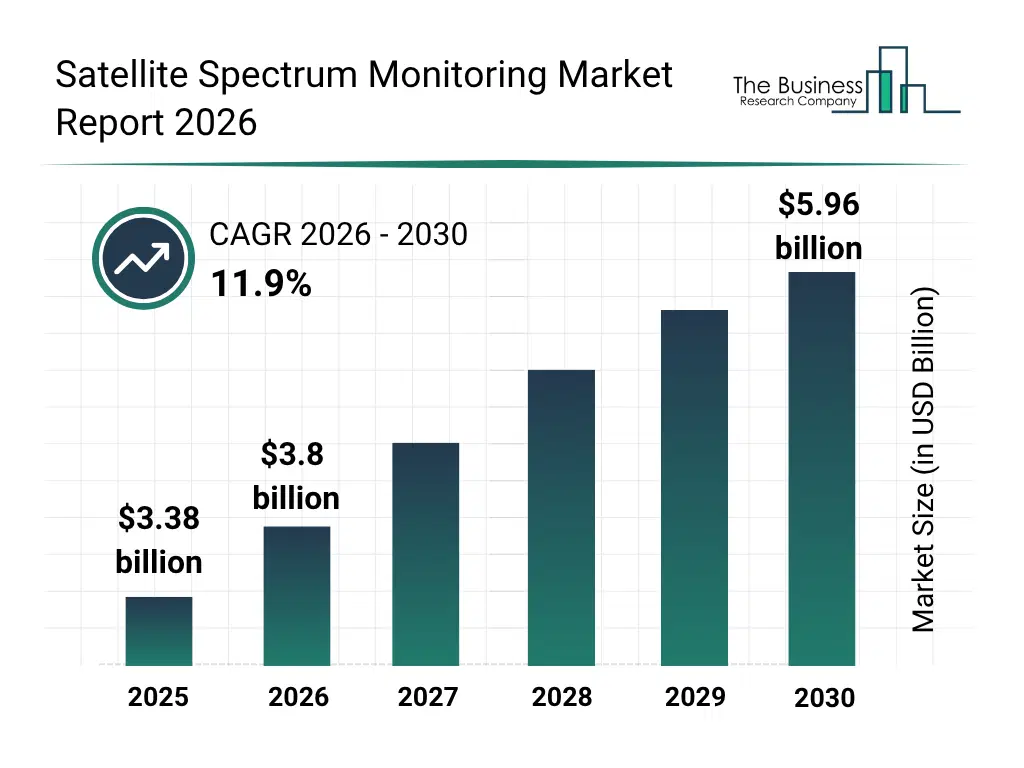
What Is The Satellite Spectrum Monitoring Market Size and Share 2026?
The satellite spectrum monitoring market size has grown rapidly in recent years. It will grow from $3.38 billion in 2025 to $3.8 billion in 2026 at a compound annual growth rate (CAGR) of 12.3%. The growth in the historic period can be attributed to increasing satellite communication deployments, rising demand for interference detection, growing satellite spectrum congestion, increasing regulatory compliance requirements, expansion of satellite-based broadcasting services.What Is The Satellite Spectrum Monitoring Market Growth Forecast?
The satellite spectrum monitoring market size is expected to see rapid growth in the next few years. It will grow to $5.96 billion in 2030 at a compound annual growth rate (CAGR) of 11.9%. The growth in the forecast period can be attributed to rising deployment of large satellite constellations, increasing demand for secure spectrum management, growing use of high-frequency satellite communications, expansion of commercial satellite broadband networks, increasing need for real-time spectrum intelligence. Major trends in the forecast period include real-time spectrum monitoring, automated interference detection, multi-orbit spectrum surveillance, dynamic frequency allocation, advanced signal geolocation.Tariff Impact On Satellite Spectrum Monitoring Market
Tariffs are impacting the satellite spectrum monitoring market by increasing the cost of imported spectrum analyzers, monitoring receivers, RF antennas, signal processing units, and specialized electronic components. Hardware and monitoring equipment segments are likely to experience the greatest cost pressures, particularly in North America, Europe, and Asia-Pacific due to globally interconnected electronics and aerospace supply chains. However, tariffs may encourage regional manufacturing, supplier diversification, and development of domestically produced spectrum monitoring technologies, strengthening supply-chain resilience and local capabilities.
Global Satellite Spectrum Monitoring Market Segmentation
2) By Orbit: Geostationary Orbit Monitoring, Non Geostationary Orbit Monitoring, Multi Orbit Monitoring 3) By Frequency: Very High Frequency, Ultra High Frequency, Super High Frequency, Extremely High Frequency 4) By End User: Aerospace, Maritime, Oil And Gas, Military, Government, Media And Entertainment Subsegments: 1) By Hardware: Spectrum Monitoring Receivers, Radio Frequency Antennas, Spectrum Analyzers, Signal Processing Units, Monitoring Sensors, Data Acquisition Systems, Communication Gateways, Control Consoles 2) By Software: Spectrum Analysis Software, Signal Processing Software, Interference Detection Software, Spectrum Management Software, Network Monitoring Software, Data Visualization Software, Reporting And Analytics Software, Remote Monitoring Software 3) By Services: Installation Services, Integration Services, Consulting Services, Managed Monitoring Services, Maintenance And Support Services, Training Services, Calibration Services, Technical Support ServicesWhat Is The Driver Of The Satellite Spectrum Monitoring Market?
The increasing number of satellite launches is expected to propel the growth of the satellite spectrum monitoring market going forward. Satellite launches are the process of sending artificial satellites into Earth's orbit using launch vehicles to support communication, navigation, Earth observation, scientific research, and defense applications. The increasing number of satellite launches is due to expanding global space activities, leading governments and commercial organizations to deploy more satellites for communication, navigation, Earth observation, and broadband connectivity. Satellite launches support the growth of satellite spectrum monitoring by expanding the number of active satellite signals that require continuous frequency monitoring, interference detection, spectrum coordination, and regulatory compliance. For instance, in May 2026, according to the Satellite Industry Association (SIA), a US-based trade association, in 2025, a total of 325 launches were conducted worldwide, including 296 commercially procured launches, while global commercial launch revenues reached $12.4 billion, representing a 33% increase compared with 2024. Therefore, the increasing number of satellite launches is driving the growth of the satellite spectrum monitoring industry.Key Players In The Global Satellite Spectrum Monitoring Market
Major companies operating in the satellite spectrum monitoring market are Lockheed Martin Corporation, Airbus SE, Northrop Grumman Corporation, Thales SA, Safran, Keysight Technologies Inc., Rohde & Schwarz GmbH & Co. KG, SES S.A., Viasat Inc., Kratos Defense & Security Solutions Inc., Anritsu Corporation, Singapore Technologies Engineering Ltd., Comtech Telecommunications Corp., Telesat Corporation, Gilat Satellite Networks Ltd., Atos SE, Calian Group Ltd., LS telcom AG, SKY Perfect JSAT Corporation, Integrasys S.A., CRFS Limited, Narda Safety Test Solutions GmbH, Celestia Technologies Group, LP Technologies Inc.
This chart is for illustrative purposes; the full report includes a detailed competitor analysis and comprehensive overview of the top 10 companies in the market.
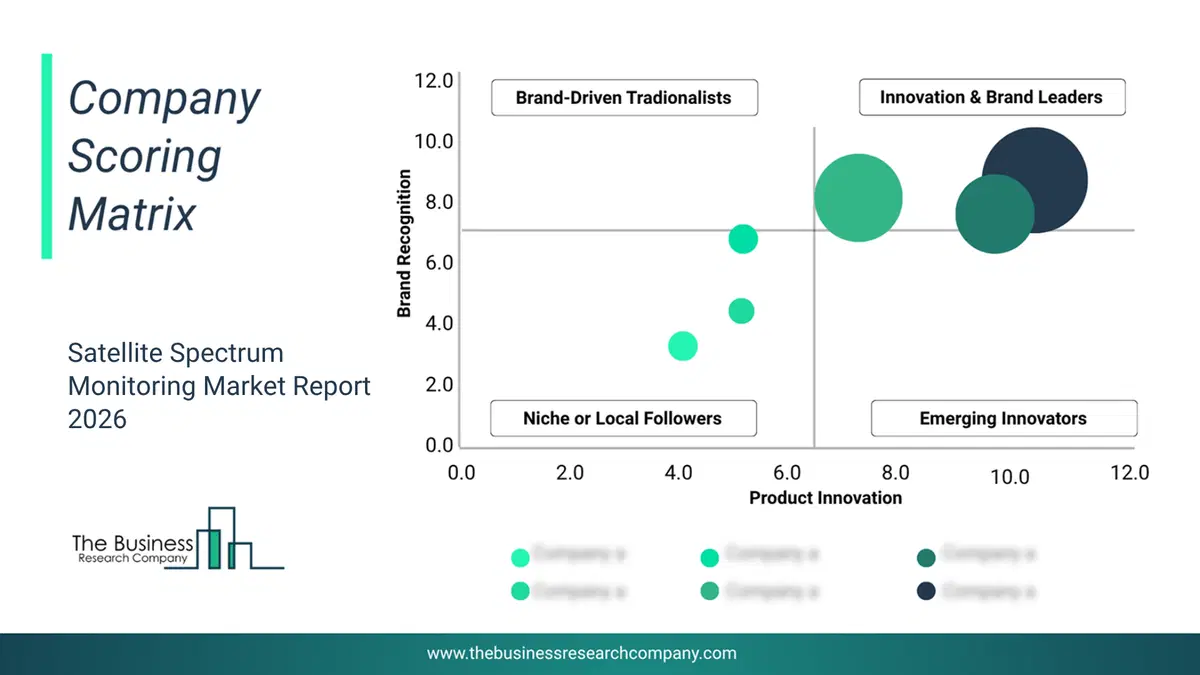
This chart maps companies by product innovation and brand strength, with bubble size indicating relative revenue, helping identify market leaders, challengers, and niche players. This is an illustrative chart; the full report provides a complete and accurate competitive analysis.
Global Satellite Spectrum Monitoring Market Trends and Insights
Major companies operating in the satellite spectrum monitoring market are focusing on developing advanced solutions, such as AI-powered satellite monitoring systems, to enhance real-time spectrum visibility, improve interference prediction, optimize frequency resource allocation, and support efficient satellite communications. AI-powered satellite monitoring systems refer to advanced platforms that use artificial intelligence and real-time signal analysis to monitor satellite communications, identify potential interference, and improve spectrum utilization. For instance, in May 2025, Eviden, a France-based digital, cloud, big data, and security company, introduced SkyMon NG, a next-generation satellite monitoring solution designed to address the requirements of digital and modular satellite systems. The solution incorporates AI-powered interference prediction, real-time monitoring, virtualized ground-station capabilities, and frequency resource optimization to provide satellite operators and regulators with greater visibility and control over spectrum usage.What Are Latest Mergers And Acquisitions In The Satellite Spectrum Monitoring Market?
In May 2026, Anritsu EMEA GmbH, an Austria-based communication test and measurement solutions provider, partnered with YOTASYS AG to offer advanced AI-enabled spectrum monitoring solutions. As a result of the partnership, the companies introduced an AI-enabled spectrum monitoring solution that integrates Anritsu's spectrum analyzer technology with YOTASYS' AI software and GPU-accelerated processing capabilities. The solution supports wideband spectrum monitoring from 9 kHz to 54 GHz and is designed for applications including satellite communications, spectrum monitoring, wireless network optimization, regulatory compliance, defense and security systems, and next-generation wireless research. YOTASYS AG is a Switzerland-based technology company specializing in AI-driven cognitive communications, RF networking, and autonomous spectrum analysis.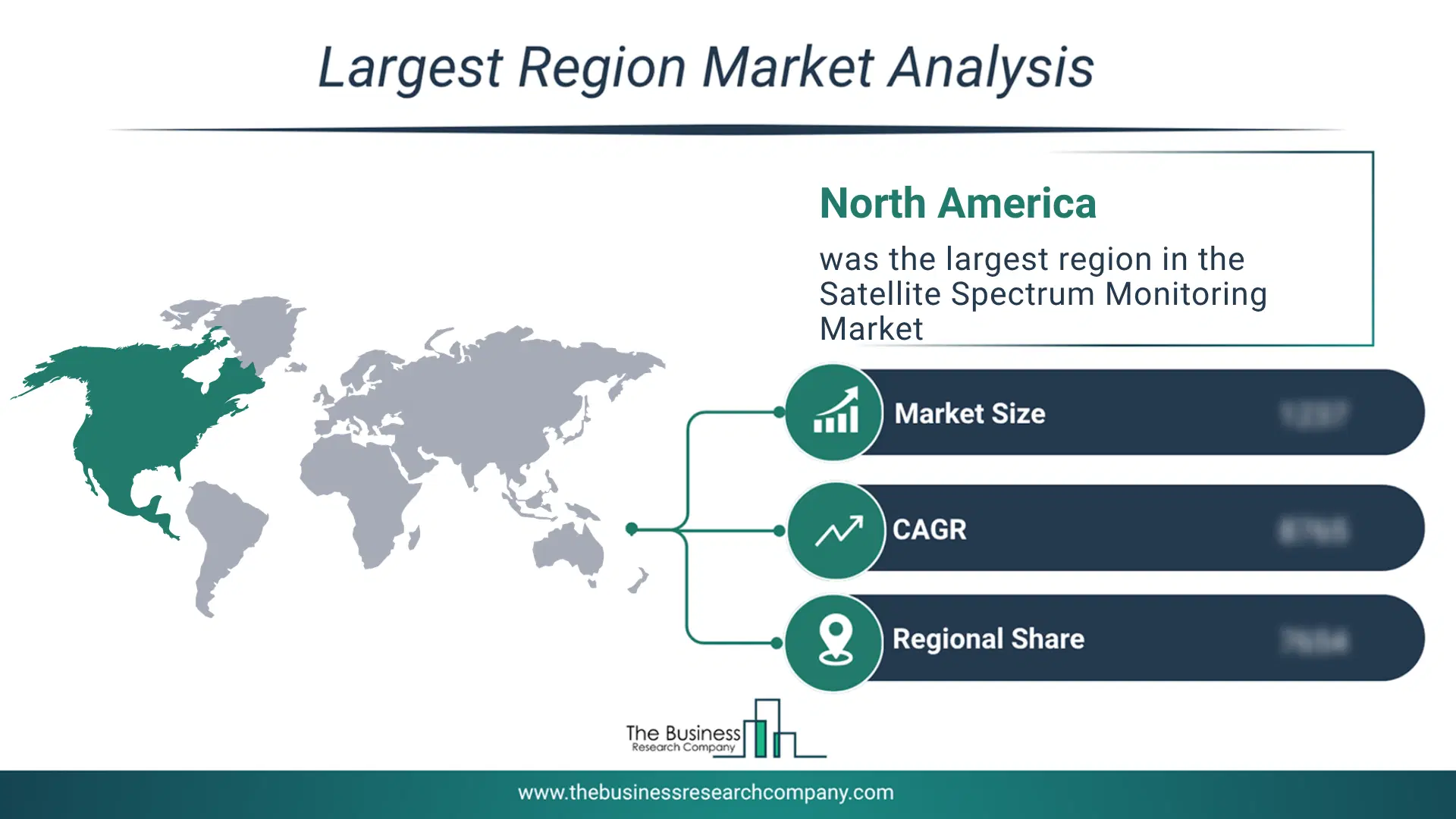
Regional Outlook/Insights
North America was the largest region in the satellite spectrum monitoring market in 2025. Asia-Pacific is expected to be the fastest-growing region in the forecast period. The regions covered in this market report are Asia-Pacific, South East Asia, Western Europe, Eastern Europe, North America, South America, Middle East, Africa. The countries covered in this market report are Australia, Brazil, China, France, Germany, India, Indonesia, Japan, Taiwan, Russia, South Korea, UK, USA, Canada, Italy, Spain.What Defines the Satellite Spectrum Monitoring Market?
The satellite spectrum monitoring market consists of revenues earned by entities by providing services such as satellite signal monitoring, radio frequency spectrum analysis, interference detection, spectrum management, signal geolocation, regulatory compliance monitoring, and satellite network performance monitoring. The market value includes the value of related goods sold by the service provider or included within the service offering. The satellite spectrum monitoring market also includes sales of spectrum monitoring systems, radio frequency monitoring equipment, spectrum monitoring antennas, signal analyzers, direction-finding receivers, and spectrum measurement equipment. Values in this market are ‘factory gate’ values, that is, the value of goods sold by the manufacturers or creators of the goods, whether to other entities (including downstream manufacturers, wholesalers, distributors and retailers) or directly to end customers. The value of goods in this market includes related services sold by the creators of the goods.How is Market Value Defined and Measured?
The market value is defined as the revenues that enterprises gain from the sale of goods and/or services within the specified market and geography through sales, grants, or donations in terms of the currency (in USD unless otherwise specified). The revenues for a specified geography are consumption values that are revenues generated by organizations in the specified geography within the market, irrespective of where they are produced. It does not include revenues from resales along the supply chain, either further along the supply chain or as part of other products.
This chart presents market attractiveness based on a quantitative evaluation of growth, competition, strategic alignment, and risk, offering a clear view of opportunity areas for decision-making. This chart is for illustrative purposes; the full report contains the complete analysis.

This chart highlights the Total Addressable Market (TAM) by estimating the maximum revenue opportunity using an assumption-driven approach, supporting strategic planning and opportunity sizing across markets. The chart is illustrative; the full report provides a more comprehensive analysis.
What Key Data and Analysis Are Included in the Satellite Spectrum Monitoring Market Report 2026?
The satellite spectrum monitoring market research report is one of a series of new reports from The Business Research Company that provides market statistics, including industry global market size, regional shares, competitors with the market share, detailed market segments, market trends and opportunities, and any further data you may need to thrive in the satellite spectrum monitoring industry. The market research report delivers a complete perspective of everything you need, with an in-depth analysis of the current and future state of the industry.Satellite Spectrum Monitoring Market Report Forecast Analysis
| Report Attribute | Details |
|---|---|
| Market Size Value In 2026 | $3.8 billion |
| Revenue Forecast In 2030 | $5.96 billion |
| Growth Rate | CAGR of 11.9% from 2026 to 2035 |
| Base Year For Estimation | 2025 |
| Actual Estimates/Historical Data | 2020-2025 |
| Forecast Period | 2026 - 2030 |
| Market Representation | Revenue in USD Billion and CAGR from 2026 to 2030 |
| Segments Covered | Component, Orbit, Frequency, End User |
| Regional Scope | Asia-Pacific, Western Europe, Eastern Europe, North America, South America, Middle East, Africa |
| Country Scope | The countries covered in the report are Australia, Brazil, China, France, Germany, India, Indonesia, Japan, Taiwan, Russia, South Korea, UK, USA, Canada, Italy, Spain. |
| Customization Scope | Request for Customization |
| Pricing And Purchase Options | Explore Purchase Options |