
Scenario-Based Autonomous Vehicle (AV) Testing Platforms Market Report 2026
Global Outlook – By Component (Software, Hardware, Services), By Deployment Mode (On-Premises, Cloud-Based), By Testing Type (Simulation Testing, Closed-Course Testing, On-Road Testing, Hardware-In-The-Loop, Software-In-The-Loop), By Application (Passenger Vehicles, Commercial Vehicles, Industrial Vehicles, Other Applications), By End-User (Automotive OEMs, Tier 1 Suppliers, Research Institutes, Regulatory Bodies, Other End-User) – Market Size, Trends, Strategies, and Forecast to 2030
Scenario-Based Autonomous Vehicle (AV) Testing Platforms Market Overview
• Scenario-Based Autonomous Vehicle (AV) Testing Platforms market size has reached to $1.45 billion in 2025 • Expected to grow to $3.09 billion in 2030 at a compound annual growth rate (CAGR) of 16.3% • Growth Driver: Rising Adoption Of Autonomous Vehicles Driving Growth Of The Market Due To Increasing Need For Safe, Efficient, And Realistic Testing • Market Trend: Advancing Autonomous Vehicle Testing Through High-Fidelity And AI-Driven Simulation • North America was the largest region in 2025 and Asia-Pacific is the fastest growing region.What Is Covered Under Scenario-Based Autonomous Vehicle (AV) Testing Platforms Market?
Scenario-based autonomous vehicle (AV) testing platforms refer to advanced software and simulation environments designed to evaluate, validate, and verify autonomous driving systems across a wide range of real-world and edge-case scenarios. These platforms enable continuous, safe, and scalable testing of AVs by replicating complex traffic conditions, environmental variations, and unpredictable driving behaviors without relying solely on physical road tests. Their primary goal is to enhance AV safety, accelerate development timelines, and support regulatory compliance by offering rigorous, repeatable, and high-fidelity scenario simulations. The main components of the scenario-based av testing platforms include software, hardware, and services. Software refers to platforms and tools designed to simulate, model, and analyze autonomous vehicle (AV) scenarios, enabling testing of driving algorithms, decision-making processes, and safety responses in virtual or controlled environments. There are deployment modes such as on-premises and cloud-based. The testing types include simulation testing, closed-course testing, on-road testing, hardware-in-the-loop, and software-in-the-loop. Applications span passenger vehicles, commercial vehicles, industrial vehicles, and others, and the key end-users comprise automotive OEMs, Tier 1 suppliers, research institutes, regulatory bodies, and others.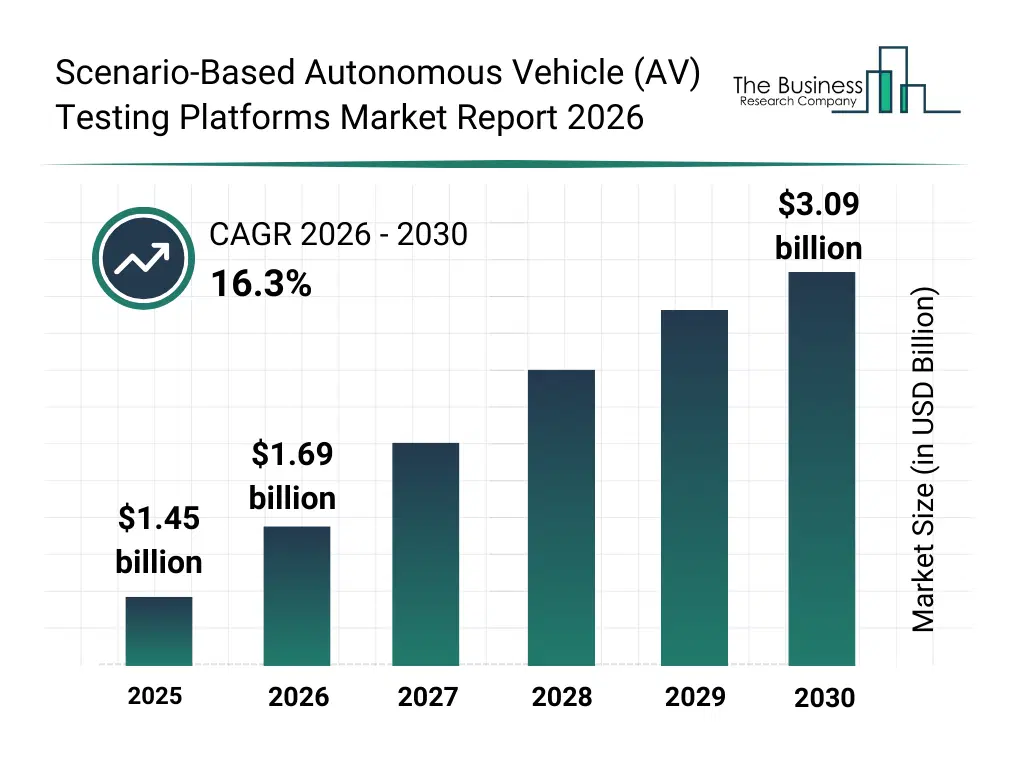
What Is The Scenario-Based Autonomous Vehicle (AV) Testing Platforms Market Size and Share 2026?
The scenario-based AV testing platforms market size has grown rapidly in recent years. It will grow from $1.45 billion in 2025 to $1.69 billion in 2026 at a compound annual growth rate (CAGR) of 16.6%. The growth in the historic period can be attributed to growing autonomous vehicle pilot programs, early regulatory pressure for safety validation, rise of simulation technologies, increasing complexity of driving scenarios, demand for cost-efficient testing methods.What Is The Scenario-Based Autonomous Vehicle (AV) Testing Platforms Market Growth Forecast?
The scenario-based testing platforms market size is expected to see rapid growth in the next few years. It will grow to $3.09 billion in 2030 at a compound annual growth rate (CAGR) of 16.3%. The growth in the forecast period can be attributed to expansion of level 4–5 autonomy development, stricter global safety and compliance standards, integration of ai-driven scenario generation, rising investments in av r&d, need for large-scale virtual testing environments. Major trends in the forecast period include adoption of generative ai for scenario creation, shift toward cloud-native testing ecosystems, use of digital twins for real-time validation, cross-industry collaboration for shared scenario libraries, growth of continuous and automated testing workflows.
Global Scenario-Based Autonomous Vehicle (AV) Testing Platforms Market Segmentation
1) By Component: Software, Hardware, Services 2) By Deployment Mode: On-Premises, Cloud-Based 3) By Testing Type: Simulation Testing, Closed-Course Testing, On-Road Testing, Hardware-In-The-Loop, Software-In-The-Loop 4) By Application: Passenger Vehicles, Commercial Vehicles, Industrial Vehicles, Other Applications 5) By End-User: Automotive OEMs, Tier 1 Suppliers, Research Institutes, Regulatory Bodies, Other End-User Subsegments: 1) By Software: Simulation Software, Testing Management Software, Data Analysis Software 2) By Hardware: Sensor Systems, Testing Vehicles, Computing Hardware 3) By Services: Consulting Services, Implementation Services, Maintenance and Support ServicesWhat Is The Driver Of The Scenario-Based Autonomous Vehicle (AV) Testing Platforms Market?
The increasing adoption of autonomous vehicles is expected to propel the growth of the scenario-based autonomous vehicle (AV) testing platforms market going forward. Autonomous vehicles are self driving or driver assist vehicles that can navigate roads using sensors, AI, and connectivity rather than relying exclusively on human input. The adoption is rising as regulators and companies continue to grant permits for AV testing and deployment, enabling more real world AVs to be on the roads. Scenario based AV testing platforms support autonomous vehicles by supplying realistic simulations and repeatable test scenarios that mirror the complexity of public roads, thereby helping AV developers accelerate safe rolling out of AVs. For instance, in January 2025, according to the California Department of Motor Vehicles (DMV), a US-based government department, autonomous vehicles under testing permits logged 4,498,066 test miles on California’s public roads between December 2023 and November 2024. Therefore, the increasing adoption of autonomous vehicles is driving the growth of the scenario-based autonomous vehicle (AV) testing platforms industry.Key Players In The Global Scenario-Based Autonomous Vehicle (AV) Testing Platforms Market
Major companies operating in the scenario-based autonomous vehicle (av) testing platforms market are Tesla Inc., NVIDIA Corporation, Dassault Systèmes SE, Keysight Technologies Inc., TÜV SÜD AG, AVL List GmbH, ANSYS Inc., National Instruments Corporation (NI), Altair Engineering Inc., Waymo LLC, dSPACE GmbH, IPG Automotive GmbH, AImotive Informatikai Kft., Foretellix Ltd., Speedgoat GmbH, Deepen AI Inc., Mechanical Simulation Corporation, rFpro Ltd., Cognata Ltd., Typhoon HIL Inc.
This chart is for illustrative purposes; the full report includes a detailed competitor analysis and comprehensive overview of the top 10 companies in the market.
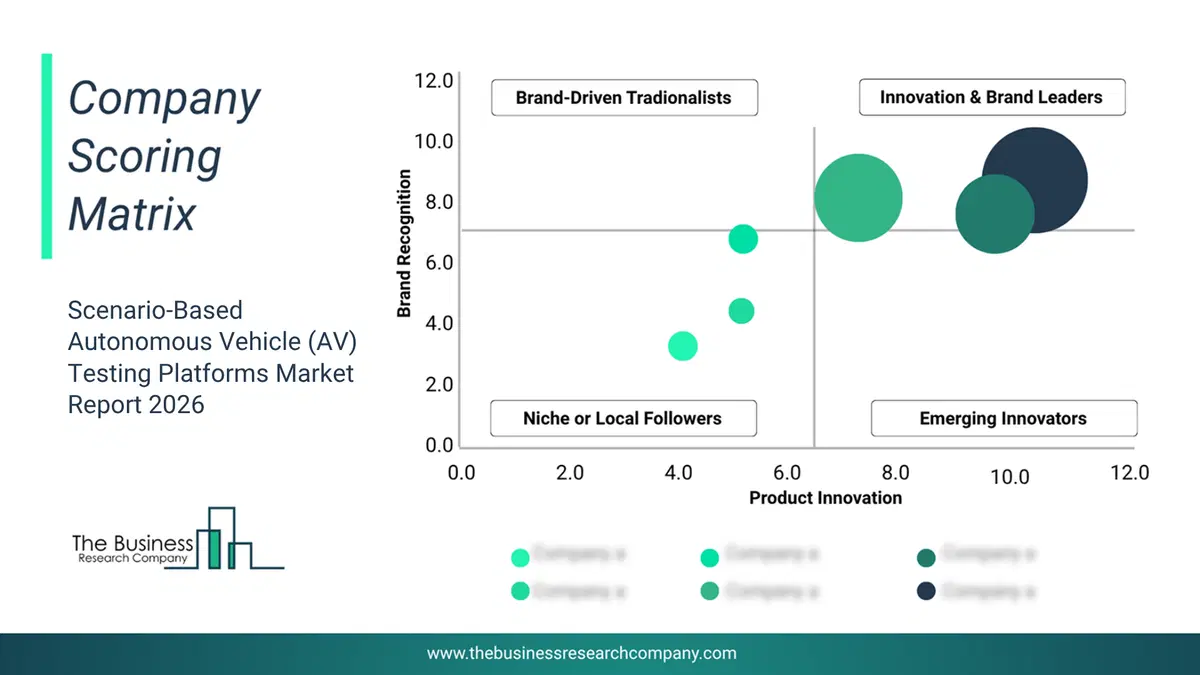
This chart maps companies by product innovation and brand strength, with bubble size indicating relative revenue, helping identify market leaders, challengers, and niche players. This is an illustrative chart; the full report provides a complete and accurate competitive analysis.
Global Scenario-Based Autonomous Vehicle (AV) Testing Platforms Market Trends and Insights
Major companies operating in the scenario-based autonomous vehicle (AV) testing platforms market are focusing on developing advanced solutions, such as high-fidelity AV testing solutions, to accelerate development cycles. High-fidelity AV testing solutions are simulation systems that accurately mirror real-world driving environments, including sensors, vehicle dynamics, and traffic situations, to thoroughly assess the performance and safety of autonomous vehicles. For instance, in November 2025, Foretellix, an Israel-based software company, partnered with Inverted AI, a Canada-based technology company, to launch a hybrid simulation solution. This solution uniquely combines controllable scenario generation with AI-driven driving behavior models to create reactive, realistic, and diverse simulation scenarios for autonomous vehicles (AVs). It allows developers to rigorously test and validate AV systems across both everyday traffic and rare, high-risk events that are difficult or unsafe to replicate in the real world. By integrating Foretellix’s scenario automation with Inverted AI’s naturalistic behavior models, surrounding road users are controlled based on patterns learned from large-scale real-world driving data. The connection through Foretellix’s Behavioral Models API ensures a flexible, standardized interface, enabling rapid adaptation of scenarios to varied simulation requirements.What Are Latest Mergers And Acquisitions In The Scenario-Based Autonomous Vehicle (AV) Testing Platforms Market?
In December 2024, Ansys, a US based engineering simulation software provider, partnered with Sony Semiconductor Solutions Corporation to enhance scenario based perception testing for autonomous vehicles (AVs) through high fidelity sensor simulation. With this collaboration, Ansys aimed to improve validation of advanced driver assistance systems (ADAS) and AV perception functionality by integrating its AVxcelerate Sensors simulation platform with Sony’s high dynamic range (HDR) image sensor models to replicate diverse lighting and weather conditions within virtual scenarios. The combined solution enables OEMs and Tier 1 suppliers to conduct robust, scenario based testing that accelerates validation of camera based perception systems, reduces reliance on extensive on road testing, and enhances safety performance in varied environments. Sony Semiconductor Solutions Corporation is a japan-based imaging solutions provider.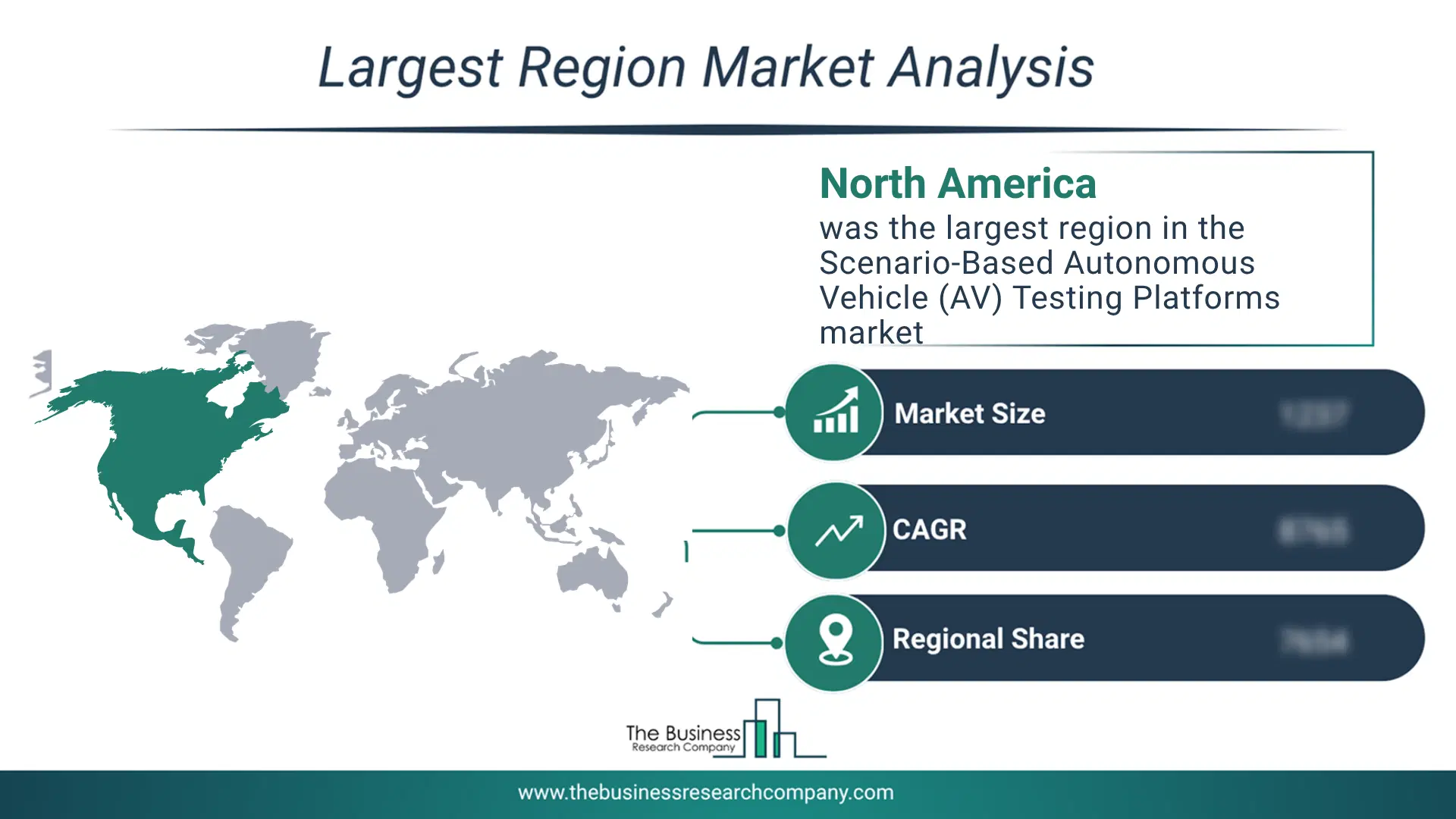
Regional Insights
North America was the largest region in the scenario-based AV testing platforms market in 2025. Asia-Pacific is expected to be the fastest-growing region in the forecast period. The regions covered in this market report are Asia-Pacific, South East Asia, Western Europe, Eastern Europe, North America, South America, Middle East, Africa. The countries covered in this market report are Australia, Brazil, China, France, Germany, India, Indonesia, Japan, Taiwan, Russia, South Korea, UK, USA, Canada, Italy, Spain.What Defines the Scenario-Based Autonomous Vehicle (AV) Testing Platforms Market?
The scenario-based autonomous vehicle (AV) testing platforms market consists of revenues earned by entities providing services such as simulation-driven testing, virtual scenario generation, ADAS/AV validation, digital twin environments, and safety assessment solutions. The market value includes the value of related goods sold by the service provider or included within the service offering. The scenario-based AV (Autonomous Vehicle) testing platforms market also includes sales of simulation engines, test automation tools, sensor modeling modules, AI-powered scenario creation systems, and smart integration with real-world testing workflows. Values in this market are ‘factory gate’ values, that is, the value of goods sold by the manufacturers or creators of the goods, whether to other entities (including downstream manufacturers, wholesalers, distributors, and retailers) or directly to end customers. The value of goods in this market includes related services sold by the creators of the goods.How is Market Value Defined and Measured?
The market value is defined as the revenues that enterprises gain from the sale of goods and/or services within the specified market and geography through sales, grants, or donations in terms of the currency (in USD unless otherwise specified). The revenues for a specified geography are consumption values that are revenues generated by organizations in the specified geography within the market, irrespective of where they are produced. It does not include revenues from resales along the supply chain, either further along the supply chain or as part of other products.
This chart presents market attractiveness based on a quantitative evaluation of growth, competition, strategic alignment, and risk, offering a clear view of opportunity areas for decision-making. This chart is for illustrative purposes; the full report contains the complete analysis.

This chart highlights the Total Addressable Market (TAM) by estimating the maximum revenue opportunity using an assumption-driven approach, supporting strategic planning and opportunity sizing across markets. The chart is illustrative; the full report provides a more comprehensive analysis.
What Key Data and Analysis Are Included in the Scenario-Based Autonomous Vehicle (AV) Testing Platforms Market Report 2026?
The scenario-based autonomous vehicle (av) testing platforms market research report is one of a series of new reports from The Business Research Company that provides market statistics, including industry global market size, regional shares, competitors with the market share, detailed market segments, market trends and opportunities, and any further data you may need to thrive in the scenario-based autonomous vehicle (av) testing platforms industry. The market research report delivers a complete perspective of everything you need, with an in-depth analysis of the current and future state of the industry.Scenario-Based Autonomous Vehicle (AV) Testing Platforms Market Report Forecast Analysis
| Report Attribute | Details |
|---|---|
| Market Size Value In 2026 | $1.69 billion |
| Revenue Forecast In 2030 | $3.09 billion |
| Growth Rate | CAGR of 16.6% from 2026 to 2030 |
| Base Year For Estimation | 2025 |
| Actual Estimates/Historical Data | 2020-2025 |
| Forecast Period | 2026 - 2030 - 2030 |
| Market Representation | Revenue in USD Billion and CAGR from 2026 to 2030 |
| Segments Covered | Component, Deployment Mode, Testing Type, Application, End-User |
| Regional Scope | Asia-Pacific, Western Europe, Eastern Europe, North America, South America, Middle East, Africa |
| Country Scope | The countries covered in the report are Australia, Brazil, China, France, Germany, India, Indonesia, Japan, Taiwan, Russia, South Korea, UK, USA, Canada, Italy, Spain. |
| Key Companies Profiled | Tesla Inc., NVIDIA Corporation, Dassault Systèmes SE, Keysight Technologies Inc., TÜV SÜD AG, AVL List GmbH, ANSYS Inc., National Instruments Corporation (NI), Altair Engineering Inc., Waymo LLC, dSPACE GmbH, IPG Automotive GmbH, AImotive Informatikai Kft., Foretellix Ltd., Speedgoat GmbH, Deepen AI Inc., Mechanical Simulation Corporation, rFpro Ltd., Cognata Ltd., Typhoon HIL Inc. |
| Customization Scope | Request for Customization |
| Pricing And Purchase Options | Explore Purchase Options |