

Scintillator Array Market Report 2026
Global Outlook – By Type ( Organic Scintillators, Inorganic Scintillators, Plastic Scintillators, Ceramic Scintillators), By Form Factor ( Single-Channel Detectors, Multi-Channel Detectors, Custom Configurations), By Application ( Medical Imaging, Nuclear Power Plants, High Energy Physics, Homeland Security, Other Applications), By End-User ( Healthcare, Industrial, Defense, Research Institutions, Other End-Users) – Market Size, Trends, Strategies, and Forecast to 2030
Scintillator Array Market Overview
• Scintillator Array market size has reached to $1.59 billion in 2025 • Expected to grow to $2.73 billion in 2030 at a compound annual growth rate (CAGR) of 11.4% • Growth Driver: Growing Demand In Medical Imaging Fueling The Market Growth Due To Aging Population And Healthcare Expansion • North America was the largest region in 2025 and Asia-Pacific is the fastest growing region.What Is Covered Under Scintillator Array Market?
A scintillator array is a device consisting of multiple scintillator elements arranged in a grid or lattice pattern, designed to detect and image ionizing radiation with high resolution and efficiency. This process involves the conversion of the incoming ionizing radiation into visible light by each scintillator element, followed by the detection and processing of this light signal to generate accurate electronic readouts for imaging or measurement purposes. The main types of scintillator arrays are organic scintillators, inorganic scintillators, plastic scintillators, and ceramic scintillators. Organic scintillators are carbon-based materials that emit light quickly when exposed to radiation, enabling fast and efficient detection. They are available in various form factors, including single-channel detectors, multi-channel detectors, and custom configurations. They are used in a variety of applications, such as medical imaging, nuclear power plants, high-energy physics, homeland security, and others. End-users of these scintillators include healthcare providers, industrial companies, defense organizations, research institutions, and other users.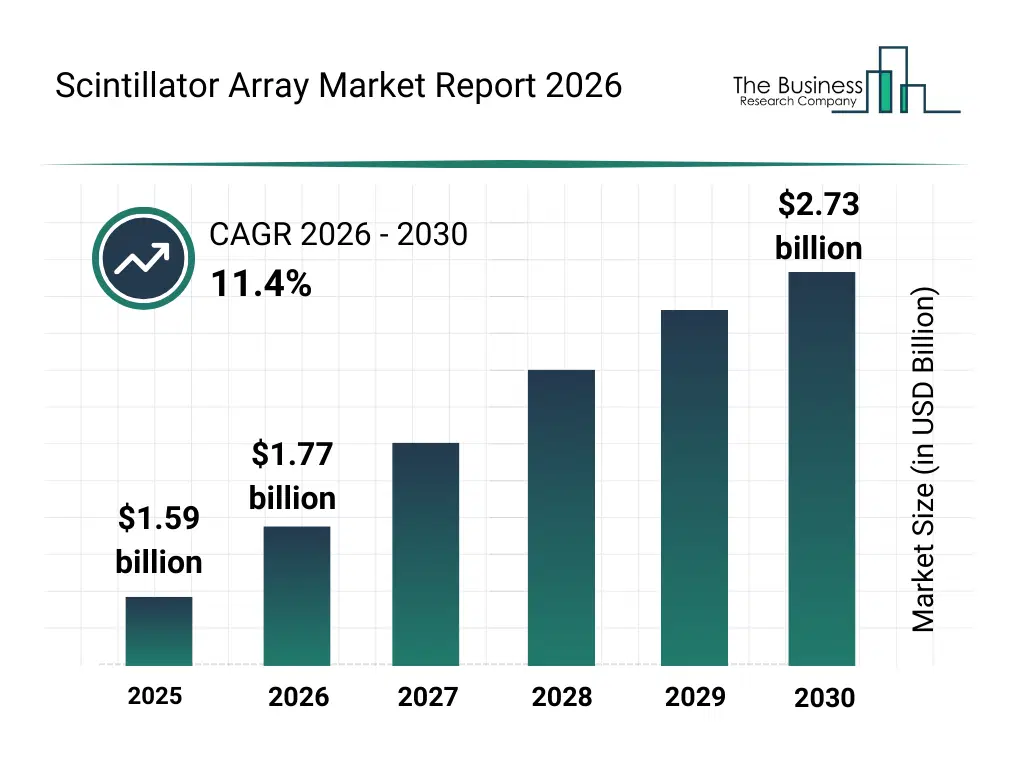
What Is The Scintillator Array Market Size 2026 And Growth Rate?
The scintillator array market size has grown rapidly in recent years. It will grow from $1.59 billion in 2025 to $1.77 billion in 2026 at a compound annual growth rate (CAGR) of 11.7%. The growth in the historic period can be attributed to increasing adoption of medical imaging technologies, rising demand from nuclear power plants, growth in high energy physics research, advancements in scintillator materials, government funding for defense and security applications.What Is The Scintillator Array Market Growth Forecast?
The scintillator array market size is expected to see rapid growth in the next few years. It will grow to $2.73 billion in 2030 at a compound annual growth rate (CAGR) of 11.4%. The growth in the forecast period can be attributed to integration with ai-based imaging, development of portable detection devices, expansion in homeland security applications, innovations in multi-channel detector arrays, growth in precision medicine diagnostics. Major trends in the forecast period include high-resolution imaging systems, advanced radiation detection techniques, miniaturized scintillator designs, enhanced light conversion efficiency, customizable multi-channel detector arrays.
Global Scintillator Array Market Segmentation
1) By Type: Organic Scintillators, Inorganic Scintillators, Plastic Scintillators, Ceramic Scintillators 2) By Form Factor: Single-Channel Detectors, Multi-Channel Detectors, Custom Configurations 3) By Application: Medical Imaging, Nuclear Power Plants, High Energy Physics, Homeland Security, Other Applications 4) By End-User: Healthcare, Industrial, Defense, Research Institutions, Other End-Users Subsegments: 1) By Organic Scintillators: Liquid Organic Scintillators, Crystal Organic Scintillators, Glass Organic Scintillators 2) By Inorganic Scintillators: Alkali Halide Scintillators, Oxide Crystal Scintillators, Fluoride Crystal Scintillators 3) By Plastic Scintillators: Polyvinyl Toluene Based Scintillators, Polystyrene Based Scintillators, Polyester Based Scintillators 4) By Ceramic Scintillators: Garnet Based Scintillators, Perovskite Based Scintillators, Rare Earth Doped ScintillatorsWhat Is The Driver Of The Scintillator Array Market?
The growing demand in medical imaging is expected to propel the growth of the scintillator array market going forward. Medical imaging refers to the use of various technologies and techniques to create visual representations of the interior structures of the human body for clinical analysis, diagnosis, and medical intervention. The rising demand for medical imaging is driven by the aging population globally, as older adults require more frequent diagnostic procedures to monitor and detect age-related health conditions. Scintillator arrays support medical imaging by converting high-energy X-rays or gamma rays into visible light with high spatial resolution and efficiency, enabling precise detection and accurate image formation in diagnostic devices such as CT scanners, PET systems, and gamma cameras, thereby improving image quality and enhancing the ability to detect and diagnose medical conditions. For instance, in November 2023, according to the National Health Service, a UK-based government department, in the year ending March 2023, England carried out 45.0 million imaging tests, marking a 2.2% rise from 44.0 million the previous year. Additionally, this total included 10.3 million diagnostic ultrasound tests, up 1.8%; 7.1 million CT scans, up 5.5%; and 4.1 million MRI scans, up 6.2%. Therefore, the growing demand in medical imaging is driving the growth of the scintillator array industry.What Is The Driver Of The Scintillator Array Market?
The expansion of nuclear power plants is expected to propel the growth of the scintillator array market going forward. Nuclear power plants are facilities that utilize nuclear reactions to generate electricity, and their expansion involves the construction of new reactors and the enhancement of existing facilities. The rising expansion is due to the growing demand for clean energy, the urgent need to reduce greenhouse gas emissions, and the push toward sustainable and low-carbon electricity generation. Scintillator arrays help nuclear power plants by providing precise radiation detection and monitoring, enabling accurate measurement of radioactive emissions, ensuring operational safety, protecting personnel and equipment, and supporting efficient maintenance and regulatory compliance. For instance, in August 2024, according to the International Atomic Energy Agency, an Austria-based intergovernmental organization, electricity generation from nuclear power increased by 2.6% in 2023 compared to 2022. Additionally, in December 2023, there were 413 operational nuclear reactors across 31 countries, providing a total global capacity of 371.5 GW(e). Therefore, the expansion of nuclear power plants is driving the growth of the scintillator array industry.Key Players In The Global Scintillator Array Market
Major companies operating in the scintillator array market are Thermo Fisher Scientific Inc., Siemens Healthineers AG, Koninklijke Philips N.V., GE HealthCare Technologies Inc., Hamamatsu Photonics K.K., Mirion Technologies Inc., Ludlum Measurements Inc., Kromek Group plc, Berkeley Nucleonics Corporation, Crytur Ltd., Luxium Solutions Inc., Eljen Technology Inc., EPIC Crystal Co. Ltd., Scintacor Ltd., Advatech UK Limited, Rexon Components Inc., Zecotek Photonics Inc., ShanghAI SICCAS High Technology Corporation, Alpha Spectra Inc., Scintitech Inc.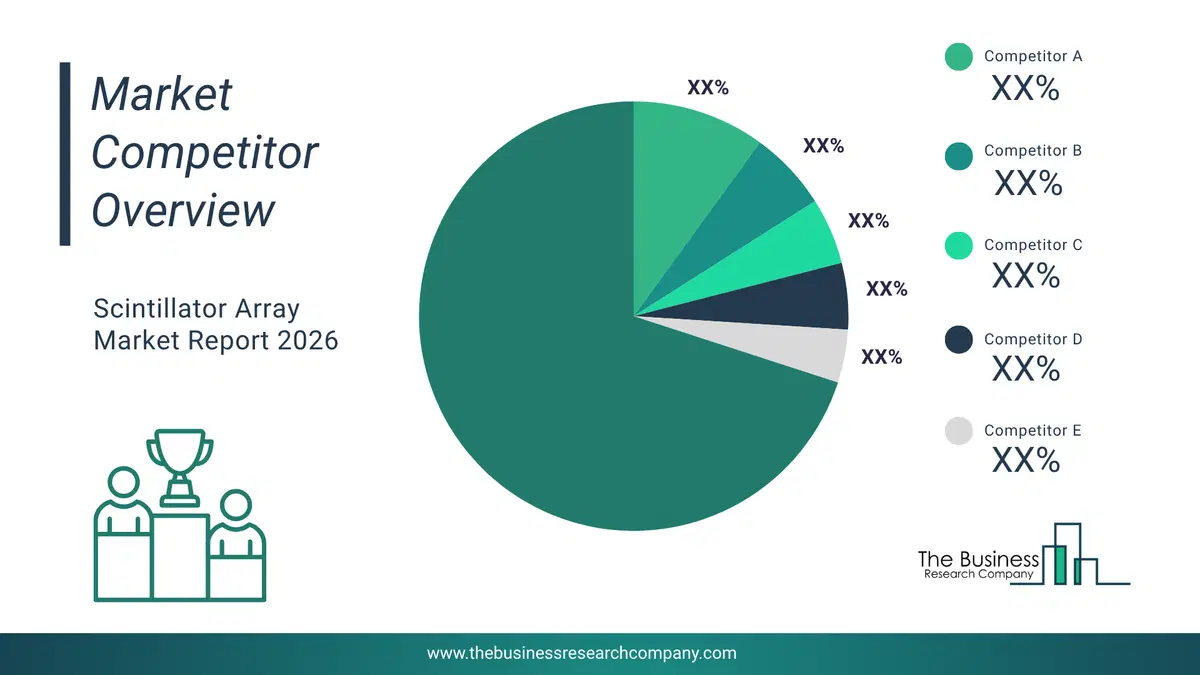
This chart is for illustrative purposes; the full report includes a detailed competitor analysis and comprehensive overview of the top 10 companies in the market.
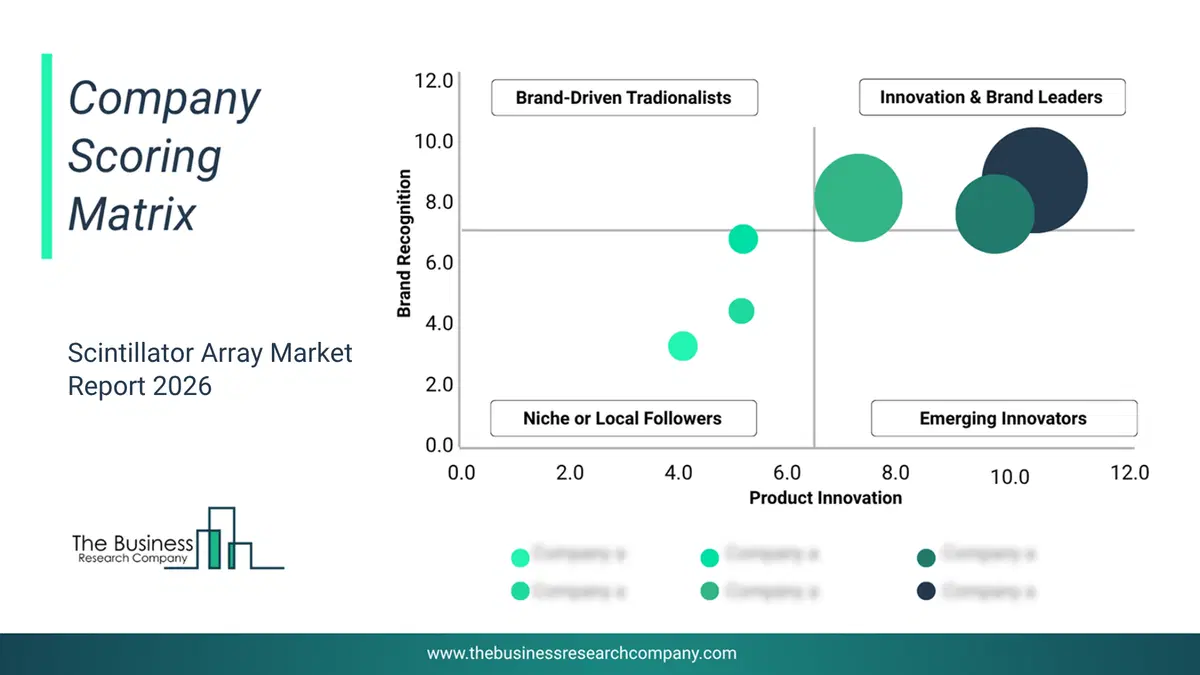
This chart maps companies by product innovation and brand strength, with bubble size indicating relative revenue, helping identify market leaders, challengers, and niche players. This is an illustrative chart; the full report provides a complete and accurate competitive analysis.
What Are Latest Mergers And Acquisitions In The Scintillator Array Market?
In July 2024, Luxium Solutions LLC, a US-based company that offers advanced engineering solutions, acquired Inrad Optics Inc. for an undisclosed amount. With this acquisition, Luxium Solutions aims to strengthen its leadership in optics and photonics by expanding its product portfolio, leveraging complementary technical expertise, and enhancing resources, capacity, and value for customers, while also accelerating innovation, driving operational excellence, and positioning the company for long-term growth. Inrad Optics Inc. is a US-based manufacturing company that specializes in advanced optics and photonics solutions, including single crystal scintillation materials for radiation detection applications.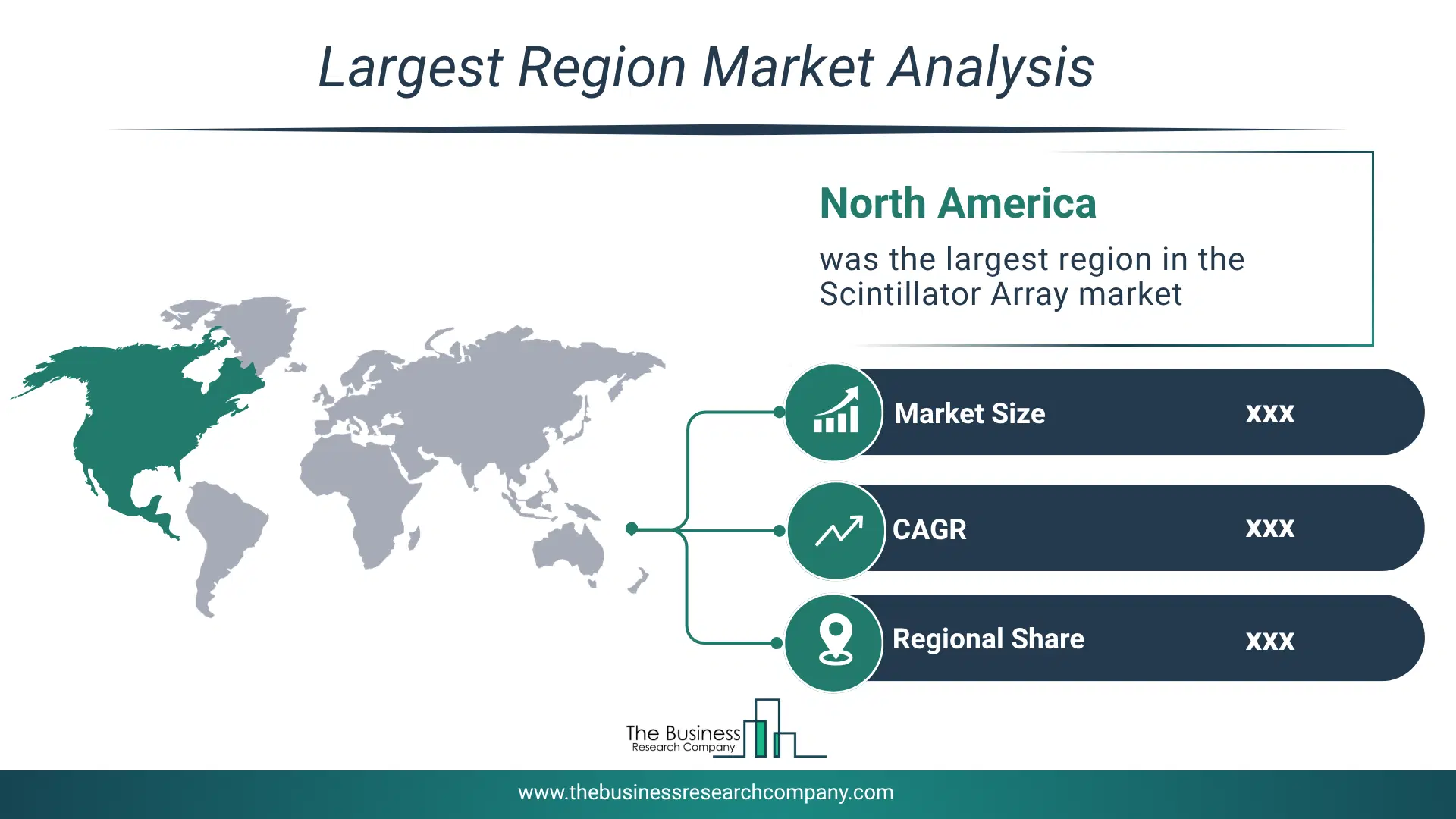
Regional Outlook
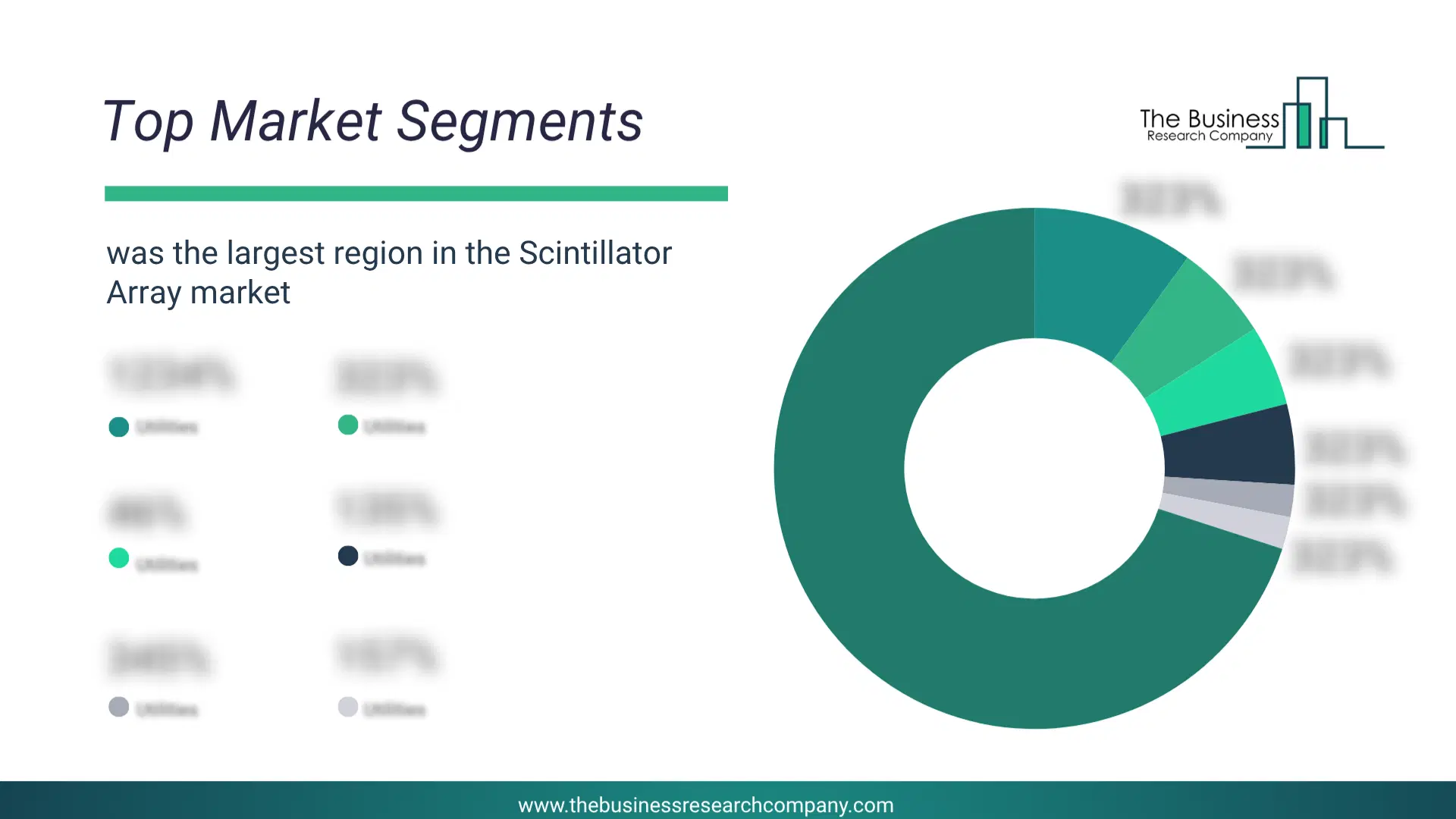
North America was the largest region in the scintillator array market in 2025. Asia-Pacific is expected to be the fastest-growing region in the forecast period. The regions covered in this market report are Asia-Pacific, South East Asia, Western Europe, Eastern Europe, North America, South America, Middle East, Africa. The countries covered in this market report are Australia, Brazil, China, France, Germany, India, Indonesia, Japan, Taiwan, Russia, South Korea, UK, USA, Canada, Italy, Spain.What Defines the Scintillator Array Market?
The scintillator array market consists of sales of pixellated scintillator arrays, two-dimensional (2D) scintillator arrays, monolithic scintillator arrays, custom-integrated array modules, and encapsulated scintillator array assemblies. Values in this market are ‘factory gate’ values, that is the value of goods sold by the manufacturers or creators of the goods, whether to other entities (including downstream manufacturers, wholesalers, distributors and retailers) or directly to end customers. The value of goods in this market includes related services sold by the creators of the goods.How is Market Value Defined and Measured?
The market value is defined as the revenues that enterprises gain from the sale of goods and/or services within the specified market and geography through sales, grants, or donations in terms of the currency (in USD unless otherwise specified). The revenues for a specified geography are consumption values that are revenues generated by organizations in the specified geography within the market, irrespective of where they are produced. It does not include revenues from resales along the supply chain, either further along the supply chain or as part of other products.
This chart presents market attractiveness based on a quantitative evaluation of growth, competition, strategic alignment, and risk, offering a clear view of opportunity areas for decision-making. This chart is for illustrative purposes; the full report contains the complete analysis.

This chart highlights the Total Addressable Market (TAM) by estimating the maximum revenue opportunity using an assumption-driven approach, supporting strategic planning and opportunity sizing across markets. The chart is illustrative; the full report provides a more comprehensive analysis.
What Key Data and Analysis Are Included in the Scintillator Array Market Report 2026?
The scintillator array market research report is one of a series of new reports from The Business Research Company that provides market statistics, including industry global market size, regional shares, competitors with the market share, detailed market segments, market trends and opportunities, and any further data you may need to thrive in the scintillator array industry. The market research report delivers a complete perspective of everything you need, with an in-depth analysis of the current and future state of the industry.Scintillator Array Market Report Forecast Analysis
| Report Attribute | Details |
|---|---|
| Market Size Value In 2026 | $1.77 billion |
| Revenue Forecast In 2030 | $2.73 billion |
| Growth Rate | CAGR of 11.4% from 2026 to 2030 |
| Base Year For Estimation | 2025 |
| Actual Estimates/Historical Data | 2020-2025 |
| Forecast Period | 2026 - 2030 |
| Market Representation | Revenue in USD Billion and CAGR from 2026 to 2030 |
| Segments Covered | Type, Form Factor, Application, End-User |
| Regional Scope | Asia-Pacific, Western Europe, Eastern Europe, North America, South America, Middle East, Africa |
| Country Scope | The countries covered in the report are Australia, Brazil, China, France, Germany, India, Indonesia, Japan, Taiwan, Russia, South Korea, UK, USA, Canada, Italy, Spain. |
| Key Companies Profiled | Thermo Fisher Scientific Inc., Siemens Healthineers AG, Koninklijke Philips N.V., GE HealthCare Technologies Inc., Hamamatsu Photonics K.K., Mirion Technologies Inc., Ludlum Measurements Inc., Kromek Group plc, Berkeley Nucleonics Corporation, Crytur Ltd., Luxium Solutions Inc., Eljen Technology Inc., EPIC Crystal Co. Ltd., Scintacor Ltd., Advatech UK Limited, Rexon Components Inc., Zecotek Photonics Inc., ShanghAI SICCAS High Technology Corporation, Alpha Spectra Inc., Scintitech Inc. |
| Customization Scope | Request for Customization |
| Pricing And Purchase Options | Explore Purchase Options |