
Seed Treatment Machine Market Report 2026
Global Outlook – By Machine Type (Seed Coating Machines, Seed Dressing Or Treatment Application Machines, Seed Priming Machines, Pelletizing Seed Treatment Machines), By Treatment Type (Chemical Seed Treatment Machines, Biological Seed Treatment Machines, Nutrient-Based Seed Treatment Machines, Multi-Purpose Or Combination Seed Treatment Machines), By Level of Automation (Manual Seed Treatment Machines, Semi-Automatic Seed Treatment Machines, Fully Automatic Seed Treatment Machines), By Seed Type (Cereals, Oilseeds, Pulses & Legumes, Vegetables, Other Seed Types), By End User (Seed Processing Companies, Seed Producers & Breeders, Commercial Farms & Agribusinesses, Research & Agricultural Institutions) – Market Size, Trends, Strategies, and Forecast to 2030
Seed Treatment Machine Market Overview
• Seed Treatment Machine market size has reached to $1.33 billion in 2025 • Expected to grow to $1.96 billion in 2030 at a compound annual growth rate (CAGR) of 8.1% • Growth Driver: Rising Adoption of Hybrid and Genetically Modified Seeds Expected to Drive Growth of the Seed Treatment Machine Market • Market Trend: Innovations in Seed Coating Technology for Enhanced Crop Yields • North America was the largest region in 2025.What Is Covered Under Seed Treatment Machine Market?
A seed treatment machine is specialized agricultural equipment used to apply various protective and growth-enhancing treatments to seeds before planting. These treatments can include fungicides, insecticides, herbicides, and growth stimulants, which help prevent seed-borne diseases, enhance germination rates, and promote healthy seedling development. The machine typically features adjustable settings to control the application rate and coverage, ensuring even distribution of the treatment on the seeds. The main type of seed treatment machine are seed coating machine, seed drying machine, and other. A seed coating machine applies a uniform layer of protective substances, such as pesticides, nutrients, or bio-stimulants, directly to seeds. This coating helps protect seeds from pathogens and pests, improves their nutritional value, and enhances germination rates.The function includes seed protection and seed enhancement. It is applied for soybean, corn, wheat, and others.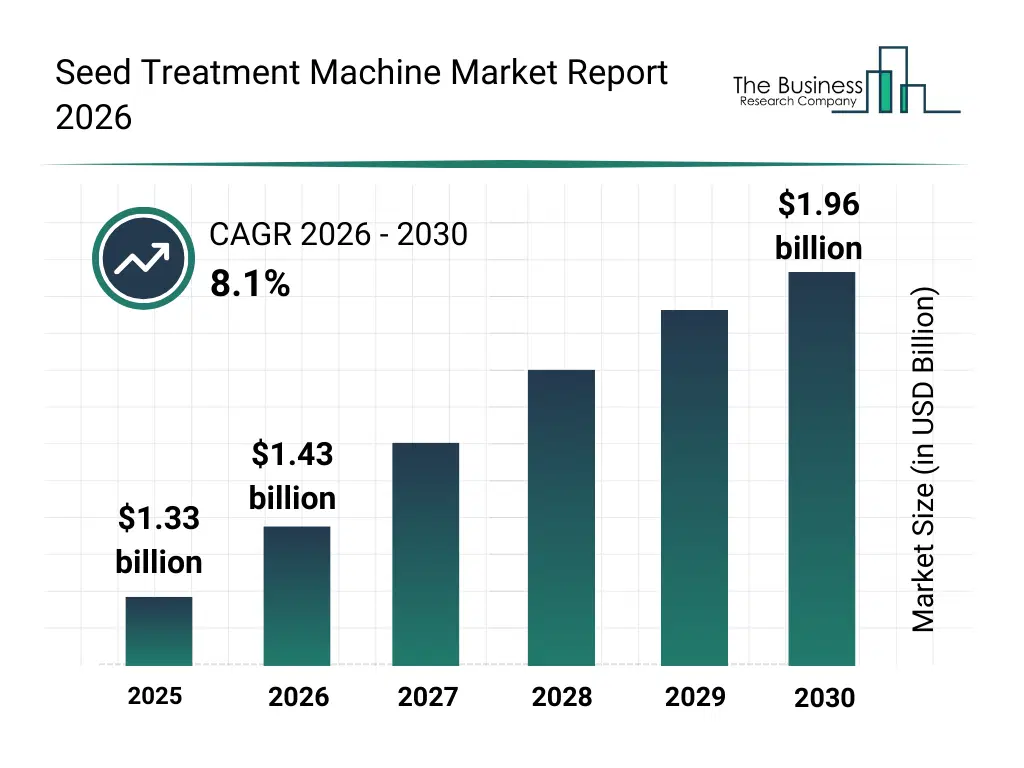
What Is The Seed Treatment Machine Market Size and Share 2026?
The seed treatment machine market size has grown strongly in recent years. It will grow from $1.33 billion in 2025 to $1.43 billion in 2026 at a compound annual growth rate (CAGR) of 8.1%. The growth in the historic period can be attributed to growth in commercial seed production, rising incidence of seed borne diseases, adoption of chemical seed protection methods, increasing mechanization in agriculture, demand for improved crop germination rates.What Is The Seed Treatment Machine Market Growth Forecast?
The seed treatment machine market size is expected to see strong growth in the next few years. It will grow to $1.96 billion in 2030 at a compound annual growth rate (CAGR) of 8.1%. The growth in the forecast period can be attributed to rising adoption of sustainable farming practices, growth in hybrid and genetically improved seeds, increasing focus on yield optimization, expansion of large scale farming operations, technological advancements in seed treatment formulations. Major trends in the forecast period include increasing adoption of precision seed coating technologies, rising use of biological and nutrient based seed treatments, growing demand for high throughput seed processing machines, expansion of automated and adjustable treatment application systems, increasing focus on uniform seed coverage and reduced chemical waste.Tariff Impact On Seed Treatment Machine Market
Tariffs have influenced the seed treatment machine market by increasing the cost of imported components such as motors, control systems, and precision coating parts. Seed coating and drying machine segments are most affected, particularly in Asia Pacific and Latin America where equipment imports are common. These tariffs have raised capital investment costs for seed producers and agricultural service providers. However, tariffs are also encouraging local manufacturing, regional supplier development, and innovation in cost efficient and energy optimized seed treatment machines.
Global Seed Treatment Machine Market Segmentation
1) By Machine Type: Seed Coating Machines, Seed Dressing Or Treatment Application Machines, Seed Priming Machines, Pelletizing Seed Treatment Machines 2) By Treatment Type: Chemical Seed Treatment Machines, Biological Seed Treatment Machines, Nutrient-Based Seed Treatment Machines, Multi-Purpose Or Combination Seed Treatment Machines 3) By Level of Automation: Manual Seed Treatment Machines, Semi-Automatic Seed Treatment Machines, Fully Automatic Seed Treatment Machines 4) By Seed Type: Cereals, Oilseeds, Pulses & Legumes, Vegetables, Other Seed Types 5) By End User: Seed Processing Companies, Seed Producers & Breeders, Commercial Farms & Agribusinesses, Research & Agricultural Institutions Subsegments: 1) By Seed Coating Machines: Chemical Seed Coaters, Biological Seed Coaters, Nutrient Seed Coaters, Coloring Seed Coaters 2) By Seed Dressing Or Treatment Application Machines: Slurry-Based Seed Treatment Machines, Dry Powder Seed Treatment Machines, Mist Or Spray Seed Treatment Machines 3) By Seed Priming Machines: Hydro-Priming Machines, Osmotic Priming Machines, Bio-Priming Machines 4) By Pelletizing Seed Treatment Machines: Rotary Drum Pelletizers, Pan Pelletizing MachinesWhat Is The Driver Of The Seed Treatment Machine Market?
The rising adoption of hybrid and genetically modified seeds is expected to propel the growth of the seed treatment machine market going forward. Hybrid seeds are created by cross-breeding different parent plants for desirable traits, while genetically modified (GM) seeds are altered using biotechnology to enhance specific characteristics. The demand for these modified seeds is due to their ability to increase crop yield, improve resistance to pests and diseases, and tolerate environmental stresses. Seed treatment machines enhance the performance of hybrid and genetically modified (GM) seeds by applying protective chemicals and biological agents that safeguard seeds from pathogens and pests, thereby improving germination rates and overall crop yield. For instance, in June 2024, according to the USDA Foreign Agricultural Service, a US-based government agency, hybrid corn seed production is projected to reach 1.74 million metric tons (MMT) in the 2023/2024 marketing year (October-September), marking a 28% rise compared to 2022/2023. Therefore, the rising adoption of hybrid and genetically modified seeds is driving the growth of the seed treatment machine industry.Key Players In The Global Seed Treatment Machine Market
Major companies operating in the seed treatment machine market are PETKUS Technologie GmbH, Cimbria A/S, Bühler Group, AGCO Corporation, AgraLex Seed Technology, OSAW Industrial Products Private Limited, Spectra Agritec, Agrosaw, Alvan Blanch Development Company Limited, NoroGard Westrup, Oliver Manufacturing Company Incorporated, Akyurek Makine Anonim Sirketi, Synmec International Trading Limited, Centor India Agri Private Limited, Westrup A/S, Synmec International Incorporated, KSi Conveyors, Lewis M. Carter Manufacturing Company, Crippen Manufacturing Company, Milltec Machinery Private Limited, Westrup Seed Processing Systems, AUSSEE Oats Milling Private Limited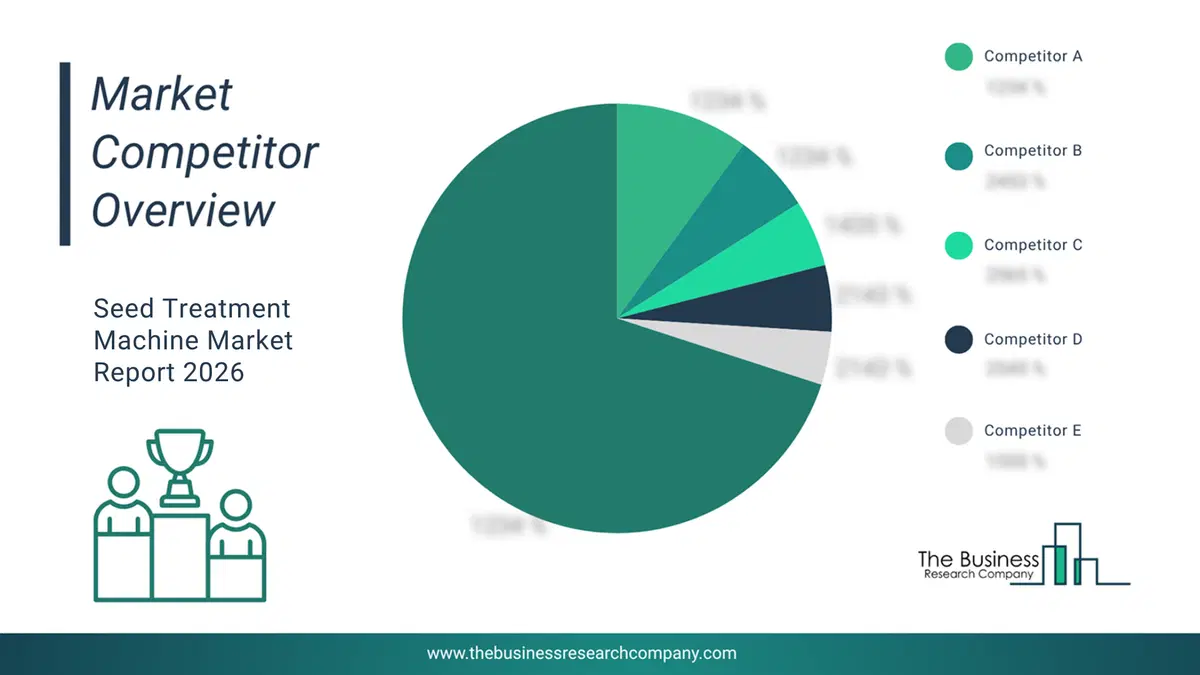
This chart is for illustrative purposes; the full report includes a detailed competitor analysis and comprehensive overview of the top 10 companies in the market.
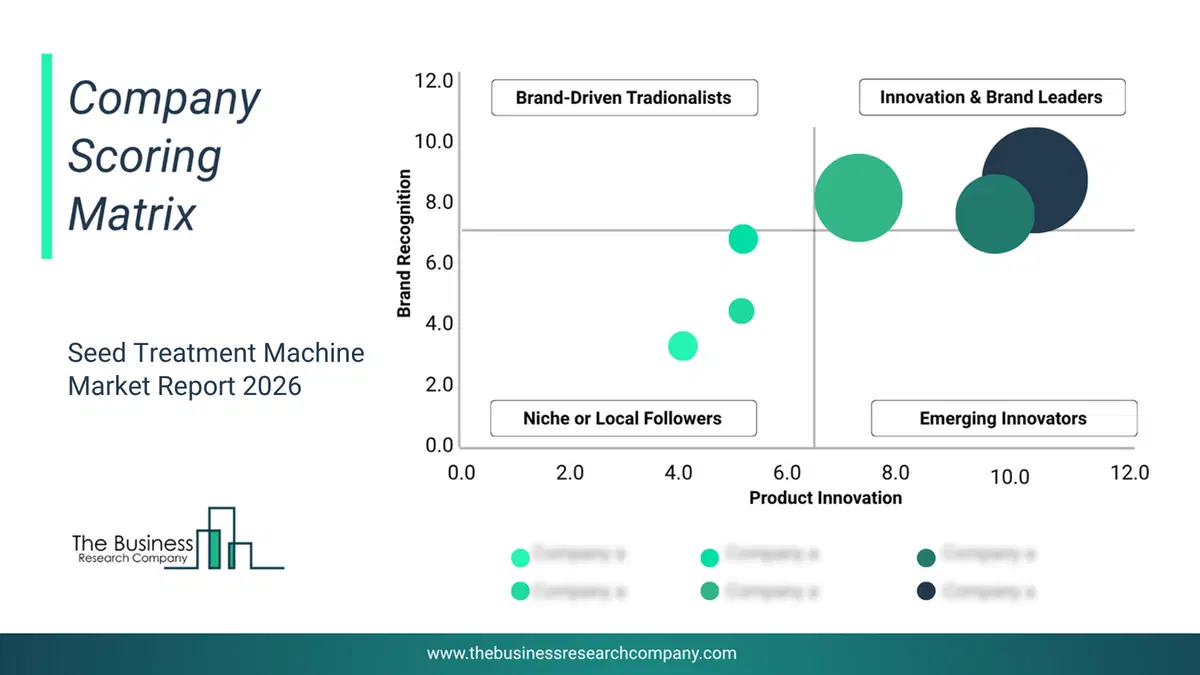
This chart maps companies by product innovation and brand strength, with bubble size indicating relative revenue, helping identify market leaders, challengers, and niche players. This is an illustrative chart; the full report provides a complete and accurate competitive analysis.
Global Seed Treatment Machine Market Trends and Insights
Major companies operating in the seed treatment machine market are introducing innovative hands-free seed treatment machines to improve seed protection and enhance crop yields. An automatic hands-free system for biological seed treatments refers to an advanced technological setup designed to apply biological agents, such as beneficial microorganisms, biopesticides, or biofertilizers, to seeds without manual intervention. For instance, in September 2024, Indigo Ag Inc., a US-based farming company, launched CLIPS device. The product is an automatic, hands-free system designed to streamline the seed treatment process, particularly for biological applications. The CLIPS device efficiently applies dry powder formulations directly from bulk seed boxes, enabling farmers to treat seeds without manual mixing or handling during the busy planting season. The device can be attached to any bulk seed box, making it versatile and adaptable to various farming setups. It can also be used up to 24 months before planting, providing flexibility in preparation.What Are Latest Mergers And Acquisitions In The Seed Treatment Machine Market?
In December 2023, Fowler Westrup, an India-based agricultural machinery manufacturing company, acquired Seed Processing Holland from H2 Equity Partners for an undisclosed amount. The acquisition aims to enhance global customer service in vegetable and field crop seed processing by expanding the product portfolio and offering innovative solutions. It also seeks to leverage synergies across global sales, service networks, and engineering capabilities for more sustainable and automated seed processing. Seed Processing Holland is a Netherlands-based company producing advanced seed processing equipment.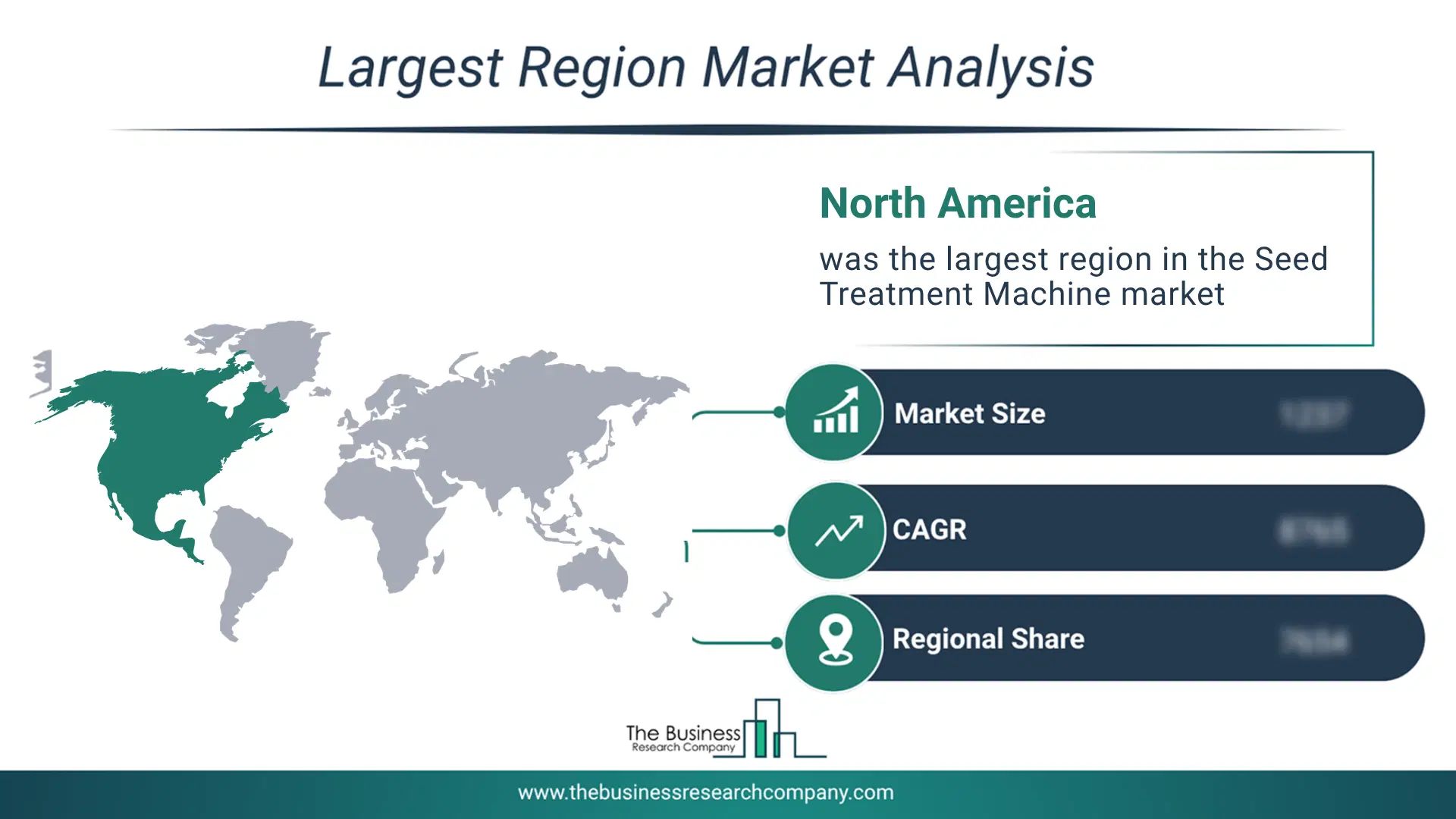
Regional Outlook
North America was the largest region in the seed treatment machine market in 2025. The regions covered in this market report are Asia-Pacific, South East Asia, Western Europe, Eastern Europe, North America, South America, Middle East, Africa The countries covered in this market report are Australia, Brazil, China, France, Germany, India, Indonesia, Japan, Taiwan, Russia, South Korea, UK, USA, Canada, Italy, Spain.What Defines the Seed Treatment Machine Market?
The seed treatment machine market consists of sales of batch seed treaters, coating machines, and seed disinfection machines. Values in this market are ‘factory gate’ values, that is the value of goods sold by the manufacturers or creators of the goods, whether to other entities (including downstream manufacturers, wholesalers, distributors and retailers) or directly to end customers. The value of goods in this market includes related services sold by the creators of the goods.How is Market Value Defined and Measured?
The market value is defined as the revenues that enterprises gain from the sale of goods and/or services within the specified market and geography through sales, grants, or donations in terms of the currency (in USD unless otherwise specified). The revenues for a specified geography are consumption values that are revenues generated by organizations in the specified geography within the market, irrespective of where they are produced. It does not include revenues from resales along the supply chain, either further along the supply chain or as part of other products.
This chart presents market attractiveness based on a quantitative evaluation of growth, competition, strategic alignment, and risk, offering a clear view of opportunity areas for decision-making. This chart is for illustrative purposes; the full report contains the complete analysis.

This chart highlights the Total Addressable Market (TAM) by estimating the maximum revenue opportunity using an assumption-driven approach, supporting strategic planning and opportunity sizing across markets. The chart is illustrative; the full report provides a more comprehensive analysis.
What Key Data and Analysis Are Included in the Seed Treatment Machine Market Report 2026?
The seed treatment machine market research report is one of a series of new reports from The Business Research Company that provides market statistics, including industry global market size, regional shares, competitors with the market share, detailed market segments, market trends and opportunities, and any further data you may need to thrive in the seed treatment machine industry. The market research report delivers a complete perspective of everything you need, with an in-depth analysis of the current and future state of the industry.Seed Treatment Machine Market Report Forecast Analysis
| Report Attribute | Details |
|---|---|
| Market Size Value In 2026 | $1.43 billion |
| Revenue Forecast In 2030 | $1.96 billion |
| Growth Rate | CAGR of 8.1% from 2026 to 2030 |
| Base Year For Estimation | 2025 |
| Actual Estimates/Historical Data | 2020-2025 |
| Forecast Period | 2026 - 2030 |
| Market Representation | Revenue in USD Billion and CAGR from 2026 to 2030 |
| Segments Covered | Machine Type, Treatment Type, Level of Automation, Seed Type, End User |
| Regional Scope | Asia-Pacific, Western Europe, Eastern Europe, North America, South America, Middle East, Africa |
| Key Companies Profiled | PETKUS Technologie GmbH, Cimbria A/S, Bühler Group, AGCO Corporation, AgraLex Seed Technology, OSAW Industrial Products Private Limited, Spectra Agritec, Agrosaw, Alvan Blanch Development Company Limited, NoroGard Westrup, Oliver Manufacturing Company Incorporated, Akyurek Makine Anonim Sirketi, Synmec International Trading Limited, Centor India Agri Private Limited, Westrup A/S, Synmec International Incorporated, KSi Conveyors, Lewis M. Carter Manufacturing Company, Crippen Manufacturing Company, Milltec Machinery Private Limited, Westrup Seed Processing Systems, AUSSEE Oats Milling Private Limited |
| Customization Scope | Request for Customization |
| Pricing And Purchase Options | Explore Purchase Options |