
Contact Us
  Search
The Business Research Company Logo
Selective Catalytic Reduction (SCR) System Global Market Opportunities And Strategies To 2035
Published :June 2026
Pages :438
Format :PDF
Delivery Time :2-3 Business Days
Why 2-3 days? We update the report with the latest data and news before delivery. Let us know if you need us to expedite.
Report Price :$4,490.00

Selective Catalytic Reduction (SCR) System Global Market Opportunities And Strategies To 2035

By Type (Urea Selective Catalytic Reduction (SCR), Ammonia Selective Catalytic Reduction (SCR), Other Types), By Component (Catalytic Converter, Urea Tank, Pump, Control Unit, Injector, Other Components), By Application (Automotive, Marine, Industrial, Power Generation, Other Applications), And By Region, Opportunities And Strategies – Global Forecast To 2035

Selective Catalytic Reduction (SCR) System Market Definition

Selective catalytic reduction (SCR) systems are advanced emission control technologies used to reduce nitrogen oxide (NOₓ) emissions from industrial plants, power stations, marine engines, and diesel vehicles. The system injects a reductant—typically ammonia or urea-based diesel exhaust fluid (DEF)—into the exhaust stream, where it reacts with NOₓ in the presence of a catalyst to convert it into harmless nitrogen (N₂) and water vapor (H₂O). The primary purpose of SCR systems is to significantly reduce NOₓ emissions and ensure compliance with environmental regulations. The selective catalytic reduction (SCR) system market consists of sales of selective catalytic reduction (SCR) system by entities (organizations, sole traders and partnerships) that is used during engine operation across on-road vehicles, non-road mobile machinery, ships, industrial boilers and power plants. They are typically integrated into the exhaust line as part of a broader emission control architecture that may also include diesel particulate filters (DPF), oxidation catalysts and exhaust gas recirculation (EGR) systems. Substitute technologies include lean NOx traps (LNT), alternative fuel engines and electrified powertrains that reduce or eliminate NOx formation.
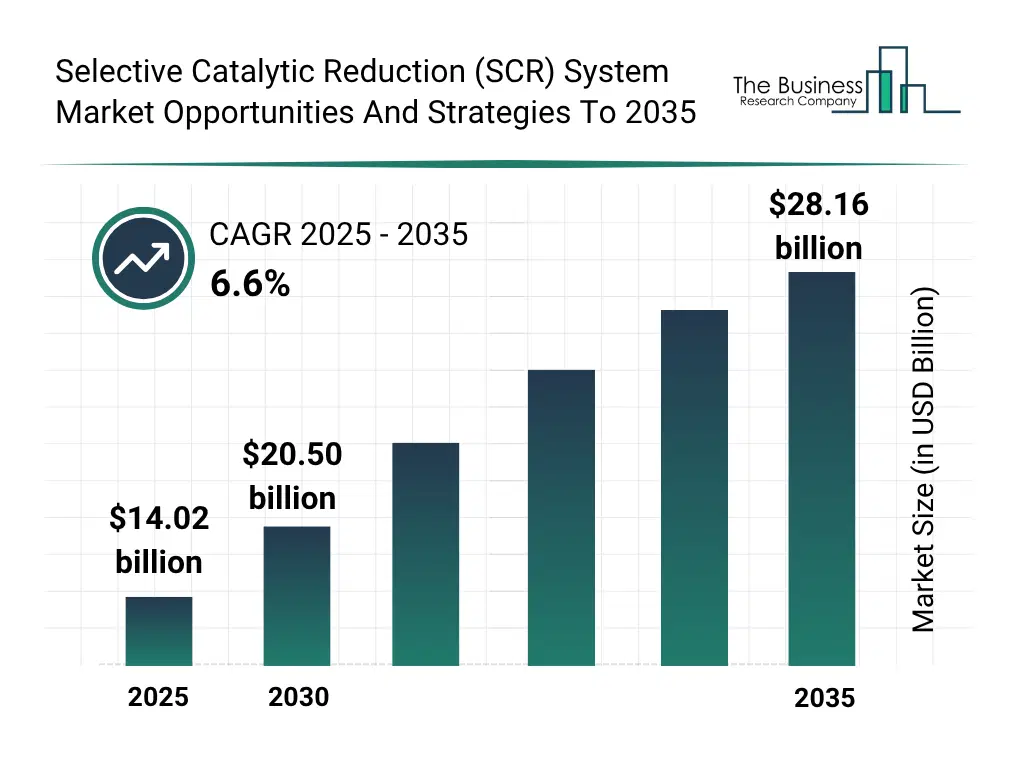
Selective Catalytic Reduction (SCR) System Global Market Opportunities And Strategies To 2035 Market Size and growth rate 2026 to 2030: Graph

Selective Catalytic Reduction (SCR) System Market Size

The global selective catalytic reduction (SCR) system market reached a value of nearly $14,015.6 million in 2025, having grown at a compound annual growth rate (CAGR) of 9.5% since 2020. The market is expected to grow from $14,015.6 million in 2025 to $20,502.3 million in 2030 at a rate of 7.9%. The market is then expected to grow at a CAGR of 6.6% from 2029 and reach $28,159.8 million in 2035. Growth in the historic period resulted from stringent environmental regulations, rising oil and gas exploration, rising onshore and offshore oil and gas activities and growth of energy and power industries. Factors that negatively affected growth in the historic period were ammonia slip and secondary emissions compliance and complex installation in retrofit applications. Going forward, demand for rising investments in industrial boilers and furnaces with emission control, growing installation of waste-to-energy and biomass power plants, increase in mining and heavy machinery operations and government incentives and investment for clean emission technologies will drive the growth. Factors that could hinder the growth of the selective catalytic reduction (SCR) system market in the future include ammonia slip and secondary emissions compliance, competition from alternative technologies and impact of trade war and tariffs.
Research Expert

Book your 30 minutes free consultation with our research experts

Selective Catalytic Reduction (SCR) System Market Segmentation The selective catalytic reduction (SCR) system market is segmented by type, by component and by application.

By Type –
The selective catalytic reduction (SCR) system market is segmented by type into:
    • a) Urea Selective Catalytic Reduction (SCR)
    • b) Ammonia Selective Catalytic Reduction (SCR)
    • c) Other Types
The urea selective catalytic reduction (SCR) market was the largest segment of the selective catalytic reduction (SCR) system market segmented by type, accounting for 62.0% or $8,684.4 million of the total in 2025. Going forward, the ammonia selective catalytic reduction (SCR) segment is expected to be the fastest-growing segment in the selective catalytic reduction (SCR) system market segmented by type, at a CAGR of 12.8% during 2025-2030.

By Component –
The selective catalytic reduction (SCR) system market is segmented by component into:
    • a) Catalytic Converter
    • b) Urea Tank
    • c) Pump
    • d) Control Unit
    • e) Injector
The catalytic converter was the largest segment of the selective catalytic reduction (SCR) system market segmented by component, accounting for 35.5% or $4,971.1 million of the total in 2025. Going forward, the urea tank segment is expected to be the fastest-growing segment in the selective catalytic reduction (SCR) system market segmented by component, at a CAGR of 11.0% during 2025-2030.

By Application –
The selective catalytic reduction (SCR) system market is segmented by application into:
    • a) Automotive
    • b) Marine
    • c) Industrial
    • d) Power Generation
    • e) Other Applications
The automotive market was the largest segment of the selective catalytic reduction (SCR) system market segmented by application, accounting for 43.3% or $6,069.5 million of the total in 2025. Going forward, the power generation segment is expected to be the fastest-growing segment in the selective catalytic reduction (SCR) system market segmented by application, at a CAGR of 9.6% during 2025-2030.

By Geography - The selective catalytic reduction (SCR) system market is segmented by geography into:
      o Asia Pacific
      • China
      • India
      • Japan
      • Australia
      • Taiwan
      • South Korea
      o South East Asia
      • Indonesia
      o North America
      • USA
      • Canada
      o South America
      • Brazil
      o Western Europe
      • France
      • Germany
      • UK
      • Italy
      • Spain
      o Eastern Europe
      • Russia
      o Middle East
      o Africa
Asia Pacific was the largest region in the selective catalytic reduction (SCR) system market, accounting for 37.1% or $5,195.6 million of the total in 2025. It was followed by Western Europe, North America and then the other regions. Going forward, the fastest-growing regions in the selective catalytic reduction (SCR) system market will be Asia Pacific and South America where growth will be at CAGRs of 8.6% and 8.0% respectively. These will be followed by Western Europe and Eastern Europe where the markets are expected to grow at CAGRs of 7.6% and 7.4% respectively.

Selective Catalytic Reduction (SCR) System Market Drivers

The key drivers of the selective catalytic reduction (SCR) system market include: Rising Investments In Industrial Boilers And Furnaces With Emission Control Rising investments in industrial boilers and furnaces with emission control are accelerating the adoption of selective catalytic reduction (SCR) system. Industrial facilities, including power generation plants, chemical processing units, refineries and manufacturing sites, are increasingly implementing nitrogen oxide (NOx) control technologies to comply with stringent environmental regulations. SCR systems are widely utilized to treat flue gas emissions from large-scale combustion units, significantly reducing NOx emissions and supporting regulatory compliance. As industries modernize combustion infrastructure and prioritize environmental performance, demand for SCR systems is expected to increase. The rising investments in industrial boilers and furnaces with emission control growth contribution during the forecast period in 2025 is 2.3%.

Selective Catalytic Reduction (SCR) System Market Restraints

The key restraints on the selective catalytic reduction (SCR) system market include: Competition From Alternative Emission Control Technologies The competition from alternative emission control technologies limits a significant barrier to market expansion. Technologies such as Exhaust Gas Recirculation (EGR) and Selective Non-Catalytic Reduction (SNCR) offer nitrogen oxide (NOx) reduction in certain applications and may present lower capital investment requirements or simpler system integration. In specific industrial or mobile applications, these alternatives can be considered viable substitutes for SCR systems, thereby limiting broader market penetration. Growth affected by competition from alternative emission control technologies limits during the forecast period in 2025 is -2.0%.

Selective Catalytic Reduction (SCR) System Market Competitive Landscape

Major Competitors are:

  • BASF SE
  • Johnson Matthey Plc
  • Cummins Inc.
  • Robert Bosch GmbH
  • Faurecia SE (FORVIA)
  • Other Competitors Include:

  • Tenneco Inc.
  • Yara International Inc.
  • Hitachi Zosen Corporation (Kanadevia Corporation)
  • Dürr CTS
  • Mitsubishi Heavy Industries Ltd. (Mitsubishi Power)
  • Xi'an Qintai Automobile Emission Technique Co. Ltd
  • Weichai Power Co. Ltd.
  • Dongfeng Motor Corporation
  • MITSUI E&S
  • Denso Corporation
  • NGK Spark Plug Co., Ltd.
  • Hitachi Astemo, Ltd.
  • Tenneco Inc.
  • Hyundai Mobis
  • Doosan Infracore
  • Tan Chong Industrial Equipment (TCIE)
  • UD Trucks
  • Scania AB
  • Haldor Topsoe
  • Volvo Trucks North America
  • Cormetech Inc.
  • Wärtsilä Corporation
  • Safety Power Inc.
  • Nett Technologies Inc.
  • Master Engineering Limited
  • Rolls-Royce Holdings plc
  • BM Catalysts
  • Continental AG
  • Faurecia SE
  • Eminox Limited
  • Albonair GmbH
  • DCL International Inc.
  • SBB Energy
  • Umicore SA
  • Clariant AG
  • Wärtsilä Oyj Abp
  • Need data on a specific region in this market?

    Opportunities And Recommendations In The Selective Catalytic Reduction (SCR) System Market

    Opportunities – The top opportunities in the selective catalytic reduction (SCR) system market segmented by type will arise in the ammonia selective catalytic reduction (SCR) segment, which will gain $3,078.1 million of global annual sales by 2030. The top opportunities in the selective catalytic reduction (SCR) system market segmented by component will arise in the urea tank segment, which will gain $1,999.1 million of global annual sales by 2030. The top opportunities in the selective catalytic reduction (SCR) system market segmented by application will arise in the automotive segment, which will gain $2,562.0 million of global annual sales by 2030. The selective catalytic reduction (SCR) system market size will gain the most in the China at $1,346.6 million. Recommendations- To take advantage of the opportunities, The Business Research Company recommends the selective catalytic reduction (SCR) system companies to focus on advanced SCR systems with high NOx reduction efficiency, focus on expanding aftermarket SCR portfolios and vehicle coverage, focus on integrated aftertreatment solutions for turbine platforms, focus on ammonia SCR segment to drive accelerated growth, focus on urea tank segment to capture high growth component demand, expand in emerging markets, continue to focus on developed markets, focus on expanding multi-channel distribution networks, focus on value-based and tiered pricing strategies, focus on regulatory alignment and technical credibility, focus on customer education and channel partnerships and focus on power generation segment to capture high-growth opportunities.
    Chat with us