
Selenium Global Market Opportunities And Strategies To 2035
By Type (Inorganic Selenium, Organic Selenium), By Mining Type (Underground Mining, Surface Mining), End Use Industry (Electronics, Automotive, Construction, Agriculture, Others), And By Region, Opportunities And Strategies – Global Forecast To 2035
Selenium Market Definition
Selenium is a trace element primarily obtained as a byproduct of copper and other metal refining. It is processed for use across industries such as electronics, glass manufacturing, metallurgy, agriculture, and dietary supplements, owing to its semiconducting and biological properties. Its primary purpose is to enhance material performance in industrial applications (such as improving conductivity, durability, and decolorization in glass) while also serving essential biological functions, particularly as a micronutrient that supports antioxidant activity and overall metabolic health in humans and animals. The selenium market consists of sales of selenium by entities (organizations, sole traders and partnerships) that is applied in photovoltaic cells, glass decolorization and coloration, rubber processing, alloy enhancement, and as a micronutrient additive in animal feed and human supplements. Its usage occurs continuously across industrial production cycles, agricultural feeding regimes, and healthcare consumption, reflecting both steady and demand-driven utilization patterns.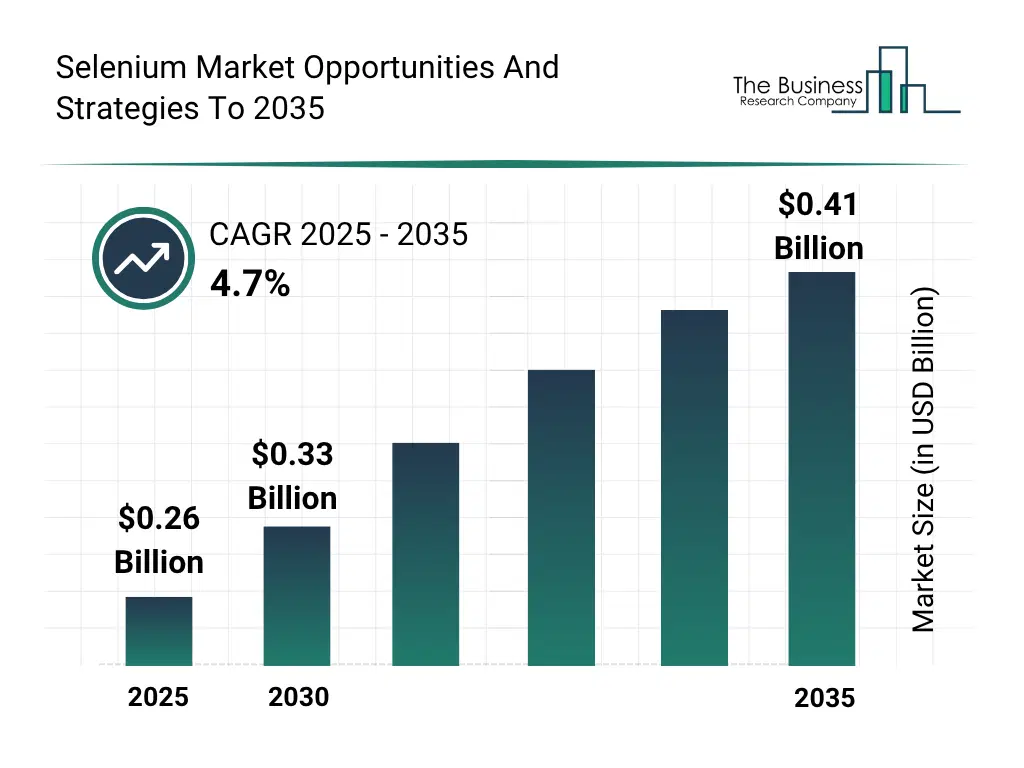
Selenium Market Size
The global selenium market reached a value of nearly $256.2 million in 2025, having grown at a compound annual growth rate (CAGR) of 8.0% since 2020. The market is expected to grow from $256.2 million in 2025 to $327.6 million in 2030 at a rate of 5.0%. The market is then expected to grow at a CAGR of 4.7% from 2030 and reach $412.1 million in 2035. Growth in the historic period resulted from growth in pigment and ceramics industry, rising use in glass manufacturing, expansion of stainless steel and metallurgy industries and high demand in animal nutrition and feed additives. Factors that negatively affected growth in the historic period were dependence on copper refining (by-product nature) and supply volatility due to fluctuations in base metal mining activity. Going forward, expansion of solar photovoltaic (PV) installations, rising government support for clean energy and sustainability, growing usage in dietary supplements and pharmaceutical and growing adoption in electronics and semiconductors industry will drive the growth. Factors that could hinder the growth of the selenium market in the future include stringent government regulations on selenium usage and disposal, limited primary selenium deposits and extraction sources and impact of trade war and tariff.
Selenium Market Segmentation
The selenium market is segmented by type, by mining type and by end-user industry.By Type –
The selenium market is segmented by type into:
- a) Inorganic Selenium
- b) Organic Selenium
By Mining Type –
The selenium market is segmented by mining type into:
- a) Underground Mining
- b) Surface Mining
By End-User Industry –
The selenium market is segmented by end-user industry into:
- a) Electronics
- b) Automotive
- c) Construction
- d) Agriculture
- e) Others
By Geography - The selenium market is segmented by geography into:
- China
- India
- Japan
- Australia
- Indonesia
- South Korea
- Bangladesh
- Thailand
- Vietnam
- Malaysia
- Singapore
- Phillipines
- Hong kong
- New Zealand
- USA
- Canada
- Mexico
- Brazil
- Argentina
- Chile
- Colombiia
- Peru
- France
- Germany
- UK
- Italy
- Spain
- Austria
- Belgium
- Denmark
- Finland
- Ireland
- Netherland
- Norway
- Portugal
- Sweden
- Switzerland
- Russia
- Czech Republic
- Poland
- Romania
- Ukraine
- Saudi Arabia
- Israel
- Iran
- Turkey
- UAE o Africa
- Egypt
- Nigeria
- South Africa
-
o Asia Pacific