
Self-Assembling Protein Nanoparticles Market Report 2026
Global Outlook – By Product Type (Vaccine Nanoparticles, Targeted Drug Delivery Nanoparticles, Diagnostic Nanoparticles, Protein-Based Nanocarriers, Research-Grade Nanoparticle Kits, Therapeutic Protein Nanoparticles, Imaging And Contrast Agent Nanoparticles), By Design Approach (Virus-Like Particles, Ferritin-Based Nanoparticles, Encapsulin-Based Nanoparticles, Designed Oligomeric Proteins, Two-Component Co-Assembling Systems), By Technology Modular Nanoparticle Platforms), By End User (Biopharmaceutical Companies, Biotechnology Companies, Academic And Research Institutes, Contract Research Organizations, Diagnostic Laboratories) – Market Size, Trends, Strategies, and Forecast to 2035
Self-Assembling Protein Nanoparticles Market Overview
• Self-Assembling Protein Nanoparticles market size has reached to $1.55 billion in 2025 • Expected to grow to $3.37 billion in 2030 at a compound annual growth rate (CAGR) of 16.8% • Growth Driver: Accelerating Demand For Precision Targeted Therapeutics Fueling The Growth Of The Market Due To Improved Clinical Outcomes And Reduced Off-Target Effects • Market Trend: Advancements In Next-Generation Universal Vaccines Using Self-Assembling Protein Nanoparticles • North America was the largest region in 2025 and Asia-Pacific is the fastest growing region.What Is Covered Under Self-Assembling Protein Nanoparticles Market?
Self-assembling protein nanoparticles are nanoscale structures formed through the spontaneous organization of engineered or naturally occurring proteins into highly ordered arrangements. These particles are designed using principles of molecular biology, structural biochemistry, and nanotechnology to achieve precise size, shape, and functional properties. They are widely studied for their ability to enable targeted delivery, controlled release, and advanced biomedical and material science applications. The main product types of self-assembling protein nanoparticles include vaccine nanoparticles, targeted drug delivery nanoparticles, diagnostic nanoparticles, protein-based nanocarriers, research-grade nanoparticle kits, therapeutic protein nanoparticles, and imaging and contrast agent nanoparticles. Vaccine nanoparticles refer to protein-based constructs designed to mimic viral structures for enhanced immune response in immunization. The design approaches include virus-like particles, ferritin-based nanoparticles, encapsulin-based nanoparticles, designed oligomeric proteins, and two-component co-assembling systems and the technologies utilized include recombinant protein technology, computational protein design, structural biology engineering, self-assembly engineering platforms, and modular nanoparticle platforms. The key applications of drug delivery, vaccine development, cancer therapy, gene therapy, diagnostics and biosensing, immunotherapy, regenerative medicine, and material science applications, while the end-users include biopharmaceutical companies, biotechnology companies, academic and research institutes, contract research organizations, and diagnostic laboratories.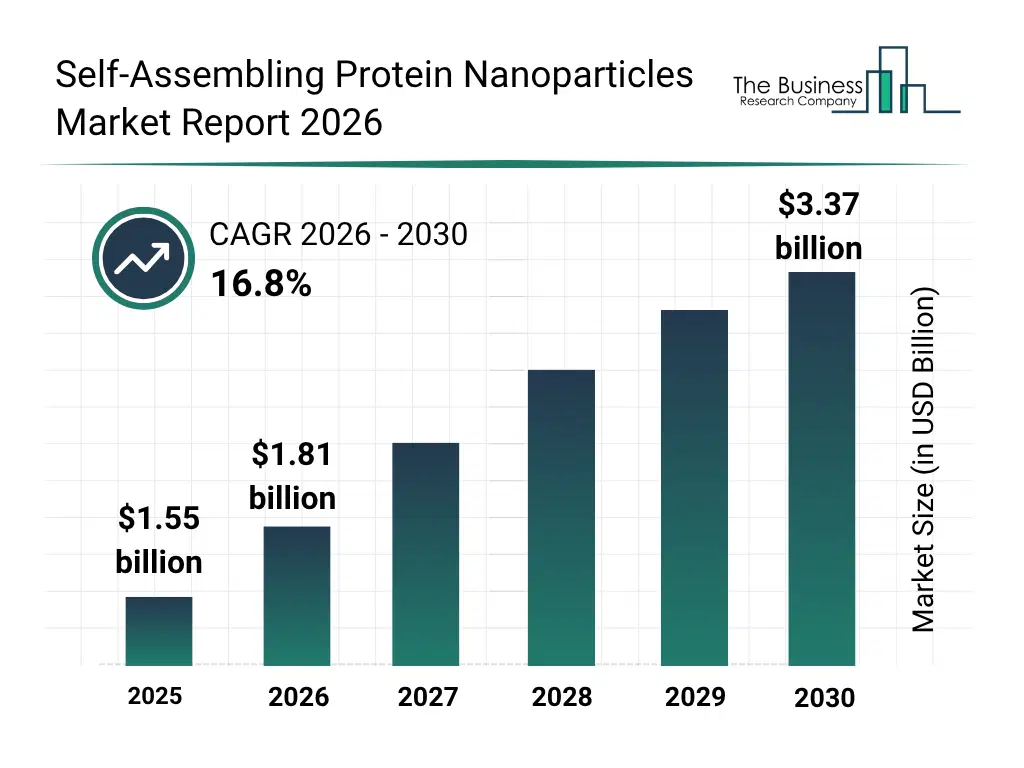
What Is The Self-Assembling Protein Nanoparticles Market Size and Share 2026?
The self-assembling protein nanoparticles market size has grown rapidly in recent years. It will grow from $1.55 billion in 2025 to $1.81 billion in 2026 at a compound annual growth rate (CAGR) of 16.6%. The growth in the historic period can be attributed to advancements in recombinant protein technology, growth of biopharmaceutical research, increasing vaccine development initiatives, rising demand for cancer and gene therapies, adoption of structural biology engineering.What Is The Self-Assembling Protein Nanoparticles Market Growth Forecast?
The self-assembling protein nanoparticles market size is expected to see rapid growth in the next few years. It will grow to $3.37 billion in 2030 at a compound annual growth rate (CAGR) of 16.8%. The growth in the forecast period can be attributed to integration of computational protein design, expansion of immunotherapy applications, increasing demand for personalized medicine, adoption of self-assembly engineering platforms, investment in modular nanoparticle platforms. Major trends in the forecast period include ai-driven protein design, modular nanoparticle engineering, targeted drug delivery optimization, real-time diagnostic nanoparticle tracking, scaffold customization platforms.
Global Self-Assembling Protein Nanoparticles Market Segmentation
1) By Product Type: Vaccine Nanoparticles, Targeted Drug Delivery Nanoparticles, Diagnostic Nanoparticles, Protein-Based Nanocarriers, Research-Grade Nanoparticle Kits, Therapeutic Protein Nanoparticles, Imaging And Contrast Agent Nanoparticles 2) By Design Approach: Virus-Like Particles, Ferritin-Based Nanoparticles, Encapsulin-Based Nanoparticles, Designed Oligomeric Proteins, Two-Component Co-Assembling Systems 3) By Technology: Recombinant Protein Technology, Computational Protein Design, Structural Biology Engineering, Self-Assembly Engineering Platforms, Modular Nanoparticle Platforms 4) By Application: Drug Delivery, Vaccine Development, Cancer Therapy, Gene Therapy, Diagnostics And Biosensing, Immunotherapy, Regenerative Medicine, Material Science Applications 5) By End User: Biopharmaceutical Companies, Biotechnology Companies, Academic And Research Institutes, Contract Research Organizations, Diagnostic Laboratories Subsegments: 1) By Vaccine Nanoparticles: Protein Cage Based Vaccine Nanoparticles, Virus Like Particle Vaccine Nanoparticles, Ferritin Scaffold Vaccine Nanoparticles, Encapsulin Derived Vaccine Nanoparticles 2) By Targeted Drug Delivery Nanoparticles: Chemotherapeutic Loaded Protein Nanoparticles, Messenger Ribonucleic Acid Loaded Protein Nanoparticles, Small Molecule Encapsulated Protein Nanoparticles, Gene Editing Component Delivery Nanoparticles 3) By Diagnostic Nanoparticles: Fluorescently Labeled Protein Nanoparticles, Enzyme Conjugated Protein Nanoparticles, Biomarker Targeted Detection Nanoparticles, Electrochemical Sensing Protein Nanoparticles 4) By Protein-Based Nanocarriers: Surface Functionalized Protein Nanocarriers, Core Shell Structured Protein Nanocarriers, Stimuli Responsive Protein Nanocarriers, Ligand Targeted Protein Nanocarriers 5) By Research-Grade Nanoparticle Kits: Pre Assembled Protein Nanoparticle Kits, Customizable Scaffold Nanoparticle Kits, Surface Modification Ready Nanoparticle Kits, Laboratory Validation Nanoparticle Kits 6) By Therapeutic Protein Nanoparticles: Antibody Displaying Protein Nanoparticles, Cytokine Loaded Protein Nanoparticles, Peptide Functionalized Protein Nanoparticles, Enzyme Delivery Protein Nanoparticles 7) By Imaging And Contrast Agent Nanoparticles: Magnetic Resonance Imaging Protein Nanoparticles, Fluorescent Imaging Protein Nanoparticles, Computed Tomography Contrast Protein Nanoparticles, Multimodal Imaging Protein NanoparticlesWhat Is The Driver Of The Self-Assembling Protein Nanoparticles Market?
The accelerating demand for precision targeted therapeutics is expected to propel the growth of the self‑assembling protein nanoparticles market going forward. Precision targeted therapeutics refer to treatment approaches that deliver therapeutic agents directly to specific cells, tissues, or molecular pathways based on individual disease characteristics to improve efficacy and reduce adverse effects. The demand for precision targeted therapeutics is increasing due to the rising global burden of complex and chronic diseases that require highly specific and individualized treatment strategies. Self‑assembling protein nanoparticles supports precision targeted therapeutics by enabling the design of uniform, programmable nanostructures that can encapsulate and deliver drugs, antigens, or genetic material directly to defined biological targets with controlled release profiles. For instance, in February 2024, according to the Personalized Medicine Coalition, a US-based nonprofit organization, personalized medicines accounted for more than one-third of new United States Food and Drug Administration drug approvals in 2023, totaling 26 targeted therapies compared to significantly lower share in 2022. Therefore, the accelerating demand for precision targeted therapeutics is driving the growth of the self‑assembling protein nanoparticles market.Key Players In The Global Self-Assembling Protein Nanoparticles Market
Major companies operating in the self-assembling protein nanoparticles market are Novavax Inc., Mika Biologics, VBI Vaccines Inc., Clover Biopharmaceuticals, Virometix AG, Medicago Inc., TechnoVax Inc., VLP Therapeutics LLC, Osivax SAS, Expres2ion Biotechnologies, SpyBiotech, SpyBiotech Ltd., Uvax Bio Inc., SK Bioscience Co. Ltd., Mynvax Private Limited, Vaxine Pty Ltd, Ufovax LLC.Global Self-Assembling Protein Nanoparticles Market Trends and Insights
Major companies operating in the self‑assembling protein nanoparticles market are focusing on developing innovative solutions, such as next-generation universal vaccine development, to enhance broad-spectrum immunity and pandemic preparedness. Next-generation universal vaccine development refers to the design, creation, and evaluation of advanced immunization strategies aimed at providing broad and durable protection against multiple strains or species within a viral family. For instance, in January 2026, SK Bioscience, a South Korea-based biopharmaceutical company, initiated a global Phase 1/2 clinical trial for GBP511, a vaccine targeting the Sarbecovirus Family. GBP511 leverages SKYCovione’s recombinant protein-based platform combined with self-assembling nanoparticle technology developed by the Institute for Protein Design at the University of Washington School of Medicine. The trial involves approximately 368 adults and evaluates safety, tolerability, and immunogenicity across multiple dose cohorts, with or without an adjuvant, including comparisons with Comirnaty. This approach aims to induce broad immune responses across current and potential future SARS-like coronaviruses, supporting universal vaccine development and pandemic preparedness.What Are Latest Mergers And Acquisitions In The Self-Assembling Protein Nanoparticles Market?
In December 2023, AstraZeneca plc, a UK-based biopharmaceutical company, acquired Icosavax Inc. for approximately $1.1 billion. Through this acquisition, AstraZeneca aims to strengthen its late-stage vaccines and immune therapies pipeline and accelerate development of innovative respiratory vaccines, including the Phase III-ready IVX-A12 candidate targeting RSV and human metapneumovirus. Icosavax Inc. is a US-based clinical-stage biotechnology company that develops vaccines using self-assembling protein nanoparticles.Regional Insights
North America was the largest region in the self-assembling protein nanoparticles market in 2025. Asia-Pacific is expected to be the fastest-growing region in the forecast period. The regions covered in this market report are Asia-Pacific, South East Asia, Western Europe, Eastern Europe, North America, South America, Middle East, Africa. The countries covered in this market report are Australia, Brazil, China, France, Germany, India, Indonesia, Japan, Taiwan, Russia, South Korea, UK, USA, Canada, Italy, Spain.What Defines the Self-Assembling Protein Nanoparticles Market?
The self-assembling protein nanoparticles market consists of revenues earned by entities by providing services such as nanoparticle design, protein engineering, structural optimization, formulation development, and characterization support. The market value includes the value of related goods sold by the service provider or included within the service offering. The self-assembling protein nanoparticles market includes sales of computationally designed protein nanoparticle scaffolds, virus-like particle vaccine candidates, antigen-display nanoparticle platforms, and recombinant protein nanoparticle kits. Values in this market are ‘factory gate’ values, that is, the value of goods sold by the manufacturers or creators of the goods, whether to other entities (including downstream manufacturers, wholesalers, distributors, and retailers) or directly to end customers. The value of goods in this market includes related services sold by the creators of the goods.How is Market Value Defined and Measured?
The market value is defined as the revenues that enterprises gain from the sale of goods and/or services within the specified market and geography through sales, grants, or donations in terms of the currency (in USD unless otherwise specified). The revenues for a specified geography are consumption values that are revenues generated by organizations in the specified geography within the market, irrespective of where they are produced. It does not include revenues from resales along the supply chain, either further along the supply chain or as part of other products.What Key Data And Analysis Are Included In The Self-Assembling Protein Nanoparticles Market Report 2026?
The self-assembling protein nanoparticles market research report is one of a series of new reports from The Business Research Company that provides market statistics, including industry global market size, regional shares, competitors with the market share, detailed market segments, market trends and opportunities, and any further data you may need to thrive in the self-assembling protein nanoparticles industry. The market research report delivers a complete perspective of everything you need, with an in-depth analysis of the current and future state of the industry.Self-Assembling Protein Nanoparticles Market Report Forecast Analysis
| Report Attribute | Details |
|---|---|
| Market Size Value In 2026 | $1.81 billion |
| Revenue Forecast In 2035 | $3.37 billion |
| Growth Rate | CAGR of 16.6% from 2026 to 2035 |
| Base Year For Estimation | 2025 |
| Actual Estimates/Historical Data | 2020-2025 |
| Forecast Period | 2026 - 2030 - 2035 |
| Market Representation | Revenue in USD Billion and CAGR from 2026 to 2035 |
| Segments Covered | Product Type, Design Approach, Technology, Application, End User |
| Regional Scope | Asia-Pacific, Western Europe, Eastern Europe, North America, South America, Middle East, Africa |
| Country Scope | The countries covered in the report are Australia, Brazil, China, France, Germany, India, Indonesia, Japan, Taiwan, Russia, South Korea, UK, USA, Canada, Italy, Spain. |
| Key Companies Profiled | Novavax Inc., Mika Biologics, VBI Vaccines Inc., Clover Biopharmaceuticals, Virometix AG, Medicago Inc., TechnoVax Inc., VLP Therapeutics LLC, Osivax SAS, Expres2ion Biotechnologies, SpyBiotech, SpyBiotech Ltd., Uvax Bio Inc., SK Bioscience Co. Ltd., Mynvax Private Limited, Vaxine Pty Ltd, Ufovax LLC. |
| Customization Scope | Request for Customization |
| Pricing And Purchase Options | Explore Purchase Options |