
Self-Driving Bus Market Report 2026
Global Outlook – By Component (Hardware, Software, Services), By Propulsion Type (Internal Combustion Engine, Battery Electric Self Driving Buses, Hybrid Buses), By Technology (Light Detection And Ranging Based Navigation, Camera Based Systems, Radar Based Systems, Ultrasonic Sensors, Vehicle To Everything Communication Technology), By Application (Public Transportation Systems, Airport Shuttle Services, Corporate Campuses, University Campuses, Tourism And Sightseeing), By End-User (Government Agencies, Private Transportation Companies, Educational Institutions, Tourism Operators, Healthcare Institutions) – Market Size, Trends, Strategies, and Forecast to 2035
Self-Driving Bus Market Overview
• Self-Driving Bus market size has reached to $1.2 billion in 2025 • Expected to grow to $3.99 billion in 2030 at a compound annual growth rate (CAGR) of 27.2% • Growth Driver: Surge In Need For Traffic Congestion Reduction Fueling The Growth Of The Market Due To Increasing Pressure On Urban Road Infrastructure • Market Trend: Next-Generation Mobility Solutions Enhance Operational Efficiency In Urban Transport Networks • North America was the largest region in 2025 and Asia-Pacific is the fastest growing region.What Is Covered Under Self-Driving Bus Market?
A self-driving bus is an autonomous vehicle designed to transport passengers without a human driver. It uses sensors, cameras, and artificial intelligence to navigate roads, avoid obstacles, and follow traffic rules. These buses aim to improve safety, efficiency, and accessibility in public transportation. The main components of self-driving bus include hardware, software, and services. Hardware refers to physical systems such as sensors, controllers, and onboard computing units that enable autonomous driving functionality in buses. These systems are categorized by propulsion type including internal combustion engine, battery electric self driving buses, and hybrid buses and are based on technologies such as light detection and ranging based navigation, camera based systems, radar based systems, ultrasonic sensors, and vehicle to everything communication technology. They find applications such as public transportation systems, airport shuttle services, corporate campuses, university campuses, and tourism and sightseeing, while the end-use includes government agencies, private transportation companies, educational institutions, tourism operators, and healthcare institutions.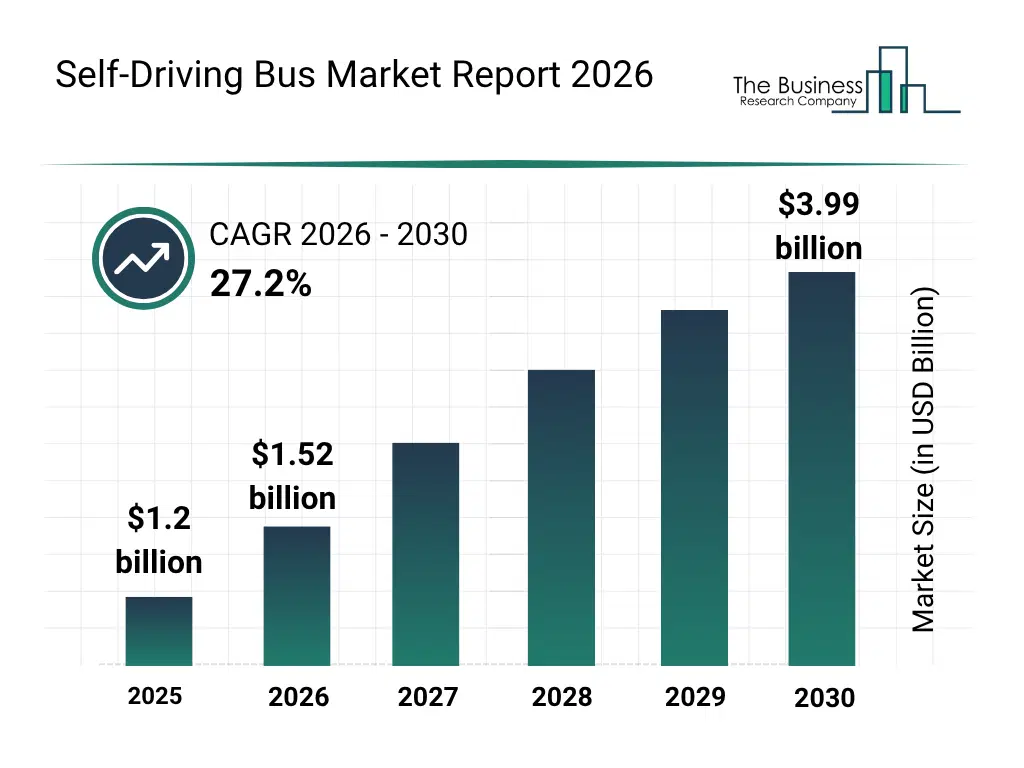
What Is The Self-Driving Bus Market Size and Share 2026?
The self-driving bus market size has grown exponentially in recent years. It will grow from $1.2 billion in 2025 to $1.52 billion in 2026 at a compound annual growth rate (CAGR) of 27.0%. The growth in the historic period can be attributed to rising urban congestion and traffic density, increasing demand for efficient public transportation systems, high operational costs of human driven bus fleets, growing focus on road safety improvements, limited automation in mass transit systems.What Is The Self-Driving Bus Market Growth Forecast?
The self-driving bus market size is expected to see exponential growth in the next few years. It will grow to $3.99 billion in 2030 at a compound annual growth rate (CAGR) of 27.2%. The growth in the forecast period can be attributed to expansion of smart city and autonomous mobility initiatives, increasing adoption of electric autonomous public transport fleets, advancements in AI based real time navigation systems, rising investment in connected vehicle infrastructure, growing demand for sustainable and low emission transportation solutions. Major trends in the forecast period include ai driven autonomous bus navigation systems, vehicle to everything enabled public transport coordination, smart fleet management for self driving buses, electric autonomous shuttle deployment in urban mobility, sensor fusion based passenger safety enhancement systems.
Global Self-Driving Bus Market Segmentation
1) By Component: Hardware, Software, Services 2) By Propulsion Type: Internal Combustion Engine, Battery Electric Self Driving Buses, Hybrid Buses 3) By Technology: Light Detection And Ranging Based Navigation, Camera Based Systems, Radar Based Systems, Ultrasonic Sensors, Vehicle To Everything Communication Technology 4) By Application: Public Transportation Systems, Airport Shuttle Services, Corporate Campuses, University Campuses, Tourism And Sightseeing 5) By End-User: Government Agencies, Private Transportation Companies, Educational Institutions, Tourism Operators, Healthcare Institutions Subsegments: 1) By Hardware: Light Detection And Ranging Sensors, Radar Sensors, Cameras, Ultrasonic Sensors, Global Positioning System Modules, Inertial Measurement Units, Electronic Control Units, Onboard Computers, Batteries, Charging Systems 2) By Software: Autonomous Driving Software, Navigation Software, Fleet Management Software, Vehicle To Everything Communication Software, Safety And Security Software, Passenger Information System Software, Data Analytics Software, Artificial Intelligence Software 3) By Services: Maintenance Services, Consulting Services, Integration Services, Training Services, Remote Monitoring Services, Software Update Services, Fleet Management Services, Customer Support ServicesWhat Is The Driver Of The Self-Driving Bus Market?
The growing need for traffic congestion reduction is expected to propel the growth of the self-driving bus market going forward. Traffic congestion reduction refers to the efforts and strategies aimed at minimizing road overcrowding, improving traffic flow efficiency, and reducing delays caused by high vehicle density in urban and interurban transport networks. The rising need for congestion reduction is driven by rapid urbanization, increasing vehicle ownership, and expanding city populations that place significant pressure on existing road infrastructure and public transport systems. Self-driving buses support congestion reduction by enabling high-capacity, optimized route planning, platooning capabilities, and continuous operations with minimal human error, thereby improving traffic efficiency, reducing idle time, and enhancing overall public transport utilization. For instance, in June 2025, according to the United Kingdom Government Digital Service, a UK-based unit within the UK Government’s Department for Science, Innovation and Technology (DSIT), indicates that, for the year ending March 2025, vehicles on local ‘A’ roads experienced an average delay of 47.9 seconds per mile relative to free-flow conditions, representing a 2.4 percent increase compared to the previous year, highlighting a continued upward trend in traffic congestion. Therefore, a growing need for traffic congestion reduction is driving the growth of the self-driving bus industry.Key Players In The Global Self-Driving Bus Market
Major companies operating in the self-driving bus market are AB Volvo, Hyundai Motor Company, Apollo Baidu, EasyMile SAS, Zhengzhou Yutong Bus Co. Ltd., The Hi-Tech Robotic Systemz Ltd., Daimler Truck AG, WeRide Inc., Pony.ai Inc., Karsan Otomotiv Sanayii ve Ticaret A.Ş., Aurrigo International plc, Mercedes-Benz Group AG, Robert Bosch GmbH, Aptiv Plc, May Mobility Inc., Ohmio Automation Limited, Imagry Inc., Glydways Inc., Beep Inc., Ultra FairwoodGlobal Self-Driving Bus Market Trends and Insights
Major companies operating in the self-driving bus market are focusing on developing high-level automation capabilities such as autonomous electric shuttle operations to improve operational efficiency, safety, and reliability in congested urban areas. Autonomous electric shuttle operations refer to the deployment and management of self-driving, battery-powered shuttle vehicles that transport passengers on fixed or flexible routes without a human driver. For instance, in December 2023, BOLDLY Co., Ltd., a Japan-based company that focuses on autonomous driving technology, launched the autonomous electric vehicle “MiCa” at HANEDA INNOVATION CITY® for year-round operation. MiCa features obstacle avoidance, Level 4 autonomous driving, and scheduled passenger shuttle services; it improves mobility for employees and visitors, optimizes route efficiency, and demonstrates a scalable model for autonomous urban transport.What Are Latest Mergers And Acquisitions In The Self-Driving Bus Market?
In March 2025, Macnica Group, a Japan based technology and autonomous driving solutions company, acquired Navya Mobility SAS for an undisclosed amount. With this acquisition, Macnica aims to strengthen its autonomous driving vehicle and system development capabilities and create a seamless supply chain from consulting to implementation and operation of autonomous driving services, accelerating the social implementation of Level 4 autonomous mobility solutions. Navya Mobility SAS is a France based autonomous driving bus and mobility technology company that specializes in 15 passenger autonomous electric buses and related autonomous driving software and vehicle implementation services.Regional Outlook/Insights
North America was the largest region in the self-driving bus market in 2025. Asia-Pacific is expected to be the fastest-growing region in the forecast period. The regions covered in this market report are Asia-Pacific, South East Asia, Western Europe, Eastern Europe, North America, South America, Middle East, Africa. The countries covered in this market report are Australia, Brazil, China, France, Germany, India, Indonesia, Japan, Taiwan, Russia, South Korea, UK, USA, Canada, Italy, Spain.What Defines the Self-Driving Bus Market?
The self-driving bus market consists of revenues earned by entities by providing services such as public transport, airport transfer, campus shuttle, city tour service, corporate transit, on-demand ride service, event transport and hospital/medical shuttle. The market value includes the value of related goods sold by the service provider or included within the service offering. The self-driving bus market includes sales of autonomous shuttle, robo-bus, electric self-driving bus, hybrid autonomous bus and last-mile autonomous vehicle. Values in this market are ‘factory gate’ values, that is, the value of goods sold by the manufacturers or creators of the goods, whether to other entities (including downstream manufacturers, wholesalers, distributors, and retailers) or directly to end customers. The value of goods in this market includes related services sold by the creators of the goods.How is Market Value Defined and Measured?
The market value is defined as the revenues that enterprises gain from the sale of goods and/or services within the specified market and geography through sales, grants, or donations in terms of the currency (in USD unless otherwise specified). The revenues for a specified geography are consumption values that are revenues generated by organizations in the specified geography within the market, irrespective of where they are produced. It does not include revenues from resales along the supply chain, either further along the supply chain or as part of other products.What Key Data and Analysis Are Included in the Self-Driving Bus Market Report 2026?
The self-driving bus market research report is one of a series of new reports from The Business Research Company that provides market statistics, including industry global market size, regional shares, competitors with the market share, detailed market segments, market trends and opportunities, and any further data you may need to thrive in the self-driving bus industry. The market research report delivers a complete perspective of everything you need, with an in-depth analysis of the current and future state of the industry.Self-Driving Bus Market Report Forecast Analysis
| Report Attribute | Details |
|---|---|
| Market Size Value In 2026 | $1.52 billion |
| Revenue Forecast In 2035 | $3.99 billion |
| Growth Rate | CAGR of 27.2% from 2026 to 2035 |
| Base Year For Estimation | 2025 |
| Actual Estimates/Historical Data | 2020-2025 |
| Forecast Period | 2026 - 2030 - 2035 |
| Market Representation | Revenue in USD Billion and CAGR from 2026 to 2035 |
| Segments Covered | Component, Propulsion Type, Technology, Application, End-User |
| Regional Scope | Asia-Pacific, Western Europe, Eastern Europe, North America, South America, Middle East, Africa |
| Country Scope | The countries covered in the report are Australia, Brazil, China, France, Germany, India, Indonesia, Japan, Taiwan, Russia, South Korea, UK, USA, Canada, Italy, Spain. |
| Key Companies Profiled | AB Volvo, Hyundai Motor Company, Apollo Baidu, EasyMile SAS, Zhengzhou Yutong Bus Co. Ltd., The Hi-Tech Robotic Systemz Ltd., Daimler Truck AG, WeRide Inc., Pony.ai Inc., Karsan Otomotiv Sanayii ve Ticaret A.Ş., Aurrigo International plc, Mercedes-Benz Group AG, Robert Bosch GmbH, Aptiv Plc, May Mobility Inc., Ohmio Automation Limited, Imagry Inc., Glydways Inc., Beep Inc., Ultra Fairwood |
| Customization Scope | Request for Customization |
| Pricing And Purchase Options | Explore Purchase Options |