
Self Leveling Underlayment Market Report 2026
Global Outlook – By Type (Cementitious, Gypsum-Based, Other Types), By Distribution Channel (Direct Sales, Retail Stores, Online Stores, Other Distribution Channels), By Application (Residential, Commercial, Industrial, Institutional), By End-Use (Flooring, Subfloor Preparation, Other End Users) – Market Size, Trends, Strategies, and Forecast to 2030
Self Leveling Underlayment Market Overview
• Self Leveling Underlayment market size has reached to $3.97 billion in 2025 • Expected to grow to $5.45 billion in 2030 at a compound annual growth rate (CAGR) of 6.5% • Growth Driver: Growth Of Commercial Renovation And New-Build Interiors Fueling The Growth Of The Market Due To Rising Nonresidential Spending • Market Trend: Advancing Interior Construction With High Flexural Strength, Lightweight Formulation, And Efficient Self-Leveling Capabilities • North America was the largest region in 2025 and Asia-Pacific is the fastest growing region.What Is Covered Under Self Leveling Underlayment Market?
Self leveling underlayment is a cement-based or polymer-modified material designed to create a smooth, flat surface over uneven or rough substrates. It flows and spreads easily under its own weight, filling low spots and minor imperfections without extensive troweling. Once cured, it provides a stable and level base suitable for the installation of various floor coverings. The main types of self leveling underlayment include cementitious, gypsum-based, and others. Cementitious self leveling underlayment is widely used due to its high compressive strength, moisture resistance, and suitability for a broad range of floor coverings, enabling smooth and even surfaces prior to final floor installation. These products are distributed through direct sales, retail stores, online stores, and others and are applied across residential, commercial, industrial, and institutional settings, primarily for flooring, subfloor preparation, and other end-uses.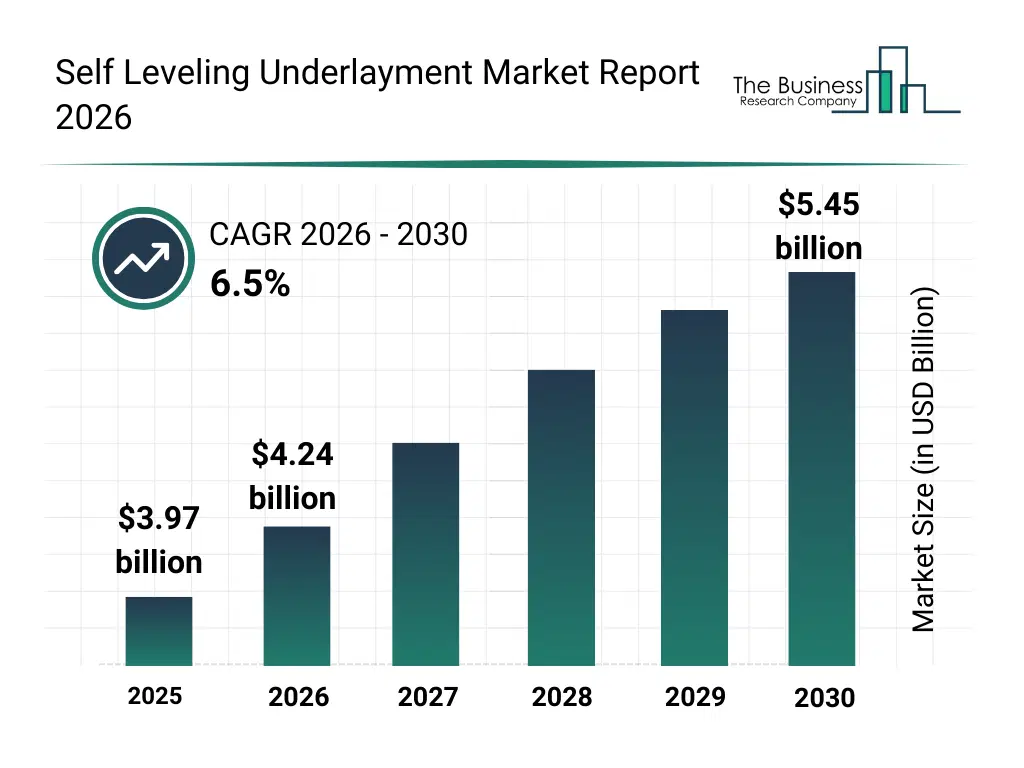
What Is The Self Leveling Underlayment Market Size and Share 2026?
The self leveling underlayment market size has grown strongly in recent years. It will grow from $3.97 billion in 2025 to $4.24 billion in 2026 at a compound annual growth rate (CAGR) of 6.8%. The growth in the historic period can be attributed to rapid urbanization and construction growth, rising renovation and retrofit projects, growing demand for durable and high-quality flooring, increasing labor and time efficiency benefits, and expansion of commercial and industrial real estate projects.What Is The Self Leveling Underlayment Market Growth Forecast?
The self leveling underlayment market size is expected to see strong growth in the next few years. It will grow to $5.45 billion in 2030 at a compound annual growth rate (CAGR) of 6.5%. The growth in the forecast period can be attributed to increasing adoption of polymer-modified and fast-setting underlayments, rising focus on eco-friendly and low volatile organic compounds (VOC) materials, growing awareness and training among contractors, expansion of distribution networks, and increasing integration of value-added services such as installation and technical consultation. Major trends in the forecast period include technology advancements in polymer-modified formulations, innovations in fiber-reinforced and low-shrinkage materials, developments in fast-curing and quick-setting underlayments, research and developments in eco-friendly and sustainable products, and advancements in digital tools and automated flooring solutions.
Global Self Leveling Underlayment Market Segmentation
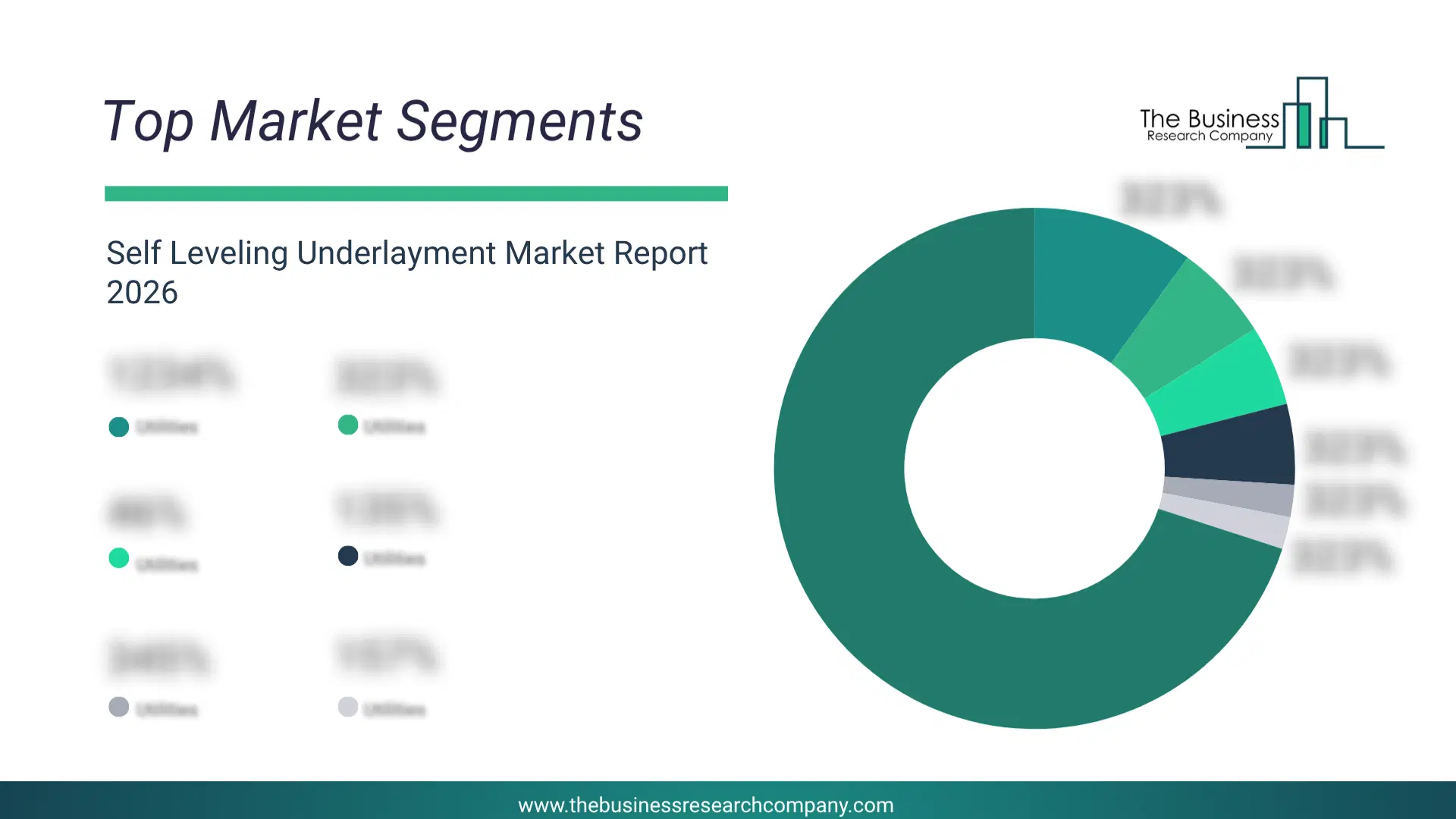
1) By Type: Cementitious, Gypsum-Based, Other Types 2) By Distribution Channel: Direct Sales, Retail Stores, Online Stores, Other Distribution Channels 3) By Application: Residential, Commercial, Industrial, Institutional 4) By End-Use: Flooring, Subfloor Preparation, Other End Users Subsegments: 1) By Cementitious: Rapid Setting, Fiber Reinforced, Polymer Modified, Standard Strength 2) By Gypsum-Based: Quick Drying, Fiber Reinforced, High Strength, Lightweight 3) By Others Type: Polymer Based, Self-Curing, Hybrid Mix, Specialty FormulationsWhat Is The Driver Of The Self Leveling Underlayment Market?
The growth of commercial renovation and new-build interiors is expected to propel the growth of the self leveling underlayment market going forward. Commercial renovation and new-build interiors refer to flooring preparation in office, retail, and institutional spaces during upgrades or construction. The rise in commercial renovation and new-build interiors is due to economic expansion and property redevelopment, as they require smooth, level surfaces for durable flooring installations. Self leveling underlayment helps in commercial renovation and new-build interiors by providing flat, even substrates that prevent cracks and ensure long-lasting floor performance. For instance, in October 2025, according to Statistics Finland, a Finland-based official national statistics agency, $4.58 billion (€ 3.9 billion) was spent on renovating non residential buildings in 2024 with the total value of these renovations rising by 9.6% year on year and commercial and office building renovations increasing the most by 22.3 per cent. Therefore, growth of commercial renovation and new-build interiors is driving the growth of the self leveling underlayment industry.Key Players In The Global Self Leveling Underlayment Market
Major companies operating in the self leveling underlayment market are Sika AG, MAPEI S.p.A., Bostik SA, USG Corporation, Arcosa Specialty Materials, The Quikrete Companies Inc., Master Builders Solutions Holdings GmbH, ARDEX Americas, Custom Building Products Inc., Henry Company LLC, The Euclid Chemical Company, TEC Specialty Construction Brands Inc., LATICRETE International Inc., Flowcrete Group Ltd., W. R. Meadows Inc., CTS Cement Manufacturing Corporation, Dex-O-Tex, KÖSTER Bauchemie AG, CMP Specialty Products, Merkrete LLC, Hacker Industries Inc., Duraamen Engineered Products Inc., Fosroc International Ltd., Spex-Crete Industries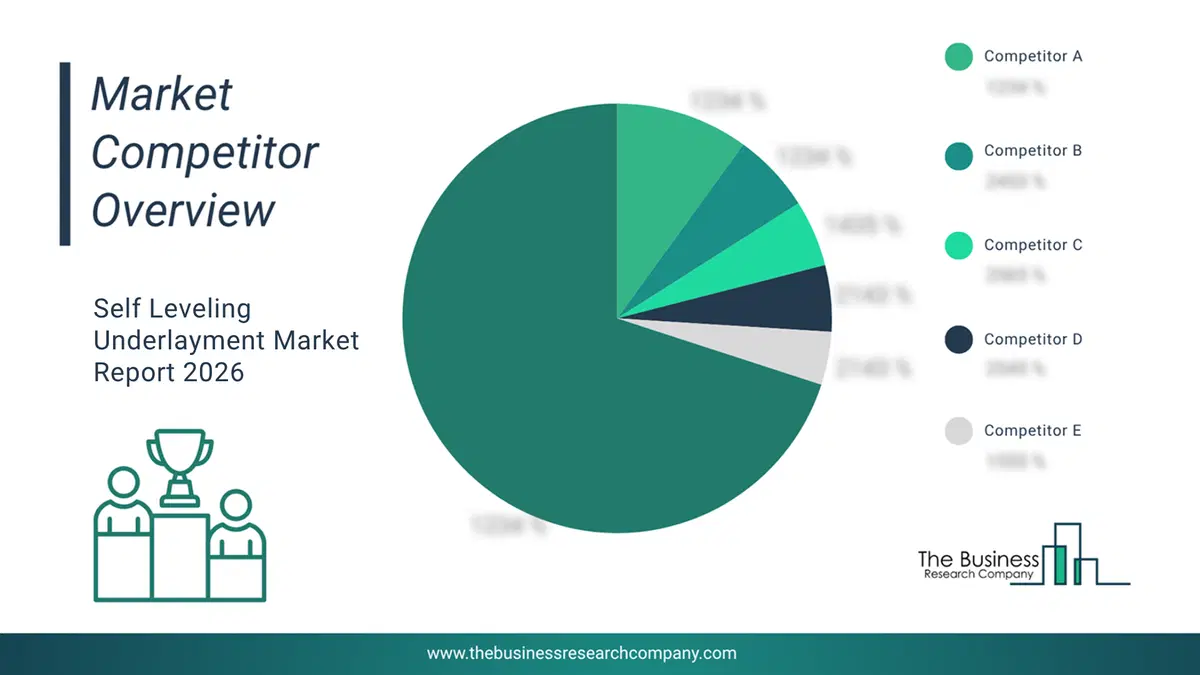
This chart is for illustrative purposes; the full report includes a detailed competitor analysis and comprehensive overview of the top 10 companies in the market.
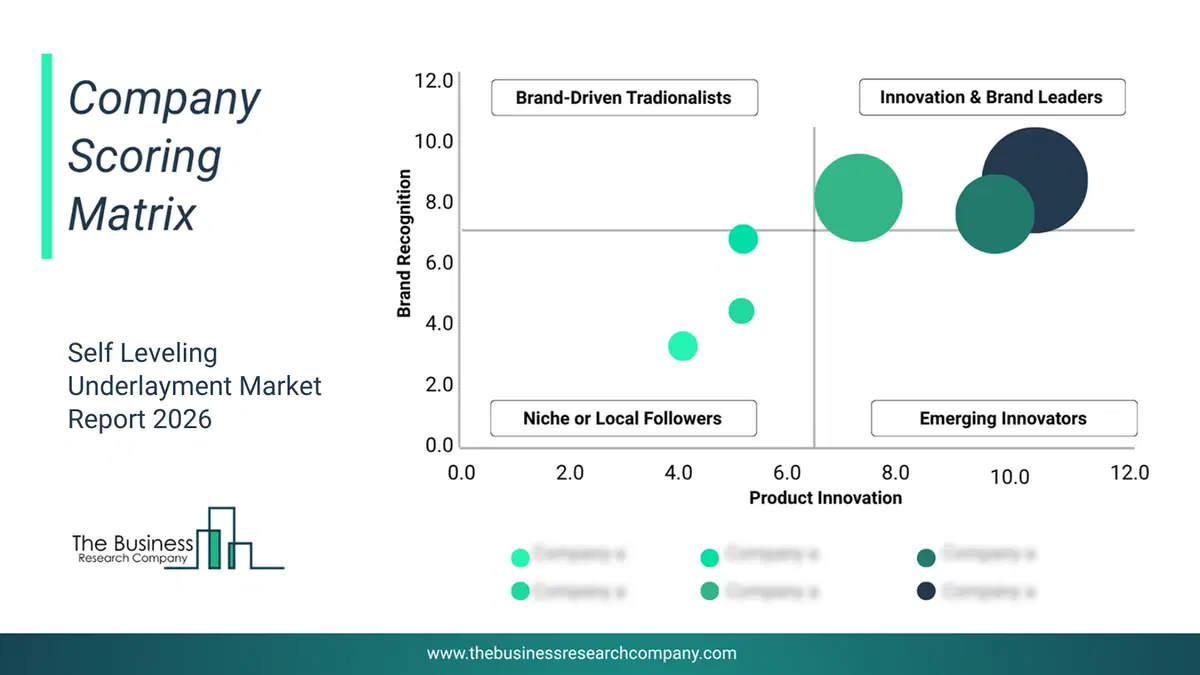
This chart maps companies by product innovation and brand strength, with bubble size indicating relative revenue, helping identify market leaders, challengers, and niche players. This is an illustrative chart; the full report provides a complete and accurate competitive analysis.
Global Self Leveling Underlayment Market Trends and Insights
Major companies operating in the self-leveling underlayment market are focusing on technological advancements, such as high flexural strength, to enable faster installations, enhance structural performance, and simplify handling for diverse construction projects. High flexural strength refers to the material’s ability to resist bending or deformation under load, ensuring durable and stable surfaces across multiple substrates. For instance, in February 2024, LATICRETE International Inc., a US-based construction solutions company, launched NXT Level Plus Lite, a versatile self-leveling underlayment designed for residential, commercial, and high-rise applications. The product features a lightweight formula that is pump-friendly, free-flowing, and can be poured up to four inches thick, reducing the need for multiple applications. Its high flexural strength allows compatibility with various substrates such as concrete, gypsum, plywood, and OSB without requiring metal lath. By integrating NXT Level Plus Lite, contractors and architects can address structural weight limitations while maintaining durability, antimicrobial protection, and low volatile organic compound compliance for modern construction requirements.What Are Latest Mergers And Acquisitions In The Self Leveling Underlayment Market?
In March 2025, Sika AG, a Switzerland-based specialty chemicals company for the construction and automotive industries, acquired HPS North America Inc. for an undisclosed amount. With this acquisition, Sika AG sought to consolidate its building finishing portfolio and strengthen its US distribution network by taking full ownership of the HPS, which is the supplier of Schönox branded subfloor preparation and flooring installation products. HPS North America Inc. is a US-based provider of premium building finishing materials and supplier of the self-leveling underlayment.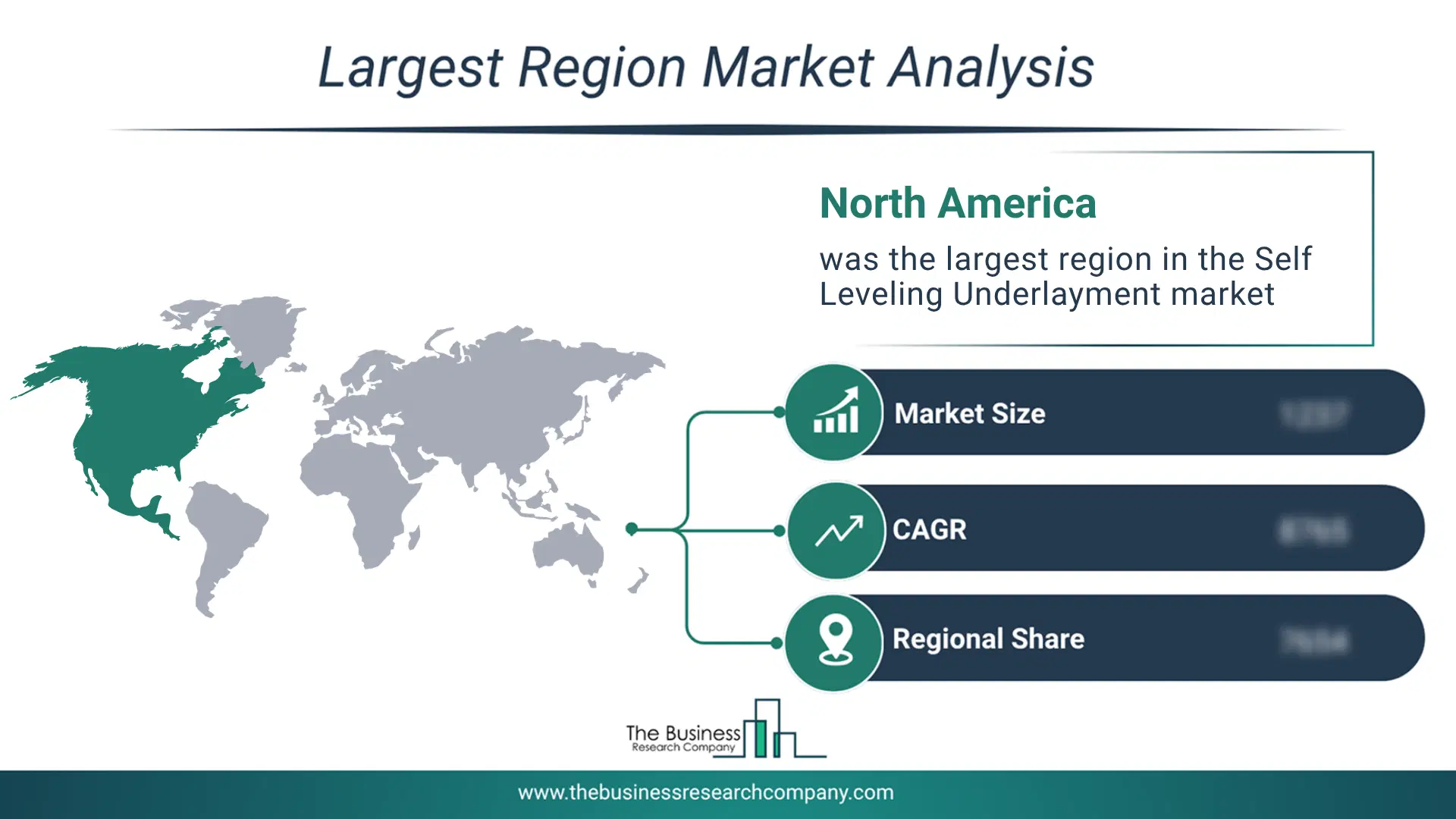
Regional Insights
North America was the largest region in the self leveling underlayment market in 2025. Asia-Pacific is expected to be the fastest-growing region in the forecast period. The regions covered in this market report are Asia-Pacific, South East Asia, Western Europe, Eastern Europe, North America, South America, Middle East, Africa. The countries covered in this market report are Australia, Brazil, China, France, Germany, India, Indonesia, Japan, Taiwan, Russia, South Korea, UK, USA, Canada, Italy, Spain.What Defines the Self Leveling Underlayment Market?
The self leveling underlayment market consists of sales of cement-based self leveling underlayment, gypsum-based self leveling underlayment, polymer-modified self leveling underlayment, rapid-setting self leveling underlayment, fiber-reinforced self leveling underlayment, and moisture-resistant self leveling underlayment. Values in this market are ‘factory gate’ values, that is, the value of goods sold by the manufacturers or creators of the goods, whether to other entities (including downstream manufacturers, wholesalers, distributors, and retailers) or directly to end customers. The value of goods in this market includes related services sold by the creators of the goods.How is Market Value Defined and Measured?
The market value is defined as the revenues that enterprises gain from the sale of goods and/or services within the specified market and geography through sales, grants, or donations in terms of the currency (in USD unless otherwise specified). The revenues for a specified geography are consumption values that are revenues generated by organizations in the specified geography within the market, irrespective of where they are produced. It does not include revenues from resales along the supply chain, either further along the supply chain or as part of other products.
This chart presents market attractiveness based on a quantitative evaluation of growth, competition, strategic alignment, and risk, offering a clear view of opportunity areas for decision-making. This chart is for illustrative purposes; the full report contains the complete analysis.

This chart highlights the Total Addressable Market (TAM) by estimating the maximum revenue opportunity using an assumption-driven approach, supporting strategic planning and opportunity sizing across markets. The chart is illustrative; the full report provides a more comprehensive analysis.
What Key Data and Analysis Are Included in the Self Leveling Underlayment Market Report 2026?
The self leveling underlayment market research report is one of a series of new reports from The Business Research Company that provides market statistics, including industry global market size, regional shares, competitors with the market share, detailed market segments, market trends and opportunities, and any further data you may need to thrive in the self leveling underlayment industry. The market research report delivers a complete perspective of everything you need, with an in-depth analysis of the current and future state of the industry.Self Leveling Underlayment Market Report Forecast Analysis
| Report Attribute | Details |
|---|---|
| Market Size Value In 2026 | $4.24 billion |
| Revenue Forecast In 2030 | $5.45 billion |
| Growth Rate | CAGR of 6.8% from 2026 to 2030 |
| Base Year For Estimation | 2025 |
| Actual Estimates/Historical Data | 2020-2025 |
| Forecast Period | 2026 - 2030 |
| Market Representation | Revenue in USD Billion and CAGR from 2026 to 2030 |
| Segments Covered | Type, Distribution Channel, Application, End-Use |
| Regional Scope | Asia-Pacific, Western Europe, Eastern Europe, North America, South America, Middle East, Africa |
| Country Scope | The countries covered in this market report are Australia, Brazil, China, France, Germany, India, Indonesia, Japan, Taiwan, Russia, South Korea, UK, USA, Canada, Italy, Spain |
| Key Companies Profiled | Sika AG, MAPEI S.p.A., Bostik SA, USG Corporation, Arcosa Specialty Materials, The Quikrete Companies Inc., Master Builders Solutions Holdings GmbH, ARDEX Americas, Custom Building Products Inc., Henry Company LLC, The Euclid Chemical Company, TEC Specialty Construction Brands Inc., LATICRETE International Inc., Flowcrete Group Ltd., W. R. Meadows Inc., CTS Cement Manufacturing Corporation, Dex-O-Tex, KÖSTER Bauchemie AG, CMP Specialty Products, Merkrete LLC, Hacker Industries Inc., Duraamen Engineered Products Inc., Fosroc International Ltd., Spex-Crete Industries |
| Customization Scope | Request for Customization |
| Pricing And Purchase Options | Explore Purchase Options |