
Self Services Technologies Market Report 2026
Global Outlook – By Component (Hardware, Software, Services), By Type (ATM, Kiosks, Vending Machine), By End-User (BFSI, Manufacturing, Hospitality, Retail, Healthcare, Offices, Education, Other End Users) – Market Size, Trends, Strategies, and Forecast to 2030
Self Services Technologies Market Overview
• Self Services Technologies market size has reached to $40.92 billion in 2025 • Expected to grow to $67.08 billion in 2030 at a compound annual growth rate (CAGR) of 10.2% • Growth Driver: Biometric Authentication Surges Catalyst For Growth In The Self-service technologies Market • Market Trend: Innovations In Artificial Intelligence (AI) Technology Enhance Seamless Self-Service Checkout And Exit Experience • North America was the largest region in 2025.What Is Covered Under Self Services Technologies Market?
Self-service technologies refer to technologies that offer customers the ability to interact and transact with a business via an interface, independent of direct communication with another person. The self-service technologies empower customers to complete or gather information without the assistance of an employee. The main types of self-service technologies are ATMs, kiosks, and vending machines. Using an ATM eliminates the requirement for a customer care representative to interface with the user's bank and accounts. In a matter of seconds, the consumer can access their account and withdraw any funds that are accessible. Instead of standing in line at a bank and then providing a bank assistant with the information, ATMs offer a quicker service. The components include hardware, software, and services that are suitable for BFSI, manufacturing, hospitality, retail, healthcare, offices, education, and other end users.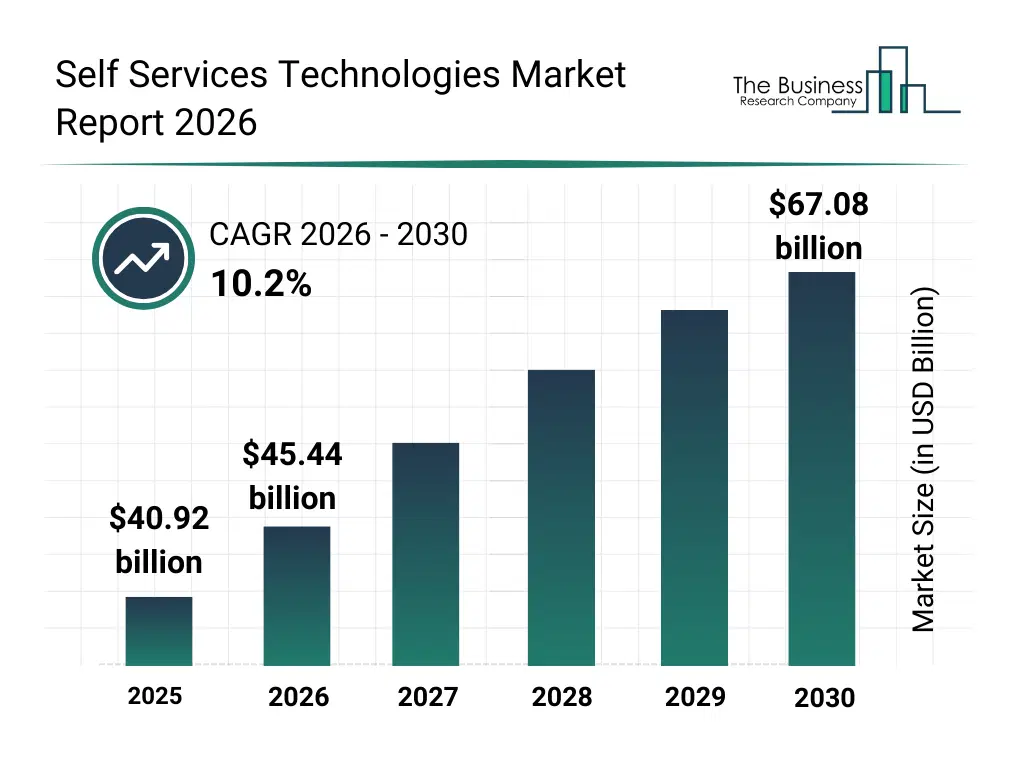
What Is The Self Services Technologies Market Size and Share 2026?
The self services technologies market size has grown rapidly in recent years. It will grow from $40.92 billion in 2025 to $45.44 billion in 2026 at a compound annual growth rate (CAGR) of 11.0%. The growth in the historic period can be attributed to expansion of retail automation initiatives, rising demand for faster customer service, adoption of atm and kiosk technologies, growth of digital payment ecosystems, early deployment of unattended service points.What Is The Self Services Technologies Market Growth Forecast?
The self services technologies market size is expected to see rapid growth in the next few years. It will grow to $67.08 billion in 2030 at a compound annual growth rate (CAGR) of 10.2%. The growth in the forecast period can be attributed to increasing adoption of ai-powered self-service solutions, rising focus on labor cost optimization, expansion of self-service in healthcare and hospitality, growing demand for secure payment-enabled terminals, increasing investments in smart customer engagement technologies. Major trends in the forecast period include increasing deployment of intelligent self-service kiosks, rising adoption of contactless transaction technologies, growing integration of ai-driven customer interfaces, expansion of multi-function self-service platforms, enhanced focus on user experience and accessibility.
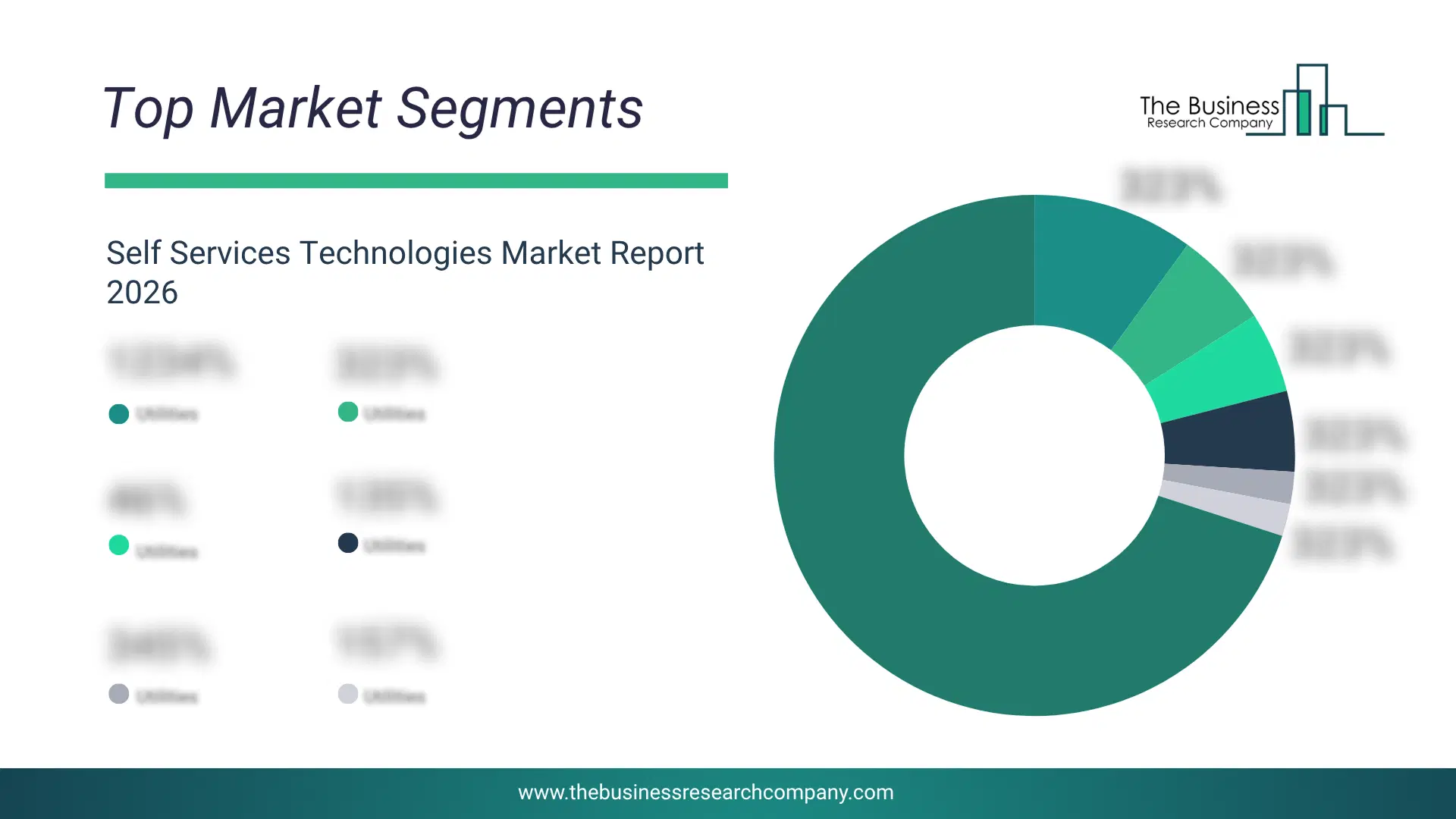
Global Self Services Technologies Market Segmentation
1) By Component: Hardware, Software, Services 2) By Type: ATM, Kiosks, Vending Machine 3) By End-User: BFSI, Manufacturing, Hospitality, Retail, Healthcare, Offices, Education, Other End Users Subsegments: 1) By Hardware: Kiosks, ATMs (Automated Teller Machines), Self-Service Terminals, Interactive Displays 2) By Software: Self-Service Application Software, Management Software, Security Software, Payment Processing Software 3) By Services: Installation Services, Maintenance And Support Services, Consulting Services, Training ServicesWhat Is The Driver Of The Self Services Technologies Market?
The increasing use of biometric authentication is expected to propel the growth of the self-service technologies market in the coming years. Biometric authentication is a security procedure that leverages an individual's unique biological or behavioral traits to validate their identification. Biometric authentication is rapidly being implemented into self-service technologies to improve security, expedite user experiences, and assure precise identity verification. For instance, in July 2025, according to the Department for Science, Innovation and Technology, a UK-based government agency, over half (52%) of surveyed organizations offering biometric technology provide non-biometric alternatives, while 41% track accuracy across demographic groups, up from 30% last year. Therefore, the increasing use of biometric authentication is driving the self-service technologies market.Key Players In The Global Self Services Technologies Market
Major companies operating in the self services technologies market are KIOSK Information Systems Inc.; NCR Corporation; HESS Cash Systems GmbH; Fujitsu Ltd.; Azkoyen Group; Maas International Europe B.V; Diebold Nixdorf Inc.; Glory Ltd.; GRG Banking Equipment Co. Ltd.; Hitachi-Omron Terminal Solutions Corp.; Nautilus Hyosung America Inc.; OKI Electric Industry Co. Ltd.; Olivetti SpA; Wincor Nixdorf AG; Zebra Technologies Corp.; Toshiba Tec Corp.; Verifone Systems Inc.; Ingenico Group SA; PAX Technology Ltd.; Parabit Systems Inc.; Source Technologies LLC; Frank Mayer and Associates Inc.; Phoenix Kiosk Inc.; Touch International Inc.; ELO Touch Solutions Inc.; Planar Systems Inc.; NEC Display Solutions Ltd.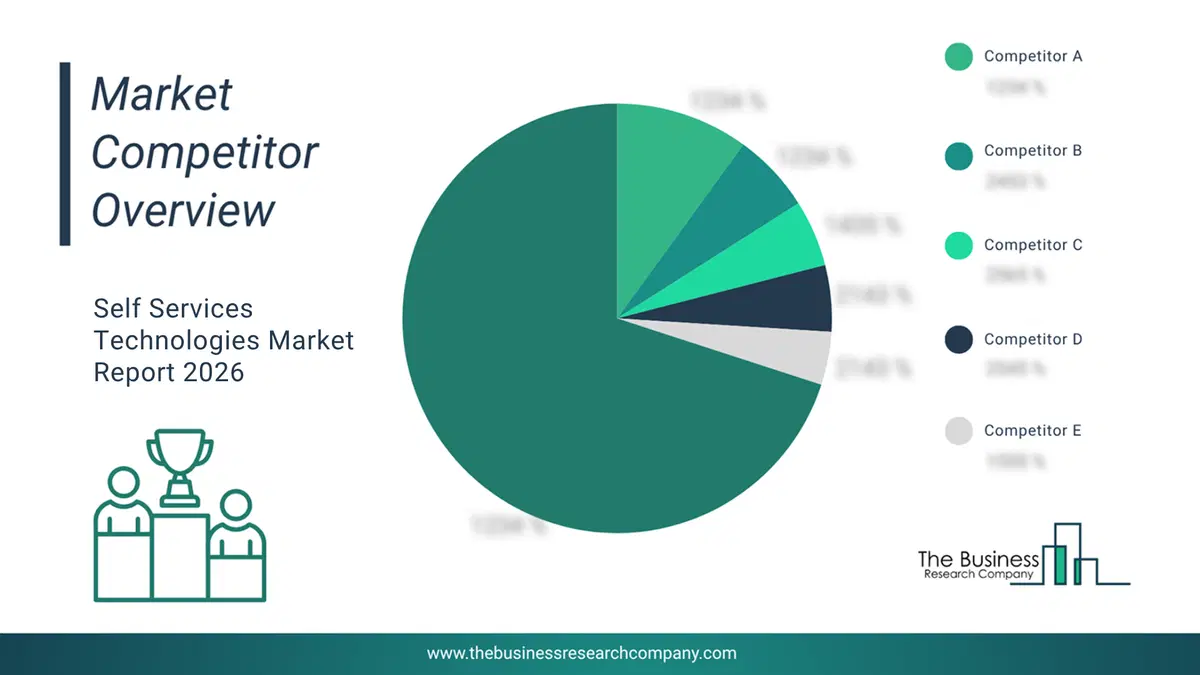
This chart is for illustrative purposes; the full report includes a detailed competitor analysis and comprehensive overview of the top 10 companies in the market.
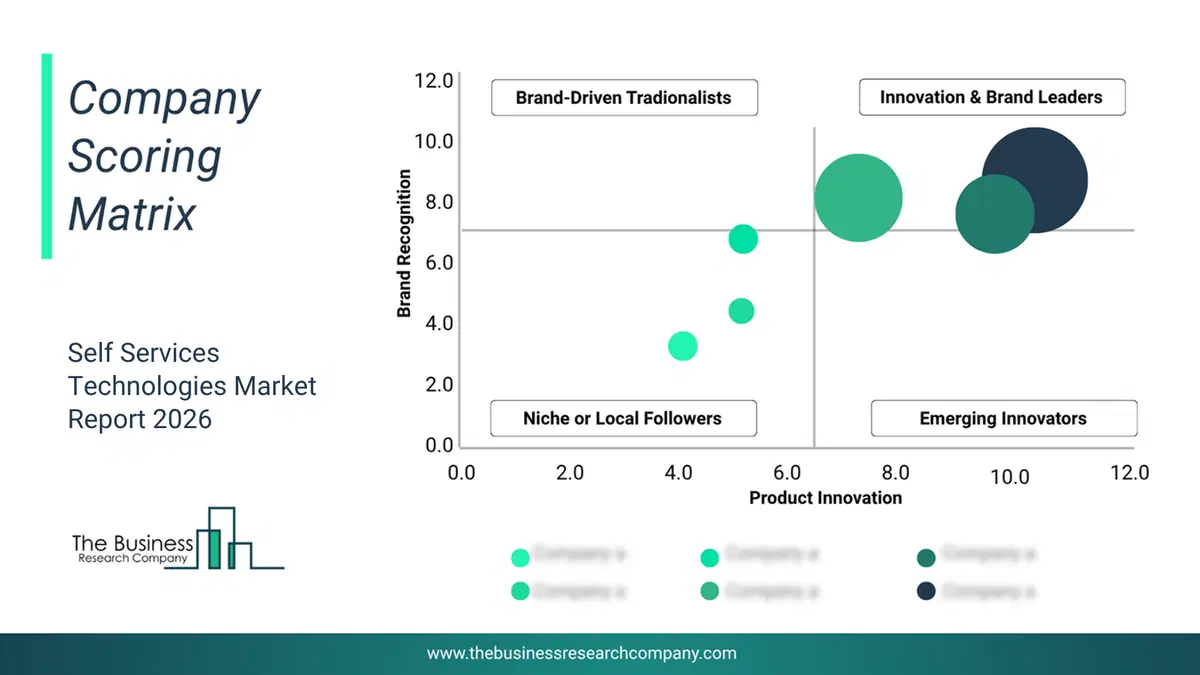
This chart maps companies by product innovation and brand strength, with bubble size indicating relative revenue, helping identify market leaders, challengers, and niche players. This is an illustrative chart; the full report provides a complete and accurate competitive analysis.
Global Self Services Technologies Market Trends and Insights
Major companies operating in the Self Services Technologies market are focusing on developing advanced solutions such as AI-powered exit systems to enhance customer experience and convenience. AI-powered exit systems use artificial intelligence and computer vision to confirm that all items in a customer’s cart have been paid for, eliminating the need for manual receipt checks and reducing wait times. For instance, in April 2024, Sam’s Club, a US-based retailer, launched its AI-powered exit technology at over 120 locations. The system captures images of shopping carts at the exit and verifies payment using AI, allowing members to leave the store faster. The technology has enabled more than half of the members to experience friction-free exits and has reduced overall exit time by 23%. Sam’s Club developed and deployed the system in-house, integrating it with its existing Scan & Go mobile application to further streamline the checkout process. The solution enhances convenience for both single-item purchases and full carts while setting a new standard for large-scale deployment of AI in retail environments.What Are Latest Mergers And Acquisitions In The Self Services Technologies Market?
In September 2024, SAP SE, a Germany-based enterprise software company, acquired WalkMe Ltd. for approximately $1.5 billion. Through this acquisition, SAP aims to enhance business transformation by integrating WalkMe’s digital adoption platform (DAP) capabilities into its portfolio, thereby improving customer experience and enriching SAP’s Business AI offerings. The acquisition will enable SAP users to navigate complex workflows more efficiently through self-service guidance and real-time support, accelerating software adoption and productivity. WalkMe Ltd. is an Israel-based company that provides digital adoption platforms designed to simplify the user experience and drive self-service enablement across enterprise applications.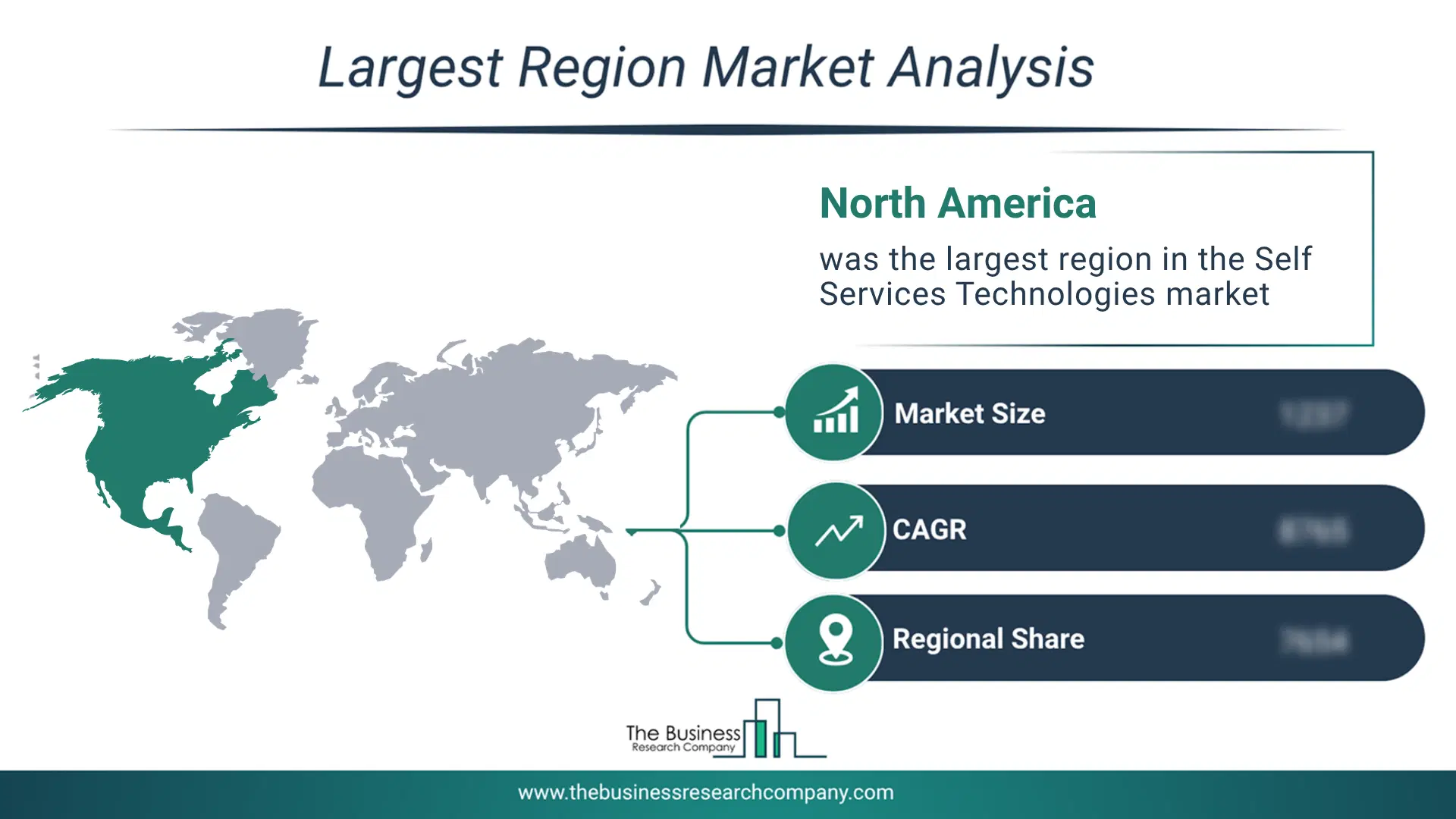
Regional Insights
North America was the largest region in the self-service’s technologies market in 2025. The regions covered in this market report are Asia-Pacific, South East Asia, Western Europe, Eastern Europe, North America, South America, Middle East, Africa. The countries covered in this market report are Australia, Brazil, China, France, Germany, India, Indonesia, Japan, Taiwan, Russia, South Korea, UK, USA, Canada, Italy, SpainWhat Defines the Self Services Technologies Market?
The self-services technologies market consists of revenues earned by entities by providing self-services technologies that enable users or customers to enjoy a service without even interacting with any service providers. The market value includes the value of related goods sold by the service provider or included within the service offering. Values in this market are ‘factory gate’ values, that is, the value of goods sold by the manufacturers or creators of the goods, whether to other entities (including downstream manufacturers, wholesalers, distributors, and retailers) or directly to end customers. The value of goods in this market includes related services sold by the creators of the goods.How is Market Value Defined and Measured?
The market value is defined as the revenues that enterprises gain from the sale of goods and/or services within the specified market and geography through sales, grants, or donations in terms of the currency (in USD unless otherwise specified). The revenues for a specified geography are consumption values that are revenues generated by organizations in the specified geography within the market, irrespective of where they are produced. It does not include revenues from resales along the supply chain, either further along the supply chain or as part of other products.
This chart presents market attractiveness based on a quantitative evaluation of growth, competition, strategic alignment, and risk, offering a clear view of opportunity areas for decision-making. This chart is for illustrative purposes; the full report contains the complete analysis.

This chart highlights the Total Addressable Market (TAM) by estimating the maximum revenue opportunity using an assumption-driven approach, supporting strategic planning and opportunity sizing across markets. The chart is illustrative; the full report provides a more comprehensive analysis.
What Key Data and Analysis Are Included in the Self Services Technologies Market Report 2026?
The self services technologies market research report is one of a series of new reports from The Business Research Company that provides market statistics, including industry global market size, regional shares, competitors with the market share, detailed market segments, market trends and opportunities, and any further data you may need to thrive in the self services technologies industry. The market research report delivers a complete perspective of everything you need, with an in-depth analysis of the current and future state of the industry.Self Services Technologies Market Report Forecast Analysis
| Report Attribute | Details |
|---|---|
| Market Size Value In 2026 | $45.44 billion |
| Revenue Forecast In 2030 | $67.08 billion |
| Growth Rate | CAGR of 10.2% from 2026 to 2030 |
| Base Year For Estimation | 2025 |
| Actual Estimates/Historical Data | 2020-2025 |
| Forecast Period | 2026 - 2030 |
| Market Representation | Revenue in USD Billion and CAGR from 2026 to 2030 |
| Segments Covered | Component, Type, End-User |
| Regional Scope | Asia-Pacific, Western Europe, Eastern Europe, North America, South America, Middle East, Africa |
| Country Scope | The Countries Covered In This Market Report Are Australia, Brazil, China, France, Germany, India, Indonesia, Japan, Taiwan, Russia, South Korea, Uk, Usa, Canada, Italy, Spain. |
| Key Companies Profiled | KIOSK Information Systems Inc., NCR Corporation, HESS Cash Systems GmbH, Fujitsu Ltd., Azkoyen Group, Maas International Europe B.V, Diebold Nixdorf Inc., Glory Ltd., GRG Banking Equipment Co. Ltd., Hitachi-Omron Terminal Solutions Corp., Nautilus Hyosung America Inc., OKI Electric Industry Co. Ltd., Olivetti SpA, Wincor Nixdorf AG, Zebra Technologies Corp., Toshiba Tec Corp., Verifone Systems Inc., Ingenico Group SA, PAX Technology Ltd., Parabit Systems Inc., Source Technologies LLC, Frank Mayer and Associates Inc., Phoenix Kiosk Inc., Touch International Inc., ELO Touch Solutions Inc., Planar Systems Inc., NEC Display Solutions Ltd. |
| Customization Scope | Request for Customization |
| Pricing And Purchase Options | Explore Purchase Options |