
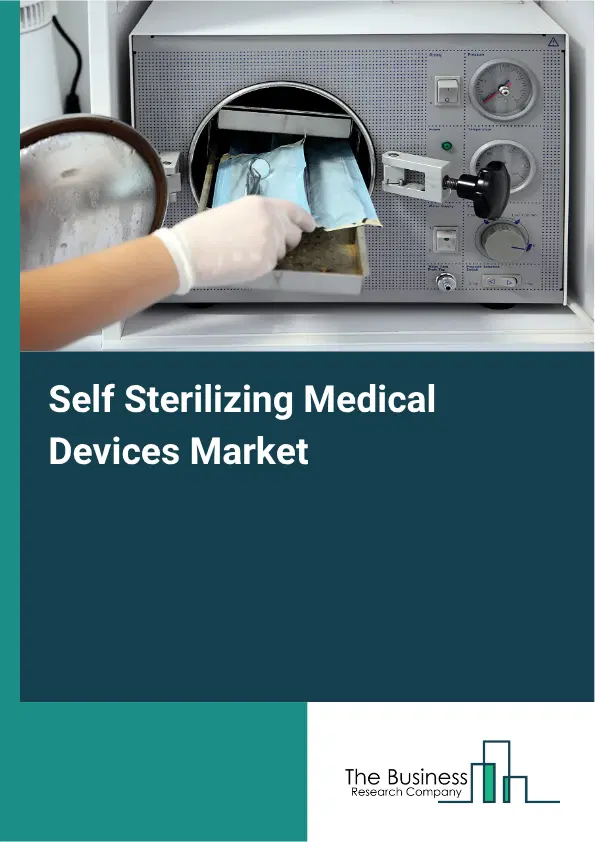
Self Sterilizing Medical Devices Market Report 2026
Global Outlook – By Product Type (Self-Sterilizing Surgical Instruments, Self-Sterilizing Catheters, Self-Sterilizing Endoscopes, Self-Sterilizing Wearables, Other Product Types), By Sterilization Technology (Ultraviolet C Light, Ozone Sterilization, Antimicrobial Coatings, Steam Based Sterilization, Other Sterilization Technologies), By Distribution Channel (Direct Sales, Medical Supply Distributors, Online Retailers, Other Distribution Channels), By End User (Hospitals, Ambulatory Surgical Centers, Clinics, Diagnostic Laboratories, Homecare Settings) – Market Size, Trends, Strategies, and Forecast to 2030
Self Sterilizing Medical Devices Market Overview
• Self Sterilizing Medical Devices market size has reached to $0.98 billion in 2025 • Expected to grow to $1.88 billion in 2030 at a compound annual growth rate (CAGR) of 14% • Growth Driver: The Increasing Prevalence Of Hospital-Acquired Infections Driving The Growth Of The Market Due To Poor Infection Control Practices • North America was the largest region in 2025 and Asia-Pacific is the fastest growing region.What Is Covered Under Self Sterilizing Medical Devices Market?
Self sterilizing medical devices are medical instruments designed with built-in technologies that enable them to eliminate or reduce microbial contamination without requiring external sterilization processes. These devices typically use methods such as antimicrobial coatings, ultraviolet (UV) light, or self-cleaning surface technologies to maintain hygiene during or after use. They are intended to enhance infection control, improve patient safety, and reduce reliance on traditional sterilization procedures in healthcare settings. The main product types of self sterilizing medical devices include self-sterilizing surgical instruments, self-sterilizing catheters, self-sterilizing endoscopes, self-sterilizing wearables, and other product types. Self-sterilizing surgical instruments refer to reusable or advanced medical tools designed to reduce infection risk by maintaining sterility through built-in mechanisms. These devices are based on sterilization technologies such as ultraviolet C light, ozone sterilization, antimicrobial coatings, steam based sterilization, and other sterilization technologies. They are distributed through direct sales, medical supply distributors, online retailers, and other distribution channels, while the end-use includes hospitals, ambulatory surgical centers, clinics, diagnostic laboratories, and homecare settings.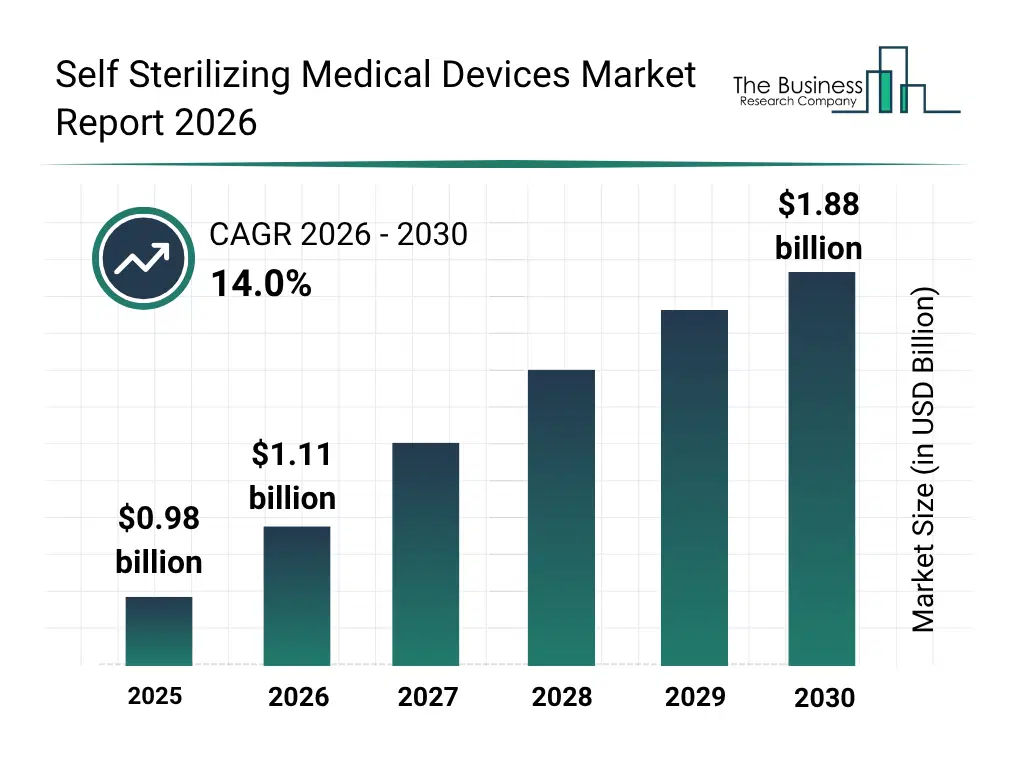
What Is The Self Sterilizing Medical Devices Market Size and Share 2026?
The self sterilizing medical devices market size has grown rapidly in recent years. It will grow from $0.98 billion in 2025 to $1.11 billion in 2026 at a compound annual growth rate (CAGR) of 13.7%. The growth in the historic period can be attributed to increasing hospital acquired infection burden, rising demand for surgical hygiene standards, growth in reusable medical instrument usage, expansion of hospital infrastructure in emerging markets, early adoption of antimicrobial coatings in medical devices.What Is The Self Sterilizing Medical Devices Market Growth Forecast?
The self sterilizing medical devices market size is expected to see rapid growth in the next few years. It will grow to $1.88 billion in 2030 at a compound annual growth rate (CAGR) of 14.0%. The growth in the forecast period can be attributed to increasing integration of self disinfecting materials in medical devices, rising demand for autonomous infection prevention systems, growth in minimally invasive surgical procedures, expansion of advanced healthcare infrastructure in developing regions, increasing focus on reducing cross contamination in clinical workflows. Major trends in the forecast period include rising adoption of uv-c based embedded sterilization in reusable medical devices, growth of antimicrobial coating innovations for infection resistance in clinical instruments, expansion of hospital-acquired infection (hai) prevention protocols driving integration of self-sterilizing devices, increasing regulatory mandates for validation and certification of autonomous sterilization medical technologies, advancement in biocompatible self-disinfecting surface materials for long-term clinical usage.
Global Self Sterilizing Medical Devices Market Segmentation
1) By Product Type: Self-Sterilizing Surgical Instruments, Self-Sterilizing Catheters, Self-Sterilizing Endoscopes, Self-Sterilizing Wearables, Other Product Types 2) By Sterilization Technology: Ultraviolet C Light, Ozone Sterilization, Antimicrobial Coatings, Steam Based Sterilization, Other Sterilization Technologies 3) By Distribution Channel: Direct Sales, Medical Supply Distributors, Online Retailers, Other Distribution Channels 4) By End User: Hospitals, Ambulatory Surgical Centers, Clinics, Diagnostic Laboratories, Homecare Settings Subsegments: 1) By Self-Sterilizing Surgical Instruments: Self Sterilizing Scalpels, Self Sterilizing Forceps, Self Sterilizing Surgical Scissors, Self Sterilizing Retractors, Self Sterilizing Clamps 2) By Self-Sterilizing Catheters: Self Sterilizing Urinary Catheters, Self Sterilizing Cardiovascular Catheters, Self Sterilizing Intravenous Catheters, Self Sterilizing Dialysis Catheters, Self Sterilizing Neurovascular Catheters 3) By Self-Sterilizing Endoscopes: Self Sterilizing Flexible Endoscopes, Self Sterilizing Rigid Endoscopes, Self Sterilizing Capsule Endoscopes, Self Sterilizing Bronchoscopes, Self Sterilizing Gastrointestinal Endoscopes 4) By Self-Sterilizing Wearables: Self Sterilizing Smart Patches, Self Sterilizing Health Monitoring Bands, Self Sterilizing Biosensor Devices, Self Sterilizing Wearable Injectors, Self Sterilizing Remote Monitoring Devices 5) By Other Product Types: Self Sterilizing Implants, Self Sterilizing Wound Care Devices, Self Sterilizing Diagnostic Devices, Self Sterilizing Medical Tubing, Self Sterilizing Hospital SurfacesWhat Are The Drivers Of The Self Sterilizing Medical Devices Market?
The increasing prevalence of hospital-acquired infections is expected to propel the growth of the self sterilizing medical devices market going forward. Hospital-acquired infections (HAIs) refer to infections that a patient develops while receiving medical treatment in a healthcare facility, which were not present or incubating at the time of admission. Increasing prevalence of hospital-acquired infections is due to poor infection control practices such as inadequate hand hygiene, improper sterilization of medical equipment, and non-compliance with standard safety protocols, which facilitate the spread of pathogens within healthcare settings. Self-sterilizing medical devices help reduce hospital-acquired infections by continuously eliminating microbial contamination on device surfaces, thereby minimizing cross-contamination and improving patient safety within healthcare settings. For instance, in November 2024, according to the Australian Institute of Health and Welfare, an Australia-based government agency, in 2022–23, hospital-acquired complications (HACs) occurred in 115,000 public hospitalizations (2.0%) and 34,200 private hospitalizations (0.8%). The most frequent complication was healthcare-associated infection (37%), followed by delirium (13%) and cardiac complications (12%). Therefore, the increasing prevalence of hospital-acquired infections is expected to propel the growth of the self sterilizing medical devices industry. The expansion in surgical procedures is expected to propel the growth of the self sterilizing medical devices market going forward. Surgical procedures refer to medical interventions that involve operative techniques to treat diseases, injuries, or deformities through manual or instrumental methods. Expansion in surgical procedures is primarily driven by the rising burden of chronic diseases, which increases the need for ongoing medical interventions and corrective surgeries to manage long-term conditions. Self-sterilizing medical devices support surgical procedures by continuously reducing microbial contamination on instruments, surfaces, and medical textiles, which helps lower the risk of surgical site infections and improves patient outcomes. For instance, in March 2024, according to the 2024 annual report by Intuitive Surgical Inc., a US-based medical device company, around 2,683,000 surgical procedures were carried out using da Vinci surgical systems, up from approximately 2,286,000 procedures in 2023 and 1,875,000 procedures in 2022, reflecting steady year-over-year growth in utilization. Therefore, the expansion in surgical procedures is driving the growth of the self sterilizing medical devices industry. The rising healthcare expenditure is expected to propel the growth of the self sterilizing medical devices market going forward. Healthcare expenditure refers to the total financial resources spent by individuals, organizations, or governments on preventing, treating, and managing health conditions. Healthcare expenditure is increasing due to advancements in medical technology, as new diagnostic tools, treatments, and innovative therapies often come at higher costs, leading to greater overall spending in healthcare. Rising healthcare expenditure enables greater investment in advanced infection-control technologies and premium medical innovations, thereby accelerating the adoption of self-sterilizing medical devices across healthcare systems. For instance, in December 2024, according to the Centers for Medicare and Medicaid Services, a US-based agency responsible for administering the Medicare and Medicaid programs, in 2023, U.S. health care expenditures increased by 7.5%, climbing to $4.9 trillion, or roughly $14,570 for each individual. Therefore, the rising healthcare expenditure is driving the growth of the self sterilizing medical devices industry.Key Players In The Global Self Sterilizing Medical Devices Market
Major companies operating in the self sterilizing medical devices market are Johnson & Johnson, Becton Dickinson and Company (BD), Stryker Corporation, Teleflex Incorporated, Cook Medical, Mölnlycke Health Care, Noble Biomaterials Inc., CytaCoat ABRegional Outlook
North America was the largest region in the self sterilizing medical devices market in 2025. Asia-Pacific is expected to be the fastest-growing region in the forecast period. The regions covered in this market report are Australia, Brazil, China, France, Germany, India, Indonesia, Japan, Taiwan, Russia, South Korea, UK, USA, Canada, Italy, Spain. The countries covered in this market report are Australia, Brazil, China, France, Germany, India, Indonesia, Japan, Taiwan, Russia, South Korea, UK, USA, Canada, Italy, Spain.What Defines the Self Sterilizing Medical Devices Market?
The self sterilizing medical devices market consists of sales of self-sterilizing hospital bed surfaces, antimicrobial surgical drapes, self-disinfecting medical device enclosures, antimicrobial medical packaging systems, and self-sterilizing examination gloves. Values in this market are ‘factory gate’ values, that is the value of goods sold by the manufacturers or creators of the goods, whether to other entities (including downstream manufacturers, wholesalers, distributors and retailers) or directly to end customers. The value of goods in this market includes related services sold by the creators of the goods.How is Market Value Defined and Measured?
The market value is defined as the revenues that enterprises gain from the sale of goods and/or services within the specified market and geography through sales, grants, or donations in terms of the currency (in USD unless otherwise specified). The revenues for a specified geography are consumption values that are revenues generated by organizations in the specified geography within the market, irrespective of where they are produced. It does not include revenues from resales along the supply chain, either further along the supply chain or as part of other products.What Key Data and Analysis Are Included in the Self Sterilizing Medical Devices Market Report 2026?
The self sterilizing medical devices market research report is one of a series of new reports from The Business Research Company that provides self sterilizing medical devices market statistics, including self sterilizing medical devices industry global market size, regional shares, competitors with a self sterilizing medical devices market share, detailed self sterilizing medical devices market segments, market trends and opportunities, and any further data you may need to thrive in the self sterilizing medical devices industry. This self sterilizing medical devices market research report delivers a complete perspective of everything you need, with an in-depth analysis of the current and future scenario of the industry.Self Sterilizing Medical Devices Market Report Forecast Analysis
| Report Attribute | Details |
|---|---|
| Market Size Value In 2026 | $1.11 billion |
| Revenue Forecast In 2030 | $1.88 billion |
| Growth Rate | CAGR of 14% from 2026 to 2030 |
| Base Year For Estimation | 2025 |
| Actual Estimates/Historical Data | 2020-2025 |
| Forecast Period | 2026 - 2030 |
| Market Representation | Revenue in USD Billion and CAGR from 2026 to 2030 |
| Segments Covered | Product Type, Sterilization Technology, Distribution Channel, End User |
| Regional Scope | Asia-Pacific, Western Europe, Eastern Europe, North America, South America, Middle East, Africa |
| Country Scope | The countries covered in the self sterilizing medical devices market report are Australia, Brazil, China, France, Germany, India, Indonesia, Japan, Taiwan, Russia, South Korea, UK, USA, Canada, Italy, Spain. |
| Key Companies Profiled | Johnson & Johnson, Becton Dickinson and Company (BD), Stryker Corporation, Teleflex Incorporated, Cook Medical, Mölnlycke Health Care, Noble Biomaterials Inc., CytaCoat AB |
| Customization Scope | Request for Customization |
| Pricing And Purchase Options | Explore Purchase Options |