
Self-Testing Market Report 2026
Global Outlook – By Product (Kits, Devices, Strips), By Sample Type (Blood, Urine, Stool, Other Sample Types), By Distribution Channel (Online, Offline ), By Application (Blood Glucose Testing, Pregnancy And Fertility Testing, Cancer Testing, Drug Abuse Testing, Sexually Transmitted Disease Or Sexually Transmitted Infection Testing, Cholesterol Testing, HIV Testing, Thyroid Testing, Other Applications) - Market Size, Trends, Strategies, and Forecast to 2030
Self-Testing Market Overview
• Self-Testing market size has reached to $16.88 billion in 2025 • Expected to grow to $25.99 billion in 2030 at a compound annual growth rate (CAGR) of 8.7% • Growth Driver: Increasing Prevalence of Chronic Diseases Fueling Growth In Self-Testing • Market Trend: Revolutionizing Diagnostic Testing with Innovative Self-Sampling Kits • North America was the largest region in 2025 and Asia-Pacific is the fastest growing region.What Is Covered Under Self-Testing Market?
Self-testing refers to the practice of individuals testing themselves for a particular medical condition or characteristic using diagnostic tools or kits without the direct involvement of a healthcare professional. These tests allow individuals to monitor their health status, screen for specific conditions, or manage chronic diseases at home, offering benefits such as convenience, privacy, and empowerment for patients. The main types of products in self-testing are kits, devices, and strips. Kits are comprehensive packages containing all the necessary materials and instructions for individuals to collect and analyze their own samples. Which can be used for various sample types, including blood, urine, stool, and others, and are accessible through different distribution channels, including online and offline, and can be used for various applications such as blood glucose testing, pregnancy and fertility testing, cancer testing, drug abuse testing, sexually transmitted disease or sexually transmitted infection testing, cholesterol testing, HIV testing, thyroid testing, and others.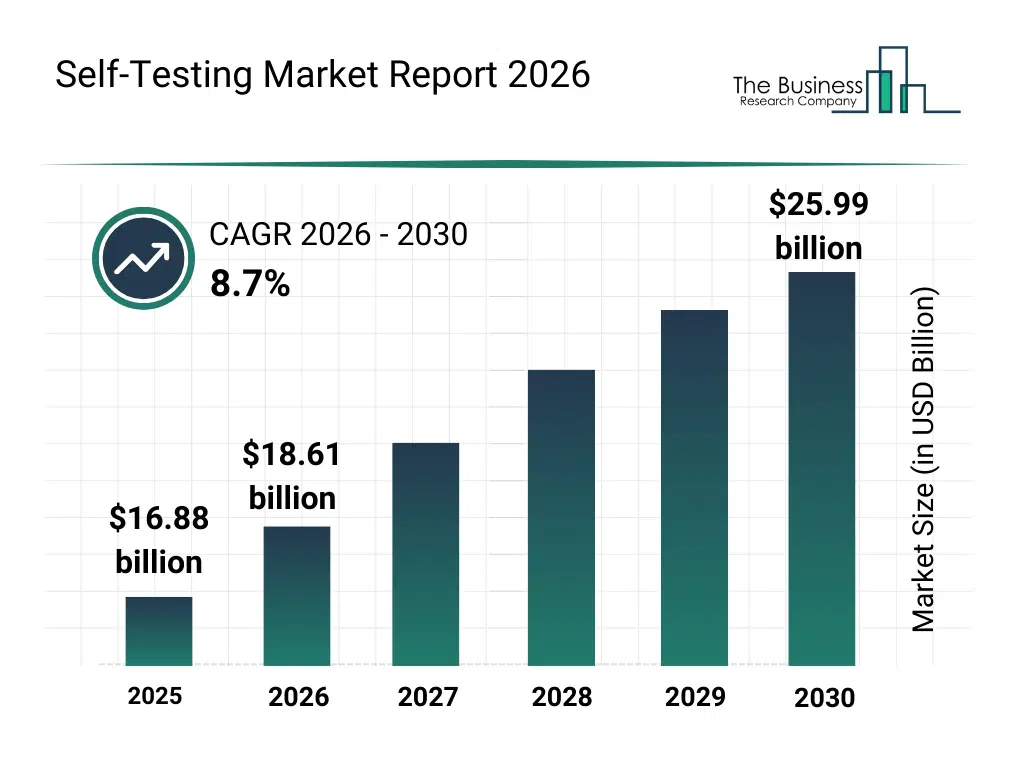
What Is The Self-Testing Market Size and Share 2026?
The self-testing market size has grown rapidly in recent years. It will grow from $16.88 billion in 2025 to $18.61 billion in 2026 at a compound annual growth rate (CAGR) of 10.3%. The growth in the historic period can be attributed to growing awareness of early disease detection, technological advances in diagnostics, home-based testing adoption, expansion of chronic disease monitoring, regulatory approvals for OTC tests.What Is The Self-Testing Market Growth Forecast?
The self-testing market size is expected to see strong growth in the next few years. It will grow to $25.99 billion in 2030 at a compound annual growth rate (CAGR) of 8.7%. The growth in the forecast period can be attributed to AI-integrated test interpretation, smartphone-compatible diagnostics, expansion in infectious disease self-tests, telemedicine-linked testing, personalized testing solutions. Major trends in the forecast period include rapid diagnostic kits, AI-powered test analysis, at-home lab testing, mobile-connected health tests, disease-specific test kits.
Global Self-Testing Market Segmentation
1) By Product: Kits, Devices, Strips 2) By Sample Type: Blood, Urine, Stool, Other Sample Types 3) By Distribution Channel: Online, Offline 4) By Application: Blood Glucose Testing, Pregnancy And Fertility Testing, Cancer Testing, Drug Abuse Testing, Sexually Transmitted Disease Or Sexually Transmitted Infection Testing, Cholesterol Testing, HIV Testing, Thyroid Testing, Other Applications Subsegments: 1) By Kits: Blood Glucose Testing Kits, Pregnancy Test Kits, Ovulation Test Kits, HIV Test Kits, COVID-19 Test Kits, Allergy Test Kits, Cholesterol Test Kits 2) By Devices: Blood Glucose Meters, Thermometers (Digital, Infrared), Blood Pressure Monitors, Pulse Oximeters, ECG Or EKG Monitors, Pregnancy Test Devices (Electronic), Home Hearing Test Devices 3) By Strips: Blood Glucose Test Strips, Urine Test Strips, Pregnancy Test Strips, Ovulation Test Strips, Cholesterol Test Strips, Urinary Tract Infection (UTI) Test Strips, Ketone Test StripsWhat Is The Driver Of The Self-Testing Market?
The increasing prevalence of chronic diseases is expected to propel the growth of the self-testing market going forward. Chronic diseases refer to long-lasting medical conditions that generally progress slowly and persist over an extended period. This disease arises because of demographic changes, lifestyle habits, environmental factors, and advancements in healthcare. Self-testing is leveraged in chronic diseases to actively manage their health, improve adherence to treatment plans, and facilitate early detection of any complications or changes in their condition. For instance, in April 2025, according to the Centers for Disease Control and Prevention, a US-based federal agency, in 2023, about 76.4% of U.S. adults reported having at least one of 12 selected chronic conditions. 51.4% of U.S. adults reported multiple chronic conditions. Therefore, the increasing prevalence of chronic diseases is driving the growth of the self-testing industry.Key Players In The Global Self-Testing Market
Major companies operating in the self-testing market are Roche Diagnostics, Abbott Laboratories, Quidel Corporation, OraSure Technologies, Meridian Bioscience, iHealth Labs, Everly Health, Helix OpCo, BioIQ, 23andMe, Pathway Genomics, Vitagene, Orig3n, LetsGetChecked, Cue Health, Ellume Health, OraQuick, Atomo Diagnostics, ACON Laboratories, SD Biosensor, OraSure Diagnostics
This chart is for illustrative purposes; the full report includes a detailed competitor analysis and comprehensive overview of the top 10 companies in the market.
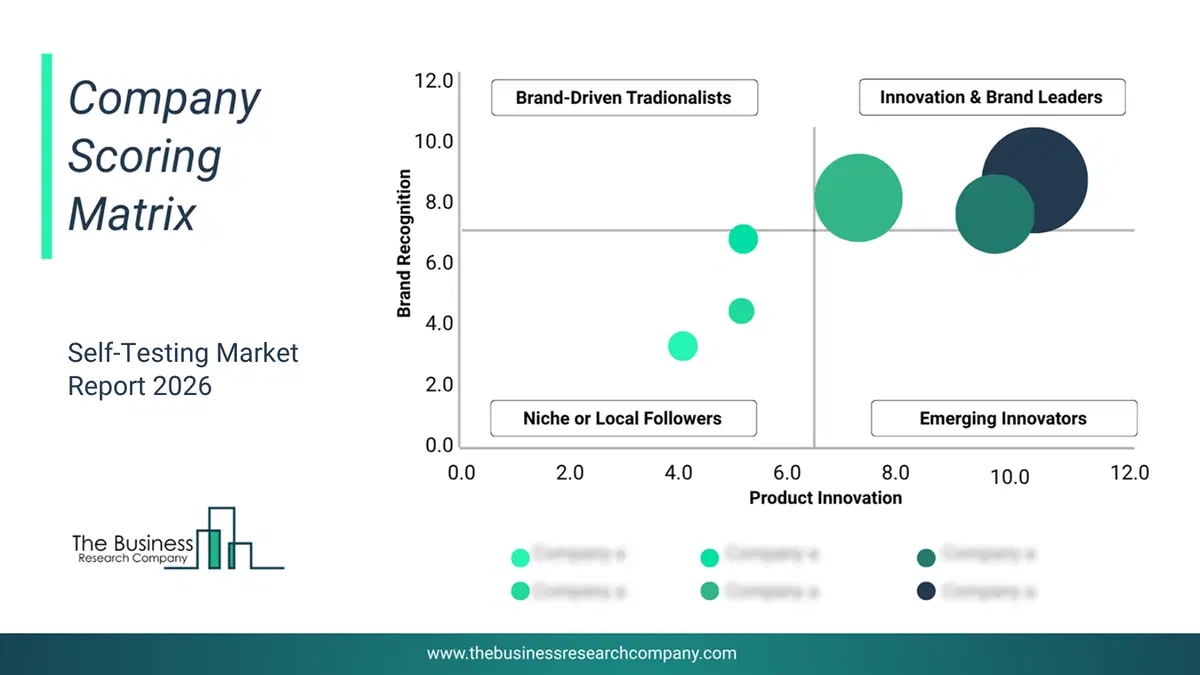
This chart maps companies by product innovation and brand strength, with bubble size indicating relative revenue, helping identify market leaders, challengers, and niche players. This is an illustrative chart; the full report provides a complete and accurate competitive analysis.
Global Self-Testing Market Trends and Insights
Major companies operating in the self-testing market are focusing on developing innovative solutions, such as Cervicheck self-sampling kits, to provide greater convenience, accessibility, and accuracy for users. This medical device allows individuals to collect biological samples, such as blood, saliva, urine, or tissue, for diagnostic testing or analysis. For instance, in April 2023, Pragmatech Healthcare Solutions, an India-based biotechnology company, launched Cervicheck, a self-testing kit for screening women for the human papillomavirus (HPV), a significant cause of cervical cancer cases. This kit allows women to collect samples in the privacy of their homes, addressing issues related to late detection due to reluctance to undergo sample collection at hospitals or clinics. Additionally, it features self-sampling and point-of-care detection. Also, this kit is a significant step towards empowering women to detect cervical cancer early, aiming to reduce mortality rates and the burden associated with late-stage cancer detection.What Are Latest Mergers And Acquisitions In The Self-Testing Market?
In December 2024, OraSure Technologies Inc., a US-based provider of point-of-need and home diagnostic tests and sample collection devices, acquired Sherlock Biosciences Inc. for an undisclosed amount. With this acquisition, OraSure aims to expand its molecular diagnostics pipeline and accelerate development of over‑the‑counter, high-accuracy self‑tests by leveraging Sherlock’s advanced isothermal amplification and CRISPR-based molecular platform. Sherlock Biosciences is a US-based biotechnology company that develops rapid, next‑generation molecular diagnostics suitable for self‑collected samples, including a self-test for Chlamydia and Gonorrhea.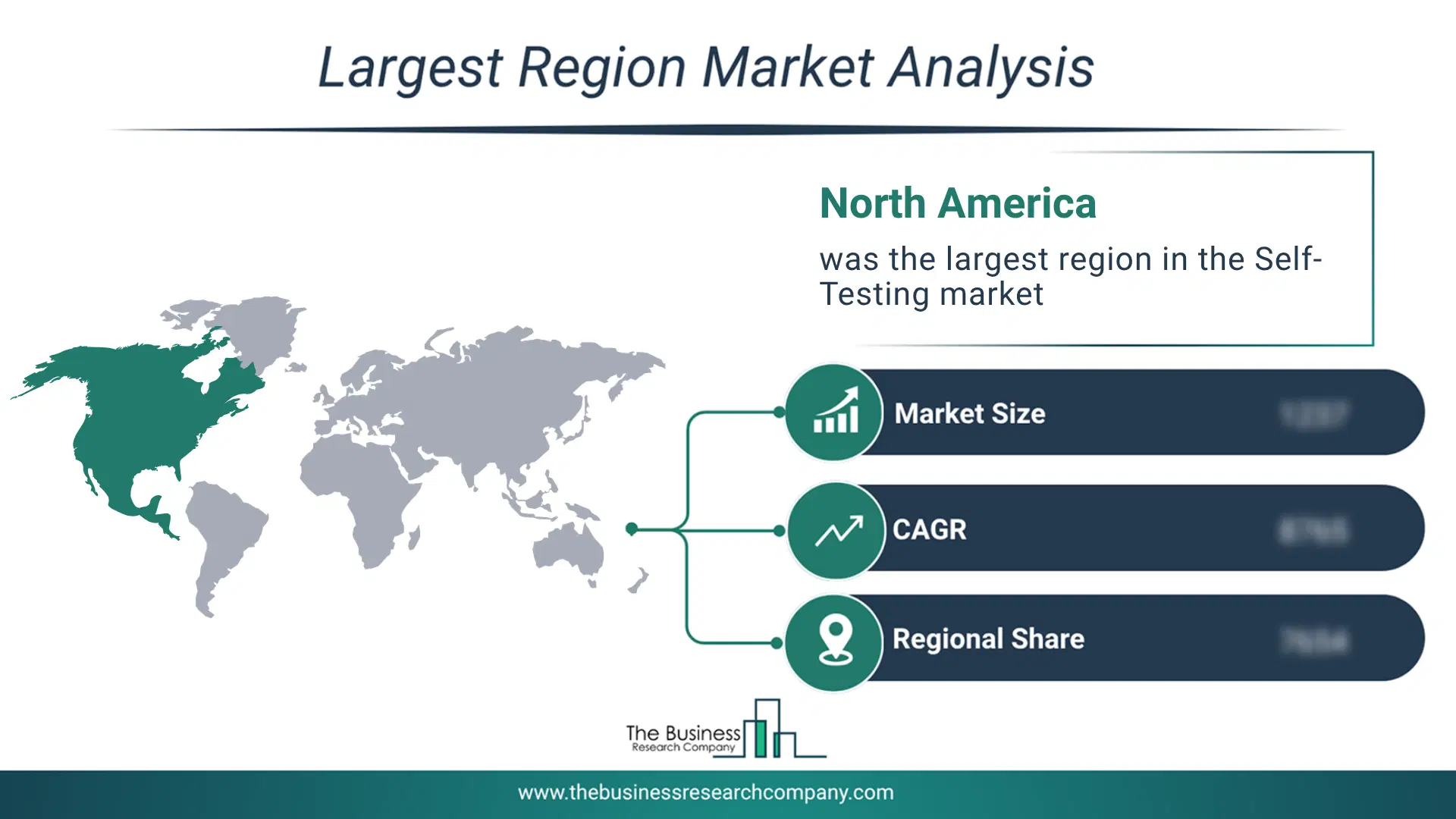
Regional Outlook
North America was the largest region in the self-testing market in 2025. Asia-Pacific is expected to be the fastest-growing region in the forecast period. The regions covered in this market report are Asia-Pacific, South East Asia, Western Europe, Eastern Europe, North America, South America, Middle East, Africa. The countries covered in this market report are Australia, Brazil, China, France, Germany, India, Indonesia, Japan, Taiwan, Russia, South Korea, UK, USA, Canada, Italy, Spain.What Defines the Self-Testing Market?
The self-testing market consist of revenues earned by entities by providing services such as medical self-testing services, professional skills self-assessment services, medical stimulation services, and fitness and wellness self-testing services. The market value includes the value of related goods sold by the service provider or included within the service offering. The self-testing market also includes sales of medical self-testing products, health monitoring wearables, online symptom checkers, home diagnostic kits, personal health monitoring devices, and disease-specific testing kits. Values in this market are ‘factory gate’ values, that is, the value of goods sold by the manufacturers or creators of the goods, whether to other entities (including downstream manufacturers, wholesalers, distributors, and retailers) or directly to end customers. The value of goods in this market includes related services sold by the creators of the goods.How is Market Value Defined and Measured?
The market value is defined as the revenues that enterprises gain from the sale of goods and/or services within the specified market and geography through sales, grants, or donations in terms of the currency (in USD unless otherwise specified). The revenues for a specified geography are consumption values that are revenues generated by organizations in the specified geography within the market, irrespective of where they are produced. It does not include revenues from resales along the supply chain, either further along the supply chain or as part of other products.
This chart presents market attractiveness based on a quantitative evaluation of growth, competition, strategic alignment, and risk, offering a clear view of opportunity areas for decision-making. This chart is for illustrative purposes; the full report contains the complete analysis.

This chart highlights the Total Addressable Market (TAM) by estimating the maximum revenue opportunity using an assumption-driven approach, supporting strategic planning and opportunity sizing across markets. The chart is illustrative; the full report provides a more comprehensive analysis.
What Key Data and Analysis Are Included in the Self-Testing Market Report 2026?
The self-testing market research report is one of a series of new reports from The Business Research Company that provides market statistics, including industry global market size, regional shares, competitors with the market share, detailed market segments, market trends and opportunities, and any further data you may need to thrive in the self-testing industry. The market research report delivers a complete perspective of everything you need, with an in-depth analysis of the current and future state of the industry.Self-Testing Market Report Forecast Analysis
| Report Attribute | Details |
|---|---|
| Market Size Value In 2026 | $18.61 billion |
| Revenue Forecast In 2030 | $25.99 billion |
| Growth Rate | CAGR of 8.7% from 2026 to 2030 |
| Base Year For Estimation | 2025 |
| Actual Estimates/Historical Data | 2020-2025 |
| Forecast Period | 2026 - 2030 |
| Market Representation | Revenue in USD Billion and CAGR from 2026 to 2030 |
| Segments Covered | Product, Sample Type, Distribution Channel, Application |
| Regional Scope | Asia-Pacific, Western Europe, Eastern Europe, North America, South America, Middle East, Africa |
| Country Scope | The countries covered in the report are Australia, Brazil, China, France, Germany, India, Indonesia, Japan, Taiwan, Russia, South Korea, UK, USA, Canada, Italy, Spain |
| Key Companies Profiled | Roche Diagnostics, Abbott Laboratories, Quidel Corporation, OraSure Technologies, Meridian Bioscience, iHealth Labs, Everly Health, Helix OpCo, BioIQ, 23andMe, Pathway Genomics, Vitagene, Orig3n, LetsGetChecked, Cue Health, Ellume Health, OraQuick, Atomo Diagnostics, ACON Laboratories, SD Biosensor, OraSure Diagnostics |
| Customization Scope | Request for Customization |
| Pricing And Purchase Options | Explore Purchase Options |