
Semantic Knowledge Graphing Market Report 2026
Global Outlook – By Knowledge Graph Type (Context-Rich Knowledge Graphs, External-Sensing Knowledge Graphs, Natural Language Processing (NLP) Knowledge Graphs), By Data Source (Structured, Unstructured, Semi-Structured), By Task Type (Link Prediction, Entity Resolution, Link-Based Clustering), By Application (Semantic Search, Question And Answer (Qna) Machines, Information Retrieval, Electronic Reading, Other Applications), By End-User (Banking, Financial Services And Insurance (BFSI), Healthcare, Manufacturing) – Market Size, Trends, Strategies, and Forecast to 2030
Semantic Knowledge Graphing Market Overview
• Semantic Knowledge Graphing market size has reached to $1.7 billion in 2025 • Expected to grow to $3.06 billion in 2030 at a compound annual growth rate (CAGR) of 12.4% • Growth Driver: Rising Demand For Structured Data Propels Growth In The Semantic Knowledge Graphing Market • Market Trend: Adoption of AI-Assisted Semantic Knowledge Graph Platforms to Enhance Data Connectivity and Analytics • North America was the largest region in 2025.What Is Covered Under Semantic Knowledge Graphing Market?
Semantic knowledge graphing refers to the process of creating a visual representation of knowledge in a structured format, using semantic relationships between different concepts and entities. Semantic knowledge graphs are often used in various fields, such as artificial intelligence, data management, and information retrieval, to represent complex relationships between data entities in a meaningful way. The main types of knowledge graphs in semantic knowledge graphing are context-rich knowledge graphs, external-sensing knowledge graphs, and natural language processing (NLP) knowledge graphs. Context-rich knowledge graphs are a type of semantic knowledge graph that is used to integrate and analyze data from IoT devices and sensors, enabling more sophisticated insights into complex systems and environments. The structured, unstructured, and semi-structured source of data can be used for link prediction, entity resolution, and link-based clustering for semantic search, question and answer (QNA) machines, information retrieval, electronic reading, and other applications by banking, financial services and insurance (BFSI), healthcare, and manufacturing end users.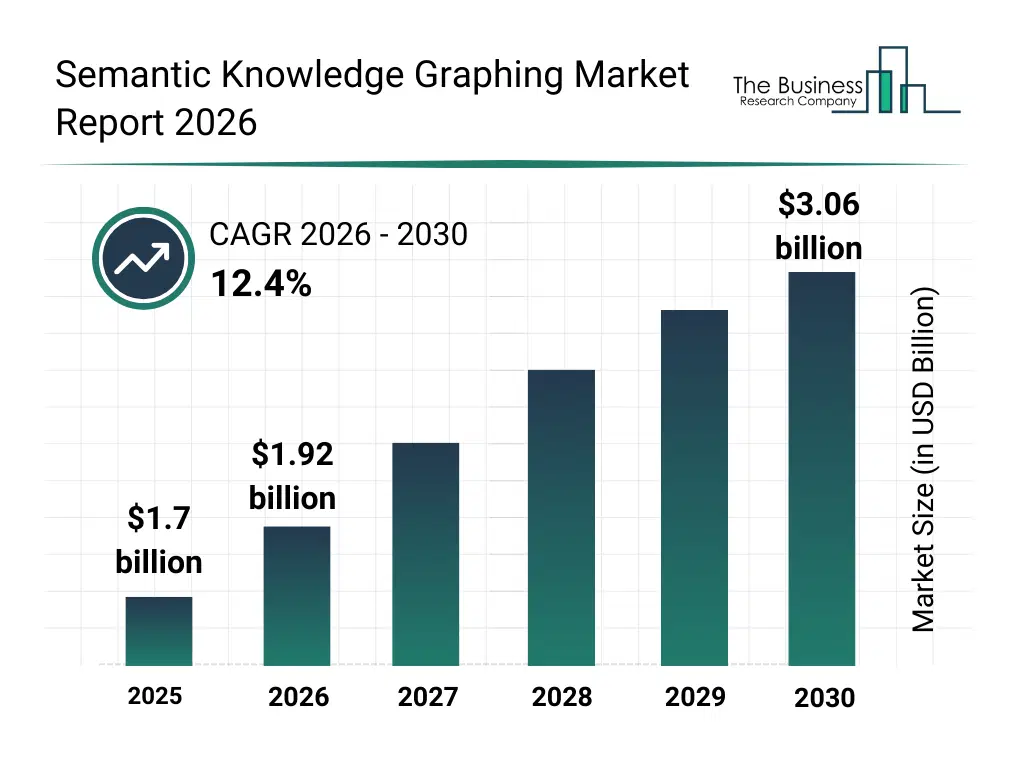
What Is The Semantic Knowledge Graphing Market Size and Share 2026?
The semantic knowledge graphing market size has grown rapidly in recent years. It will grow from $1.7 billion in 2025 to $1.92 billion in 2026 at a compound annual growth rate (CAGR) of 12.7%. The growth in the historic period can be attributed to growth of structured and unstructured data volumes, increasing adoption of data-driven decision systems, expansion of enterprise data management platforms, rising use of semantic search technologies, growing investments in AI research.What Is The Semantic Knowledge Graphing Market Growth Forecast?
The semantic knowledge graphing market size is expected to see rapid growth in the next few years. It will grow to $3.06 billion in 2030 at a compound annual growth rate (CAGR) of 12.4%. The growth in the forecast period can be attributed to increasing deployment of knowledge graphs in enterprise AI applications, rising demand for explainable AI systems, expansion of semantic data integration, growing focus on real-time knowledge discovery, increasing adoption of graph-based analytics. Major trends in the forecast period include increasing adoption of enterprise knowledge graphs, rising use of nlp-based semantic modeling, growing integration with AI and machine learning systems, expansion of context-aware data relationships, enhanced focus on data interoperability.
Global Semantic Knowledge Graphing Market Segmentation
1) By Knowledge Graph Type: Context-Rich Knowledge Graphs, External-Sensing Knowledge Graphs, Natural Language Processing (NLP) Knowledge Graphs 2) By Data Source: Structured, Unstructured, Semi-Structured 3) By Task Type: Link Prediction, Entity Resolution, Link-Based Clustering 4) By Application: Semantic Search, Question And Answer (Qna) Machines, Information Retrieval, Electronic Reading, Other Applications 5) By End-User: Banking, Financial Services And Insurance (BFSI), Healthcare, Manufacturing Subsegments: 1) By Context-Rich Knowledge Graphs: Domain-Specific Knowledge Graphs, Enterprise Knowledge Graphs 2) By External-Sensing Knowledge Graphs: IoT-Integrated Knowledge Graphs, Sensor Data-Driven Knowledge Graphs 3) By Natural Language Processing (NLP) Knowledge Graphs: Textual Knowledge Extraction Graphs, Semantic Relationship GraphsWhat Is The Driver Of The Semantic Knowledge Graphing Market?
The growing need for structured data is expected to propel the growth of the semantic knowledge graphing market going forward. Structured data refers to data that is organized and formatted in a way that is easily identifiable and searchable by computer systems. Semantic knowledge graphing enhances the value and utility of structured data by providing a framework for organizing and connecting information in a meaningful way. For instance, in September 2023, according to Komprise, a US-based provider of unstructured data management surveys, organizations managing more than 10 PB of data grew from 27% in 2022 to 32% in 2023, a 19% increase. Further, nearly three-quarters (73%) are spending 30% or more of their IT budget on data storage and protection, measurably higher than 67% in 2022. Therefore, the growing need for structured data is driving the growth of the semantic knowledge graphing industry.Key Players In The Global Semantic Knowledge Graphing Market
Major companies operating in the semantic knowledge graphing market are Amazon.com Inc., Google LLC, Microsoft Corporation, Facebook Inc., The International Business Machines Corporation, Oracle Corporation, SAP SE, Baidu Inc., LinkedIn Corporation, Wipro Limited, Yandex N.V., OpenLink Software, Neo4j, MarkLogic, Bitnine, Ontotext, Stardog Union, TopQuadrant, GraphAware, Cambridge Semantics, Memgraph, Franz Inc.
This chart is for illustrative purposes; the full report includes a detailed competitor analysis and comprehensive overview of the top 10 companies in the market.
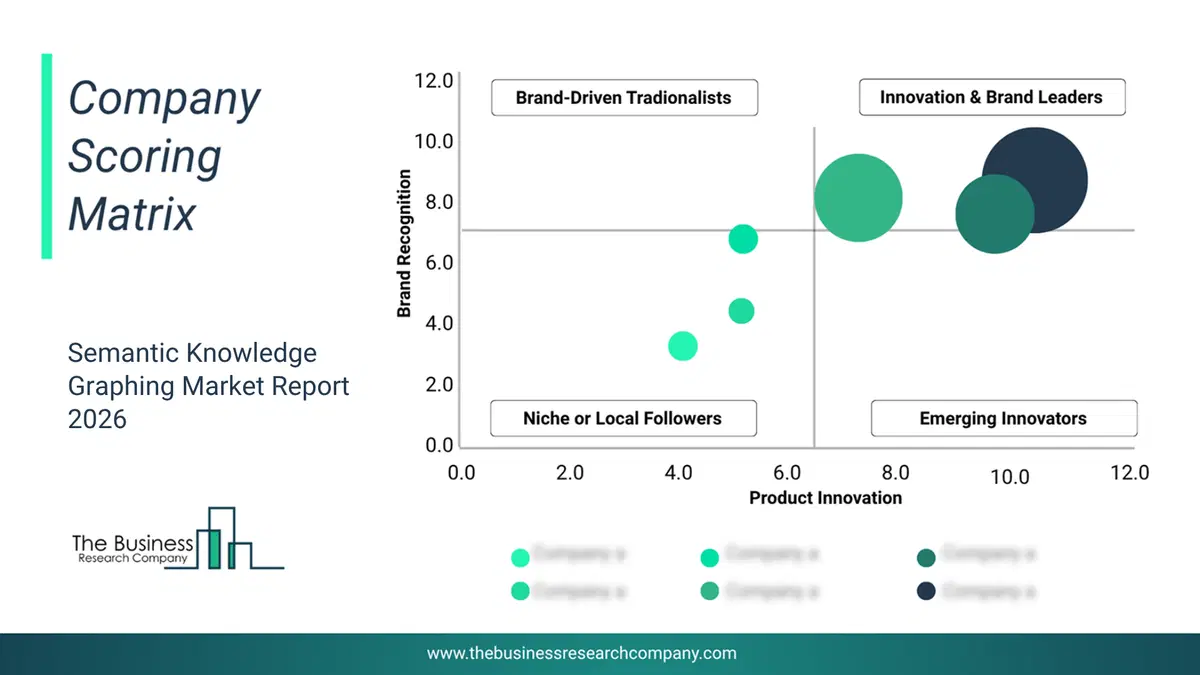
This chart maps companies by product innovation and brand strength, with bubble size indicating relative revenue, helping identify market leaders, challengers, and niche players. This is an illustrative chart; the full report provides a complete and accurate competitive analysis.
Global Semantic Knowledge Graphing Market Trends and Insights
Major companies are operating in the semantic knowledge graphing market, focusing on developing technological advancements such as AI-assisted semantic knowledge graph platforms to meet the rising demand for improved data interoperability, context-rich analytics, and enhanced decision-making across enterprise data landscapes. An AI-assisted semantic knowledge graph platform represents data as entities and relationships in a graph structure, allowing contextual understanding, ontology-driven modeling, and integration with machine learning and natural language processing workflows unlike traditional relational databases or keyword-based search systems. For instance, in April 2024, metaphacts, a Germany-based software company, launched the Dimensions Knowledge Graph, powered by metaphactory. The product integrates internal enterprise data with large public research datasets (over 350 million records), featuring a flexible semantic model, ontology-based design, API-based visualization and exploration, and a symbolic AI layer for transparency in decision-making. Its unique capabilities enable enriched context, research discovery, and downstream application integration, helping organizations transform siloed data into actionable insights.What Are Latest Mergers And Acquisitions In The Semantic Knowledge Graphing Market?
In July 2024, Squirro, a US-based generative AI platform company, acquired Synaptica for an undisclosed amount. Through this acquisition, Squirro aims to enhance its AI capabilities by integrating knowledge graph technologies to improve accuracy, knowledge discovery, and business process automation. Synaptica, a US-based software company, specializes in building structured taxonomies that serve as a foundation for creating semantic knowledge graphs, which enhance the understanding of relationships and meaning between concepts.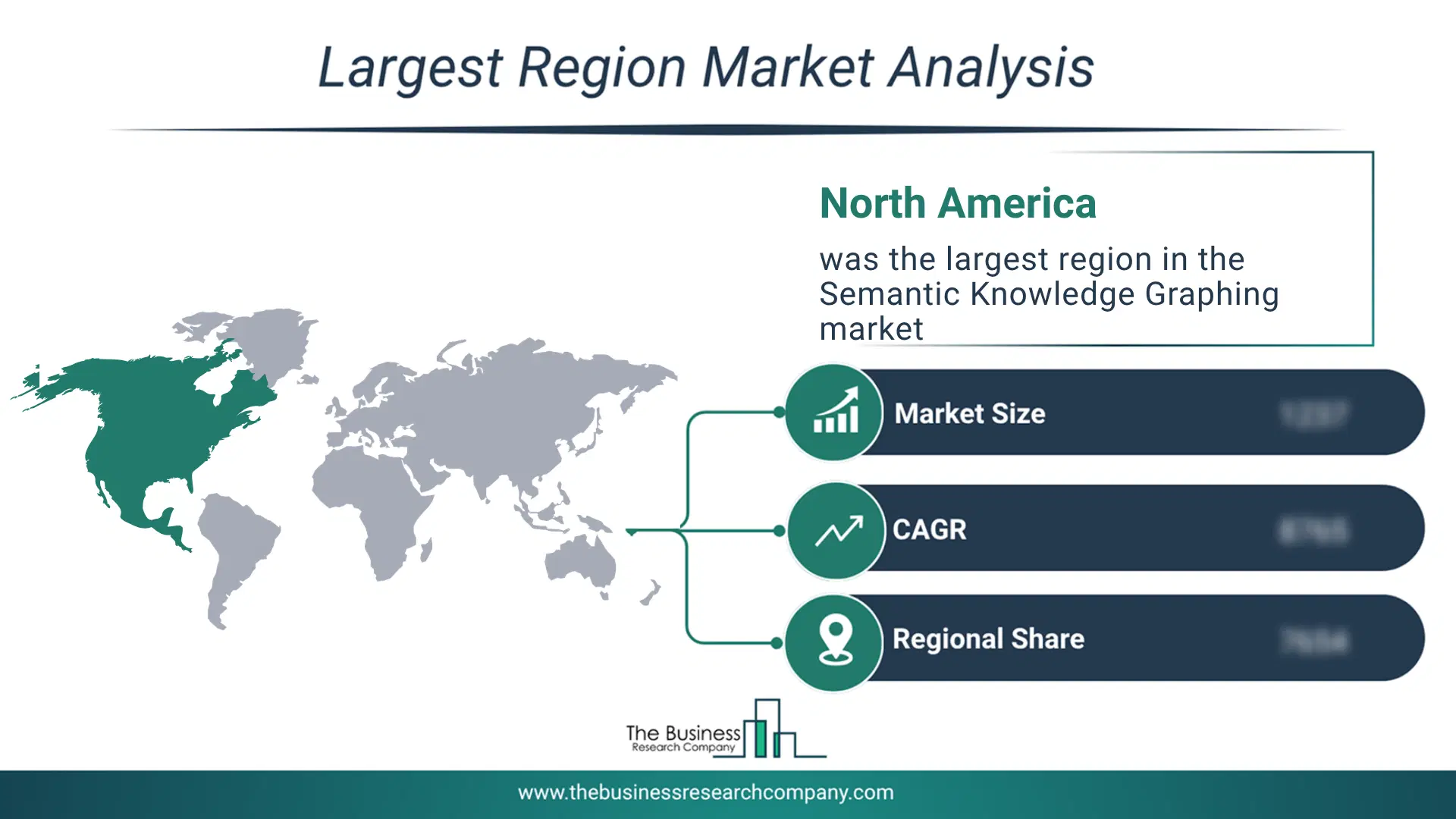
Regional Insights
North America was the largest region in the semantic knowledge graphing market in 2025. The regions covered in this market report are Asia-Pacific, South East Asia, Western Europe, Eastern Europe, North America, South America, Middle East, Africa. The countries covered in this market report are Australia, Brazil, China, France, Germany, India, Indonesia, Japan, Taiwan, Russia, South Korea, UK, USA, Canada, Italy, Spain.What Defines the Semantic Knowledge Graphing Market?
The semantic knowledge graphing market consists of revenues earned by entities by providing services such as manage and extract data, improve efficiency, and deliver personalized experiences across various verticals, including healthcare, media and entertainment, financial services, e-commerce, and manufacturing. The market value includes the value of related goods sold by the service provider or included within the service offering. The semantic knowledge graphing market also includes sales of CPUs, GPUs, memory, storage, and network devices. Values in this market are ‘factory gate’ values, that is the value of goods sold by the manufacturers or creators of the goods, whether to other entities (including downstream manufacturers, wholesalers, distributors and retailers) or directly to end customers. The value of goods in this market includes related services sold by the creators of the goods. The IT market is segmented into IT services; computer hardware; telecom and software products.How is Market Value Defined and Measured?
The market value is defined as the revenues that enterprises gain from the sale of goods and/or services within the specified market and geography through sales, grants, or donations in terms of the currency (in USD unless otherwise specified). The revenues for a specified geography are consumption values that are revenues generated by organizations in the specified geography within the market, irrespective of where they are produced. It does not include revenues from resales along the supply chain, either further along the supply chain or as part of other products.
This chart presents market attractiveness based on a quantitative evaluation of growth, competition, strategic alignment, and risk, offering a clear view of opportunity areas for decision-making. This chart is for illustrative purposes; the full report contains the complete analysis.

This chart highlights the Total Addressable Market (TAM) by estimating the maximum revenue opportunity using an assumption-driven approach, supporting strategic planning and opportunity sizing across markets. The chart is illustrative; the full report provides a more comprehensive analysis.
What Key Data and Analysis Are Included in the Semantic Knowledge Graphing Market Report 2026?
The semantic knowledge graphing market research report is one of a series of new reports from The Business Research Company that provides market statistics, including industry global market size, regional shares, competitors with the market share, detailed market segments, market trends and opportunities, and any further data you may need to thrive in the semantic knowledge graphing industry. The market research report delivers a complete perspective of everything you need, with an in-depth analysis of the current and future state of the industry.Semantic Knowledge Graphing Market Report Forecast Analysis
| Report Attribute | Details |
|---|---|
| Market Size Value In 2026 | $1.92 billion |
| Revenue Forecast In 2030 | $3.06 billion |
| Growth Rate | CAGR of 12.4% from 2026 to 2030 |
| Base Year For Estimation | 2025 |
| Actual Estimates/Historical Data | 2020-2025 |
| Forecast Period | 2026 - 2030 |
| Market Representation | Revenue in USD Billion and CAGR from 2026 to 2030 |
| Segments Covered | Knowledge Graph Type, Data Source, Task Type, Application, End-User |
| Regional Scope | Asia-Pacific, Western Europe, Eastern Europe, North America, South America, Middle East, Africa |
| Country Scope | The Countries Covered In This Market Report Are Australia, Brazil, China, France, Germany, India, Indonesia, Japan, Taiwan, Russia, South Korea, Uk, Usa, Canada, Italy, Spain. |
| Key Companies Profiled | Amazon.com Inc., Google LLC, Microsoft Corporation, Facebook Inc., The International Business Machines Corporation, Oracle Corporation, SAP SE, Baidu Inc., LinkedIn Corporation, Wipro Limited, Yandex N.V., OpenLink Software, Neo4j, MarkLogic, Bitnine, Ontotext, Stardog Union, TopQuadrant, GraphAware, Cambridge Semantics, Memgraph, Franz Inc. |
| Customization Scope | Request for Customization |
| Pricing And Purchase Options | Explore Purchase Options |